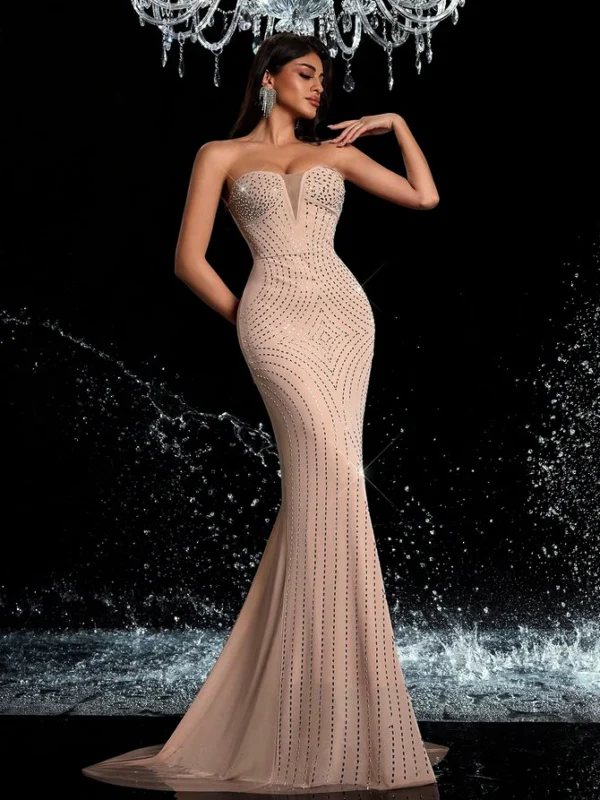
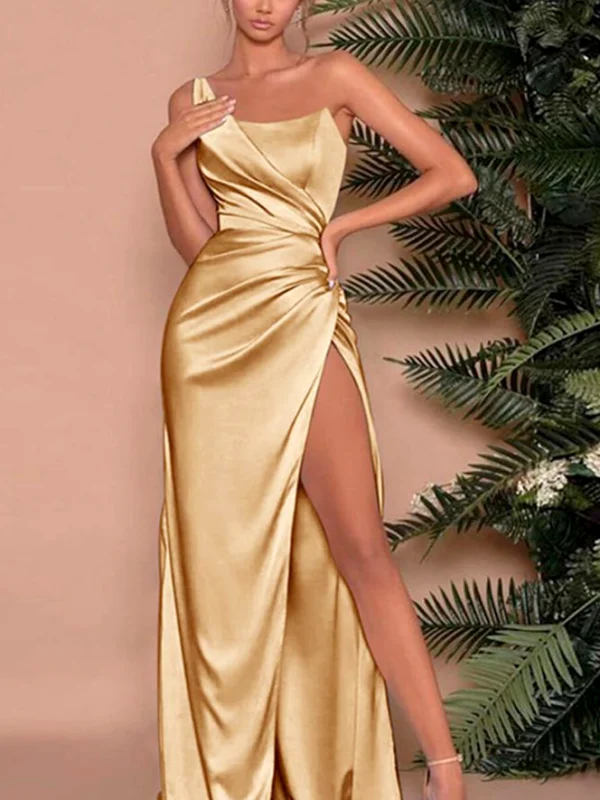
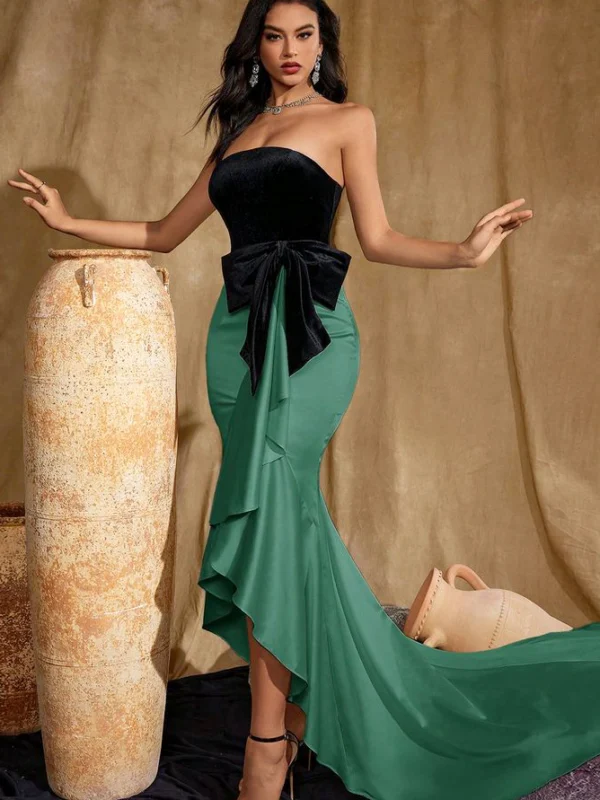
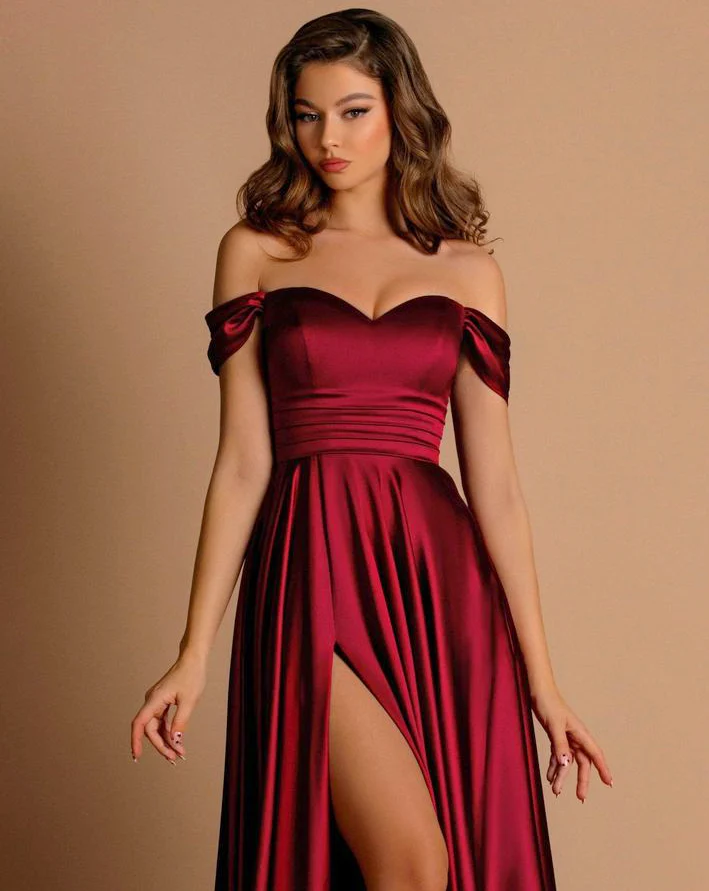
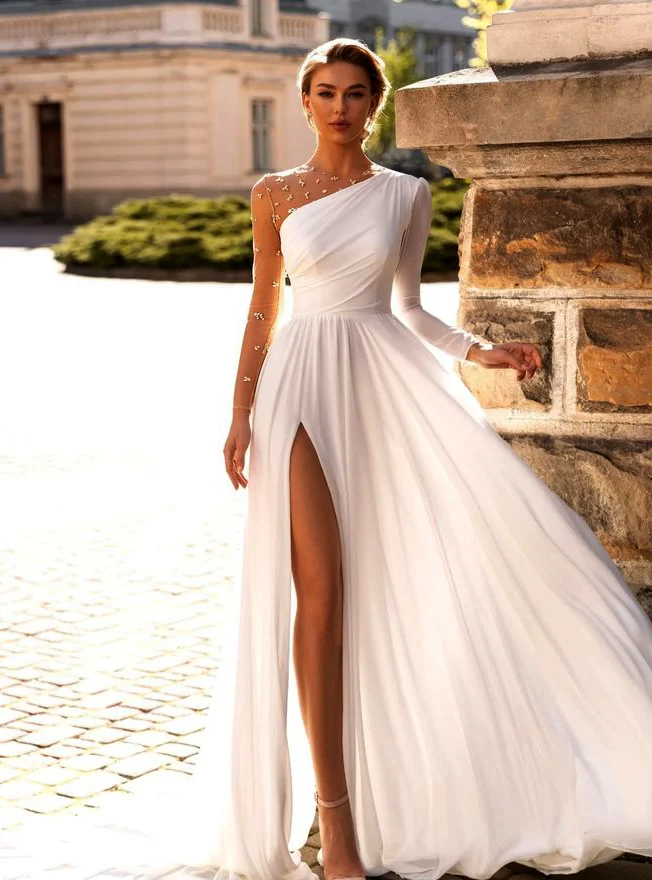
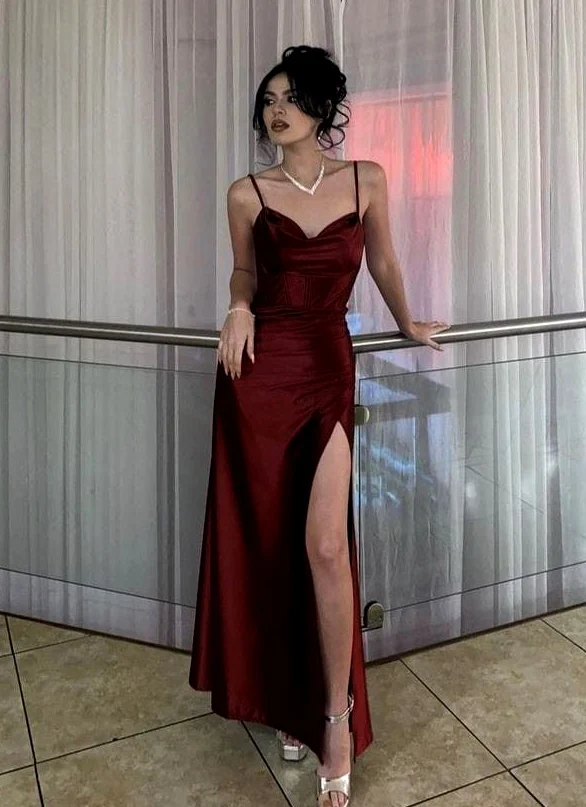
An evening dress with a leg slit can be described through the opening’s position and its relationship to the rest of the skirt. The leading burgundy reference shows a wider skirt, a broad finely folded waistband and a high front opening. Three other photographs add closer, folded or asymmetric variations. The short burgundy dress is a deliberate comparison: its uncovered legs result from the short hem and do not establish a leg slit. Use the five independent views as visible comparisons rather than a shared collection or historical evidence.
1. Name the actual opening position
The leading image places the leg opening near the front centre, slightly left within the photograph. The visible opening of the long burgundy strappy dress lies farther right in its image, while the black folded dress shows it on the left. These image directions help describe an individual view. They do not securely establish whether a product is offered with a centre, side or offset slit. A turned pose can change the impression further.
A named product example makes that distinction concrete. Reformation explicitly describes a centre-front slit on Delphi. That is information about this named product, not an identification of the archive images or a transfer of its composition to them. Ask about the exact opening position on your actual candidate. Use a technical product description only when it belongs to the real offered model rather than deriving the construction solely from a visible leg.
2. Compare the opening with skirt width
The leading burgundy dress begins beneath its broad waistband with a wider, quieter area. The long burgundy strappy dress stays closer to the lower outline and continues longer fabric at the side. In the black reference, diagonal folds run towards the side hip. A similarly high-looking leg opening does not produce the same overall effect in those different lower shapes. Decide which skirt outline you want beside the opening, independently of the amount of uncovered leg.
Start with a complete view of your own dress in a straight stance. A photograph shows one selected leg position rather than a reliable movement sequence. Sit and walk a few steps in the actual candidate. Judge how much area you want visible during movements that matter for your event. A more widely spread skirt guarantees neither greater freedom of movement nor particular behaviour when walking. Those questions are answered on the real product rather than through photographic width or another person’s pose.
3. Choose the upper line as a separate decision
The leading reference has a heart-like upper edge and low folded areas beside the upper arms. Thin straps lead to a softly falling front edge in the long burgundy dress. The black version also combines thin upper connections with long black gloves. In the pale asymmetric photograph, gold-looking motifs lie on a sheer-looking sleeve and chest area, while the opposite side has a more opaque long sleeve. It is not a shape with both arms uncovered.
The comparison of fringe evening dresses offers other outer lines. Do not transfer its material information to a different reference. Record upper edge, sleeves and lower opening as separate wishes in your selection. Ask for the actual candidate’s corresponding back and details of offered inner layers. A close-looking upper body explains no particular support or inner layers. Gold-looking motifs identify neither fibre nor a specific production method. Liking two details in one photograph does not require choosing both together.
4. Add the hem and your own shoes
The leading photograph omits the complete lower hem and feet. It suits a comparison of waist, upper skirt width and opening, but cannot finish a length decision. Other views show individual shoes partly or omit the lower area as well. Describe only the visible shoe parts; a covered second shoe or unknown rear hem remains open. Add the missing view on the same actual model rather than completing it with a different long dress.
The guide to shoes for an evening dress helps consider the planned lower outfit together. Try your own shoes before discussing the offered length or a possible alteration. Compare again in a straight stance and ordinary movement afterwards. The heel height in someone else’s reference is not a fixed instruction for you. For an online listing, request a complete view if existing photographs crop precisely the area that matters for your decision.
5. Separate jewellery, pose and opening
The long burgundy strappy dress combines a pale V-shaped jewellery line with one hand on a railing. The black reference carries a green pendant and long black gloves, with one hand raised near the head. Those accessories and positions affect the visible frame but determine neither the construction of the opening nor an appropriate invitation. Choose your jewellery and ordinary arm position separately from the desired leg slit instead of adopting the entire photograph as a fixed combination.
The guide to a party outfit for women adds the assembly of all the pieces. Read the actual rule on your invitation too and clarify uncertainty with the host. High openings in the archive do not establish universal suitability for particular events. A railing, stone wall or interior also confirms no celebration that the wearer actually experienced. The selection should help you name visible wishes and ask practical questions about your real candidate rather than using the setting as evidence of a dress’s history.
6. Confirm included pieces and care on the product
Shiny burgundy, pale or black surfaces do not explain their composition. Ask about real components, lining, fastenings and included pieces. Discuss possible alterations on that exact dress; an existing opening does not automatically mean that its position or height can be changed. Have a desired version confirmed specifically and retain the corresponding information. The independent short comparison supplies no information about a long skirt’s construction. Similar colour or an upper frame does not fill that technical gap.
GINETEX explains textile care symbols. Use the product’s actual care instructions and additional information about decoration or separate pieces. A leg slit establishes no general washing or cleaning method. Choose your evening dress with a leg slit through opening position, complete shape and your own assessment. The image idea can remain a clear decision aid while size, included pieces and behaviour are assigned to the actual offered model.
Compare the opening position, upper lines and complete view of an evening dress with a leg slit. Four slit references sit beside a short dress without that opening.
Frequently asked questions
Does the short burgundy comparison show a leg slit?
The short burgundy comparison shows uncovered legs below a short hem, but no visible leg slit. Four other references show openings within longer skirt shapes.
Is the visible opening of an evening dress equally high in every movement?
The evening dress with a leg slit is photographed in one selected leg position. Check the desired uncovered area on the actual dress while walking and sitting; a still view confirms no identical behaviour.
How do I confirm the precise slit position before ordering?
Ask for the precise opening position on the actual evening dress with a leg slit to be named and shown. An image direction or another named product cannot replace that model-specific information.
Do the photographs establish a particular historical origin?
The evening-dress references provide no evidence of historical dating, particular designers or previous wearers. Visible shape ideas are compared here without those attributions.