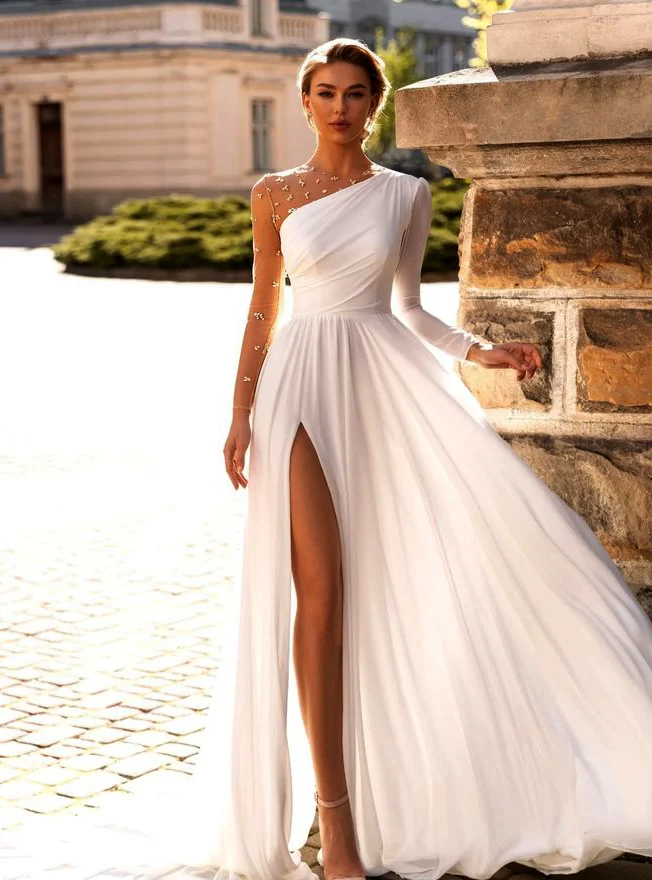
The long pale shape combines a diagonal upper edge with two differently appearing sleeve sides. Gold-looking motifs cover a sheer-looking sleeve and chest area on the image’s left. Opposite is a more opaque long sleeve; that arm is not classified as uncovered. A high front leg opening sits on the left. One hand braces against stone while the other stays down. One pale open ankle shoe is only partly visible at the lower edge.
Separate the asymmetric coverage of the arms from the uncovered leg area. Both features can be chosen independently rather than adopted as a fixed combination. The gold-looking drawing establishes no particular metal or technique. The stone in the background likewise explains neither origin nor an occasion actually experienced. Lighting through the sleeve is not a fibre specification.
Request a further view of your own candidate with both hands free beside the body. Look at the entire sleeve line and corresponding back there. Add your shoes and complete lower hem for length. The current braced stance provides a visible pose, not information about the actual dress’s behaviour when walking.