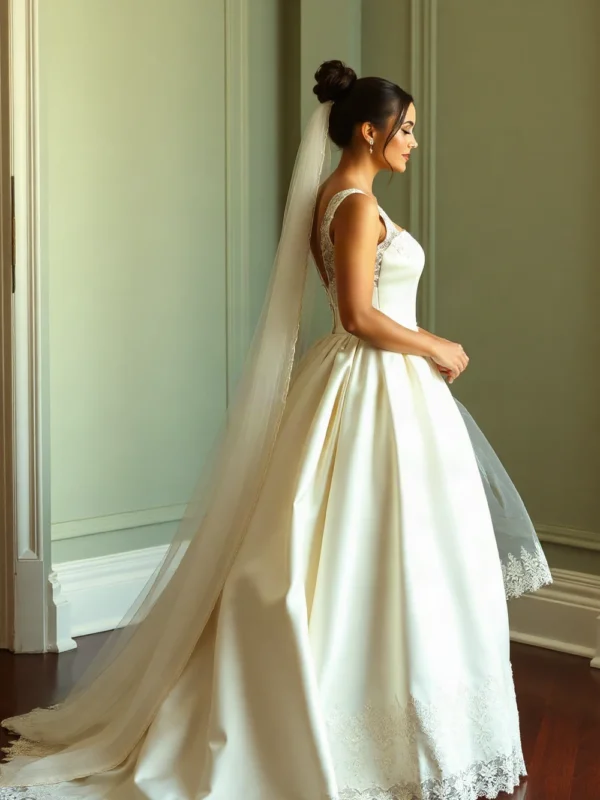
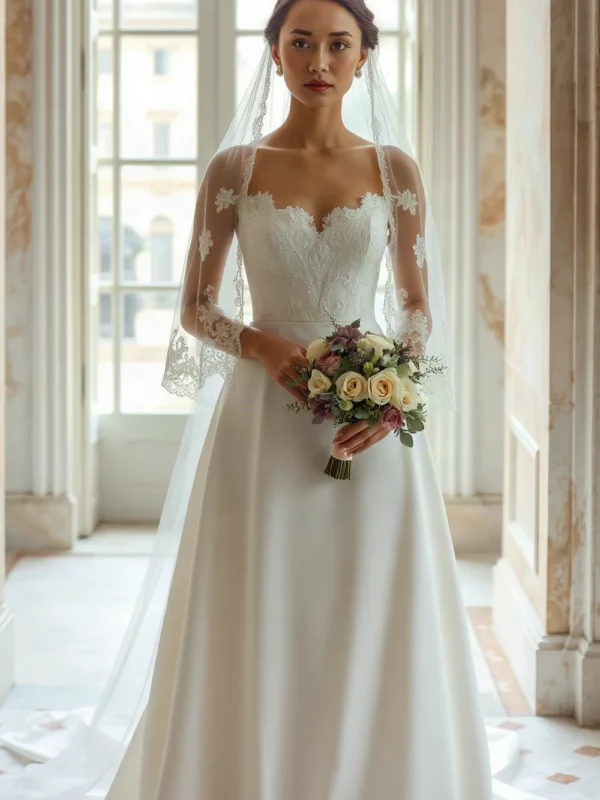
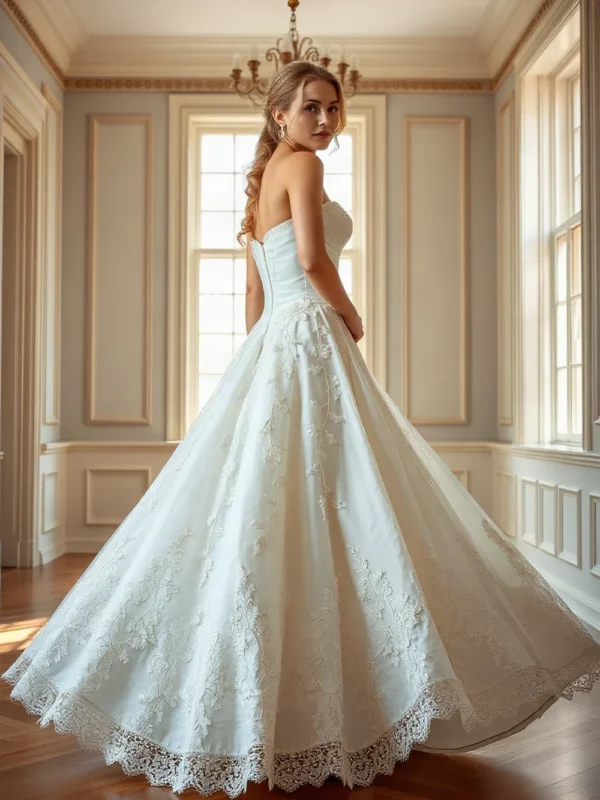
Romantic ball-gown styling works best when volume, surface detail and veil length are planned as one composition rather than chosen separately. Across these six visual concepts, the recurring idea is an ivory full skirt paired with lace at the bodice, hem or veil edge. Yet their effects differ sharply: window light makes a scattered border feel gentle, a dark interior sharpens the profile, a mannequin view clarifies proportion, warm architecture emphasizes symmetry, and sunset turns a moving veil into the main gesture.
Use the images as a comparison tool, not as fixed product specifications. Decide whether attention should land on the face, waist, hem or moving veil, then consider the practical questions. Can the wearer sit, turn and walk comfortably? Will an edged layer catch on the floor? Does the intended lighting reveal or flatten the detail? The following approaches translate those observations into fitting and styling decisions.
Scattered Motifs and a Broad Perimeter
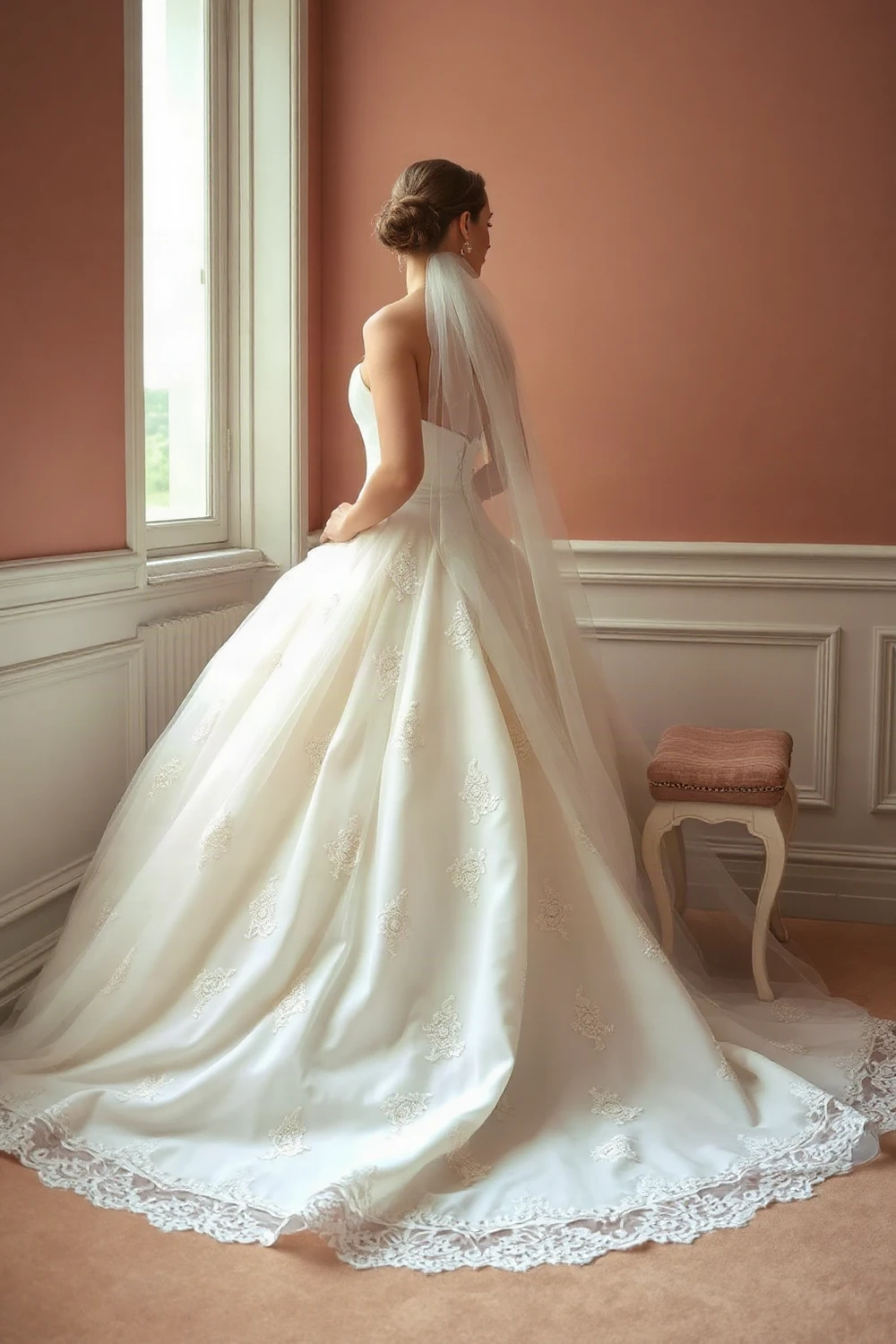
In the first image, small lace motifs are spaced across a glossy, expansive skirt, while the densest decoration collects in the broad border spreading over the floor. This distribution preserves a clean silhouette at a distance but rewards a closer view. Window light defines the folds and gives the rear volume a soft, gradual shine.
Do not assess a similar border only while standing still. Test how it folds when the skirt is gathered, on stairs, beside a chair and during a turn. If the veil also reaches the ground, two decorated edges may overlap and create visual congestion or friction. Compared with all-over lace, this treatment offers a calmer balance between an understated upper body and an intricate perimeter, though its extra floor contact requires deliberate handling.
A Veil Edge That Frames the Profile
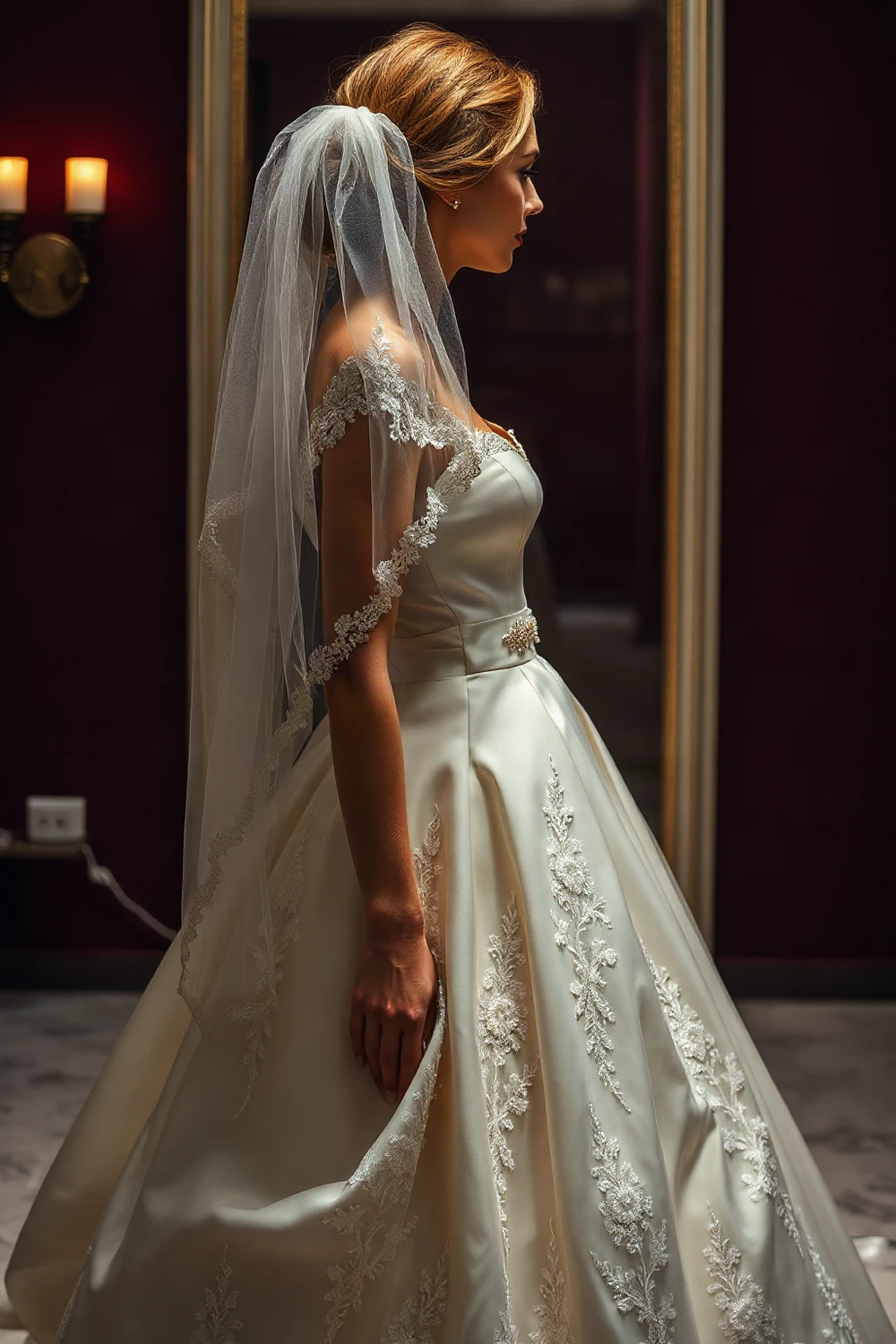
In the second concept, the scalloped veil border passes around the shoulder and becomes part of the profile portrait. Long leaf appliqués on the skirt establish a downward rhythm, while a small sparkling detail at the waist links the upper and lower areas. The burgundy background creates high contrast, allowing the ivory outline and lace edges to read clearly.
When adapting the look, examine the veil with the arms relaxed, moving and holding a bouquet. If the border slips too far forward, it may hide the neckline; if it falls too far back, the intended facial frame disappears. This option draws attention upward more strongly than a wide hem border. If statement earrings, an embellished bodice and a detailed veil all occupy the portrait area, quieting one of them will keep the face from becoming visually crowded.
Balancing an Ornate Bodice and Quiet Skirt
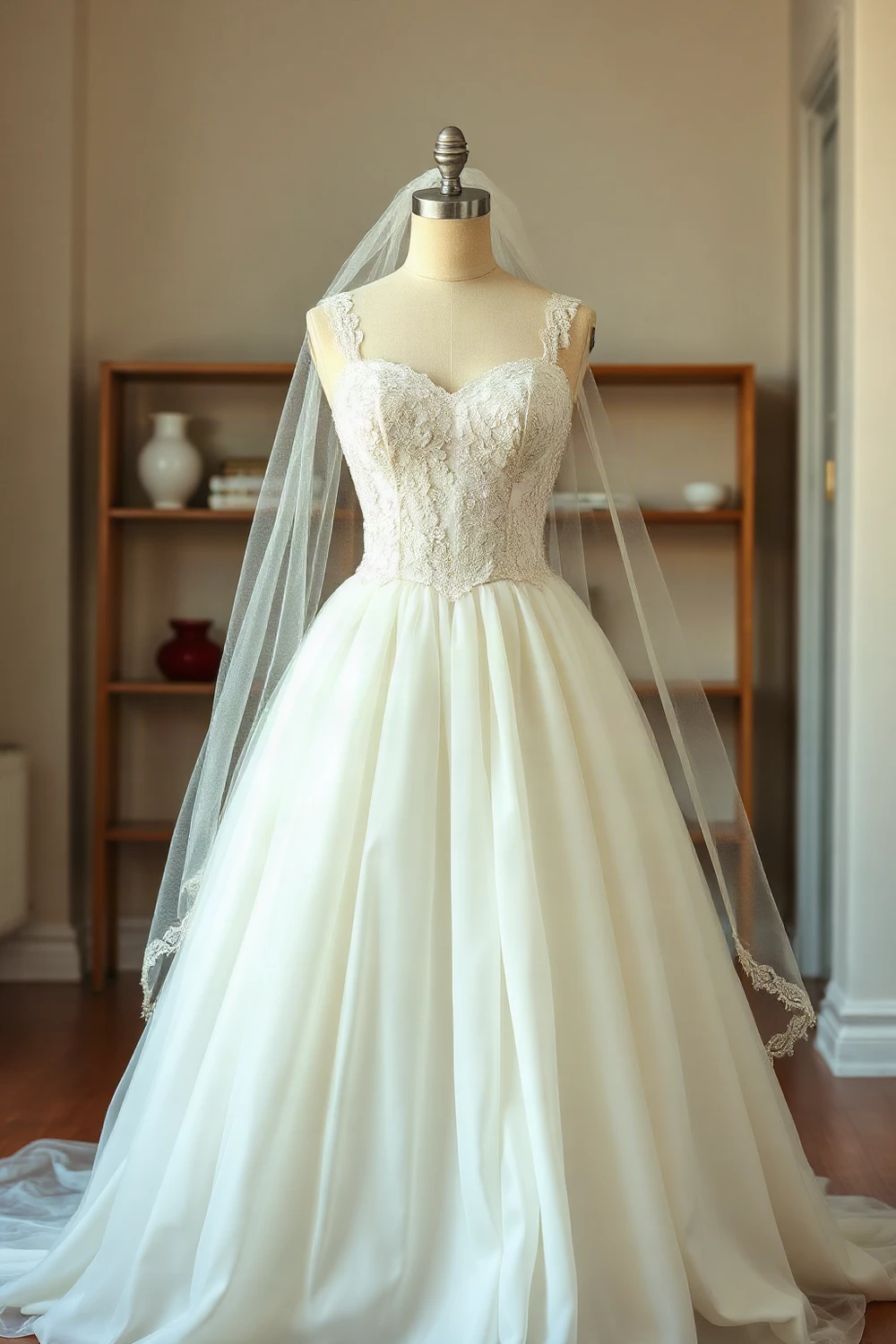
The third visual separates a lace-covered sweetheart bodice and narrow straps from a broadly flared, almost unembellished skirt. The pointed lower edge of the bodice accentuates the waist, while the skirt continues in long, uninterrupted folds. Because the veil border appears only near its lower ends, it does not compete with the concentrated upper detail.
This contrast suits someone who wants lace close to the face while retaining visual space below. A mannequin, however, shows symmetry without revealing real movement. During a fitting, observe strap placement, the changing bodice line while seated and any folding at the waist junction. A decorated skirt supplies detail from more angles, whereas a clean surface emphasizes silhouette and light. Consider the venue’s visual density and the planned accessories before deciding which quality should lead.
Symmetry, Pleats and a Long Veil Frame
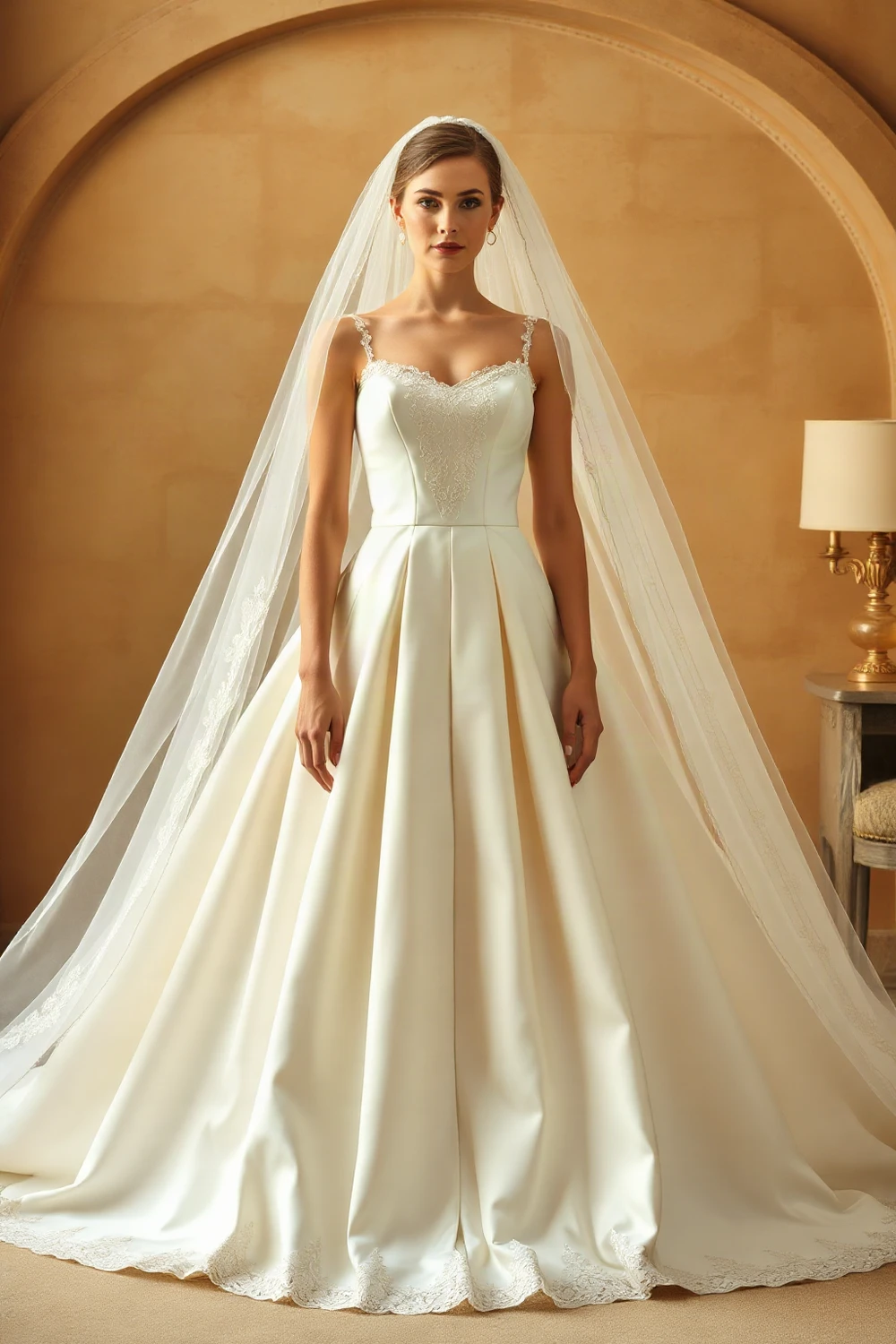
The fourth image places a centered silhouette inside a warm architectural arch, and the veil’s long lines repeat that frame on both sides. Fine straps and a controlled central lace panel transition into a skirt defined by deep, regular pleats. A narrow lace finish near the floor leaves the remaining surface calm and reflective.
This approach supports a balanced ceremonial entrance, but maintaining that symmetry requires preparation. Confirm that the head attachment stays centered, the layers fall evenly and the border remains clear of the wearer’s steps. Compared with a heavily appliquéd surface, lighting matters more because the pleats create much of the visual interest. Bright frontal light can flatten them, whereas light from one side reveals depth. Fitting photographs from straight ahead and at three-quarter angle make the difference easier to judge.
Separate Lengths in the Rear View
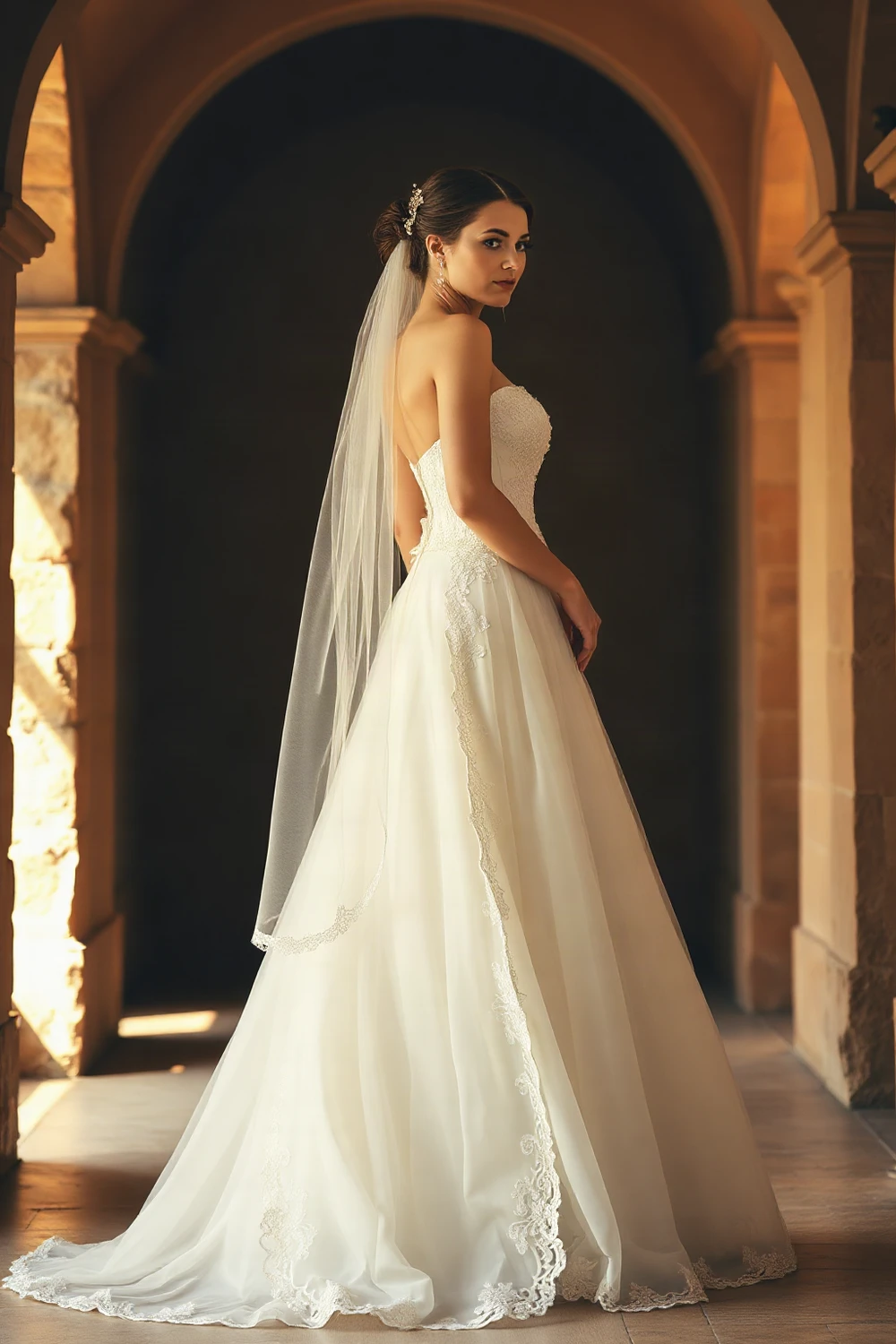
The fifth concept deliberately separates a hip-length veil from a lace line that descends along the skirt toward the floor. A three-quarter rear view reveals the strapless upper edge, hair attachment and widening skirt together. The dark center of the stone arch outlines the pale dress, while the vertical columns reinforce the downward direction of the lace trail.
This proportion adds translucency around the upper body without completely covering the rear dress detail. It may also be easier to manage than a cathedral-length veil, although the shorter border still needs testing where it meets hands, earrings or embellishment. If the back view is important, plan the hairstyle and veil attachment together rather than treating hair as a final addition. Record a short walk and turn to see whether the lace line remains balanced or shifts away from its intended position.
Sculptural Flowers and Directed Veil Movement
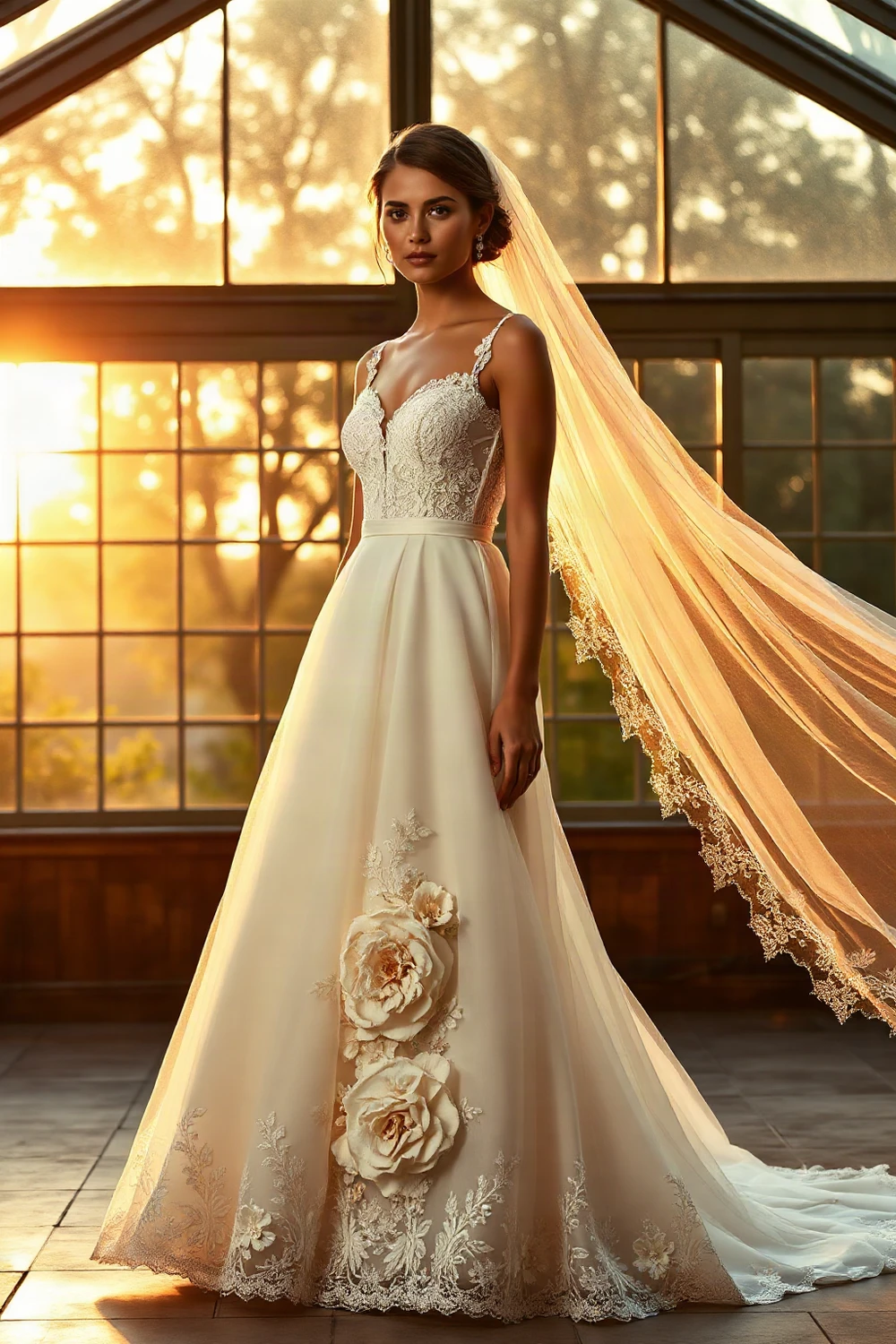
In the sixth image, large raised flowers gather low on the skirt while the lace-edged veil sweeps broadly to the right. A patterned bodice, plain waistband and quieter skirt provide a transition between those two forceful elements. Golden sunset warms the translucent veil, and the dark window grid makes its direction especially legible.
Sculptural flowers create a stronger focal point than evenly scattered appliqués, making bouquet scale and carrying height important. A large bouquet could cover the feature, while another elaborate accessory might compete with it. The animated veil is compelling in a picture, but its movement, edge weight and any helper’s position should be rehearsed. Also compare the ivory tone in daylight and indoor illumination, because warm backlight changes its appearance. Check that raised flowers remain comfortable while sitting and protected through narrow routes or transport.
The most coherent romantic look does not come from choosing the greatest amount of lace or the longest veil. It comes from giving the details a clear hierarchy. For a quiet result, concentrate texture on one area such as the bodice or hem. For greater drama, let only one element—a long veil, strong architectural contrast or sculptural flowers—provide the principal gesture.
Attend the final fitting with shoes, a veil of comparable length and an object approximating the bouquet’s volume. Photograph the look from the front, profile and back, then test sitting, turning, stairs and narrow passages. Change the direction of the light to see whether the lace border remains visible. These checks turn attractive visual inspiration into a balanced style that can be managed throughout the event.
Compare lace-edged veils with wedding dress motifs, skirt borders and train lengths to create a balanced bridal look.
Frequently asked questions
Should lace be concentrated on the bodice, hem or veil edge?
Choose the bodice or shoulder area to draw attention toward the face, and the hem to emphasize the breadth of the silhouette. A lace-edged veil suits a clean skirt when you want a moving frame. Make one area dominant and let the others support it.
Can a long lace-edged veil work in a compact venue?
Yes, but test aisle width, spaces between seats and stairs with a practice veil of similar length. Plan how the edge can be gathered temporarily and where a helper will stand during transitions so movement remains controlled.
Does a smooth skirt or an appliquéd skirt photograph better?
A smooth, reflective surface emphasizes folds and volume under directional light, while appliqués add texture in close views. A quiet skirt can balance an ornate room; stronger appliqués may read more clearly against a simple or high-contrast background.
Can a short veil be paired with a long lace trail on the skirt?
Yes. As in the fifth concept, a short veil can frame the upper body while a descending dress motif preserves continuity in the rear view. Test the point where the edges meet, the hair attachment and how the lace shifts during walking.
What bouquet works with oversized flowers on the skirt?
If the raised skirt flowers are the principal feature, a bouquet with a simpler outline or smaller volume can accompany them without obstruction. Photograph it at the natural carrying height from the front and three-quarter view to check the overlap.