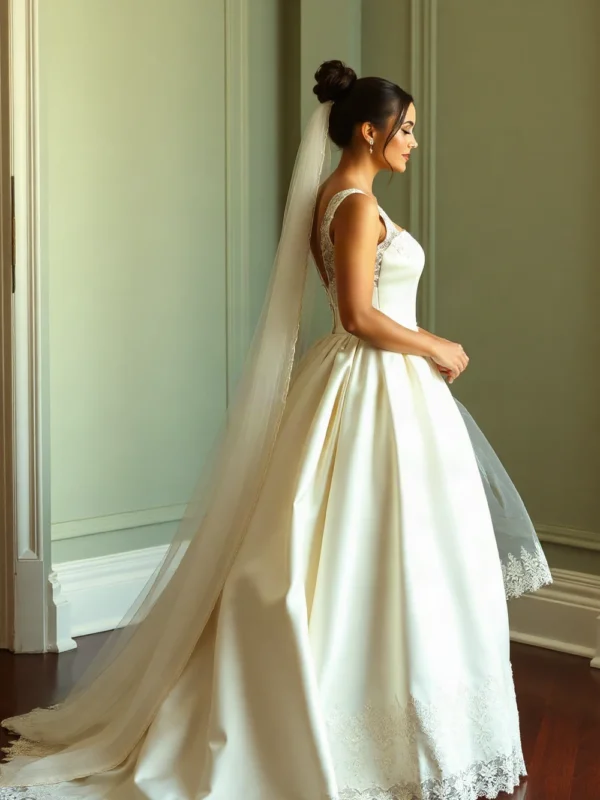
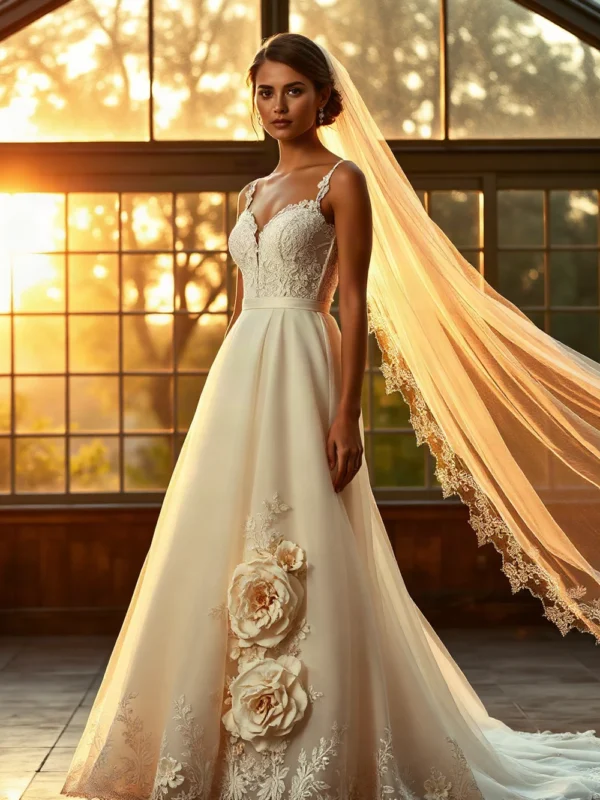
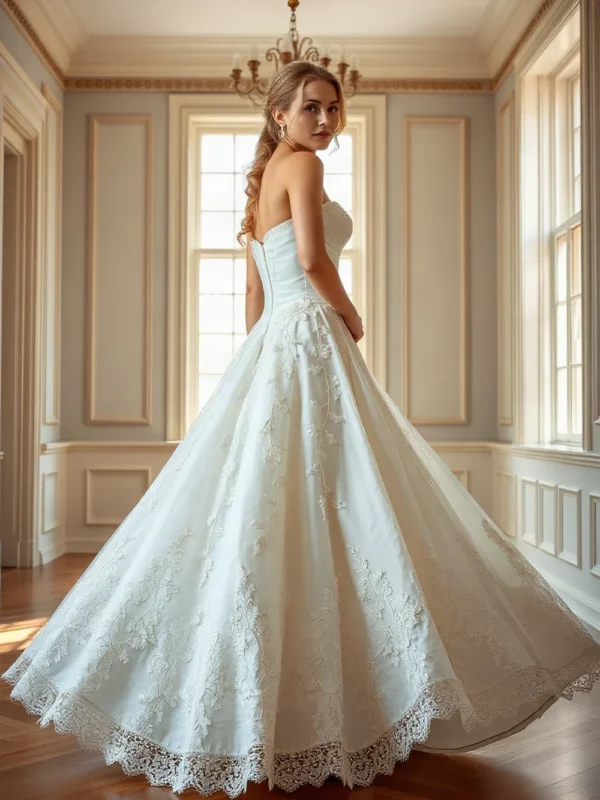
Floral lace offers a persuasive starting point for romantic bridal style, but coherence comes from more than choosing an elaborate pattern. Texture placement, skirt reflectivity, veil movement and bouquet visibility against white surfaces must work together. These six references create a related, gentle mood through different solutions: a ceremonial A-line, transparent long sleeves, portrait-friendly fine straps, a coastal veil shaped by wind, a light walking skirt and an open back leading into a patterned train.
Treat the images as styling references rather than products or exact specifications. Use them to identify priorities, while weighing venue flooring, ceremony movement, likely camera angles and comfort alongside neckline or motif. Each comparison below explains the visual relationship within a look and practical points to check during a fitting or styling trial.
Balancing a Lace Bodice with a Clean A-Line
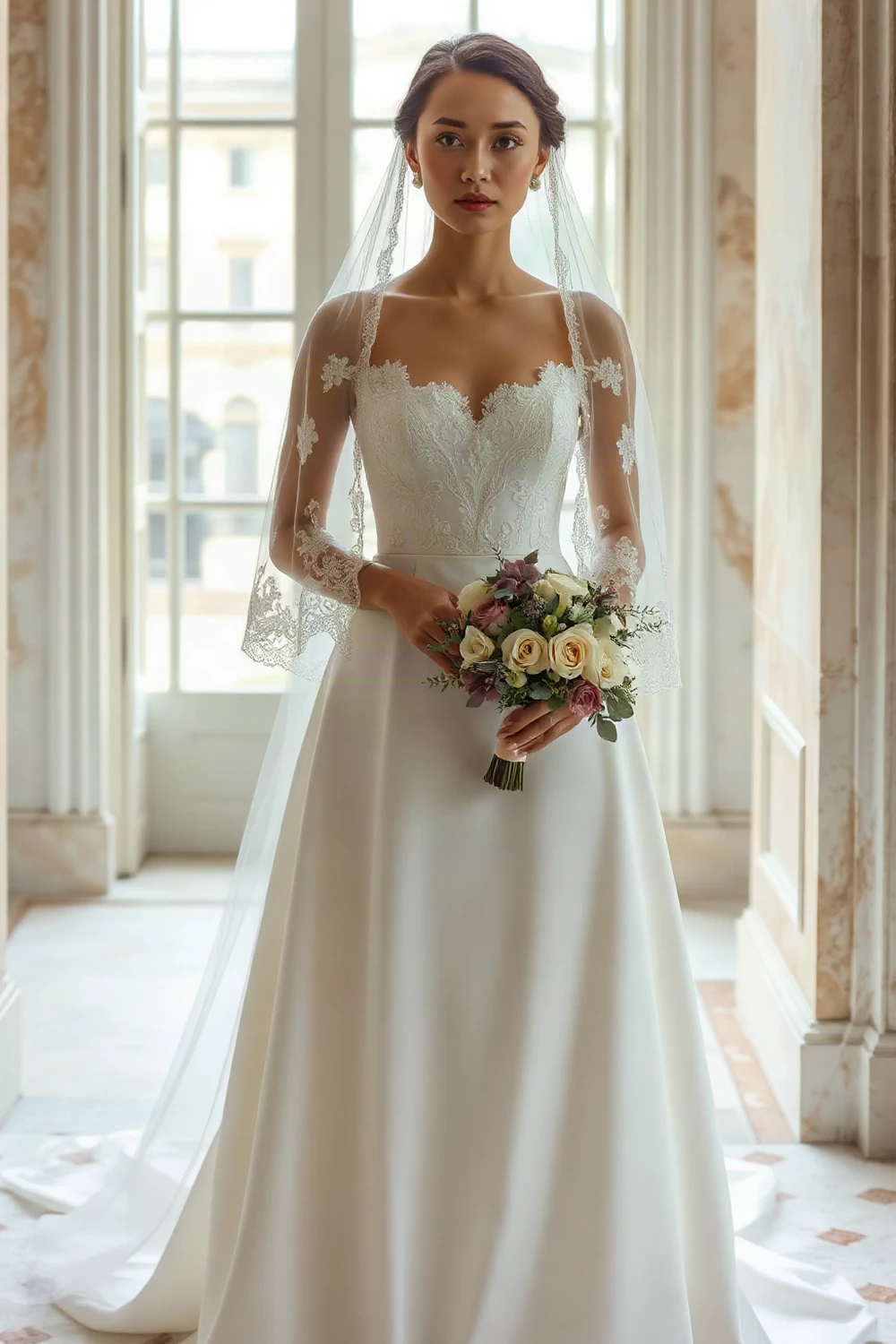
The first look concentrates detail above the waist and leaves the skirt visual breathing room. Floral lace follows a softly shaped sweetheart neckline to a clean waistband; below, a smooth white surface expands into a calm, ceremonial A-line. Lace edging and veil appliqués carry texture around the face and arms, while cream and dusty pink flowers add quiet color.
It suits someone who wants lace without pattern on every surface. The full skirt has presence in a long corridor, yet its uninterrupted finish stays clear at a distance. At a fitting, turn within its required space, sit to test the defined waist and check whether the veil border competes with the bodice. Compare a large bouquet, which may hide the central embroidery, with a controlled arrangement that keeps more of the upper body visible.
Creating a Vertical Line with Sheer Long Sleeves
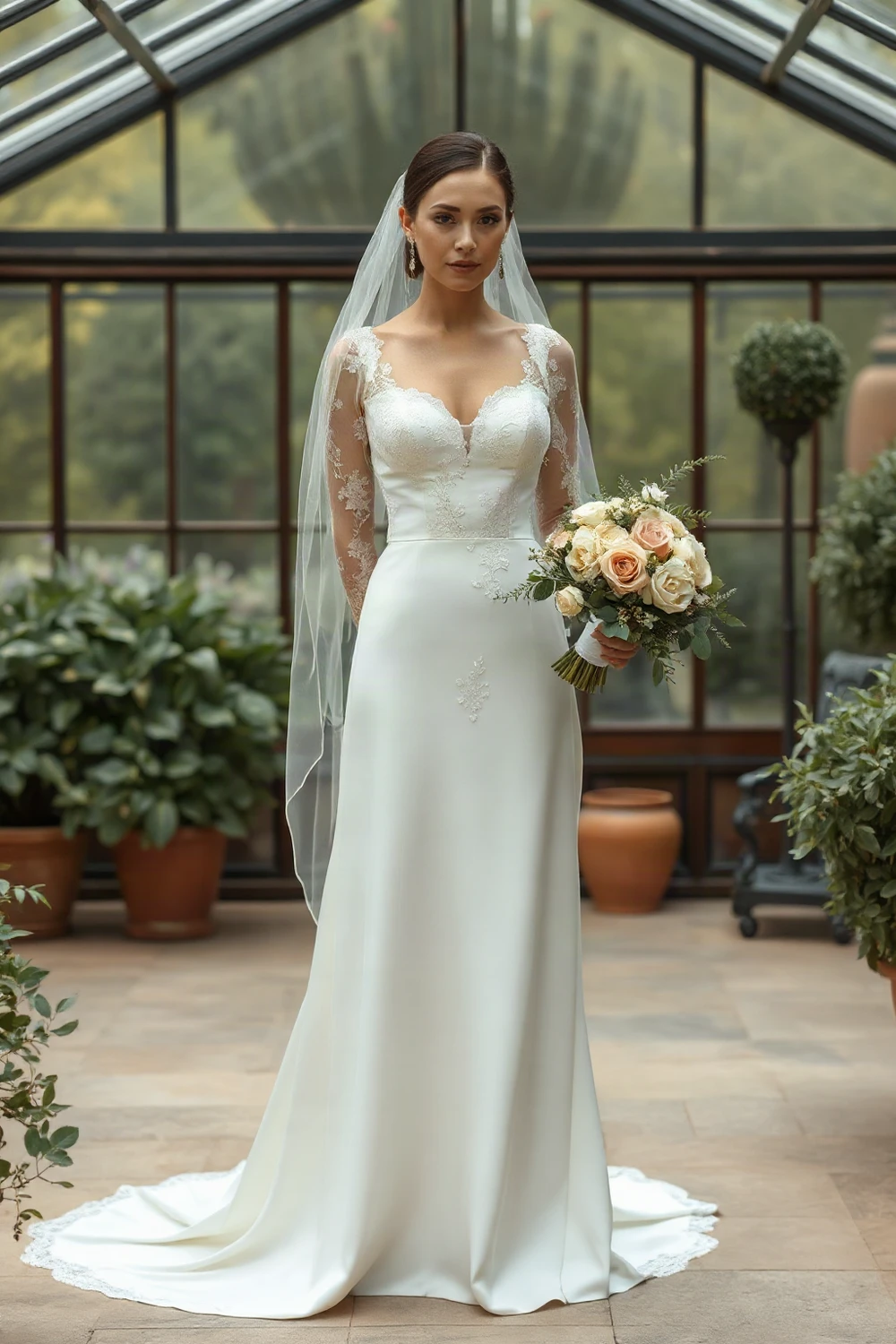
The second concept extends floral texture over transparent long sleeves while keeping a narrow, continuous skirt. Against the greenhouse’s dark framework and layered greenery, the white vertical line reads distinctly. Shoulder and arm appliqués frame the face; a small transparent neckline center creates a lighter transition than a fully closed front. Isolated skirt motifs connect upper and lower sections without filling the smooth surface.
Sleeves are not only about coverage. Motifs on sheer fabric change as elbows and wrists move, so test reaching, sitting and carrying the bouquet at different heights. This silhouette uses less lateral space than the A-line and may suit a narrow aisle, although stride still needs testing. In a plant-filled or highly decorated venue, concentrating lace on the sleeves helps prevent dress and surroundings from competing at equal levels of detail.
Judging Neckline, Strap and Bouquet Proportions
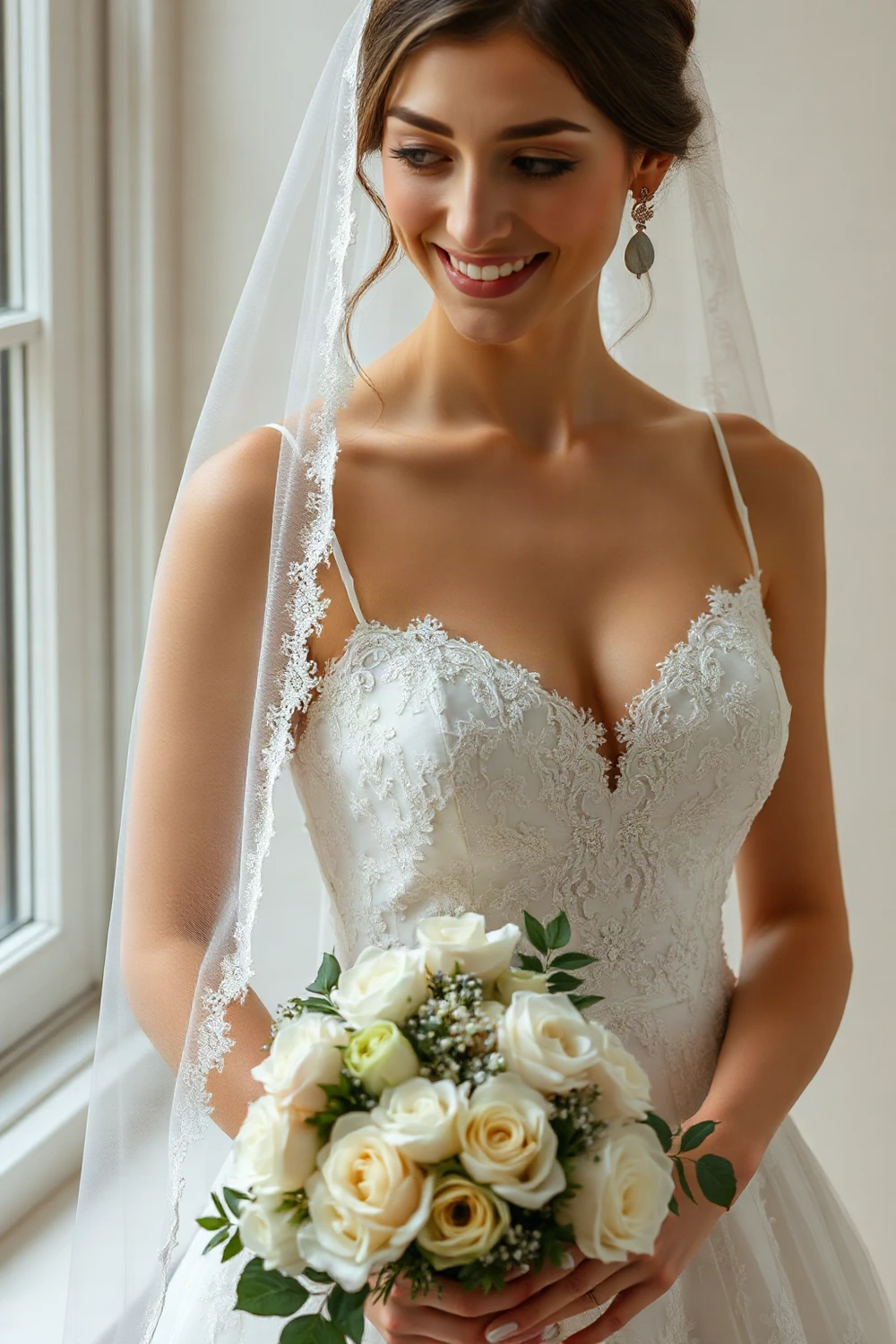
The third image focuses on how the upper-body composition reads in photographs rather than showing the full silhouette. Fine straps and a neckline deepening at the center open a frame for densely raised lace. A narrow lace-edged veil continues the motif language, while a substantial ivory-rose bouquet makes a soft, rounded countershape in front. Window light reveals white embroidery through relief and shadow rather than strong color contrast.
This reference is useful when portraits matter because earrings, loose hair strands, veil edge and neckline share the frame. Assess the deep neckline beyond a still front pose: bend, embrace someone and lift the bouquet while checking strap position and bodice support. Bouquet scale is equally practical. A generous arrangement creates a classic foreground but hides craftsmanship; a smaller cluster leaves more floral lace visible.
Making Coastal Wind Part of the Composition
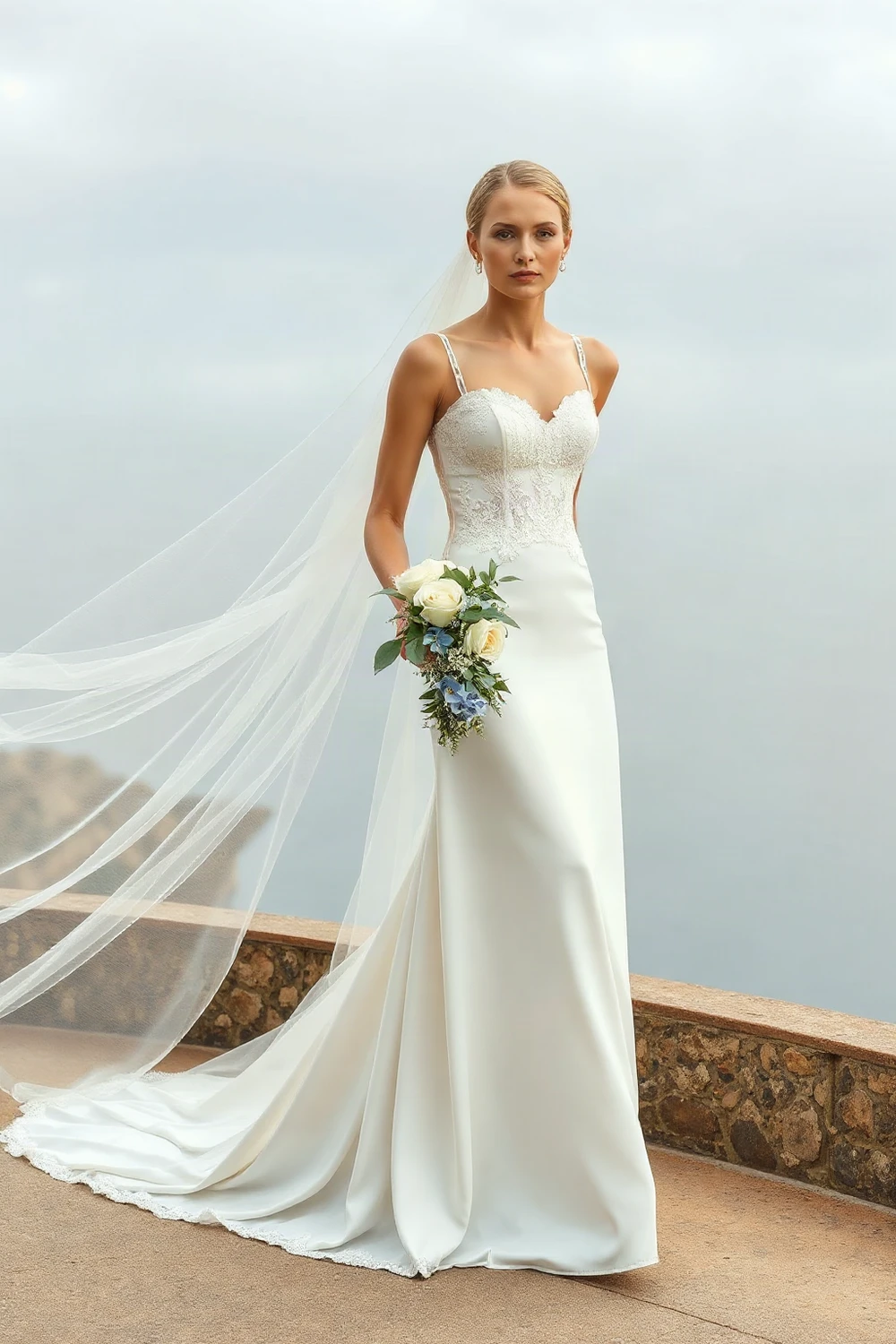
The fourth look keeps the dress controlled: a structured lace bodice leads into a long, smooth, narrow skirt. Drama comes from the veil, expanding left in broad airborne layers. Gray sky and distant water make a quiet background, while a descending bouquet of white roses and pale blue flowers repeats the cool palette. Lace, veil and landscape therefore perform separate visual tasks rather than competing in one area.
For an exposed place, a long veil requires more than hoping for a striking image. Test the comb’s hold, whether tulle turns around the face and how it meets the wall, ground and bouquet. The narrow skirt uses less space than an A-line but may restrict stride, especially on a textured terrace. This works for someone seeking expressive romantic movement without carrying dense floral lace down the entire skirt.
Prioritizing Lightness on a Meadow Path
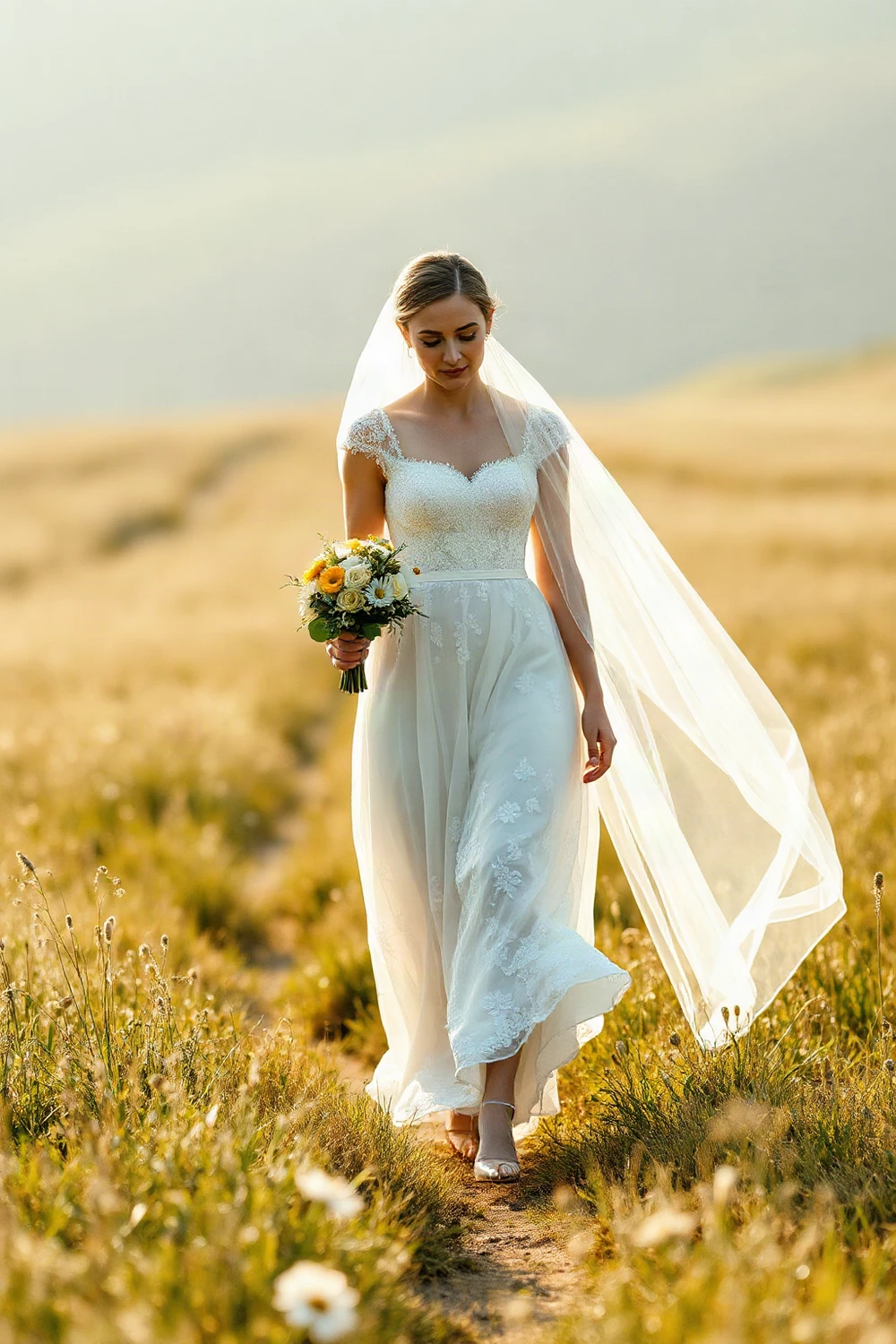
The fifth concept is defined by how the dress changes shape during a step. Short lace sleeves soften the shoulders, while a clear waistband releases a light skirt around the legs, revealing scattered floral motifs from shifting angles. A long plain veil streams behind and aside. Yellow and white flowers connect the bridal elements to the meadow’s warm late-day color.
On an outdoor path, apparent lightness must also work in motion. Check whether the hem catches vegetation, how the shoes balance on earth and whether the veil wraps around an arm or bouquet. Compared with the coastal look’s narrow, polished line, this form feels more relaxed, natural and responsive. Because the setting is already warm and textural, a compact bouquet can preserve harmony without letting the dress disappear into the scene.
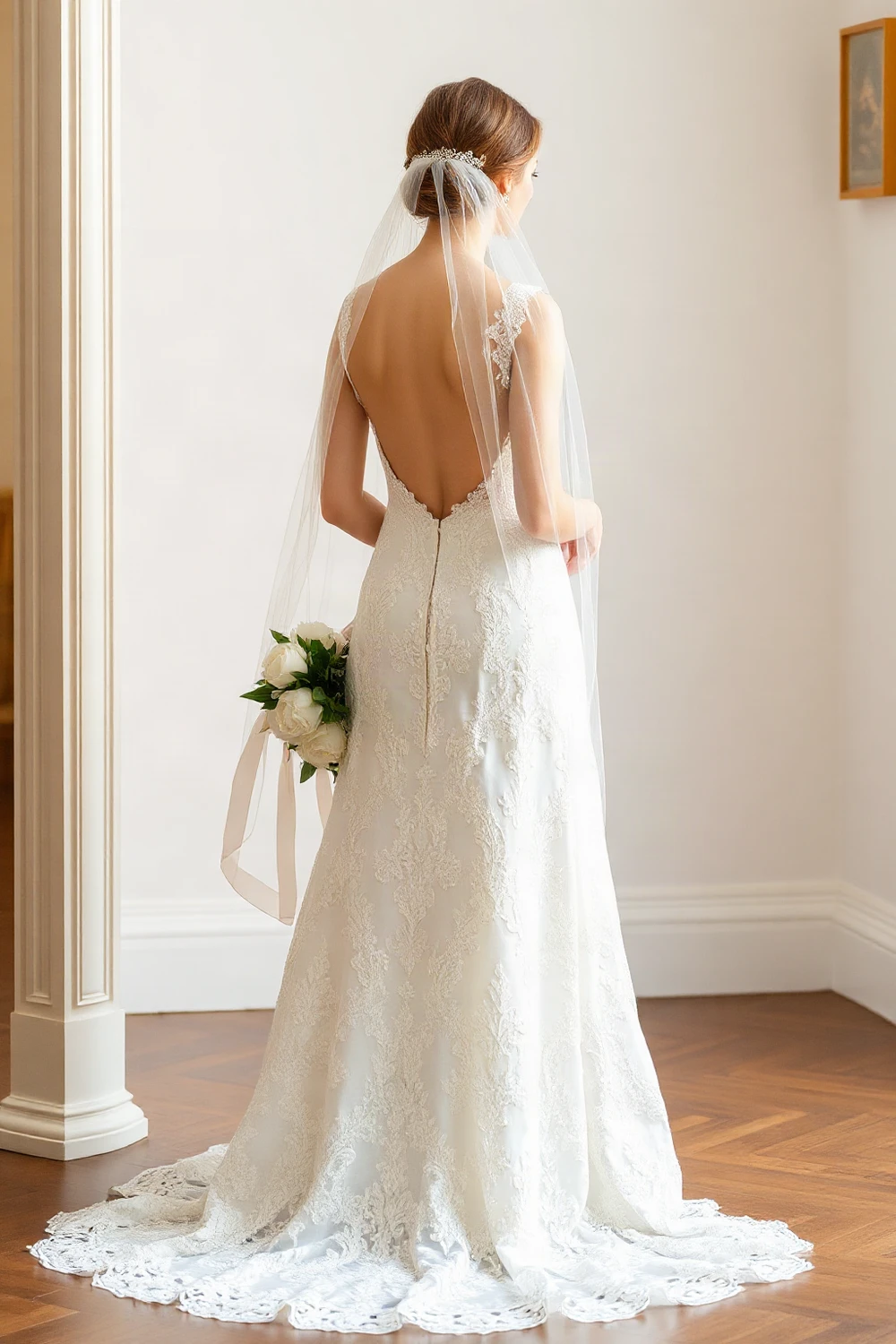
Designing the Open Back and Train Together
The sixth image makes the rear of the dress a primary design surface. Lace shoulder bands frame a deep V-shaped opening; floral motifs then continue below the waist across the skirt and broad scalloped train. A plain veil stays transparent over the back instead of concealing it. A small glint at the hair comb and long pale bouquet ribbons accompany the extensive texture with restraint.
This suits moments when processional and ceremony views from behind matter. An open back requires testing of internal support and shoulder placement: reach forward, embrace and sit while watching the bands. Then check the comb’s hold and how the train gathers for movement. Unlike the first look’s lace-above-smooth-skirt balance, detail dominates the whole lower surface. A simple veil and jewelry keep the back line and train readable instead of adding another elaborate pattern.
Begin with how you want to move through the day, not the single detail you like most. A broad A-line creates ceremonial volume, a narrow skirt gives a quieter vertical line, and lighter layers respond naturally to outdoor walking. Then decide the lace’s job: concentrated bodice focus, transparent sleeve texture, a portrait-defining neckline, continuous skirt ornament or a frame around an open back.
Veil and bouquet should support that hierarchy rather than compete with it. In wind, long plain tulle may provide the main movement; beside a restrained skirt, lace edging can connect more closely to the bodice. Read blush, blue or yellow bouquet accents against both venue and dress. Before deciding, rehearse sitting, walking, turning, embracing and carrying flowers. Romantic balance is most convincing when it survives the day’s real sequence, not only a still pose.
Explore how veils and bouquets work with floral lace wedding dresses, necklines, sleeves and back details.
Frequently asked questions
Which veil balances a densely detailed lace bodice?
Plain-edged fine tulle usually leaves intricate bodice motifs easier to read. A narrow lace border can work with a cleaner skirt, but compare the two pattern scales together during a styling trial.
What should be tested when choosing a long veil outdoors?
Check the attachment point, expected wind direction, walking route and whether the tulle catches the bouquet, arms or nearby plants. Test movement and a light draft rather than assessing it only in a still room.
How can I choose between a full A-line and a narrow skirt?
Consider aisle width, flooring and the desired sense of movement. An A-line gives fuller ceremonial volume; a narrow skirt makes a longer, quieter line, but its stride allowance needs separate testing.
How does bouquet color affect a white lace look?
Cream and blush create softness, pale blue adds a cool connection, and yellow brings warmth. Let the color respond to the setting while keeping the arrangement from concealing the main bodice detail.
What practical points matter with an open-back dress?
Evaluate internal support, movement of the shoulder bands, veil-comb placement and hairstyle together. Reach, sit and embrace during the fitting to see how the opening and support behave beyond a static pose.