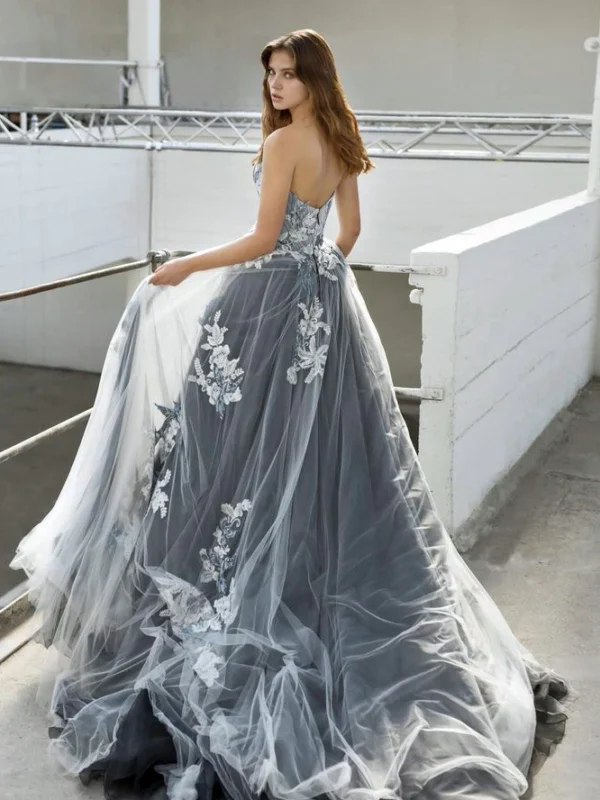
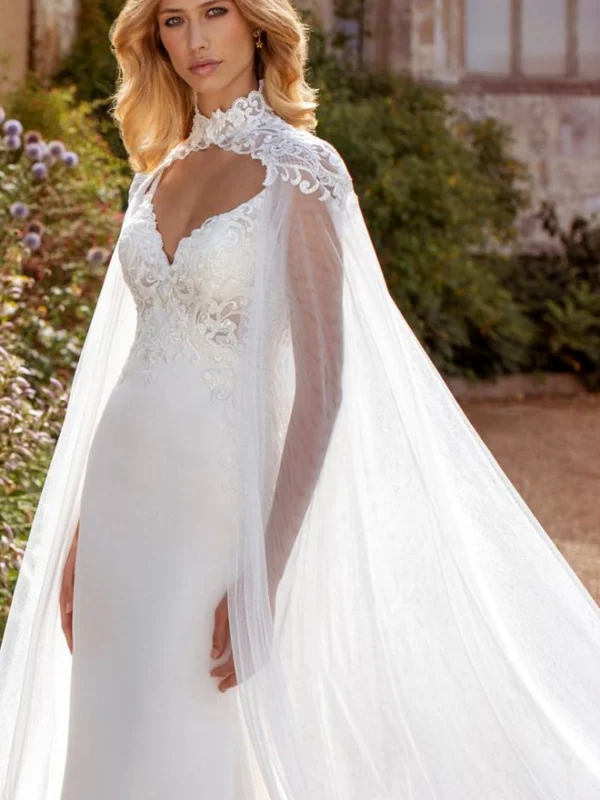
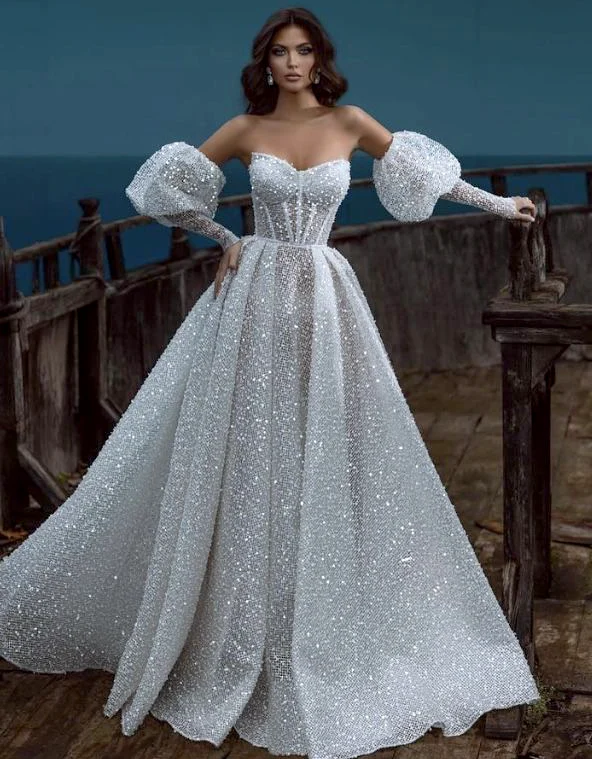
A wedding dress with clean lines need not have an entirely empty surface. What matters is which lines you want to notice first and which details should remain secondary. Our main reference shows narrow straps, a folded upper border and waist strips that appear to overlap. A separate floral rear provides a deliberate comparison through longer patterned sleeves and a lower V-shaped back edge. It is not confirmed as the back of that quiet front. Select individual features without assembling the two photographs into one existing product or a material specification.
1. Name the quiet leading line precisely
Look at the pale front before making a general judgement about its style. Narrow straps lead towards a lower folded neckline. Horizontal upper folds meet more diagonal strips at the waist, with a closer-fitting hip line beneath. Record whether the upper drape, directed middle or relationship with the lower shape interests you. A short description such as narrow straps with an emphasised folded middle gives an enquiry more precision than simple alone. You can prefer one characteristic without adopting every detail in the photograph.
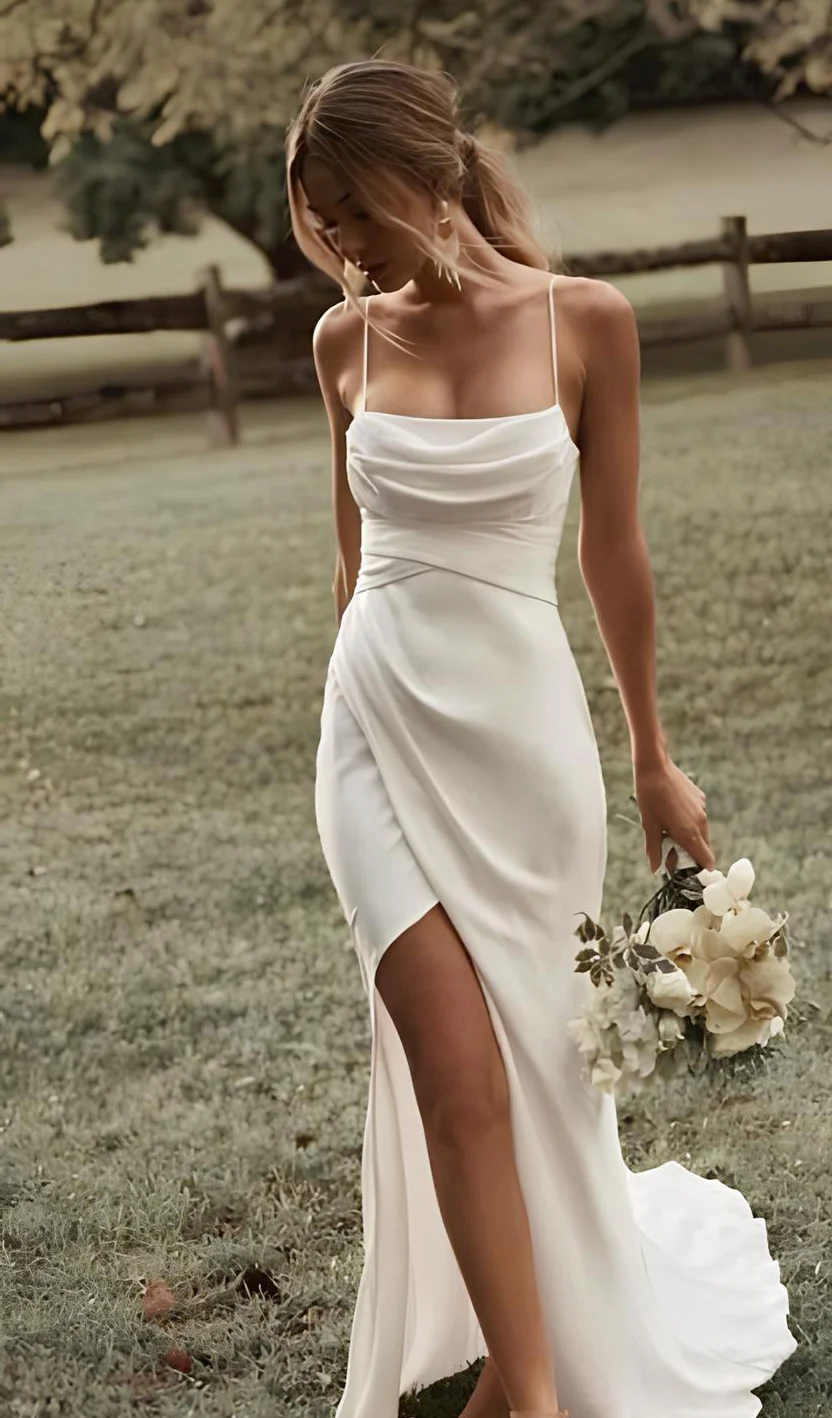
Next, decide what you want to keep quieter in your own selection. Do you mean fewer repeating motifs, an easily traced edge or fewer neighbouring accents? Those are different preferences. Narrow straps can sit beside folds, while a broad quiet surface reveals neither weight nor fibre or internal construction. Assess the desired appearance on the complete real garment. A close photograph of the middle can support your decision without replacing its corresponding full front. Mark which complete view is still missing rather than expanding a small detail into an assumed whole.
2. Avoid turning a style word into a fabric rule
The manufacturer calls a different model, Atelier Pronovias BRISEL, minimalist while also describing a three-dimensional neckline bow. That named example shows why a restrained style word does not automatically exclude a particular detail. It identifies none of our pictures. Its product features, textile information and supplied components cannot be transferred to the quiet reference. Use the example to describe how much detail you want, rather than imposing one general definition on every offer. Information about your own candidate must come from that particular product.
Ask for the actual favourite’s textile composition and existing layers. Light follows the folds in the photograph, but it measures neither handle nor density and establishes no particular fabric type. A smoother-looking surface is not a quality certificate either. If you want a detail reduced, request an assessment on the real piece before agreeing to work. The bespoke wedding dress guide helps distinguish a styling preference from the existing model and a modification that has only been proposed. Record clearly which feature is already present and which outcome still needs assessment.
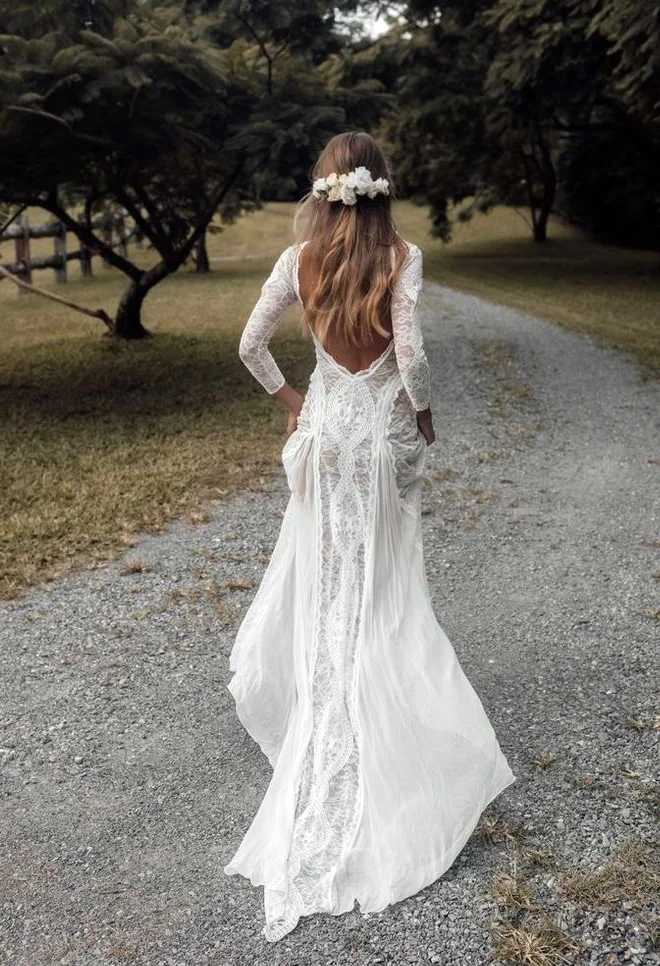
3. Obtain the matching back instead of adding another garment’s
The second reference shows an independent floral back. Its motifs extend across longer arm surfaces beside a lower V boundary. Longer loose hair partly obscures the upper back. Beneath closer-fitting hips, the lower form widens and reaches the floor. Those observations describe that image only. They establish neither the main front’s back nor matching connections for its straps, waist strips or lower area. A similar pale colour cannot identify the two as one model. Filling one picture’s gap with another picture’s pattern would turn a comparison into an unsupported product claim.
Request your actual candidate’s own complete back first. Add a normal side view and compare the same upper and middle regions. Where hair conceals a connection, ask for an additional view with that area unobscured. Name the specific border you cannot yet trace. The explanation needs to concern the same offered model and version. Combining a patterned back with a quiet front is a request to assess separately, not an existing product documented by these two photographs. Establish any proposed connection on the actual piece before treating the combination as available.
4. Assess folds and coverage in the real combination
Try the actual favourite with your planned underwear. Inspect upper folding, waist and sides standing normally, then after sitting and turning. The main reference is one standing view with a bouquet held low at the side. It does not show all internal layers or every edge behind that object. Vertical lines likewise establish no particular support. Ask about the actual construction before reading a photographed fold route as a promise of fit. Keep what your trial demonstrates connected to that same garment’s information rather than treating another person’s picture as your own measurement.
The sheer wedding dress guide separates fine-looking ground from actual coverage. Some areas in the floral back are harder to read beneath hair or drawing. More or less visible skin cannot explain every underlying layer on its own. If you want coverage changed, identify the precise location and have the existing version assessed. Save the answer with its matching views. Another picture cannot supply invisible lining for your favourite. Keeping an offered version separate from proposed work also makes clear which result has genuinely been established.
5. Compare length and accessories in a deliberate order
The main front omits the complete hem and footwear. A longer floor area appears at the right of the image without measuring your finished length. Complete front, side and rear views with intended shoes. Let the cloth fall normally first, take a few steps and inspect the edge again. If shortening is planned, ask which fold or border would be affected. Agreed modifications need another complete fitting afterwards rather than only a new detail photograph. Reassess your own lower finish on that same real model after normal movement.
Start styling with planned hair on the same actual dress. Add one jewellery piece next, followed by bouquet, veil or bag. The bridal accessories guide helps compare those decisions individually. The main reference’s bouquet sits low at the side; it is no universal instruction about your hand position or supplied components. Preserve the same base combination between trials. You can then see whether a new accessory obscures the neckline you prefer or adds a second accent beside it. Establish what is included through the offer rather than assuming every pictured addition belongs to the dress.
6. Describe the actual offered garment before deciding
For a wedding dress with clean lines, retain three things: the leading line you want, the confirmed version and views still missing. Have included pieces named individually. The older address’s year 2025 is an archived search context rather than proof of a current collection or garment age. Care follows the real finished piece’s instructions; GINETEX explains care symbols. Neither a quiet surface nor folded border determines washing or ironing. Complete your choice through full information and your own trial, clarifying uncertain treatment before planning it.
A quiet narrow-strap front with a folded neckline sits beside an independent floral rear. Choose visible lines without treating the style description as proof of fabric, quality or one shared model.
Frequently asked questions
Must a wedding dress with clean lines omit every detail?
A wedding dress with clean lines need not omit every detail. Name the leading line and one deliberately chosen feature instead of equating simplicity with a completely empty surface.
Does the quiet front of a wedding dress with clean lines establish a fabric type?
The quiet front of a wedding dress with clean lines establishes no particular fabric type. Request the actual version’s textile information; light and folds cannot replace it.
Does the floral back belong to the quiet clean-line front?
The floral back is not confirmed as the rear of the quiet clean-line front. Request the matching back of the same offered model; a shared pale colour does not establish identity.
Do few visible details prove the quality of a wedding dress with clean lines?
Few visible details do not prove the quality of a wedding dress with clean lines. Inspect the real piece and its actual information rather than treating a quiet-looking surface as a quality certificate.