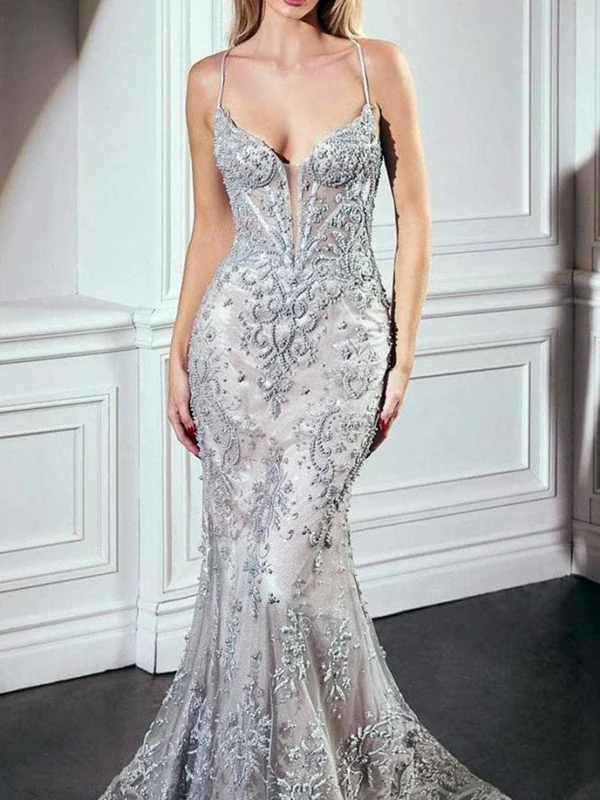
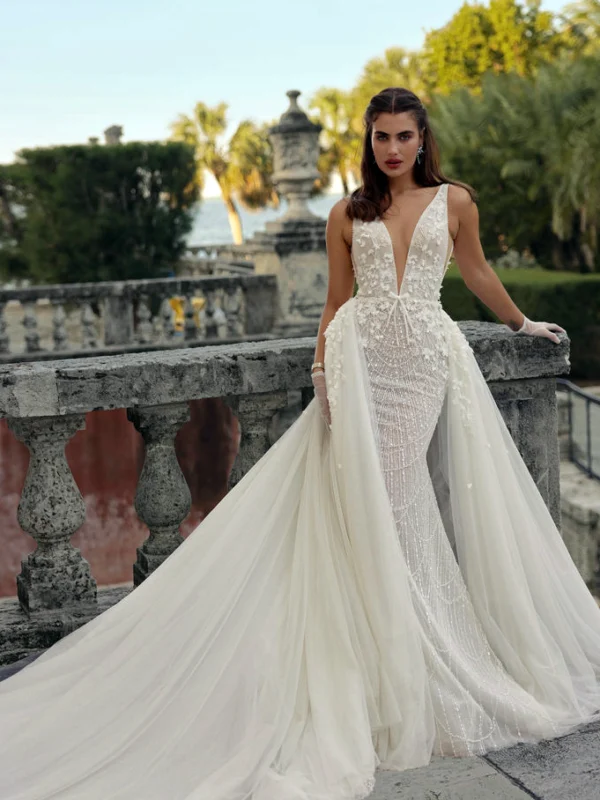
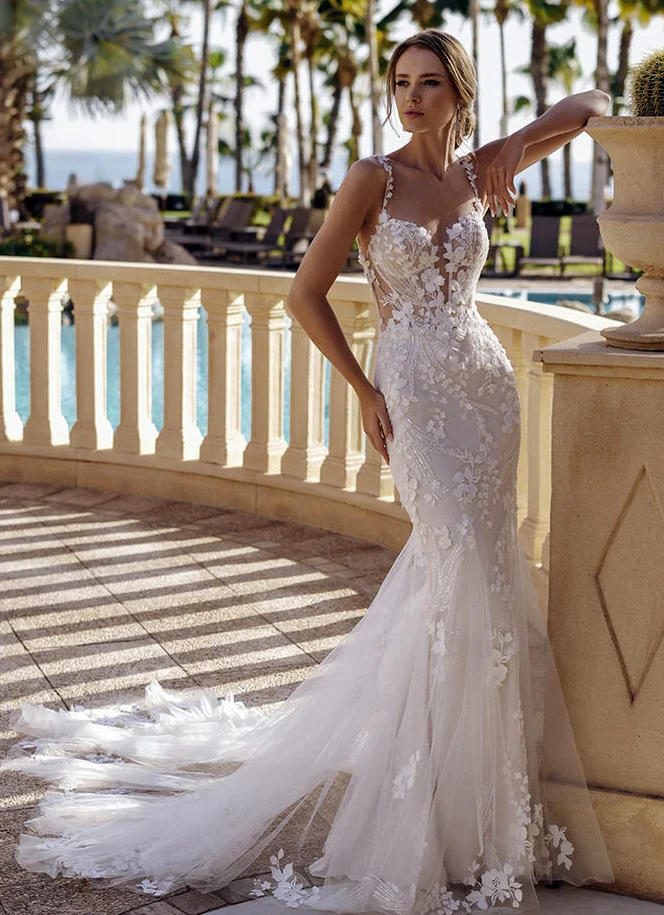
A myth-inspired wedding dress starts with an atmosphere you can translate into visible choices. You may be drawn to a framing veil, moving skirt layers, dense patterns or a floral accent. None of this requires an invented historical origin or a claim that a modern garment belongs to a particular goddess. The four references offer different starting points: a covered head area, a strongly divided skirt, a patterned back and flowers along the sides. Choose a theme you can explain yourself. Then test whether its effect works with your movements, accessories and actual venue, rather than only within the photograph’s setting.
Describe a myth-inspired wedding dress in three words
Write down three words for the atmosphere you want. They might be quiet, veiled and patterned, or moving, floral and pale. Translate each into a visible detail. Veiled could mean a head covering; moving might mean a skirt with several free edges. Decide which feature should lead. Otherwise, attractive individual elements can end up pulling the actual garment in different directions without a clear shared idea.
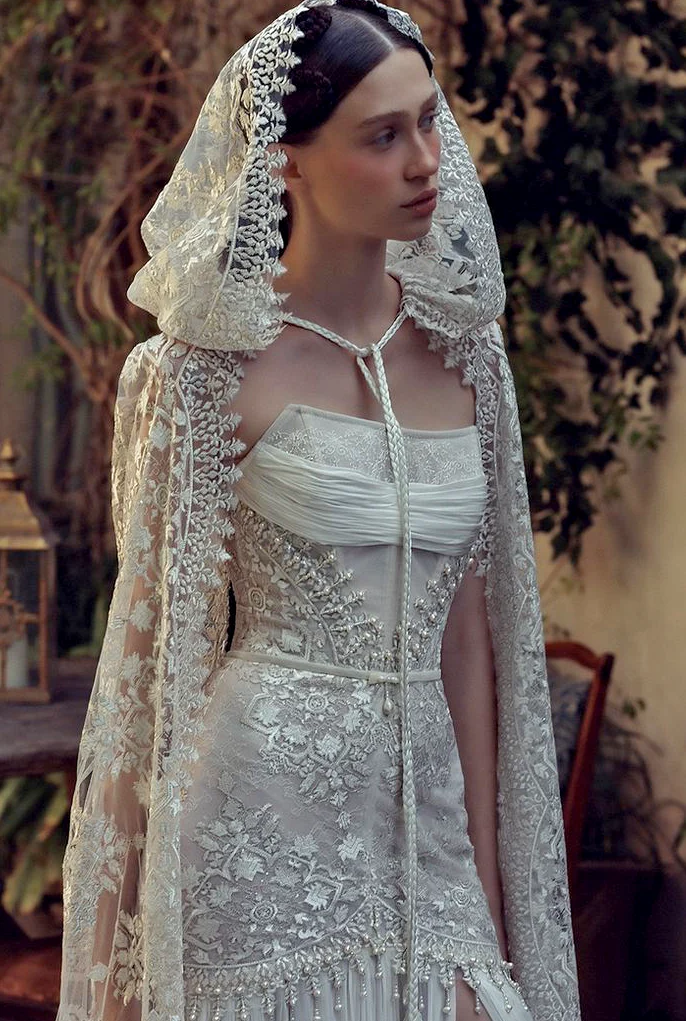
Limit the first fitting to two alternative emphases. Compare a stronger veil with a more prominent skirt before combining both. After each version, ask whether you still recognise the atmosphere without the architecture in the photograph. An old staircase or garden belongs to the image, not the garment. Your own outfit should remain understandable in an ordinary fitting room and still reflect what you wanted from the story.
Separate mythological inspiration from historical reconstruction
An imaginative bridal outfit can draw on stories without recreating historical clothing. Describe a personal association as inspiration. Floral patterns do not establish a Celtic origin, and a head covering does not automatically identify a particular ancient tradition. A single photograph cannot confirm the designer’s intention either. If a specific figure or cultural relationship matters to you, consult reliable sources before selecting symbols and assigning them a meaning.
The Metropolitan Museum’s explanation of ancient Greek dress also notes colourful, decorated fabrics. A modern pale wedding dress is therefore not automatically an accurate reconstruction of that clothing. Use museum information for context, not as retrospective proof of a pictured garment’s origin. You can choose a modern myth-inspired wedding dress and honestly explain the personal atmosphere or story that drew you to it.
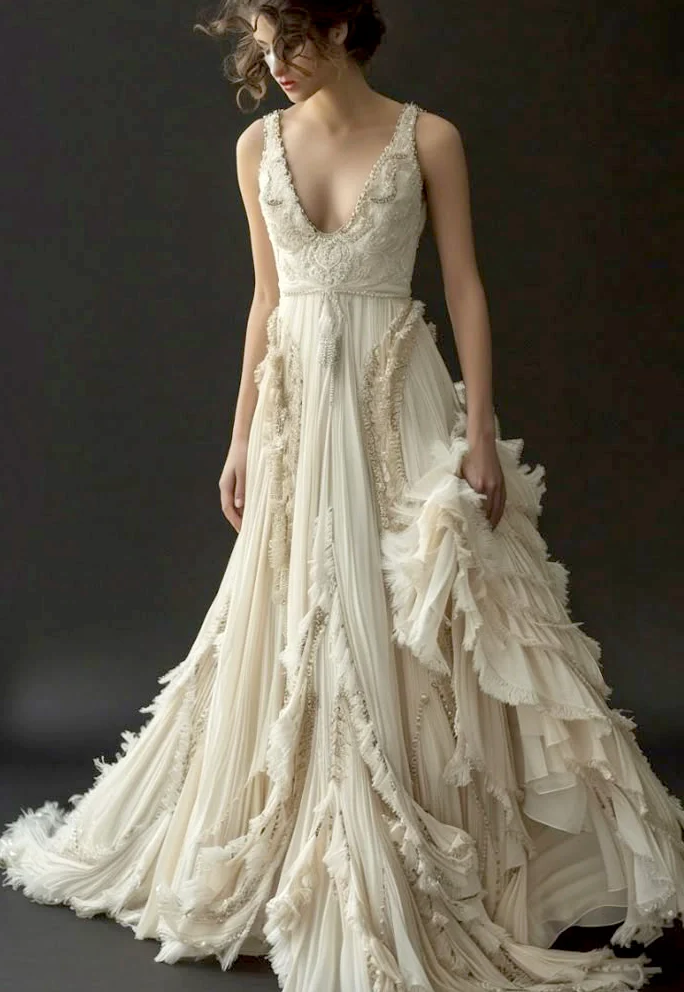
Test the veil and head frame in movement first
The first reference frames the head and shoulders with a patterned veil area. That element changes the visible outline more strongly than a small piece of jewellery. Try a similar arrangement with the hairstyle you actually plan to wear. Turn your head, look down and sit. Ask to see how it is secured and removed later. The attractive fold arrangement of a photograph does not explain this handling sequence.
Then compare the neckline with and without the veil. Where do patterns and edges meet? Does a detail you enjoy on the bodice become covered? Decide deliberately whether you like that overlap. Add earrings after the head arrangement works. Check looking sideways and making an ordinary greeting as well. A quiet, mysterious effect needs to work alongside your own orientation and movement, rather than existing only during a carefully held pose.
Myth-inspired wedding dress: compare front and back pattern placement
A densely patterned bodice and a patterned back do not create the same view. The third reference especially shows the back, leaving the front unknown. Request complete views for a similar offer. Decide which detail you want to see frequently yourself and which area will mainly be seen by others. A favourite back pattern can define the outfit, but it still needs a front you enjoy wearing.
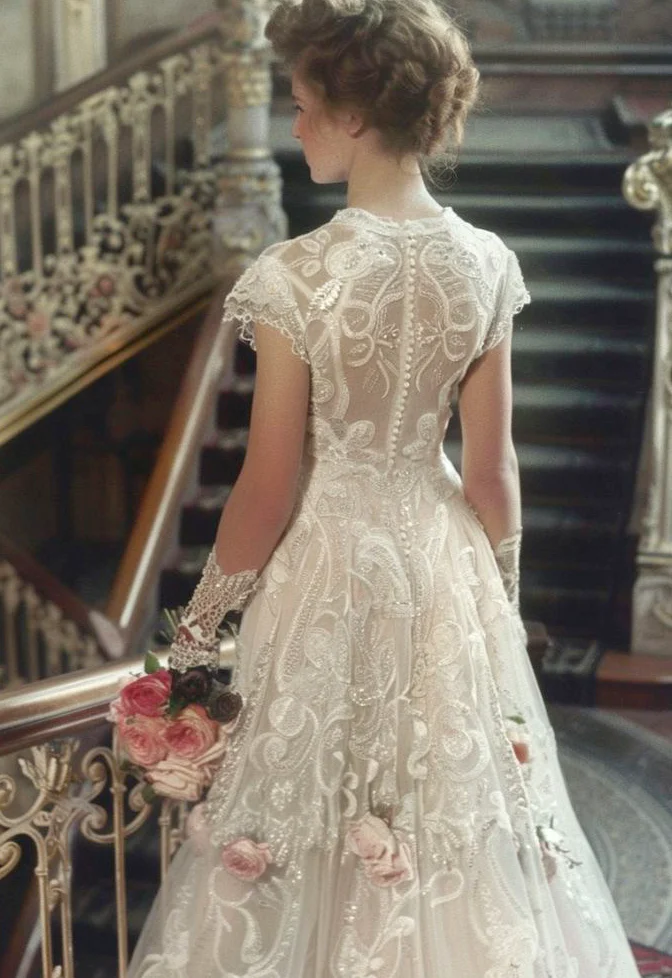
Try underwear and preferred coverage on the actual model. Raise your arms, lean slightly forward and examine the edges. The visible pattern establishes neither handwork nor a particular fibre. Request product information separately. Our crochet-look wedding dress guide helps with open pattern areas and lining questions. It is a styling reference, not evidence of the making method in any of these photographs.
Choose skirt layers through effect and space
The strongly divided skirt in the second reference creates movement through several visible edges. The floral example distributes volume differently: its sides draw attention while the centre remains more continuous. If your myth-inspired wedding dress idea is led by the skirt, compare these approaches before choosing more accessories. The question concerns where volume sits, not simply how much of it there is.
Walk in the actual dress, turn beside a chair and sit down. Check the normal fall before somebody spreads the skirt for a photograph. Ask about a proposed way to gather it if needed and have that demonstrated. Bring your shoes and discuss shortening at the actual lowest edge. Several layers or flowers can change the alteration task; their precise attachment is not established by the image.
Compare flowers, bouquet and jewellery together
The fourth reference has flowers along the skirt’s side areas. A large bouquet could hide some of them in your own outfit. Hold something of approximately your intended size where the bouquet would sit and inspect the whole area. Decide whether you want the dress flowers or bouquet to lead. Both can be visible, but their relationship should be an arrangement you deliberately enjoy.
Add jewellery and head accessories step by step. A small necklace changes the neckline differently from another large flower accent. Our boho wedding dress guide offers another shape comparison. Use it to explain your emphasis rather than adopting every detail. A myth-inspired wedding dress can be created through one clear accent; it does not require a collection of supposedly mythological signs or an invented story attached to every pattern.
Prepare alterations, transport and care concretely
Before ordering, list the pieces you actually need: dress, veil, outer layer and any train arrangement. Ask separately about changing the back, straps and hem. Have the provider explain what remains and where work would take place. Leave time for a final fitting that includes the head arrangement and accessories. That allows you to check the complete outfit under comparable conditions rather than assessing the dress alone.
Read the actual care label and ask about decoration and detachable parts. GINETEX explains the care symbols; a delicate-looking surface is not an instruction to steam or wash it. Discuss transport so that you know how layers and veil should be arranged before dressing. The result is a personal, explainable styling decision: a recognisable atmosphere, specific visible features and a practical sequence you can manage yourself.
A myth-inspired wedding dress starts with a personal story expressed through visible details. Compare veil, pattern, skirt layers and flowers on the actual garment.
Frequently asked questions
Does a floral pattern establish a particular mythological origin?
No. A personal association is inspiration, not evidence of cultural origin, designer intention or historical construction.
Is a pale wedding dress automatically ancient Greek in style?
No. The Met also describes colourful, decorated ancient fabrics. A modern pale look is not automatically a historical reconstruction.
How should I compare a veil with a strongly layered skirt?
Try two separate emphases first. Test head movement and attachment for the veil, and normal fall and movement beside a chair for the skirt.
How can I test flowers with a bouquet?
Hold something close to the planned bouquet size in the normal carrying position. Decide which flowers you want to remain visible.