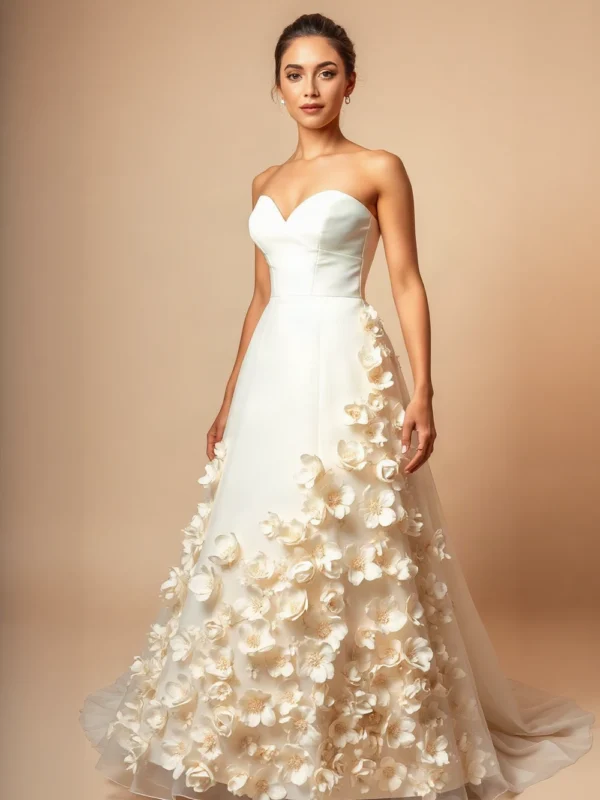
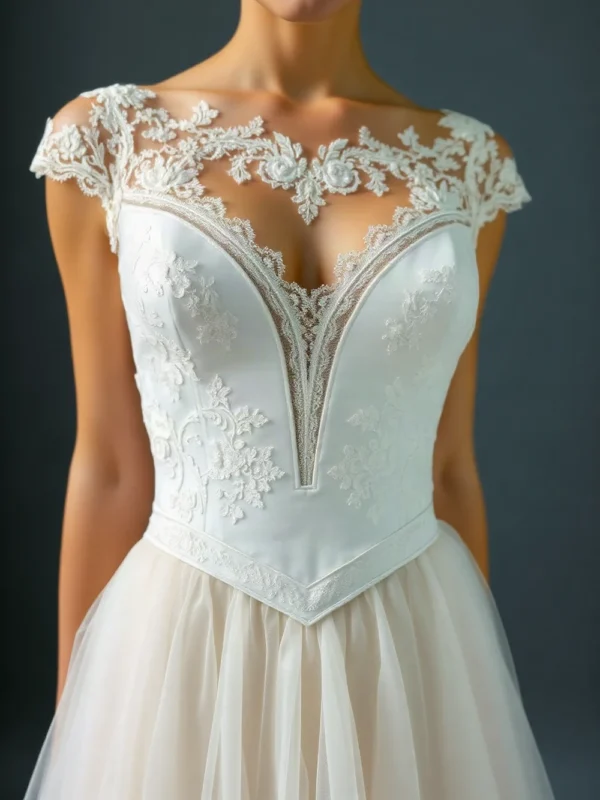
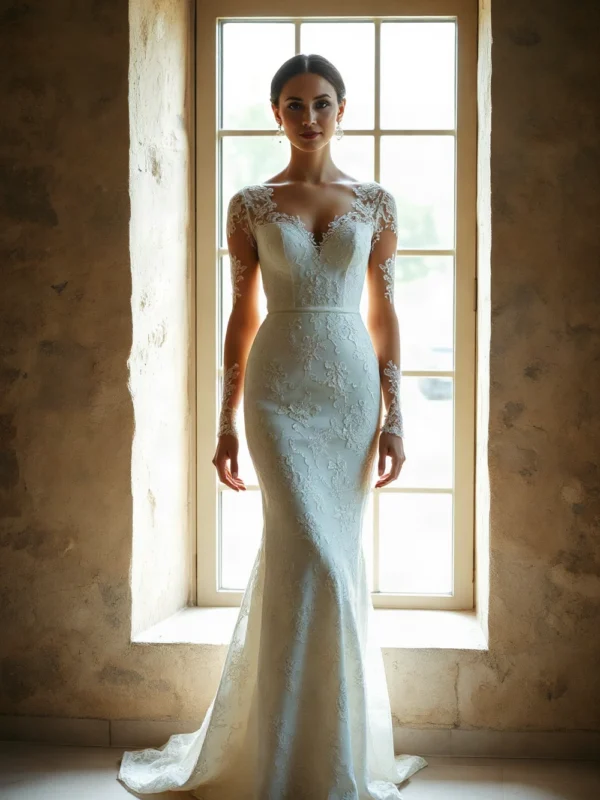
Lace ball-gown wedding dresses cannot be judged by motif alone. A close-fitting bodice and expansive skirt create strong contrast, so neckline openness, shoulder position, waist transition and detail distribution shape the result. These six mansion-set concepts compare strapless, off-the-shoulder and strapped bodices with bordered, plain and vertically embellished skirts. Mirrors, pianos, carved frames and open doors provide romantic settings while defining each pale silhouette. Rather than serving as a product catalogue, the images suggest fitting questions: Does the bodice stay secure in motion? How does the back look from several angles? How much floor space does the skirt need? Will a veil reinforce or hide the pattern? Considering these questions together helps balance a romantic, formal outline with comfort, movement and the proportions of the intended setting.
Balancing a strapless bodice and a bordered skirt
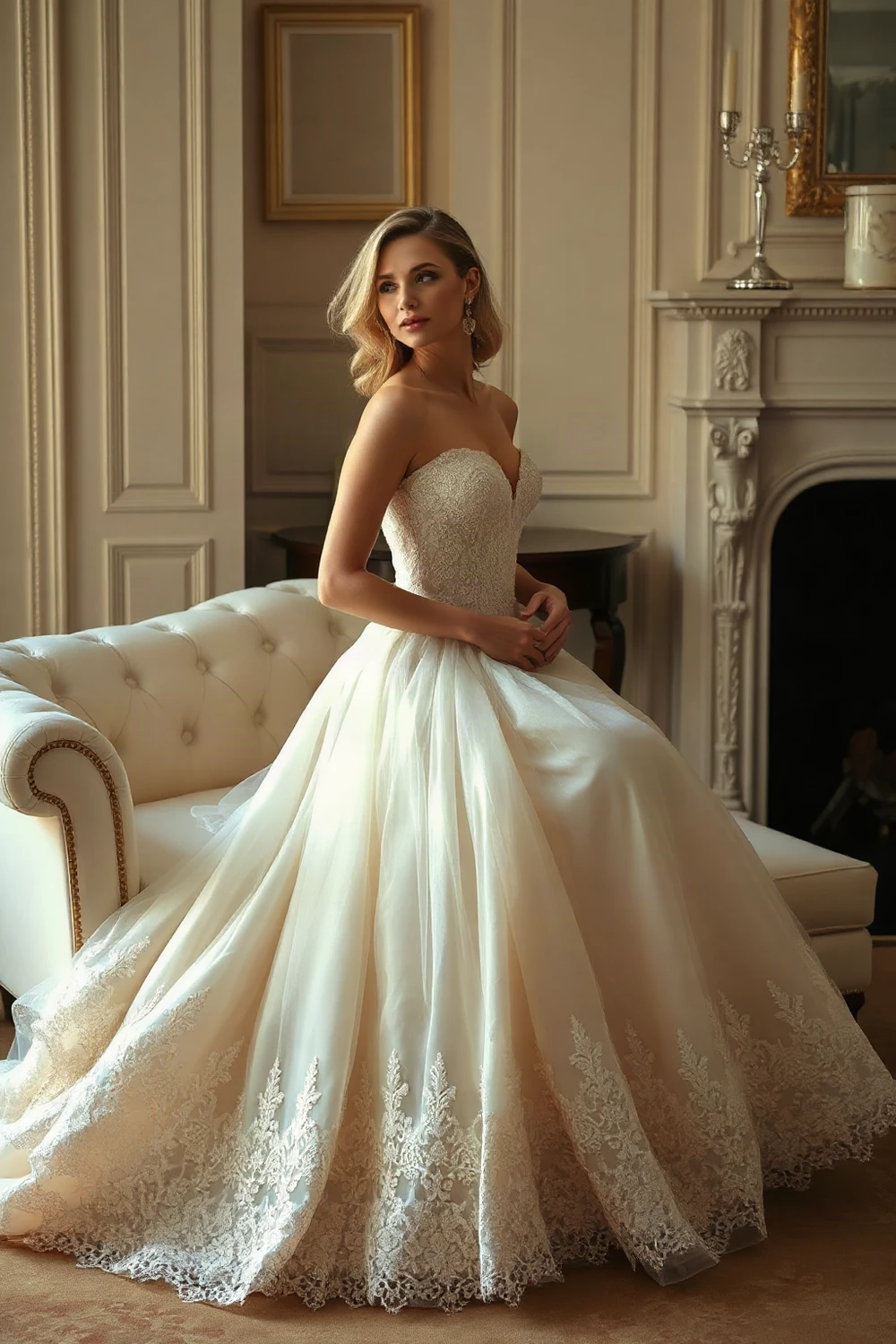
In the first image, a densely textured strapless bodice balances the broad, quieter center of the skirt. Lace-like decoration returns as a border around the hem, keeping detail near the face, waist and outer edge without filling every fold. Warm side light makes the plain areas useful: highlights and shadows reveal the skirt’s depth and volume.
Assess a strapless neckline in motion, not only while standing. Reach forward, raise the arms, sit and turn to check whether the upper edge stays level and secure. Final length matters because substantial shortening may alter how much of the border remains visible. If considering a patterned veil, compare it with the decorated hem in a full-length rear image. A restrained veil edge may preserve the distinction between detailed borders and the calmer center.
Allowing movement within an off-the-shoulder line
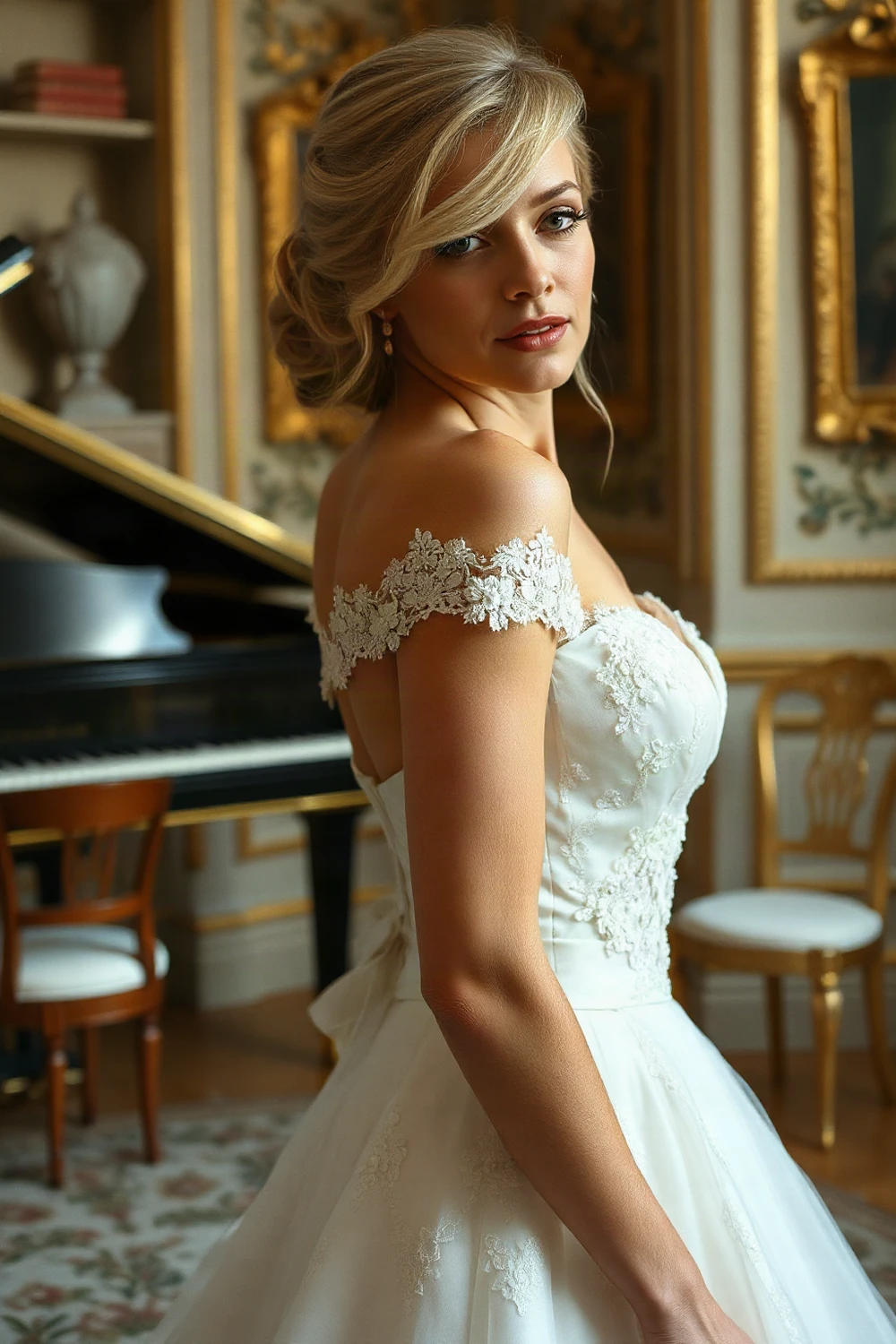
The second image closely frames floral bands positioned beyond the shoulders, extending the neckline horizontally around the upper body. Unlike a strapless bodice, this line continues visually around the shoulders and frames the face. The dark piano and gilded frames heighten contrast, so motif density is especially apparent in portraits.
Test the off-the-shoulder line and arm mobility together. Bands that are too fixed may restrict hugging, dancing or lifting a bouquet; those that shift easily may lose symmetry. Short videos with the arms in different positions reveal changes a still mirror can hide. Because the shoulder treatment is already detailed, large necklaces may compete with it. Earrings or a restrained hairstyle can keep the area clear, but assess accessories with the full skirt rather than from a cropped portrait alone.
Checking the back, waist and volume in a mirror
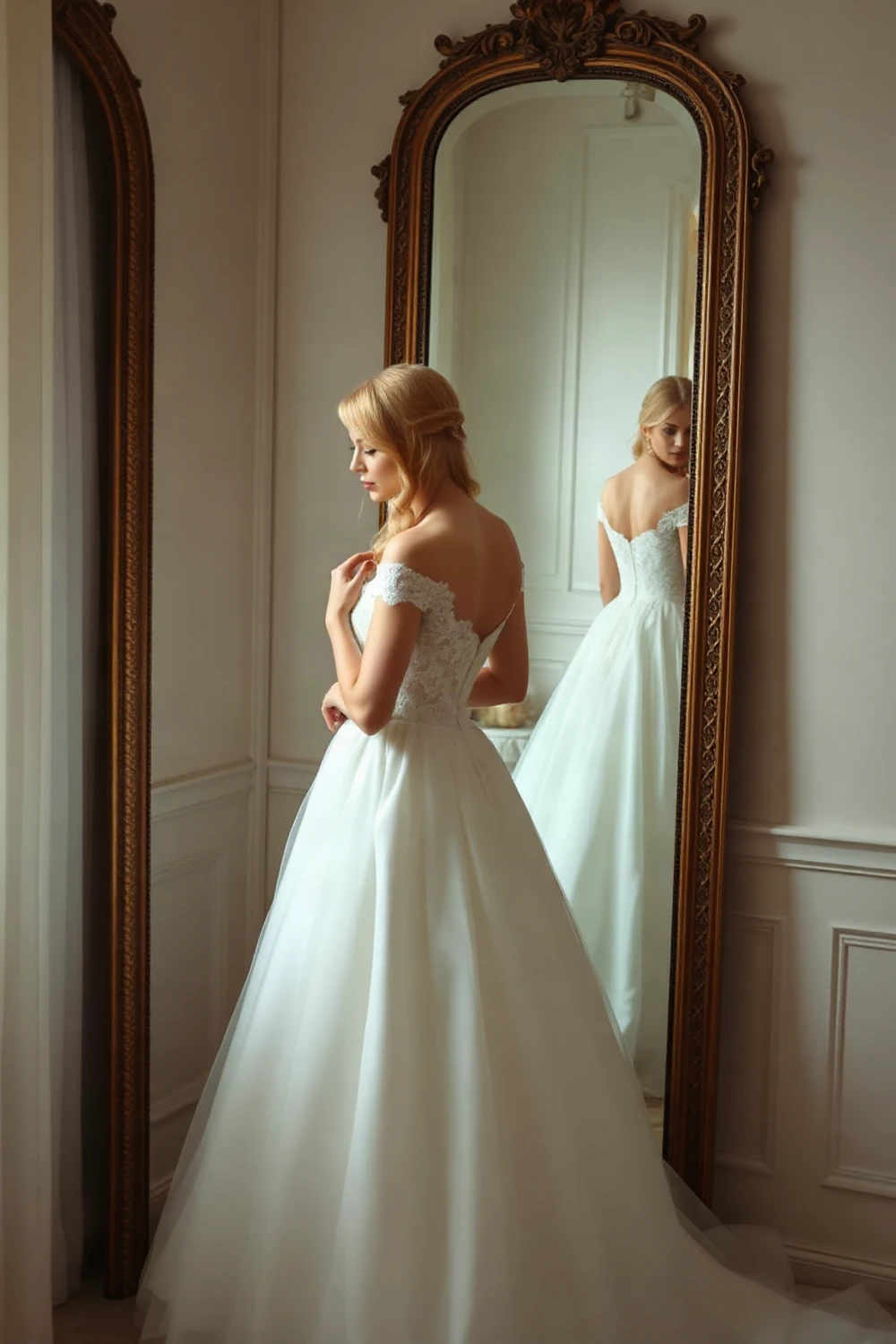
The third image pairs a rear three-quarter angle with a reflected front view. A patterned edge follows the open back from the off-the-shoulder line toward the fitted bodice, while the plain skirt creates a clear change below the waist. The sharply defined waist shows where volume begins, shaping the upper body while retaining formal ball-gown breadth.
A fitting-room mirror helps, but its angle may exaggerate the skirt or change the apparent back slope. Compare direct front, side and rear photographs. Check whether the back edge lifts during turns or leaning, the waist seam stays level and the skirt falls evenly behind the body. Test a veil from the rear as well. Placing a dense veil and a more transparent option over the bodice shows whether the patterned back remains intentional or disappears beneath another layer.
Reading proportion through strong backlighting
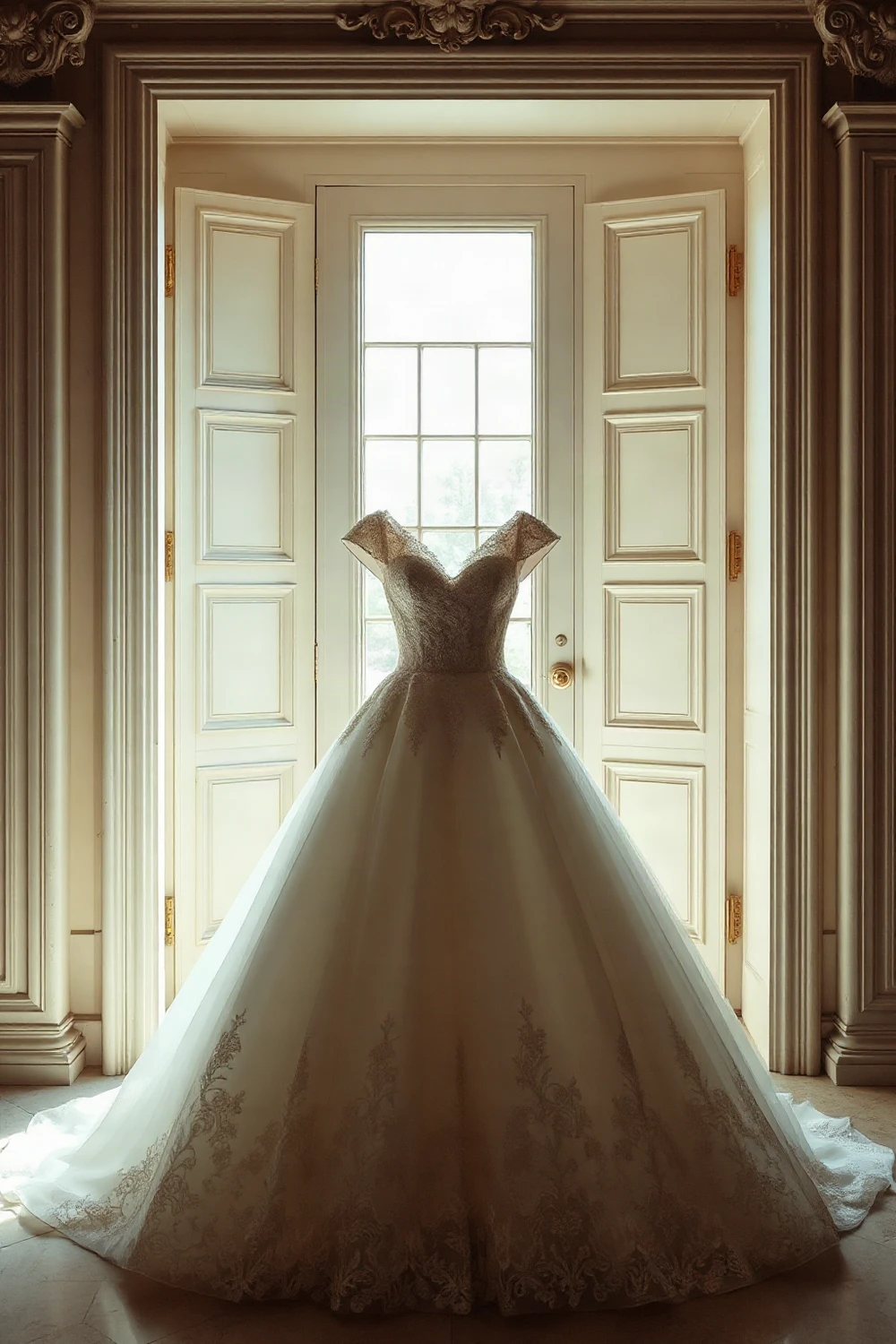
In the fourth image, a tall glazed door turns the gown into a clear, symmetrical outline. Backlight minimizes small motifs but emphasizes shoulder width, waist height and skirt flare. The relatively open skirt center separates the textured bodice from hem decoration. Outward-pointing shoulder elements also give the top a broader visual boundary than narrow straps or a fully strapless edge.
Use this view when proportion matters more than surface detail. Ask whether shoulders and skirt feel balanced, the waist sits at a flattering level and the floor spread suits the room. Because backlighting cannot reliably show subtle ivory tones or differences between layered surfaces, compare a front-lit detail view. If the ceremony route includes doors, corridors or stairs, assess walking and turning. A moving skirt’s space requirement matters more than its arranged width in a still image.
Connecting illusion shoulders to a quiet skirt
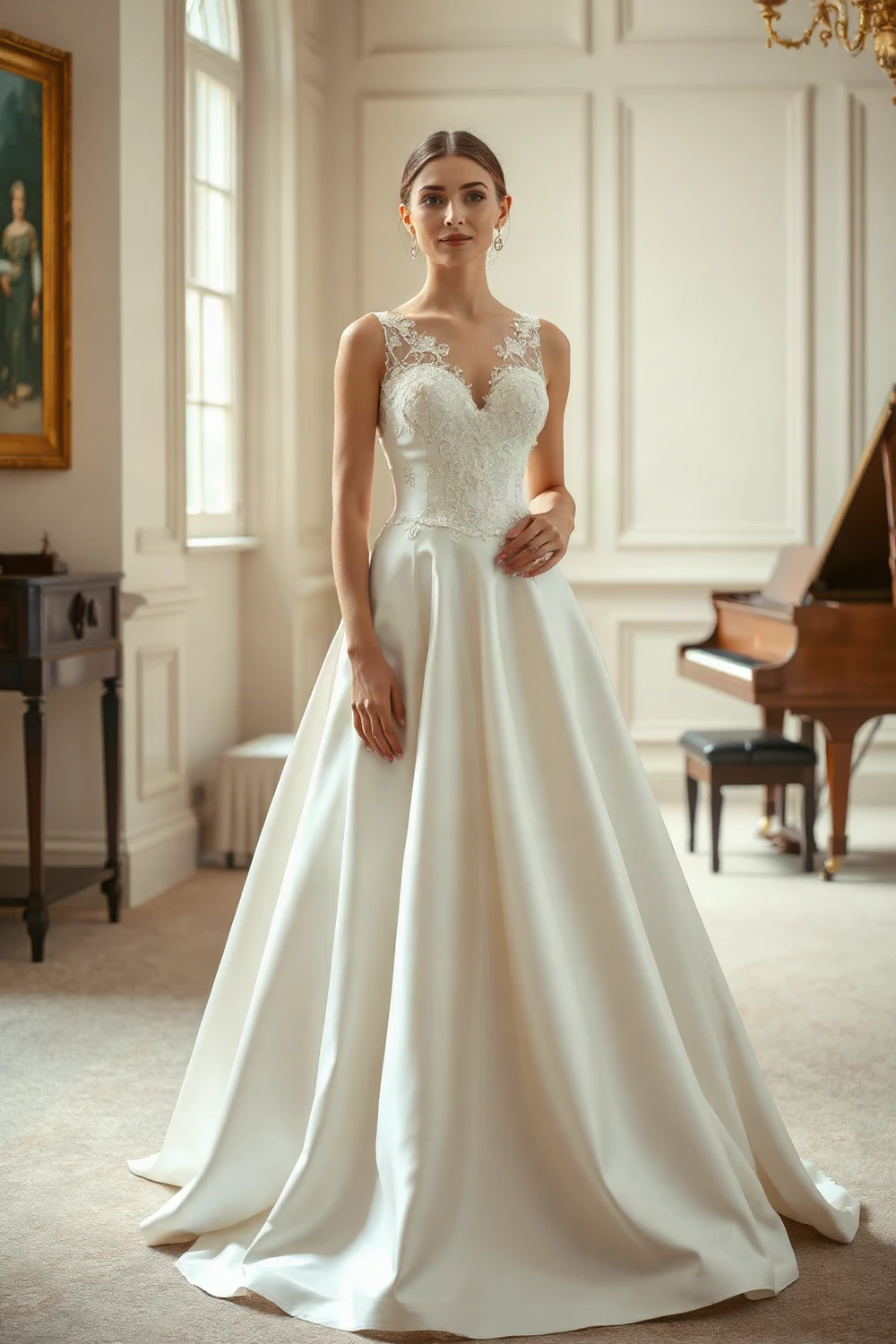
The fifth image uses floral, sheer-looking shoulder panels to frame a V neckline and connect an ornate bodice with open skin. Below the defined waist, long, smooth folds carry little decoration. Attention stays near the neckline and waist, while the broad lower silhouette reads with less interruption. Daylight in the music room clarifies the contrast between the patterned upper section and lustrous-looking skirt.
This is an alternative to allover embellishment. Examine the illusion boundary in window light and warmer indoor light because its relationship to skin may shift. A smooth skirt can seem minimal yet show creasing from sitting or transport more readily than a highly patterned surface, so review it after movement. Add jewelry and a veil individually. With the neckline already providing a decorative frame, restrained accessories may protect its focus better than several equally prominent pieces.
Extending the skirt with descending motifs
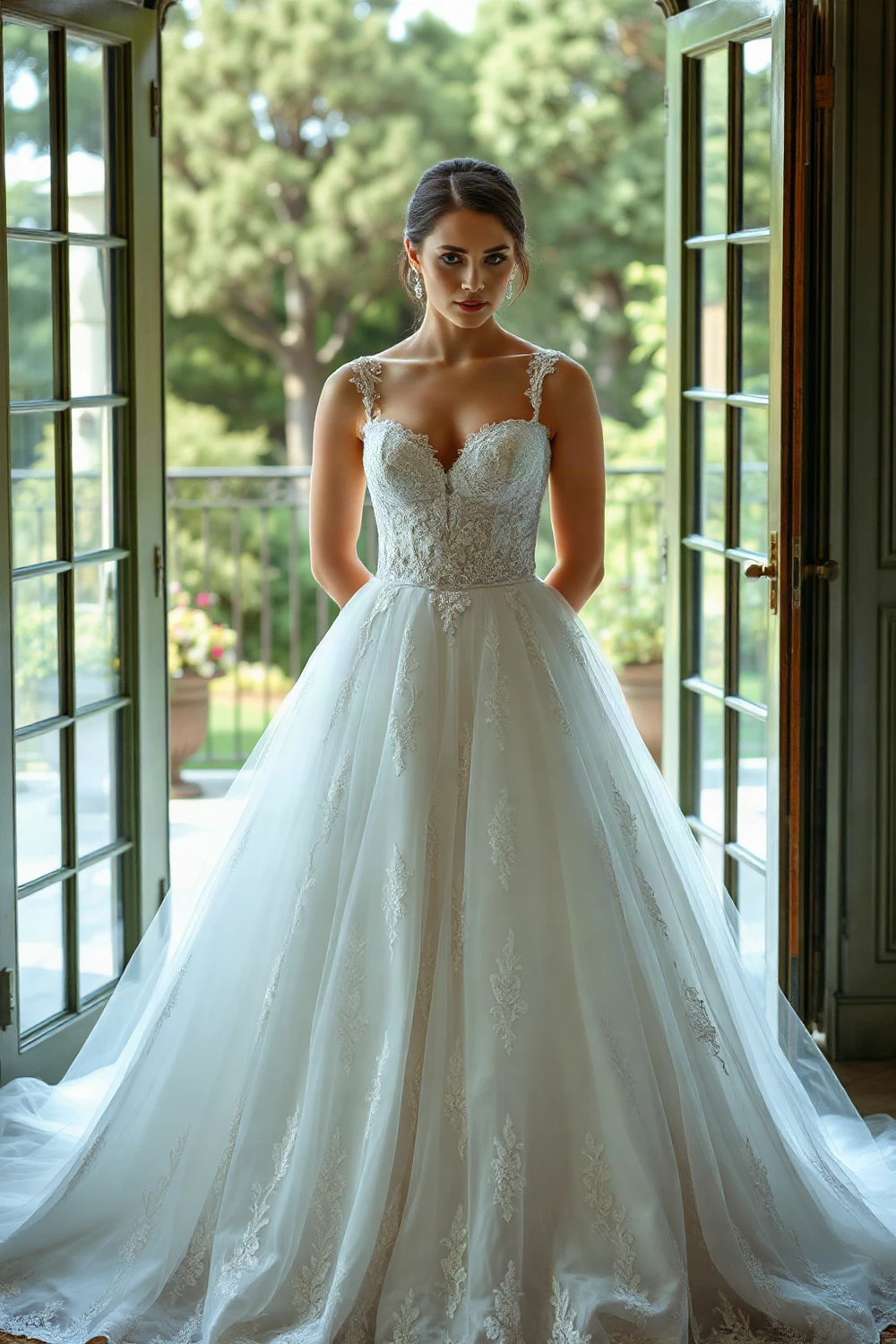
In the sixth image, narrow embellished straps connect a dense fitted bodice to a layered skirt with sparse vertical motifs. Rather than making a single horizontal hem boundary, decoration descends to different lengths below the waist. It draws the eye downward and creates continuous rhythm across the broad skirt. Dark door frames and green foliage separate the pale outline, clarifying both width and vertical pattern.
Narrow straps preserve an open shoulder area but interrupt it more than a strapless neckline. They visibly connect to the bodice and may affect how secure it feels. Check that they stay flat while sitting, reaching and lifting the arms. View a long patterned veil over the descending motifs from behind; overlap may enrich the flow or make it too busy. If the route crosses a threshold or garden path, practise gathering the skirt and managing rear volume while walking rather than judging a static pose.
Together, these concepts show that the romance of lace ball-gown wedding dresses depends on more than decoration quantity. Strapless, off-the-shoulder and strapped bodices shift focus again when combined with bordered, plain or vertically embellished skirts. Compare neckline security and shoulder movement first, then the waist transition, rear view and floor area the skirt requires. Direct front, side and back photographs in different lighting can reveal what a mirror or dramatic doorway conceals. Add veil and jewelry only after resolving the underlying silhouette, making it easier to see whether detail supports or competes with the design. The strongest option should keep its line while walking, sitting, turning and moving between spaces, not only in one portrait. Use these images as prompts, then base any choice on an actual fitting, accurate measurements and ease of movement.
Six visual concepts set in elegant mansion interiors compare strapless, off-the-shoulder and illusion-strap bodices with bordered, plain and vertically embellished ball-gown skirts.
Frequently asked questions
How can I choose between a strapless and an off-the-shoulder ball gown?
Test both while sitting, reaching, hugging and raising your arms. A strapless bodice should remain secure and level, while off-the-shoulder bands should keep their placement without restricting normal movement.
What skirt works with a highly detailed lace-look bodice?
A plain skirt keeps attention on the neckline and waist. For a more continuous effect, choose sparse motifs extending below the waist; a strong hem border instead creates a distinct frame in full-length views.
How does a full ball-gown skirt affect venue planning?
Consider doorways, table spacing, stairs and the full walking route. Observe how much space the skirt uses while turning and moving, not only when it has been arranged for a stationary portrait.
What veil suits a wedding dress with prominent lace-like decoration?
A restrained veil can leave a detailed bodice and skirt visible. A patterned veil may work with a quieter skirt, but compare the complete rear view to avoid concentrating too many motifs in one area.
Why can an ivory gown look different inside a mansion room?
Warm lamps, window light, backlighting and reflections from dark furniture can all alter the perceived tone and surface detail. Compare direct, side-lit and backlit views before drawing conclusions from one image.