
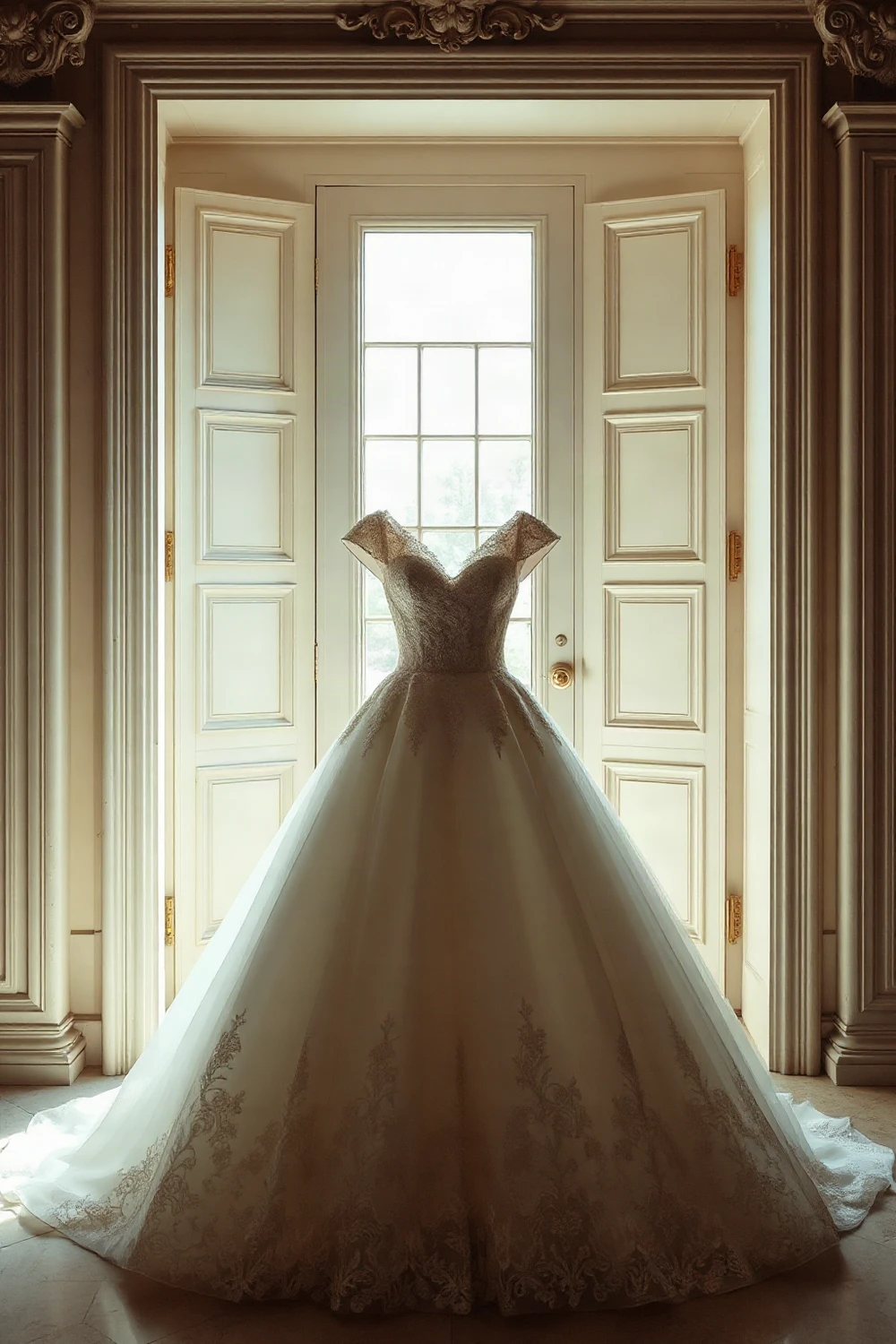
In the fourth composition, the pale gown is displayed without a person and centered precisely in a tall glazed doorway. Short shoulder elements angle outward around a V-shaped neckline, and the bodice has a densely textured, lace-like appearance. From a narrow waist, the skirt expands evenly to both sides in a strong ball-gown shape. Sparse motifs descend below the waist and become more visible near the broad hem. Light doors and panels create a bright inner frame, while a dark carved architectural surround forms a second, heavier border. The intense window light reveals the outer contour more clearly than the smaller surface details.
A backlit view like this is valuable for judging scale and proportion: shoulder width, waist height and the skirt’s floor-level spread are immediately legible. It is less reliable for assessing subtle ivory tones, motif edges or differences between layered surfaces, so it should be paired with a front-lit close view. The relationship between the skirt and the doorway is also a practical reminder. For a venue with narrow passages, tables or stairs, test how the skirt gathers and moves rather than considering its stationary circumference alone. A walking and turning rehearsal will show whether the desired symmetry can be maintained in motion.