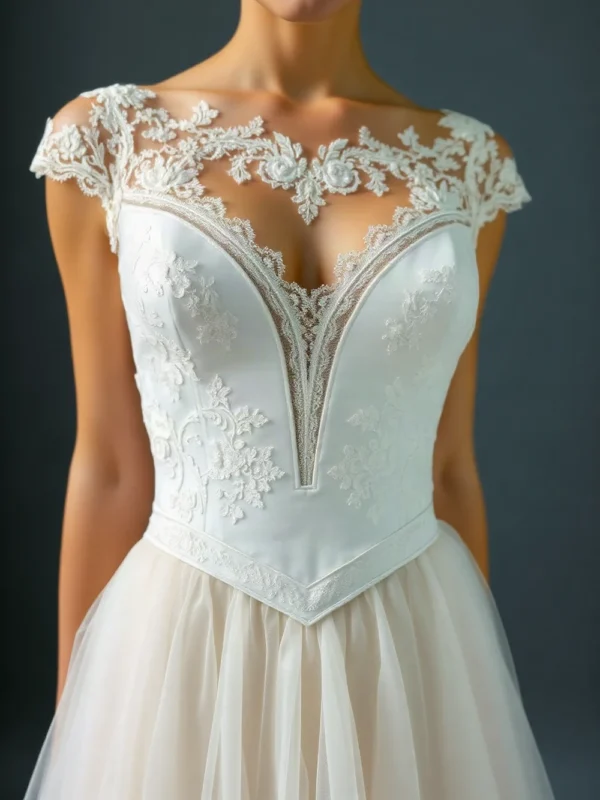
A romantic wedding dress is not defined by flowers, volume, or a soft palette alone. Its effect often comes from the relationship between a focal detail and the silhouette supporting it. These six concepts center attention on diagonal one-shoulder draping, a light-catching waist, raised flowers across a skirt, dark green ribbons, a high opening revealed in motion, and a collar framing the face.
Read the images as comparison tools rather than finished designs to copy. A detail that succeeds in a close crop may balance differently while walking, and a wide skirt must still work with waist placement, arm movement, and accessory scale. Each section considers what leads the eye, how cut and surface support it, and which fitting questions help translate inspiration into a personal choice.
Creating a Long, Fluid Line with Asymmetric Draping
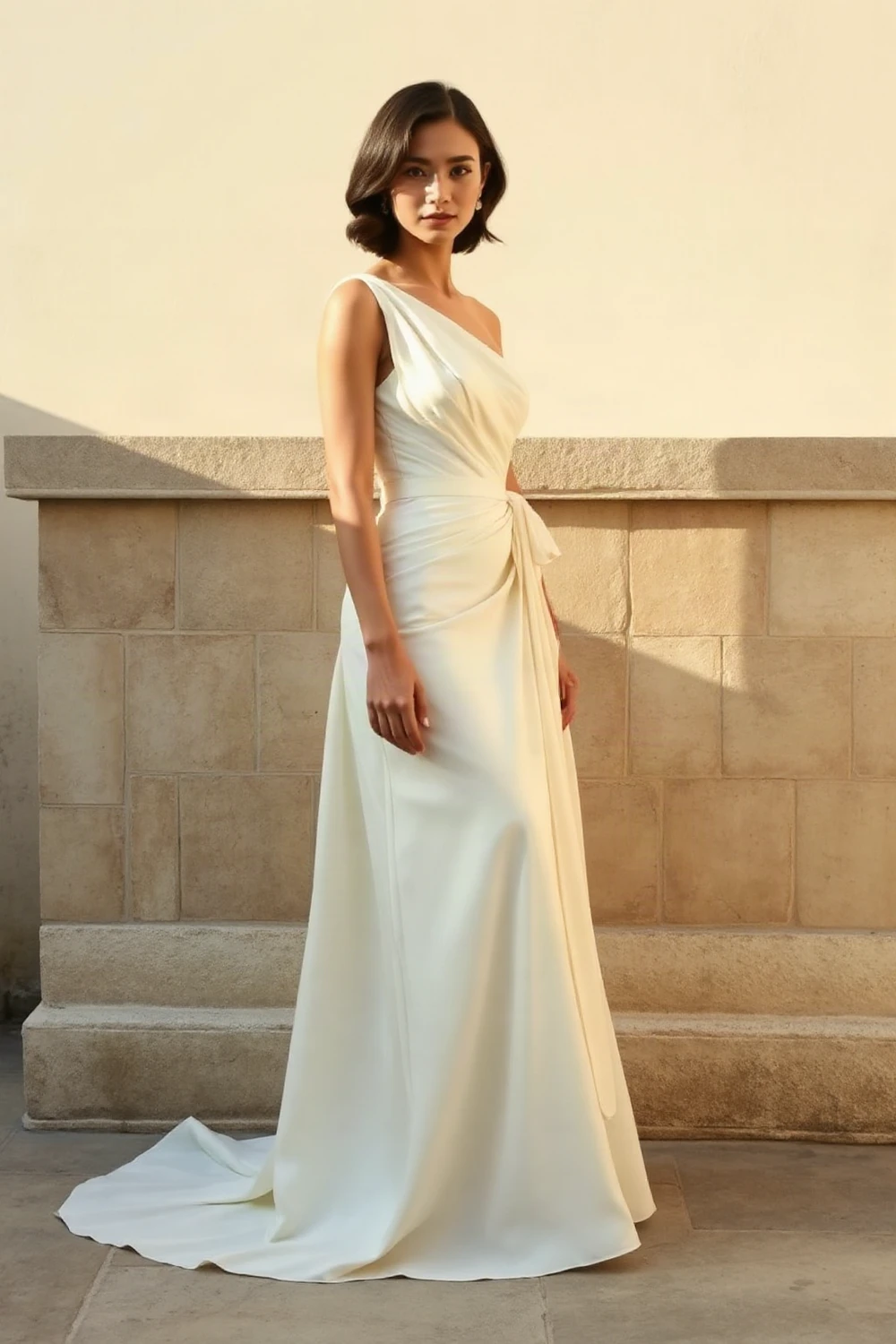
The one-shoulder look draws its impact from fabric direction rather than applied ornament. Its neckline descends from one shoulder, while folds cross the torso and gather at the opposite waist. This diagonal route guides the eye downward, making the close-fitting skirt read as one long line. A compact train extends the flow without adding visual weight.
Because the asymmetry is already strong, a large necklace or equal volume at both shoulders could blur the neckline. Check whether hair hides the open side and whether the gathering shifts when seated. Compared with a full ball gown, the narrower outline needs less room and changes direction more easily. It suits someone seeking a quiet entrance, clean photographs, and a focal point created through construction.
Defining the Transition into a Full Ball-Gown Skirt
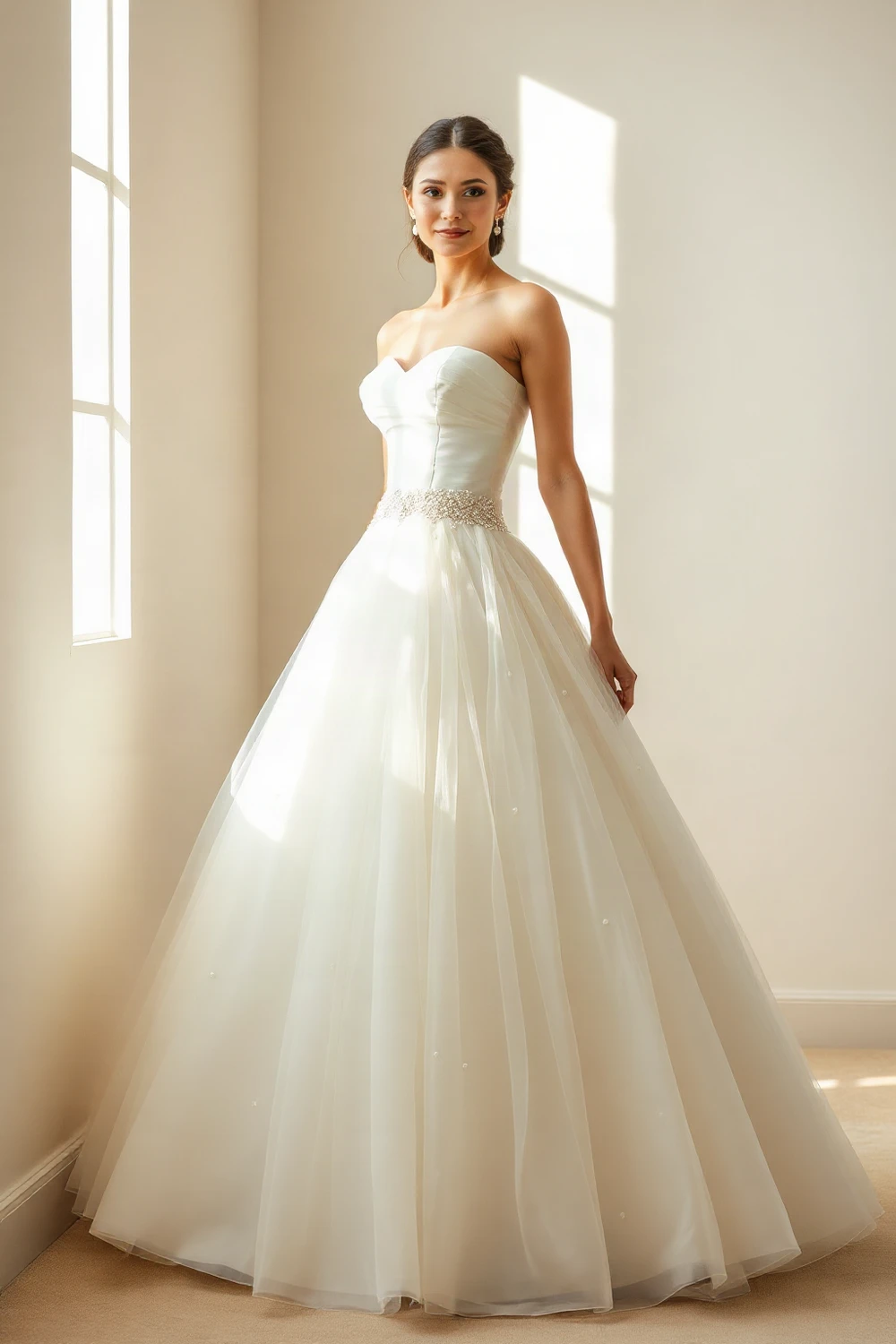
The strapless ball-gown concept makes the change from fitted bodice to expansive skirt explicit. A broad, bright-looking waist treatment creates a horizontal boundary, while shallow bodice folds soften the transition into long layered panels. Though the skirt spreads widely, its vertical lines still draw the eye downward and keep the volume from appearing entirely static.
If the waist is the main accent, smaller reflective accessories will preserve its role. Evaluate the skirt beyond a front-facing mirror: consider narrow doorways, chair spacing, and how the layers follow a turn. Raise both arms to test the strapless bodice, then sit to see whether the waist treatment bends or shifts. This direction favors a clear waist and strong spatial presence over the easier movement of a narrower A-line.
Concentrating Dimensional Flowers on the Skirt
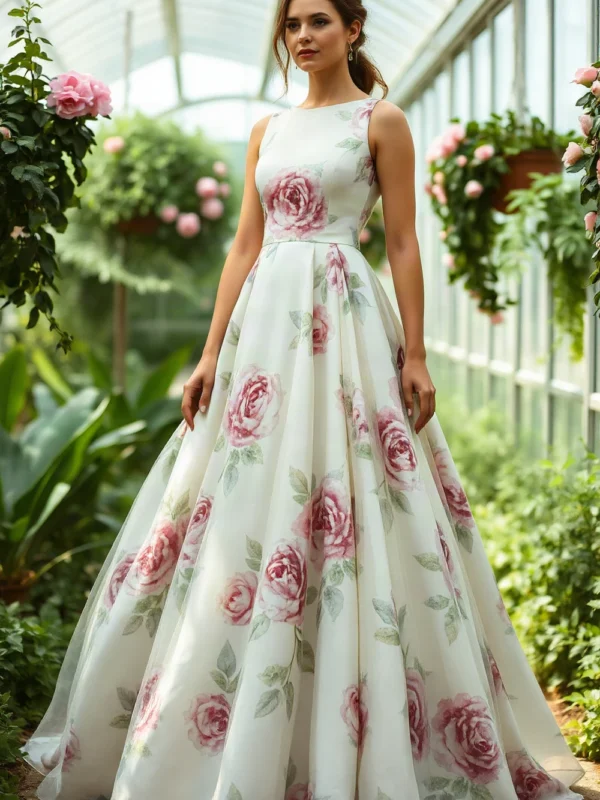
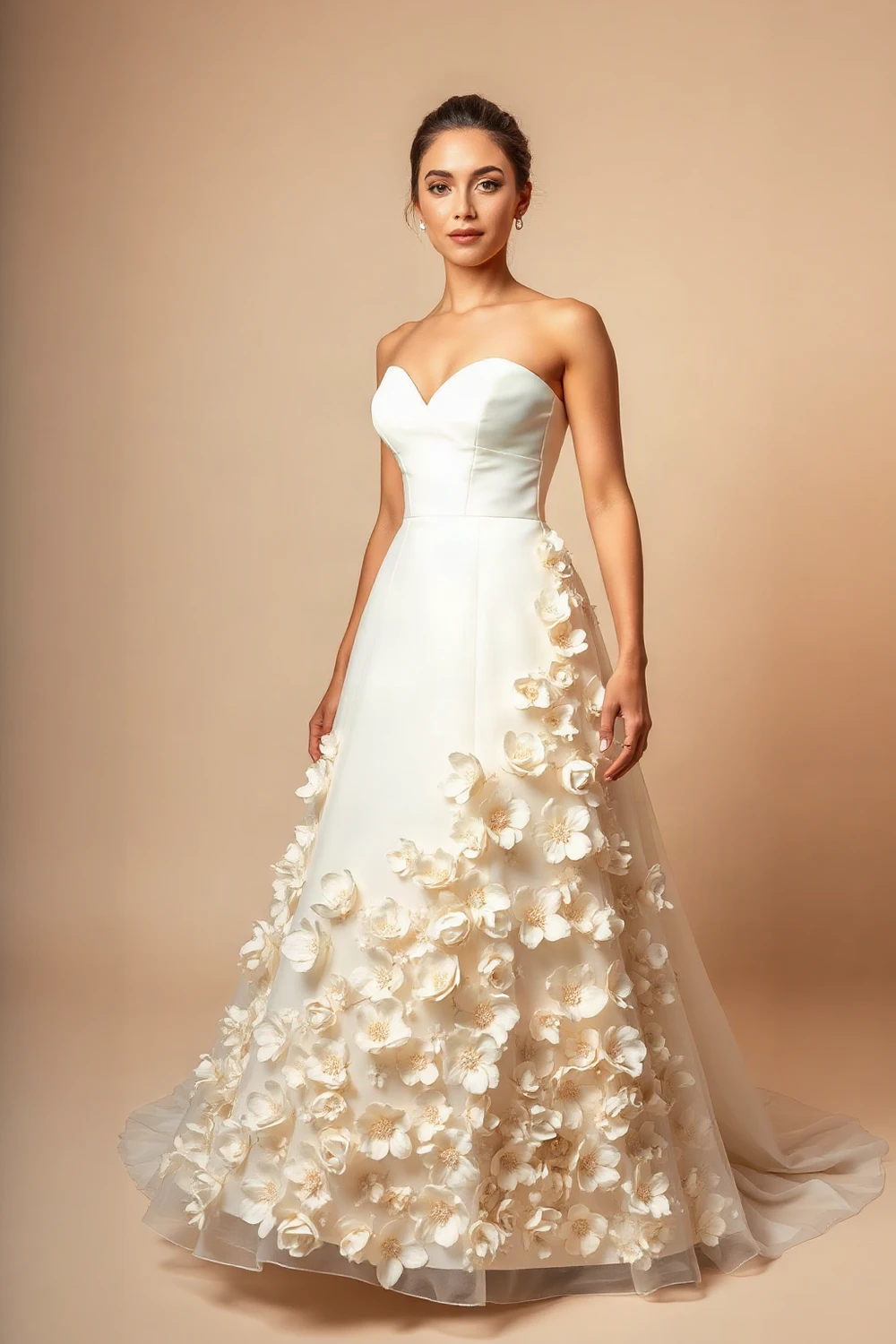
The third look uses flowers selectively instead of covering the dress. A clean strapless bodice and broad undecorated area make the raised blossoms legible as they travel from one hip toward the lower skirt. Their asymmetric placement emphasizes one side without disturbing the A-line’s basic balance, while shadows between petals give the pale surface depth without color.
This texture reads differently in portraits and full-length photographs. A large bouquet held at the same height could hide the arrangement’s beginning, and an ornate veil could add a competing pattern. At a fitting, observe the flowers while walking and seated, including their contact with surrounding surfaces. A restrained hairstyle and simple jewelry keep the skirt central. The look suits someone who wants tactile-looking romance with a visually clean upper body.
Framing a Pale Silhouette with Dark Green Ribbon
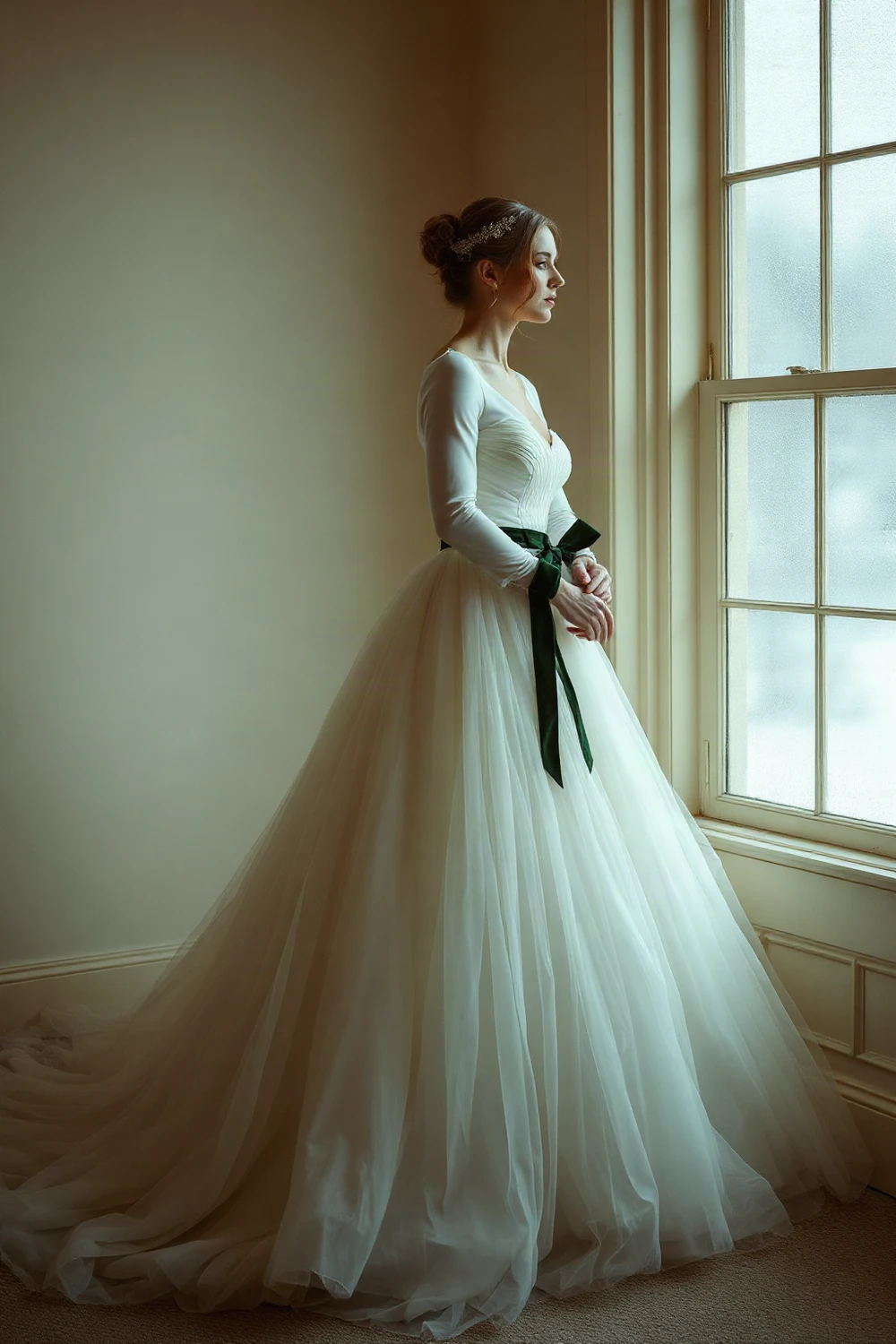
In the long-sleeved look, romance comes from an airy skirt contrasted with dark green ties. A wide sash marks the center, while its large side bow moves emphasis slightly off center. Repeating green at the cuffs creates rhythm across the upper body and makes the waist piece feel integrated. Beneath this sharper frame, the pale layered skirt stays broad and soft.
The accent need not recur in every accessory. One small hair detail or controlled bouquet link may be enough; extensive matching could weaken the sash. Check whether the long ends become trapped when seated or interfere with flowers held at the waist. All-white would maintain uninterrupted softness, while green offers personal contrast visible across a room. This balances a traditional full outline with a less expected color choice.
Making Movement the Statement with a High Slit
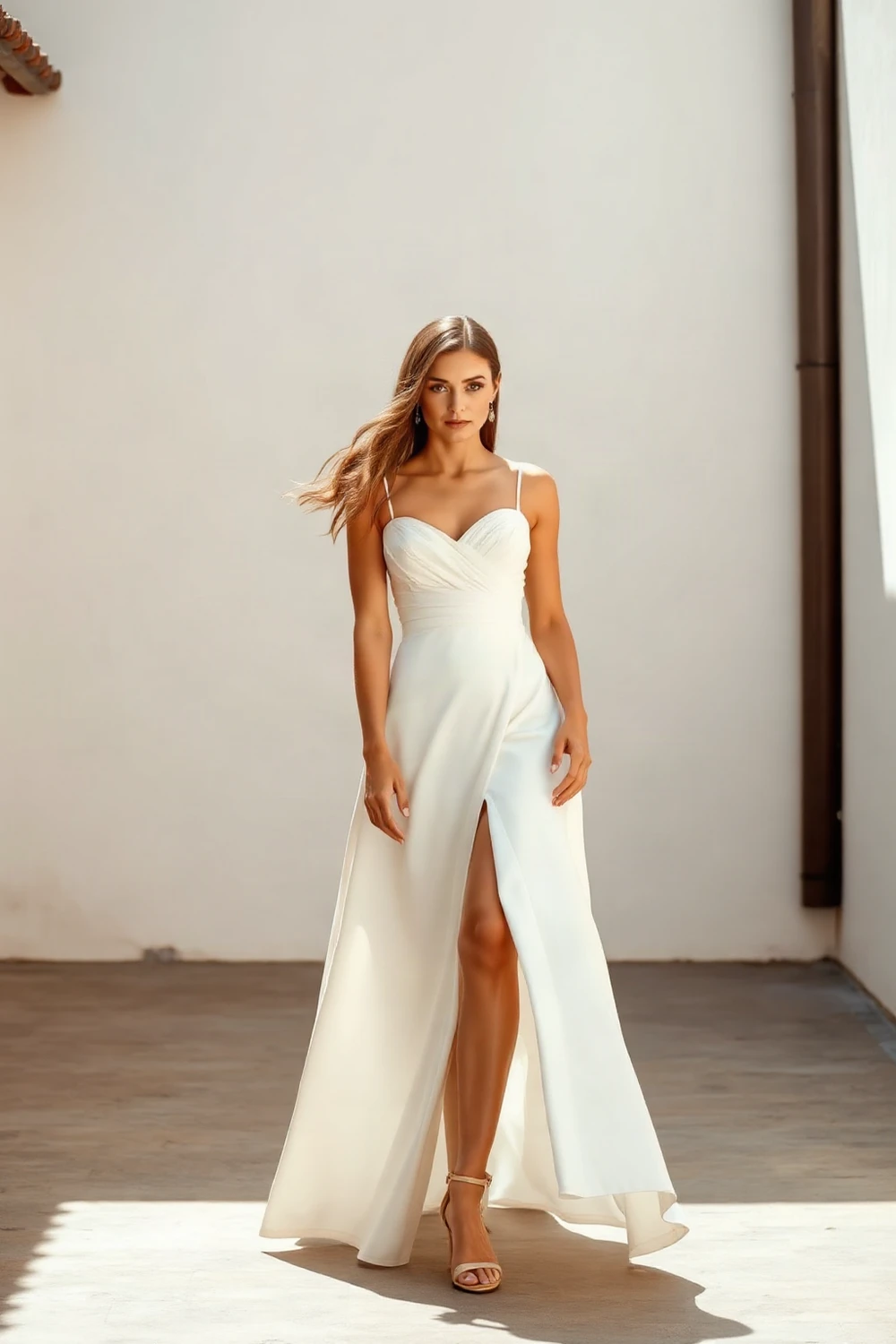
The spaghetti-strap look depends on a feature most visible in motion. Wrapped folds shape the bodice before meeting long, smooth skirt panels. During a step, the front opening separates and temporarily divides a silhouette that seems calm and nearly column-like at rest. The visible shoe becomes a small but meaningful element, especially in front-facing walking photographs.
Choosing a high opening involves more than preferred exposure. Test the panels during long strides, stair climbing, sitting, and moving air. In the same active fitting, check slim-strap support and the stability of the wrapped neckline. Clean accessories preserve the movement line, whereas a large necklace could distract from it. For someone who prefers lightness to sweeping volume, the concept shows how a minimal surface can carry a decisive focal idea.
Framing the Face with a High Collar
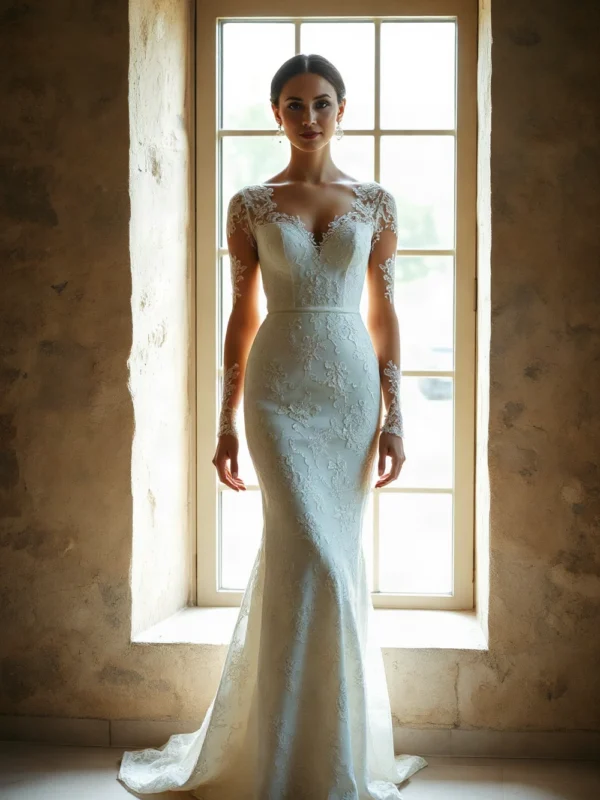
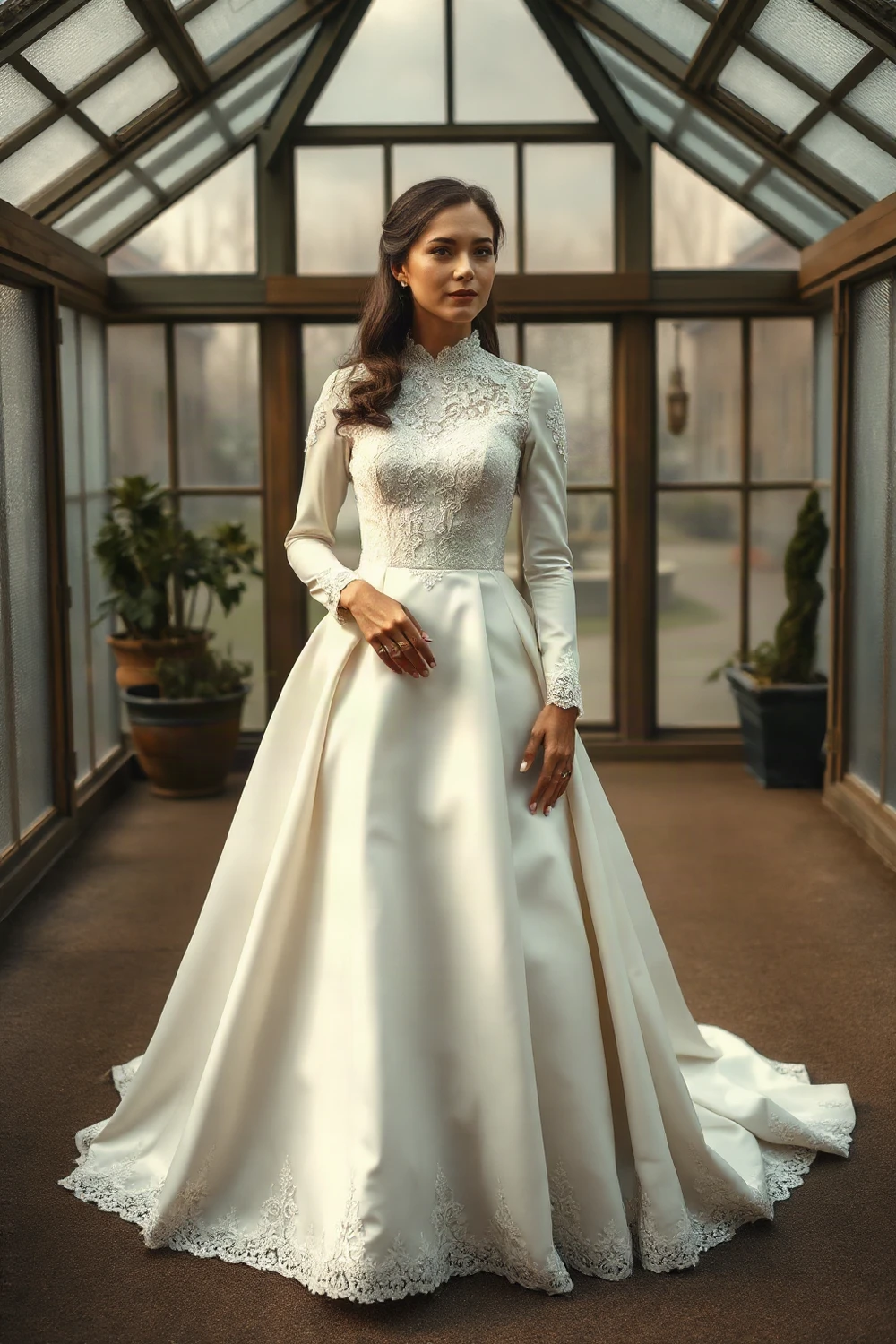
In the high-neck look, attention moves first to the face, then through the lace-patterned upper body. Long sleeves continue the covered line, while the broad, smooth skirt gives dense ornament a calm foundation. A decorative hem border repeats the upper detail in a controlled way, preventing a top-heavy effect. The symmetrical glass setting strengthens the silhouette’s vertical, ceremonial character.
Because a high collar reduces the need for a necklace, judge earrings, hair placement, and the collar edge together. An updo reveals the full shape; loose hair softens the transition but may hide some pattern. During a fitting, turn the head, raise the arms, and sit for several minutes to assess comfort beyond a still pose. Unlike the open neckline and slit, this romantic direction relies on coverage, framing, and measured ornament around an expansive skirt.
Together, these looks show that romantic impact depends less on the number of details than on a clear focus. The one-shoulder line controls flow; the bright waist organizes volume; dimensional flowers create texture; dark ribbon adds color; the slit reveals movement; and the high collar frames the face. Balance comes when accessories, hairstyle, skirt proportion, and setting reinforce the main idea rather than compete with it.
Review each option close to the mirror, from across the room, and in motion. Sit, walk, turn, and raise your arms as you would during the event. A feature that remains comfortable and stable through those actions is more likely to stay convincing throughout the day. The goal is not maximum decoration, but one meaningful statement carried by a coherent silhouette.
From one-shoulder draping and dimensional flowers to dark green ribbons, a high slit and a lace-framed collar, these six looks show how one focal detail can shape a romantic bridal silhouette.
Frequently asked questions
How should I choose the main statement detail on a romantic wedding dress?
Decide which area should remain readable from a distance: neckline, waist, skirt texture, color or movement. Keep surrounding accessories quieter, then compare the complete look both close up and in full-length photographs.
Does a one-shoulder wedding dress need a necklace?
Not necessarily. The asymmetric neckline already creates a strong path across the upper body. Small earrings and a hairstyle that does not conceal the open shoulder often preserve that line more clearly.
How can I test whether a full ball-gown skirt is practical?
Walk through a narrow space, sit in a chair, make several turns and rehearse a stair step without lifting the skirt excessively. Watch the layers around the feet and check whether the waist treatment bends while seated.
Must a dark ribbon color be repeated in other accessories?
No. A restrained connection in one hair detail or bouquet tie may be sufficient. Repeating the color in every accessory can turn a clear waist accent into a crowded theme.
How do I choose between a high slit and a high collar?
A slit emphasizes steps, shoes and openness; a high collar frames the face and provides more coverage. Test sitting, walking, stair movement, arm reach and head turning to learn which feature works comfortably.