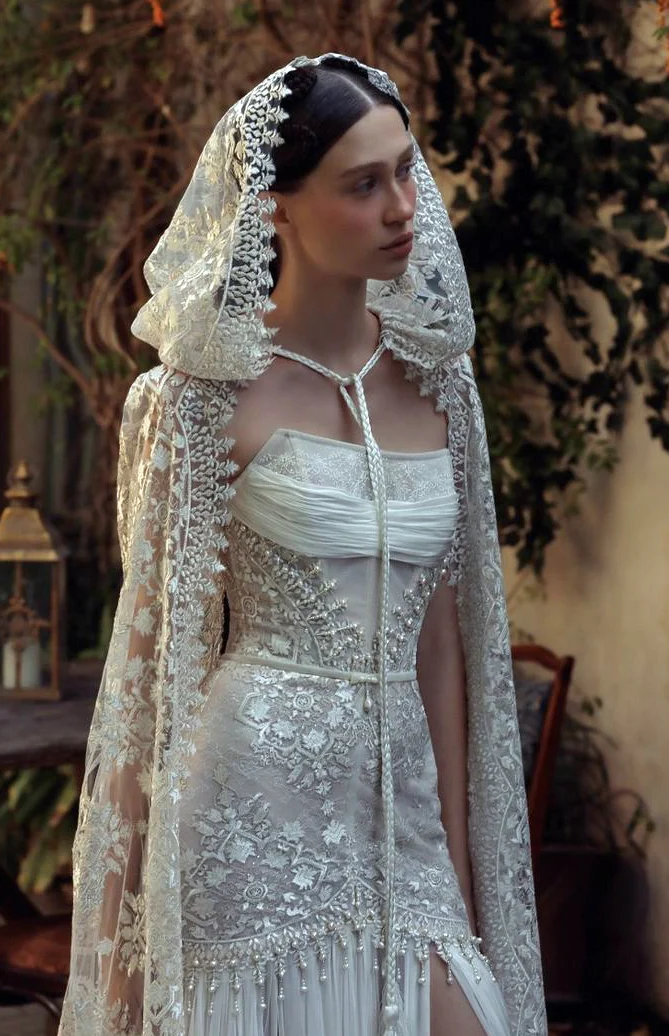
A floral hood edge forms a broad, densely drawn boundary beside the face here. The pattern continues across the shoulders, above a closely shaped decorated bodice, a softly folded upper band and a defined waist. Slender cords meet at the front and continue into long hanging ends. A side opening can be seen farther down, although the complete hem is absent. The useful comparison concerns how the head frame appears connected to the bodice through that extended central line, rather than a confirmed view of the entire lower silhouette.
Assess this arrangement without an additional long necklace first. You can decide whether the hanging ends already establish the emphasis you want or whether another small accent still has room. Keep the actual upper dress edge visible during the fitting and check where the ends rest when seated. The visible attachment area does not establish a particular fastening or removal technique. Ask separately about the cords’ function: a decorative line and an element controlling position need not perform the same task. Both should be explained on the real garment before the visible arrangement becomes your practical dressing plan.