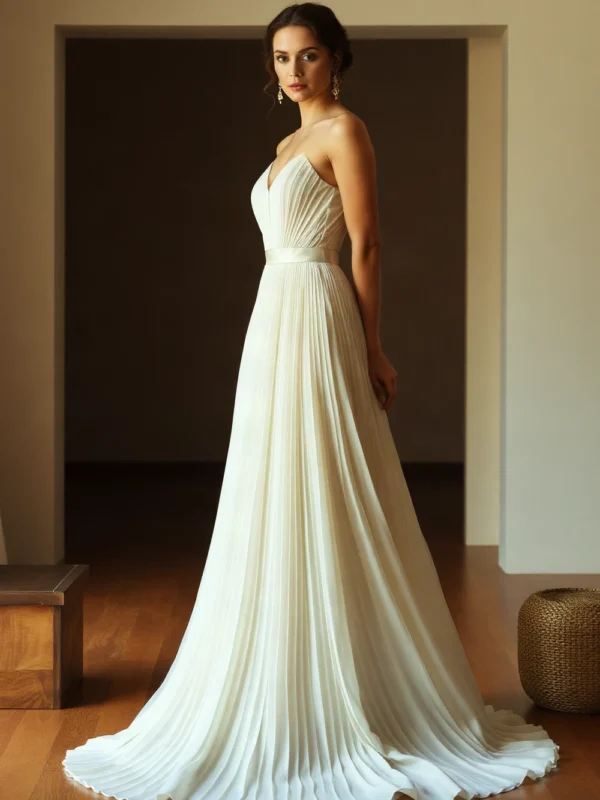
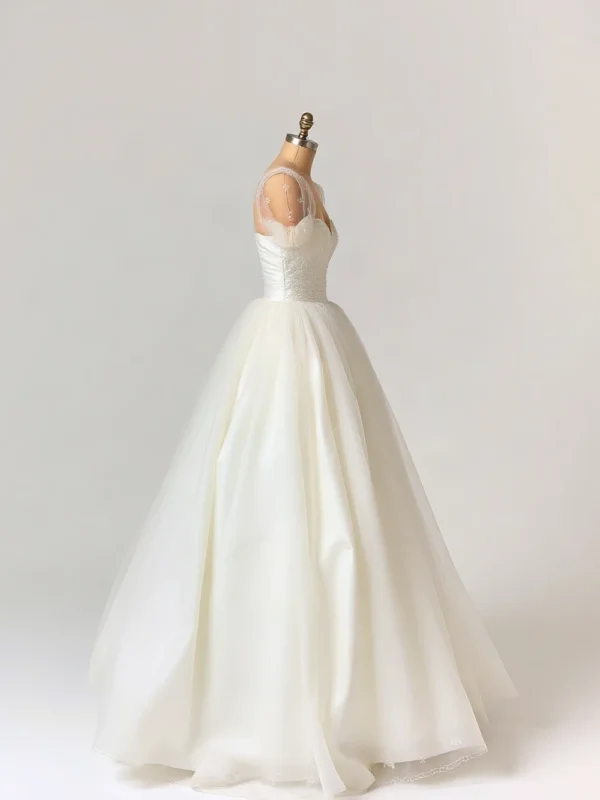
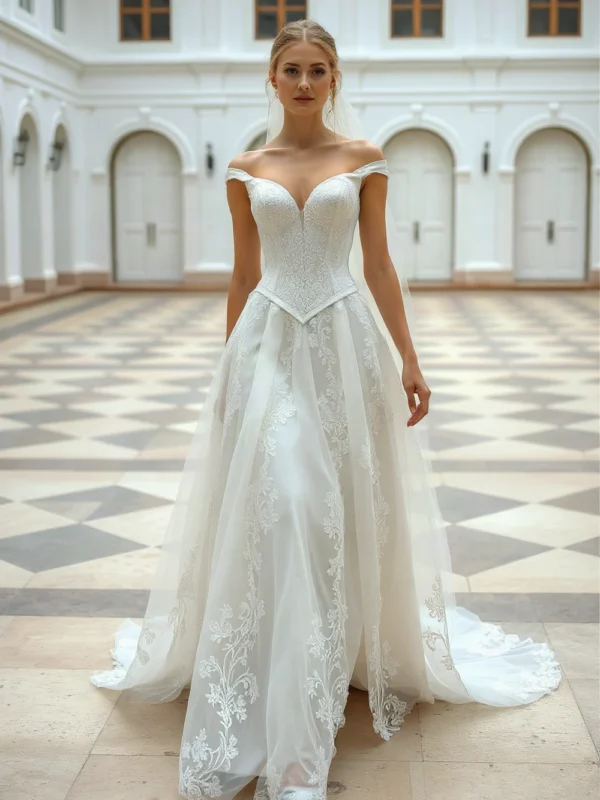
Choosing among floral wedding dress styles involves more than selecting a flower or color. Motif scale, decorative concentration and the relationship to a gown’s main lines all shape the first impression. An oversized bloom can make a corset sculptural, while a slender branch adds a botanical note without interrupting a clean skirt’s length. Flowers at the waist clarify proportions; a narrow side trail guides the eye fluidly.
These six concepts compare those effects across a strapless A-line, a close-fitting halter, a blush full skirt, a minimalist square neckline and two distinct floral bodices. Rather than ranking them, consider motif density, color contrast, accessory placement and visibility in motion. Compare the whole silhouette before focusing on details.
Using Dense Warm-Toned Motifs to Center the Waist
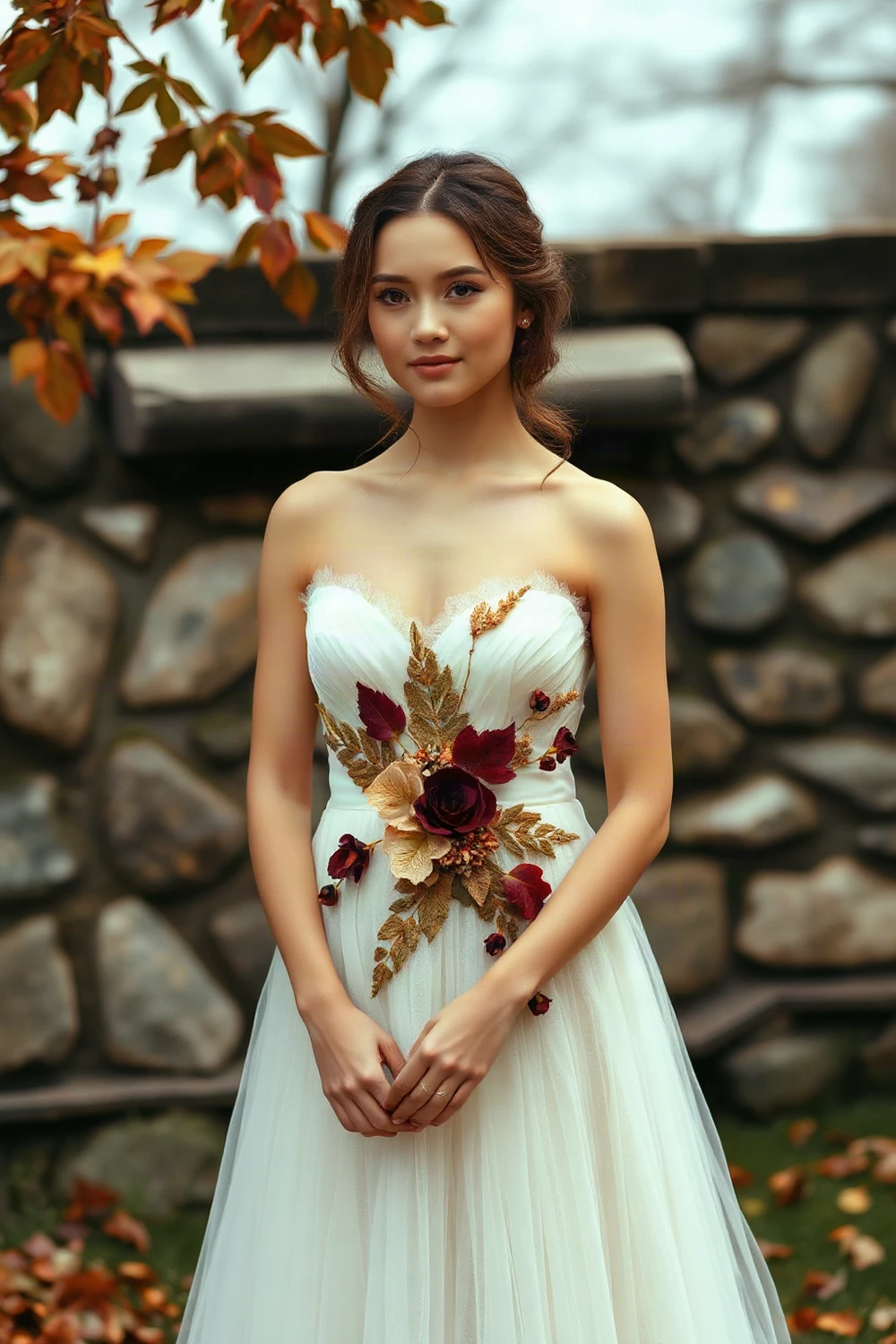
Burgundy flowers with golden and brown foliage gather at the middle of the strapless bodice. The arrangement narrows downward, centering the waist while the pale A-line skirt preserves generous visual space. Autumn leaves in the setting reinforce the palette, but the impact comes chiefly from dark-light contrast and concentrated forms around the torso.
At this scale, color bridges the face and waist. A quiet bouquet, open neckline and lightly detailed veil support that hierarchy; repeating every warm shade across the accessories could dilute it. Because the decoration appears raised and overlapping, test it beyond a still frontal view: lower the arms, hold a bouquet and sit. This shows whether projected edges remain comfortable and avoid the natural position of hands and arms.
Lengthening a Close Silhouette with a Vertical Floral Trail
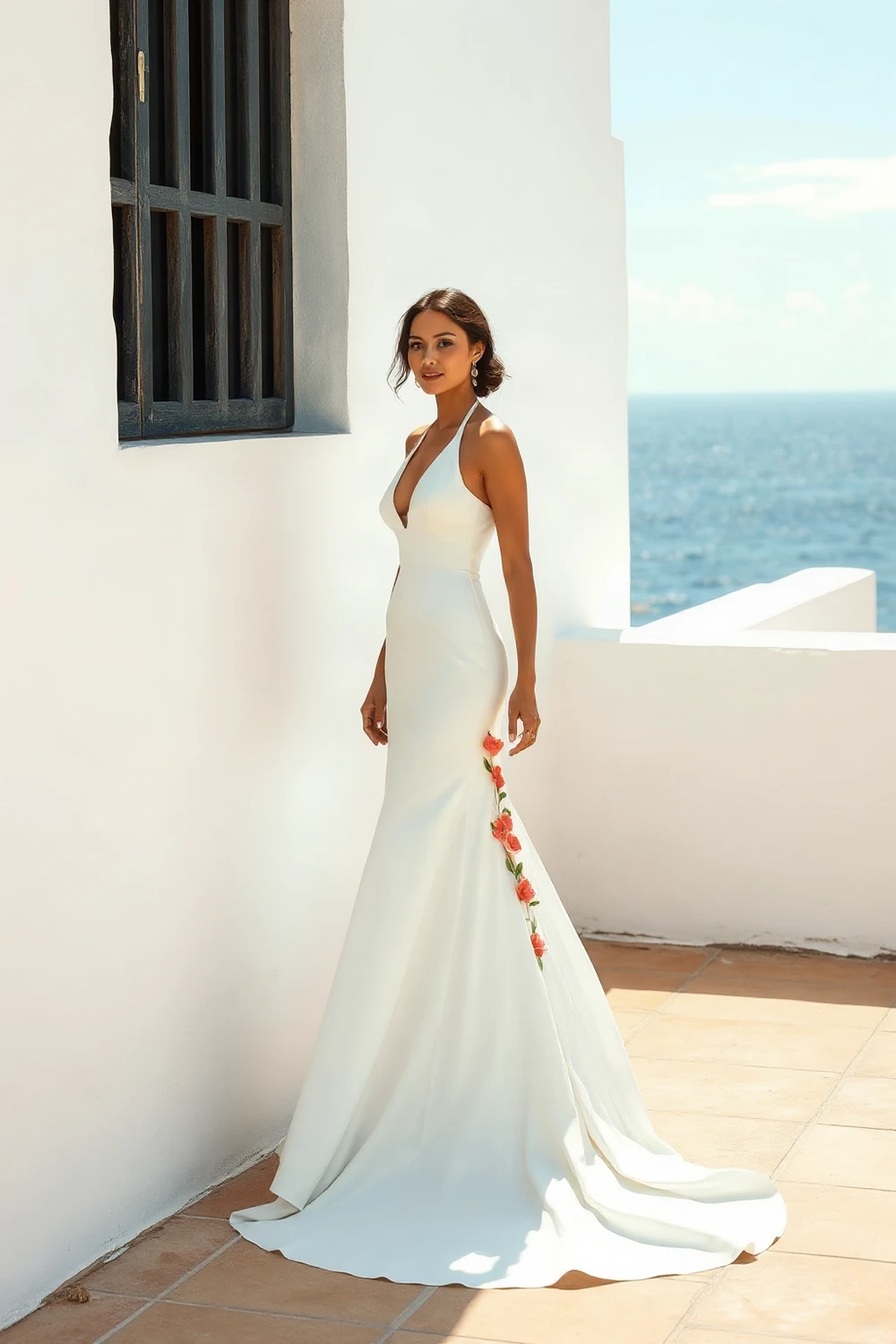
Small coral flowers and green leaves travel down one side of the otherwise plain, close white silhouette beneath a plunging halter neckline. Unlike the horizontal division of a floral belt, this sparse asymmetrical trail directs the eye diagonally and vertically, preserving the gown’s long, uninterrupted character while adding one exact line of color.
Placement changes with posture and viewpoint: a narrow frontal accent may become more prominent during a turn or as the lower skirt moves. At the fitting, take a short walk and assess front, side and rear views instead of one pose. A small coral echo in the bouquet or hair can create continuity, but a large arrangement in identical colors may conceal the finer trail. The accent should guide the silhouette rather than become a competing block of color.
Softening a Centered Floral Cluster with a Blush Ground
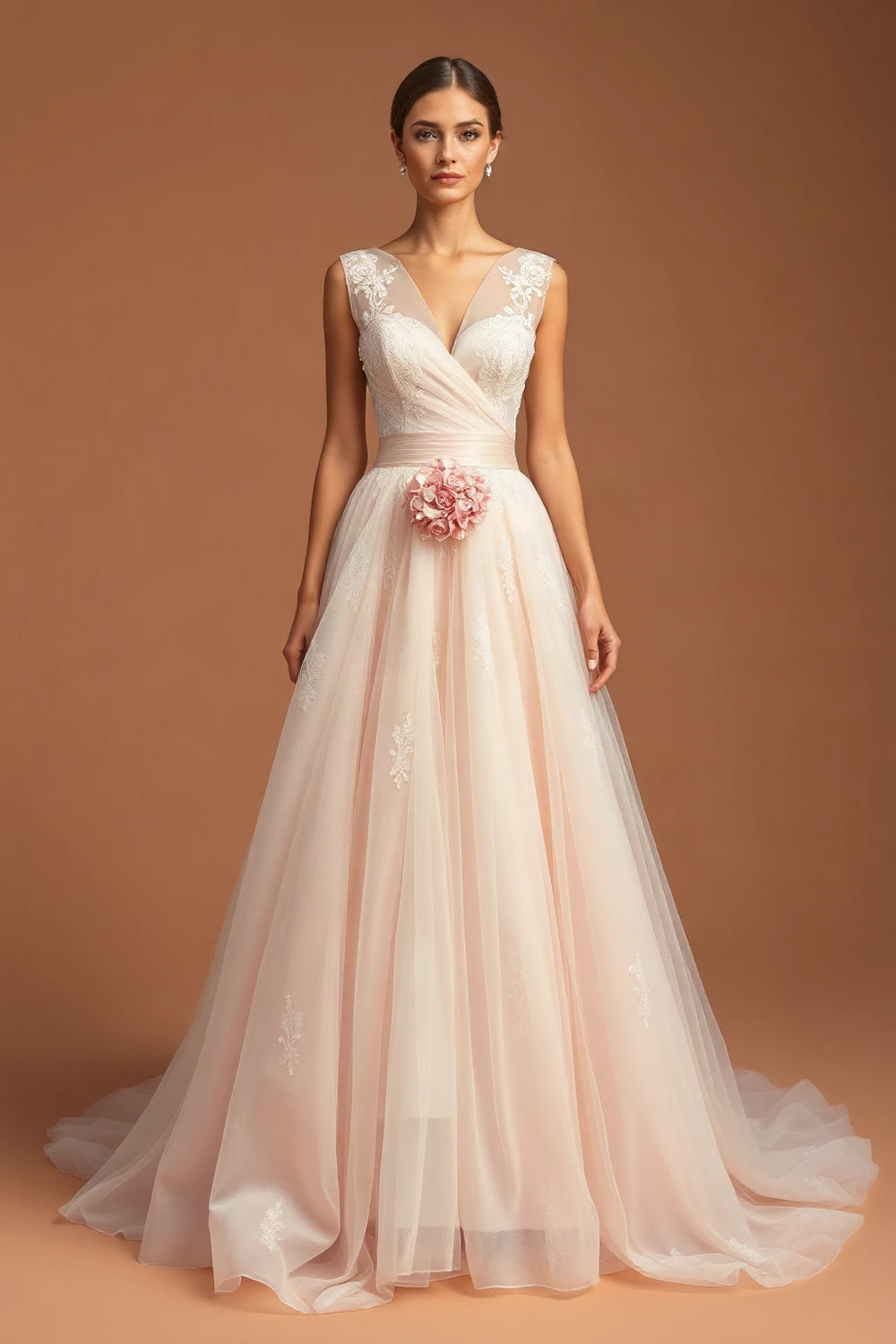
White patterns around the illusion-like V neckline and diagonal bodice draping lead to dimensional pink flowers at the center waist. Sparse pale motifs repeat the botanical idea across the blush full skirt, but low contrast keeps the surface from feeling crowded. This A-line composition is visibly floral and colored without becoming sharp or graphic.
The cluster defines the waist and separates bodice from skirt without a belt, although its precise height matters: slightly above or below the natural waist can alter proportions, especially from the side. Because the diagonal drape already supplies movement, a detailed necklace may add too much. Small earrings or a clean hairstyle keep the transition clear. Also test bouquet size and carrying height so the pink focal point stays visible rather than disappearing behind flowers held at the torso.
Letting One Botanical Branch Define a Minimal Dress
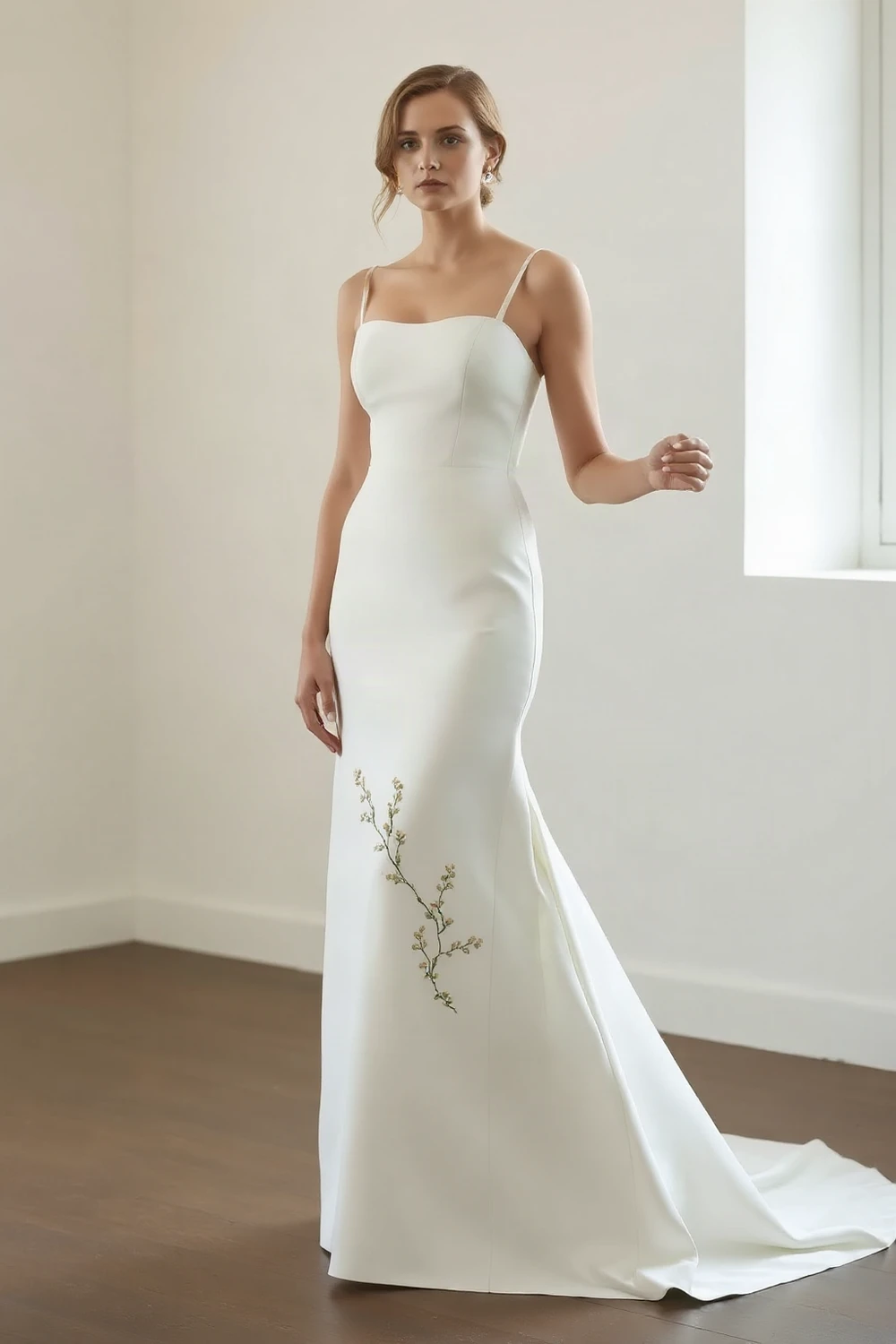
Narrow straps, a square neckline and a fitted upper section are almost undecorated. Below, the skirt opens into a restrained flare, and a fine budding branch rises diagonally from one side of its lower portion. Against the broad white field, this single motif becomes a quiet botanical signature, while long seams reinforce the minimal silhouette’s vertical direction.
Minimal treatment makes exact placement more exposed. A long veil may cover the branch, and a large bouquet can obstruct it from the front. The open neckline, however, accommodates expressive earrings, a hair accessory or a shorter veil without crowding the dress. During a fitting, rotate the skirt, walk and observe from several distances. These checks show how the branch behaves as fabric moves and which photographic angles preserve its asymmetry most clearly.
Framing the Sweetheart Neckline with Pink Roses
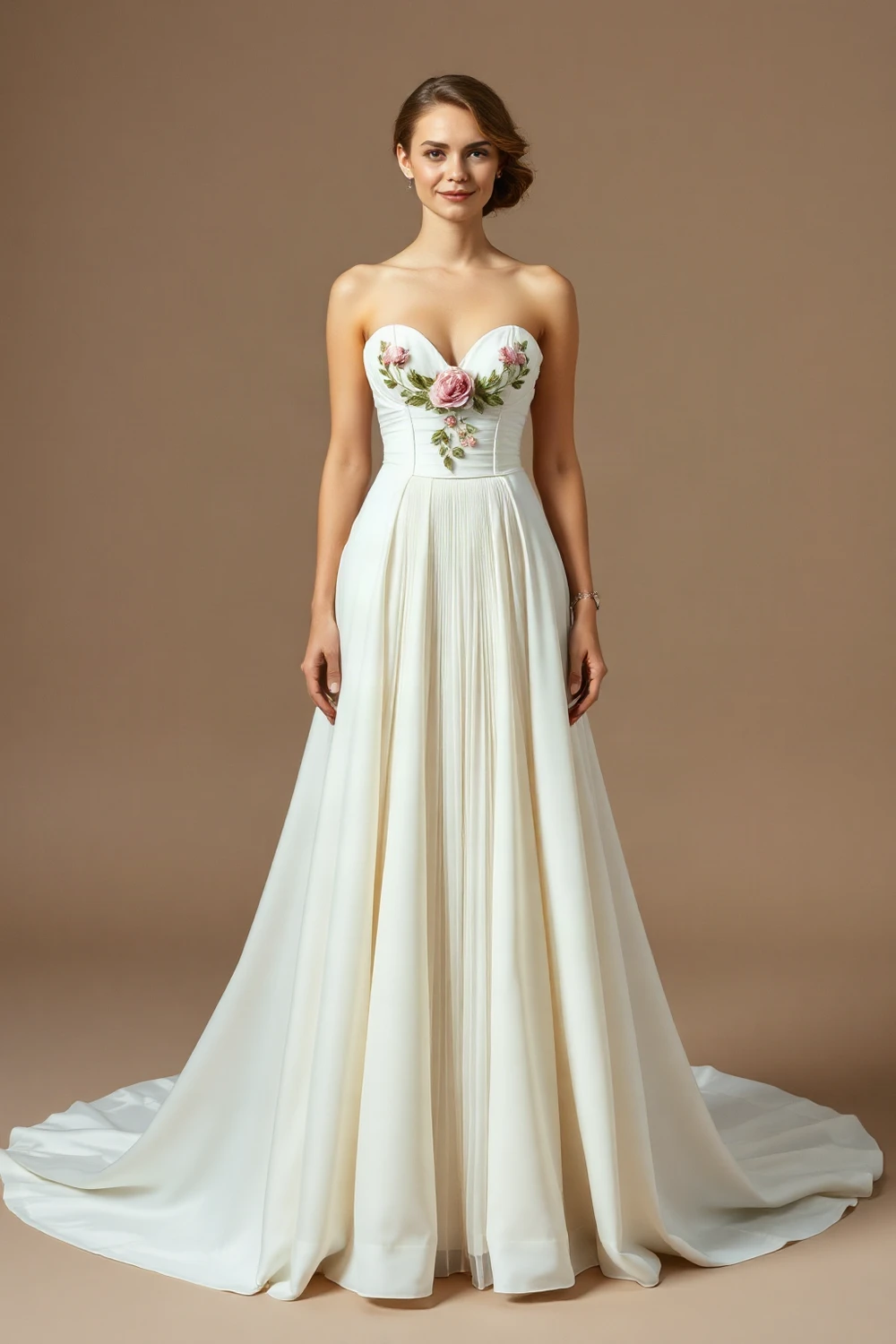
Pink roses and green leaves spread across both sides of the strapless sweetheart neckline. A larger central rose establishes symmetry, while smaller forms descend over the seamed bodice. As the pale skirt widens from the waist with little decoration, the floral upper section creates a clear focal point beneath the face: colorful and romantic without covering the entire dress.
These neckline flowers share visual space with jewelry, hair and bouquet. A necklace filling the open décolletage may compete with the rose frame; small earrings and a restrained swept style preserve breathing room. The bouquet may echo pink without duplicating every shade, leaf and flower size. Test raised elements along the upper edge with arms moving and resting naturally. Then step back from the appealing close detail to confirm that the broad skirt balances the decorated corset in the full-length view.
Creating a Sculptural Corset with Tone-on-Tone Blooms
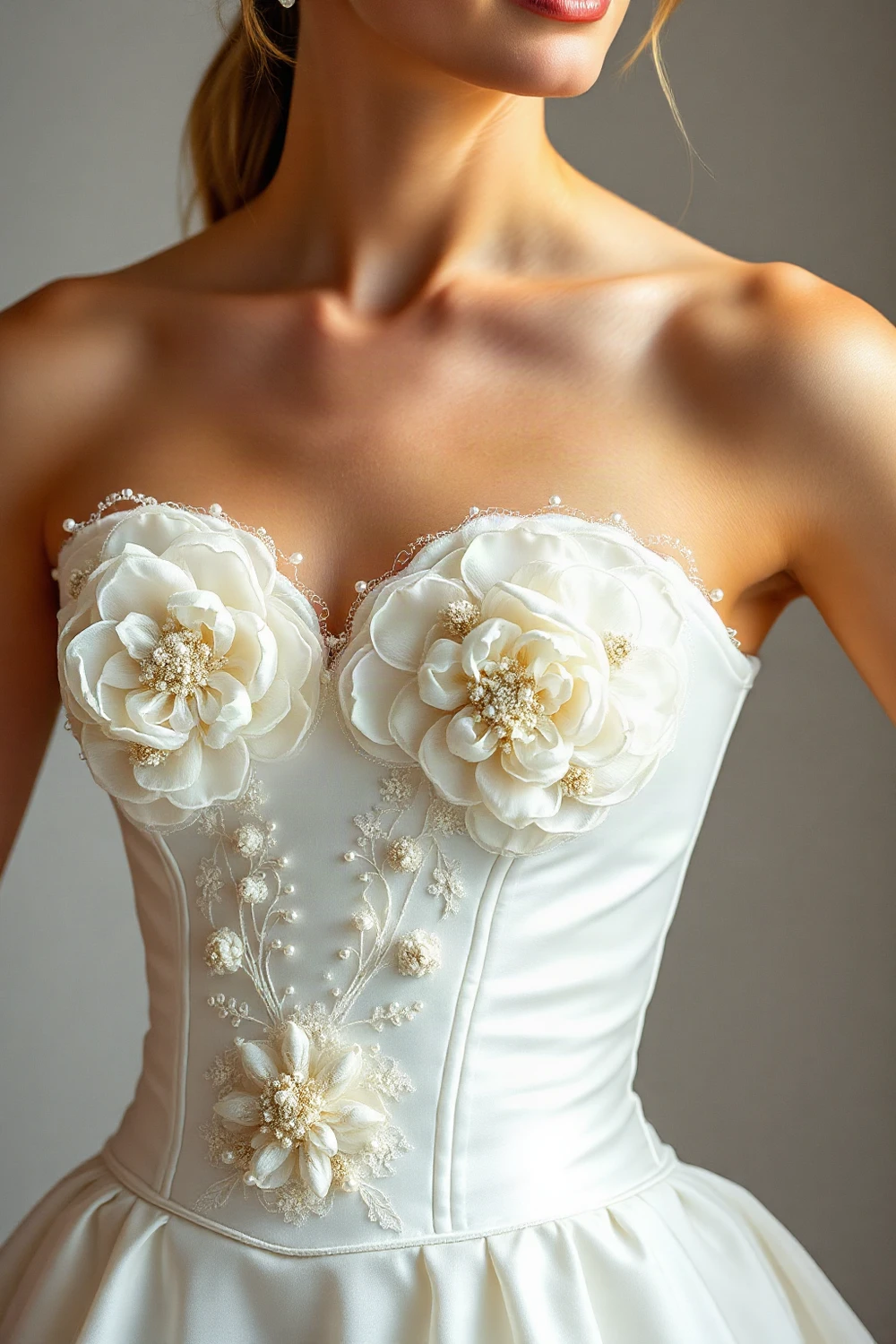
Oversized ivory blooms cover both curves of the strapless corset, making this the most pronounced use of floral scale. Pearl-like points and pale botanical embroidery extend down its center. Because decoration and ground differ little in color, the drama comes from layered petals, projected volume and cast shadows. Even beneath this dense surface treatment, curved corset seams remain readable in the close view.
Motifs this large often benefit from fewer accessories: a necklace-free neckline, simple earrings and a veil with limited edging keep the flower shapes clear. Practical interaction matters too. A bouquet raised to the chest may hide the lower embroidery, while projecting petals may touch the arms or another person during an embrace. After inspecting craftsmanship closely, step several paces from the mirror to decide whether floral volume and corset remain proportional to the skirt rather than looking visually separate.
The right floral motif is not necessarily the largest or most intricate; it depends on its role in the silhouette. Flowers may center the waist, extend the skirt’s visual length, frame the neckline or supply one botanical signature on a plain surface. Colored motifs gain definition through contrast, while tone-on-tone blooms depend more on volume and shadow.
Compare each option from the front and side and in motion. Test the bouquet at its likely height, note how the veil crosses the skirt and balance jewelry density against neckline decoration. Check where raised details make contact. These observations reveal whether the flowers work with the gown’s cut and proportions rather than reading as an unrelated layer.
The size and position of floral details can transform the entire wedding-dress silhouette. Compare six visual concepts focused on the bodice, waist and skirt, with practical guidance on color, accessories and movement.
Frequently asked questions
Where do large floral motifs look most balanced?
That depends on the main structure of the dress. A defined corset can support larger blooms, while one cluster at the waist can center the proportions. Keeping the skirt quiet gives substantial bodice motifs room to read.
How should a bouquet be chosen for a colorful floral dress?
It does not need to duplicate every color. A restrained bouquet can preserve the focal point when dress motifs are dense, while a small color echo can connect accessories to a sparse floral trail.
How can an asymmetrical skirt motif be assessed during a fitting?
View it while walking, turning and holding the bouquet, not only in a frontal pose. Check whether a long veil covers it and from which camera angles the asymmetry remains clear.
Do three-dimensional corset flowers affect jewelry choices?
Yes. Large blooms already create a strong neckline focus, so simple earrings or a clean hair accessory may work better than a necklace. Their projection and comfort should also be tested.
Does a floral waist cluster need an additional belt?
Often the cluster already acts as a visual belt. Before adding another element, inspect whether it defines the natural waist clearly enough from both the front and side.