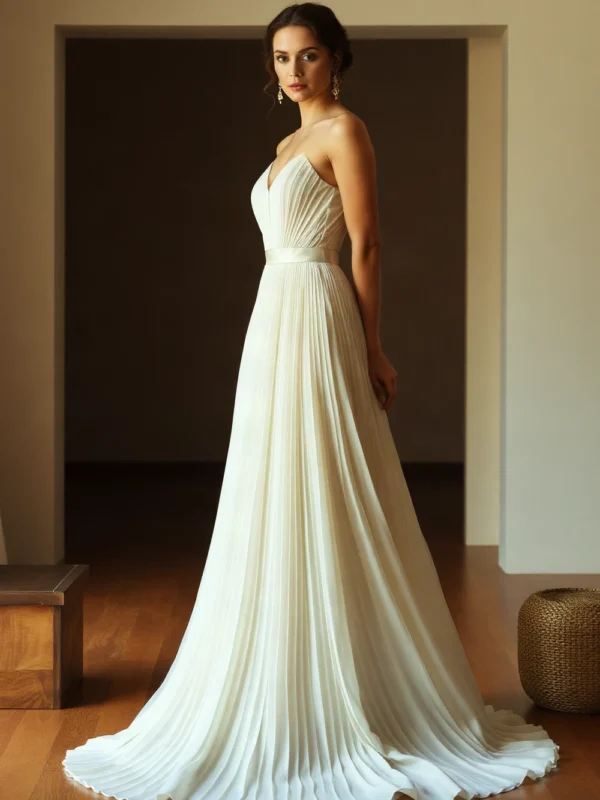
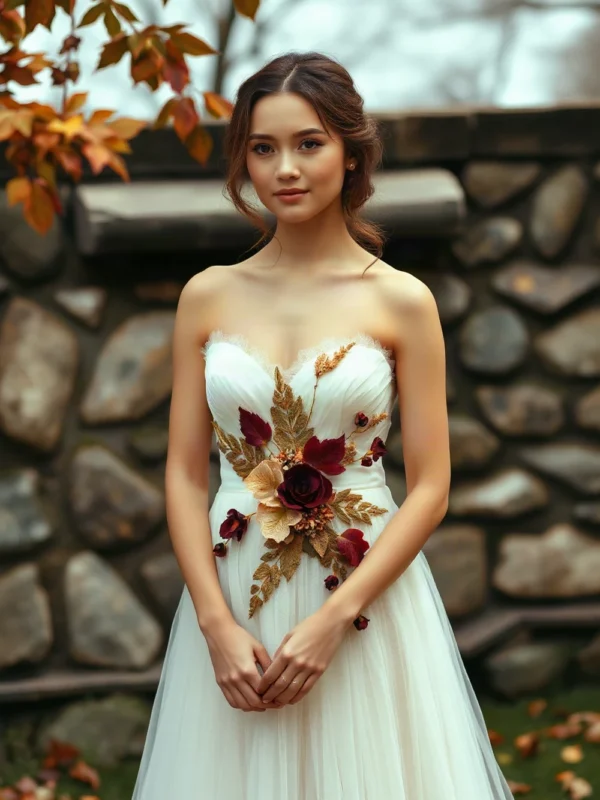
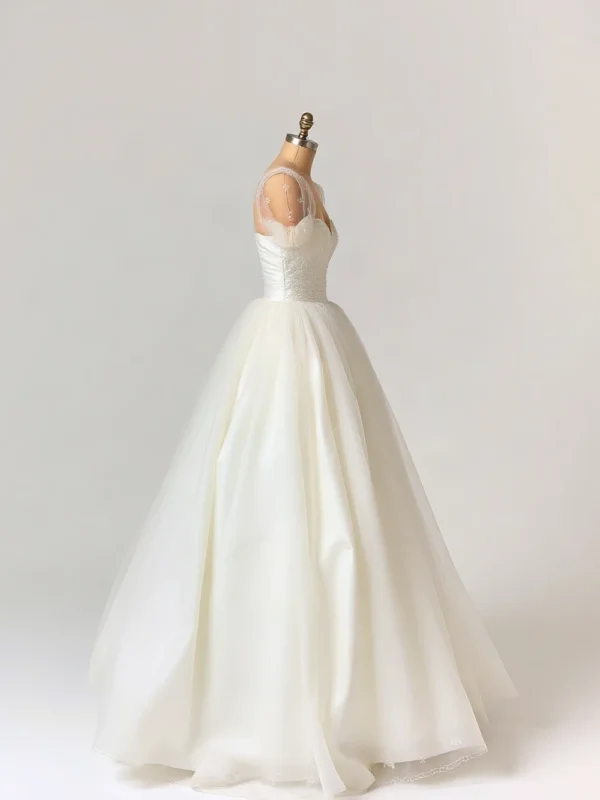
With floral embroidered wedding dresses, placement matters as much as the flower itself. A sleeve, shoulder, bodice, skirt or train changes how the silhouette reads, where portraits draw attention and how restrained accessories should be. These six concepts contrast sheer sleeves traced with white branches, a botanical cape around a minimal column, pastel wildflowers on a full skirt, concentrated blue motifs on white, an architectural branching train and dimensional peach flowers cascading diagonally.
Read them as references for motif scale, color and decorated versus open space, not proof of finished construction, weight, flexibility or technique. Test a favored composition against movement, venue conditions and preferred photography. The strongest placement reinforces rather than conceals the dress.
A Light Botanical Line across Sheer Sleeves
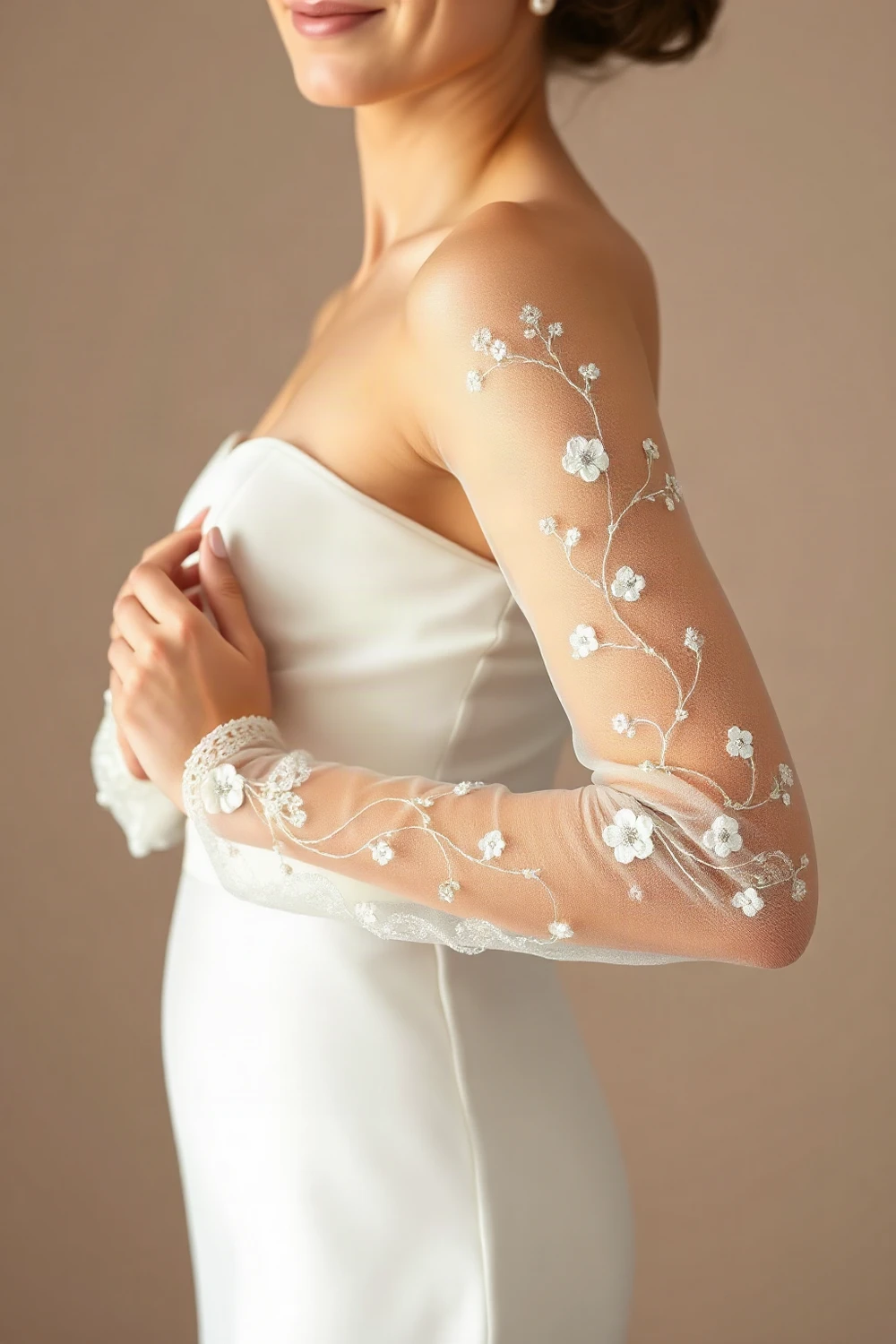
The first look places floral detail in the portrait area without covering the dress. A smooth, undecorated bodice leaves transparent, skin-close long sleeves prominent. Fine white branches curve from shoulder to wrist, with small flowers at selected points, visually lengthening the arms. Open transparent ground keeps them airy, even where motifs thicken around the elbow; when the arm bends, separate branches meet and briefly look richer.
This suits someone wanting upper-body interest with a calm bodice, but movement matters. At a fitting, reach forward, bend the elbows and rotate the shoulders. If motifs gather at the wrist, test bracelet or jewelry edges against them. Small earrings may balance the slender branches better than a dense necklace, letting the floral line frame the upper body without creating competing focal points.
A Floral Cape Framing a Minimal Silhouette
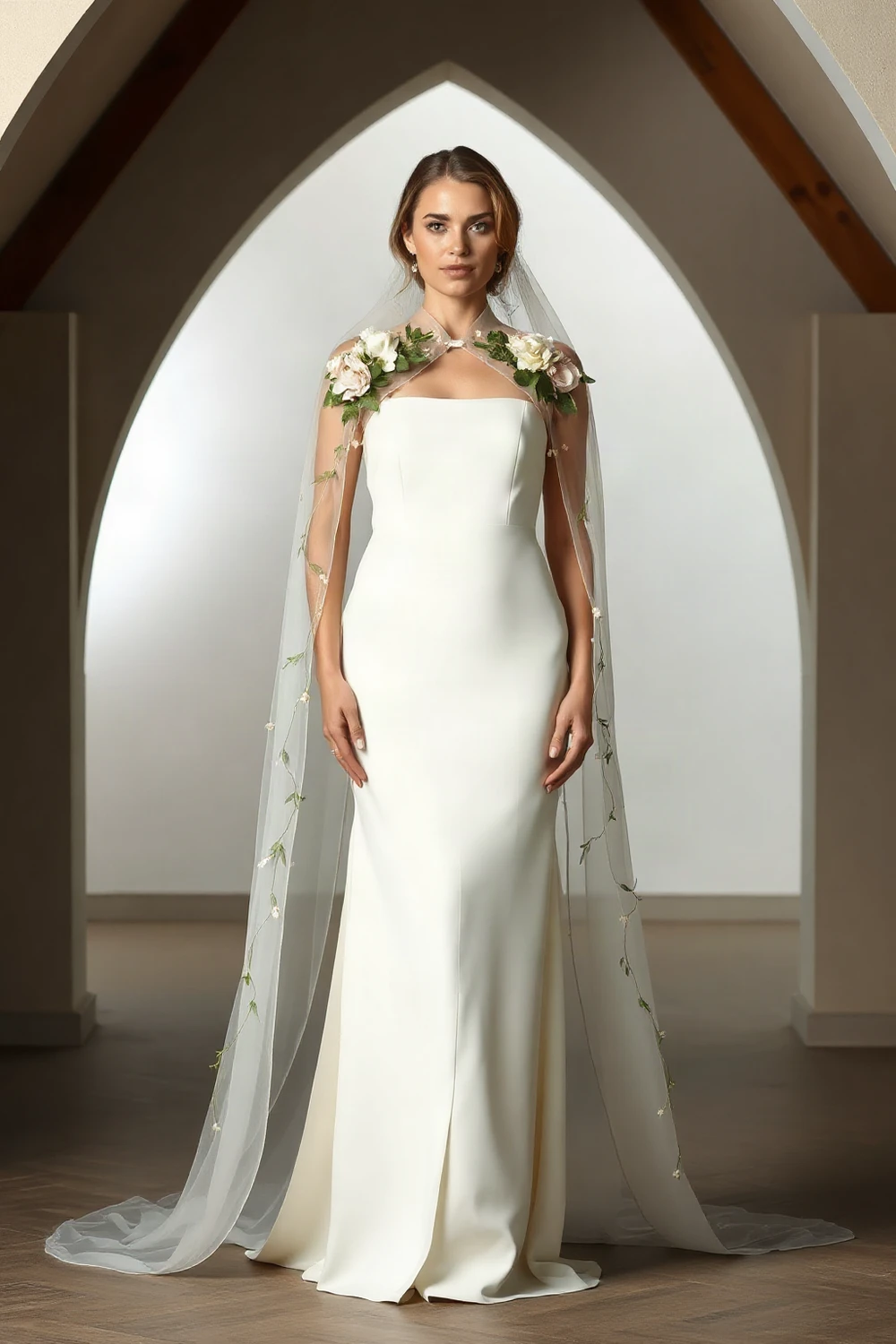
Flowers sit on a separate transparent layer rather than directly across the dress. The almost plain, straight-necked column is framed by large pale flowers and green leaves defining the shoulders. Smaller stems descending along the cape edges soften that breadth and create a long vertical frame. The pointed architectural background echoes the taper, clarifying the outer line while the center stays quiet.
Because large blooms sit near the face, statement earrings, an elaborate hairpiece and a broad bouquet could compete together; simpler companions keep the botanical neckline clear. Test the neck closure, whether lifting the arms pulls the cape and how its long edges behave while turning. If the cape will be removed between ceremony and reception, view and photograph the plain column alone to confirm that it still feels intentionally complete.
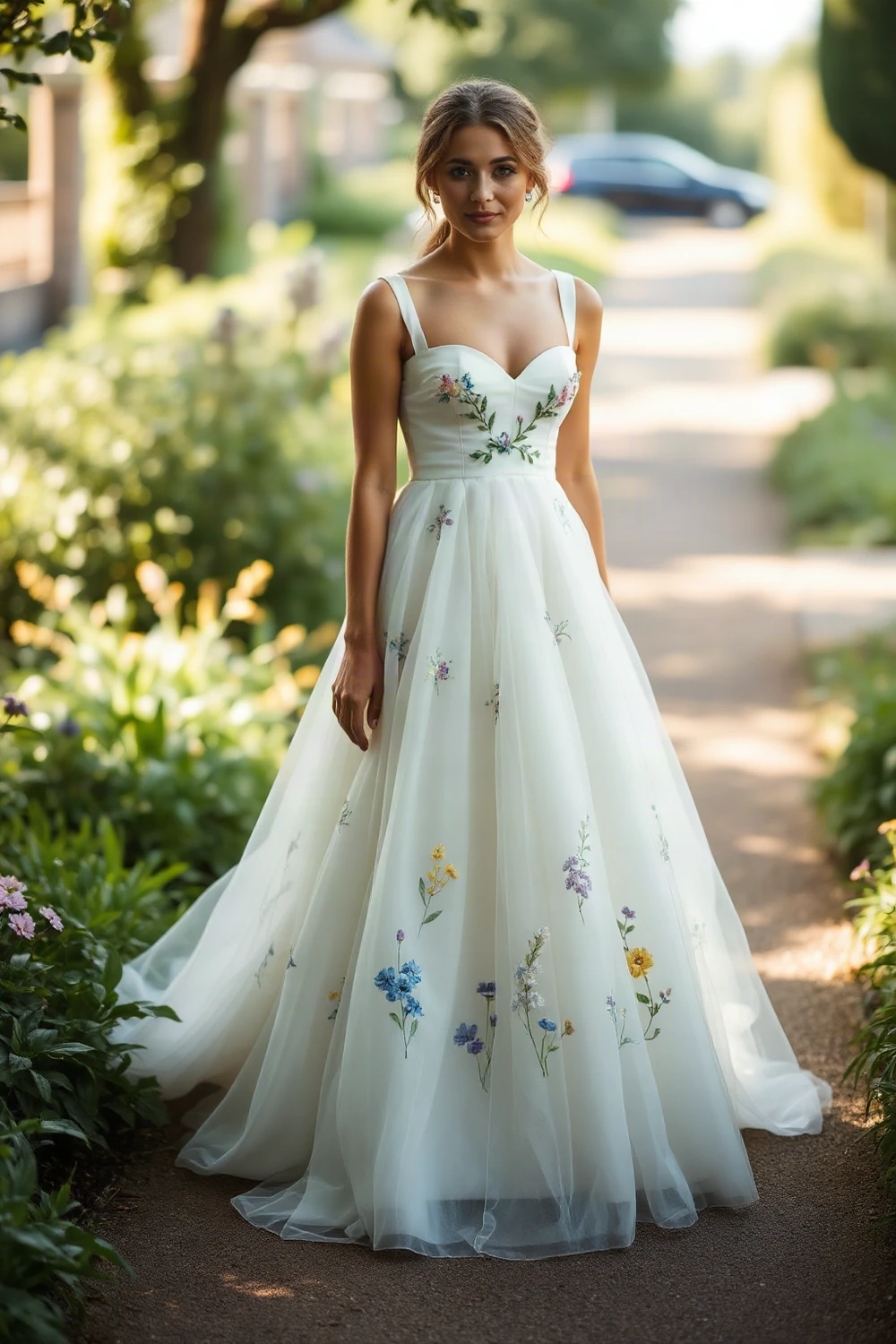
Color Dispersed through Pastel Wildflowers
The third concept spreads small, widely spaced blue, purple, yellow and pink flowers across a full skirt. They form a branching center on the bodice, then loosen below, while longer stems near the hem follow the broad A-line’s vertical folds. The garden strengthens the wildflower association, but generous pale ground prevents the colors from merging into a heavy pattern.
A multicolored dress need not repeat every shade in bouquet or jewelry. Echoing one gentle embroidery color, or using mostly white and green, creates harmony without over-coordination. Small motifs appear delicate at a distance and more complex in close photographs, so prioritize the images you value. Outdoors, consider the voluminous skirt on narrow paths, near planting beds and where outer layers meet the ground. A clearly defined waist provides a structural pause, keeping the loose distribution intentional.
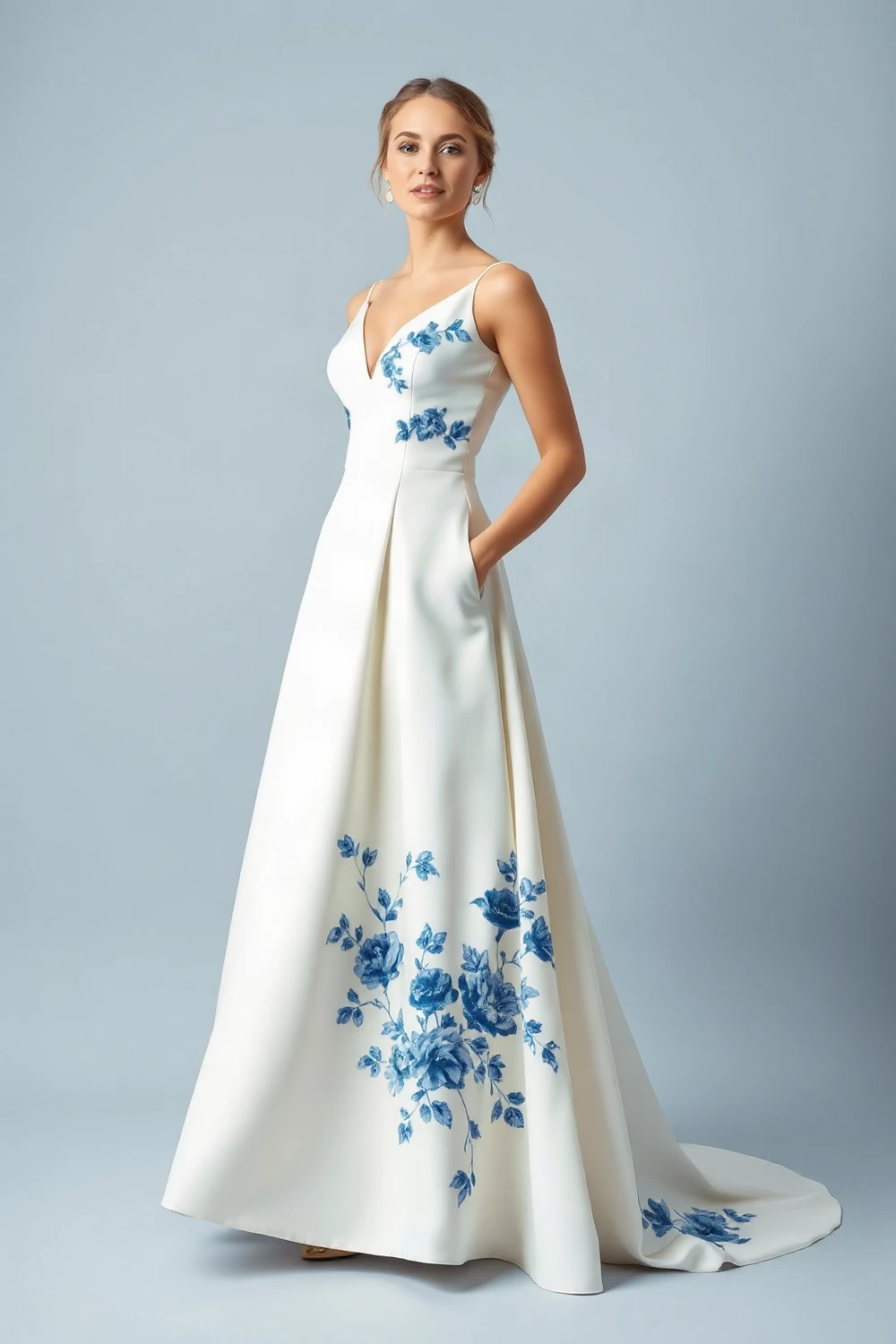
An A-Line Directed by Blue Floral Clusters
The fourth look replaces scattered color with concentrated clusters in one limited palette. Dark and medium blue flowers start as a small accent on one side of the white bodice, expand into a prominent lower-front skirt arrangement and return at the train’s end, guiding the gaze downward. Narrow straps, a deep V-neck, pockets and a smooth A-line surface give the romantic pattern a clean, contemporary frame.
Here, placement matters more than flower type. The upper branch adds identity without overpowering the face; the lower cluster dominates full-length images. Neutral accessories preserve this hierarchy better than repeating blue everywhere. Before shortening the skirt, check how the alteration line meets the large near-hem motif. Also try the pockets with hands in and out: using them changes the front folds and can alter the cluster’s appearance in motion and photographs.
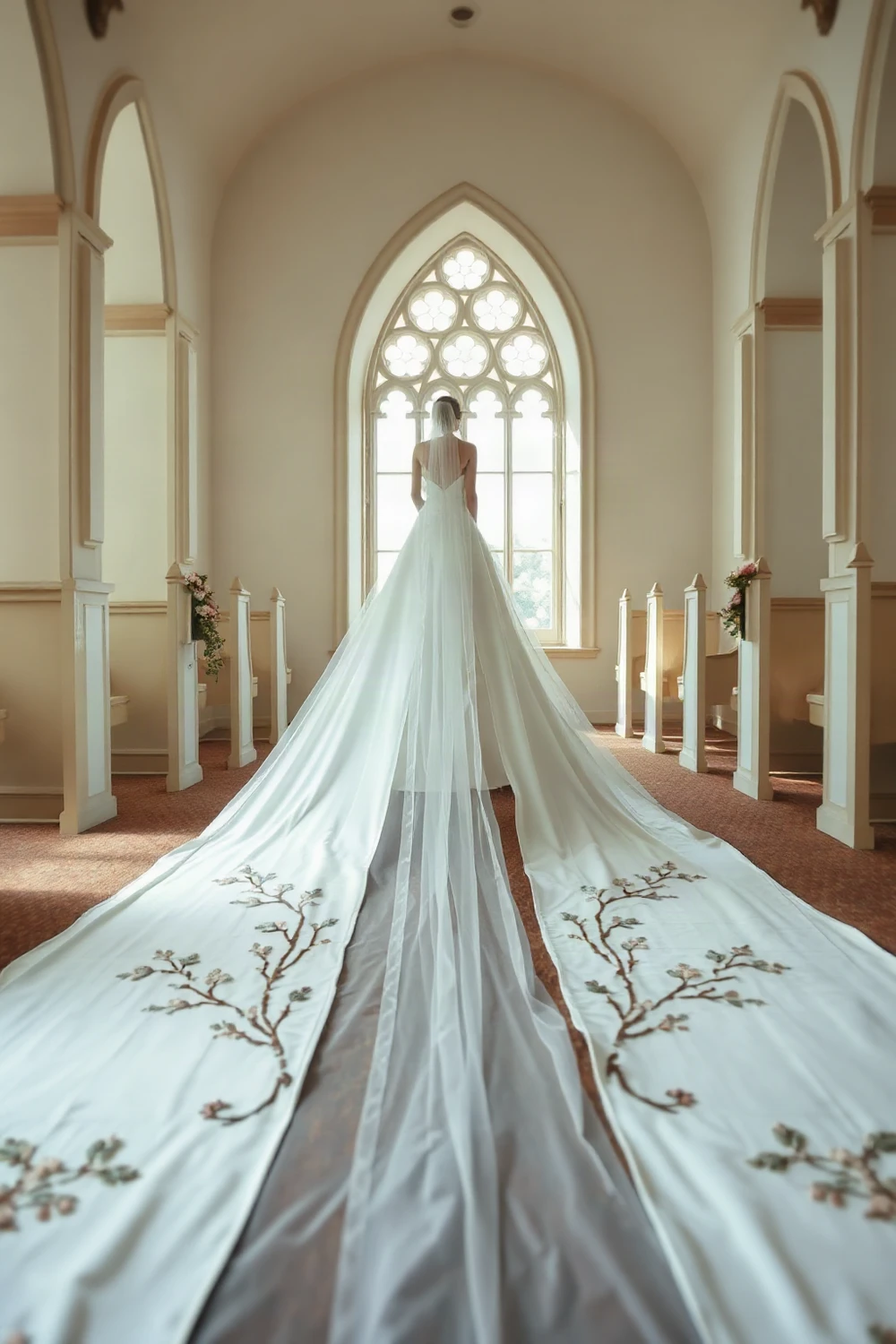
A Botanical Train Shaped for the Ceremony Space
The fifth concept shifts botanical detail from the front to an extended rear composition shaped by the venue. The broad train opens into two sides, with brown-green flowering branches running along the outer panels. A pale, undecorated central layer leaves a clear path to the viewer. The symmetrical aisle and pointed window reinforce that axis, making the train the ceremonial image’s main frame rather than a close-range detail.
Choose such a train with the space in mind: assess aisle width, turning room, steps and the planned route after the entrance. The panels must be arranged openly to show branch symmetry, and their appearance when gathered also matters. Because the long central layer already separates the decorated sides, a densely bordered veil may crowd the composition. A simpler rear hairstyle and quieter center preserve room for the branches and venue geometry.
A Diagonal Focus Made with Dimensional Flowers
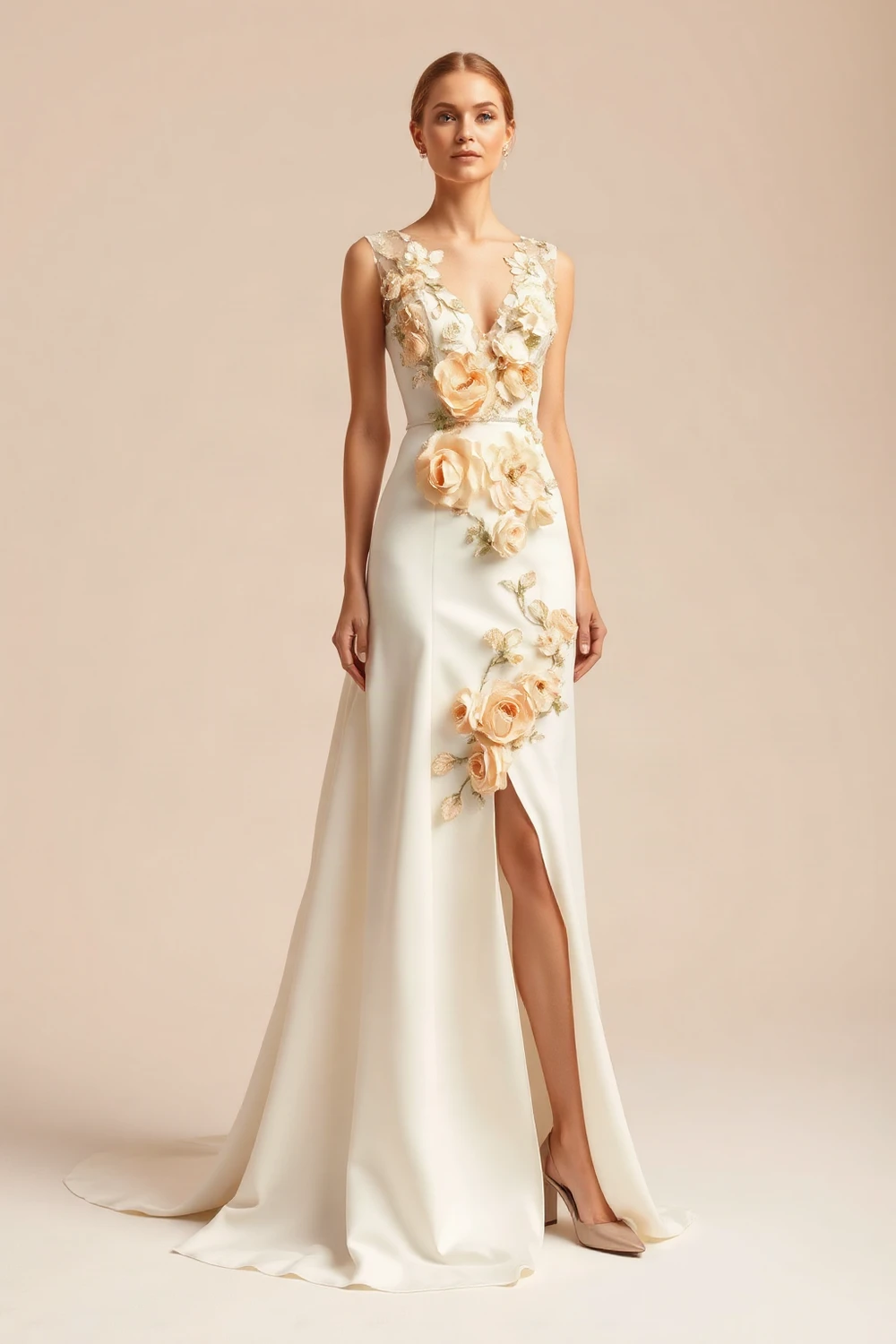
The final look sends botanical detail diagonally across a close silhouette instead of over a wide skirt. Large peach and cream flowers begin at the deep V-neck, gather at the waist and continue in broken clusters from hip toward the front slit. Against smooth white, shadows reveal their raised forms. The route frames the face, defines the waist and directs the eye downward, making the slit feel like its conclusion rather than an unrelated feature.
These sculptural flowers have more close-range presence than fine embroidery, and their volume needs testing. Check whether resting hands touch motifs and whether raised elements near the waist or sitting line remain comfortable. With flowers around the neckline, omitting a necklace preserves open space. An equally large-flowered bouquet could compete, while a simpler outline keeps the diagonal clear. Judge slit height during normal steps, not only standing, and in relation to the chosen shoes.
Together, these concepts show that the key question is not how many flowers, but where they sit and at what scale. Sheer sleeves and capes focus the portrait area; pastel sprigs and blue clusters articulate a skirt; a branching train claims ceremonial space; dimensional flowers follow the body down the front. Compare each idea in full-length front, side and rear views, not from one close detail.
Then consider whether motifs compete with accessories, respond well to sitting and walking, and suit the venue’s scale. The strongest arrangement preserves enough undecorated space for the dress structure to read. It guides the eye deliberately, supports the silhouette and still works beyond a composed photograph.
Compare six botanical concepts, from sheer floral sleeves and a decorated cape to pastel wildflowers, blue clusters, a sweeping train and sculptural blooms, focusing on motif scale, placement and silhouette balance.
Frequently asked questions
Should floral embroidery sit on the upper body or the skirt?
Sleeves, shoulders and bodices are more visible in portraits and can frame the face. A skirt or train placement has greater impact in full-length and rear photographs. Choose the area where the motif can direct attention without interrupting the dress’s essential lines.
How should a bouquet be chosen for a multicolored floral dress?
The bouquet does not need to reproduce every color. It can emphasize one soft shade from the motif or use a restrained white-and-green palette. When the dress carries large dimensional flowers, a simpler bouquet shape helps prevent competition between the two focal elements.
Is a floral cape or an embroidered sheer sleeve more practical?
A sheer sleeve keeps the detail attached to the body, while a cape creates a separate frame and may offer a removable layer. Practicality depends on arm movement, the neck fastening, cape length and the event plan. Test sitting, embracing and raising the arms in either option.
Can large floral motifs complicate hemming?
A large motif positioned close to the hem can be disrupted when the skirt is shortened. Before alterations begin, view its relationship to the proposed new edge and discuss whether the motif can be preserved or repositioned by the person responsible for the work.
What venue works best with an extended botanical train?
A wide, level aisle allows the train to open and the branching design to remain visible from a distance. Narrow passages, stairs or frequent turns require a reliable way to gather it. Check aisle width, floor conditions and turning space during a venue visit.