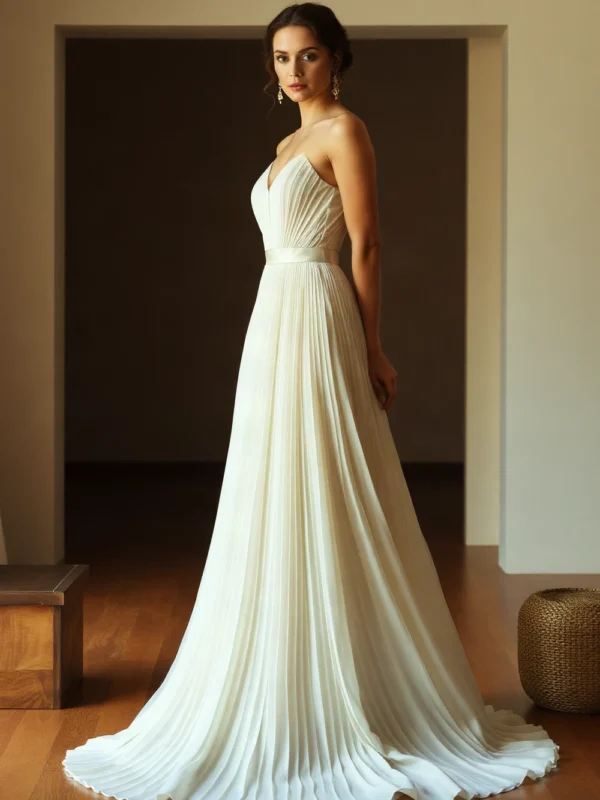
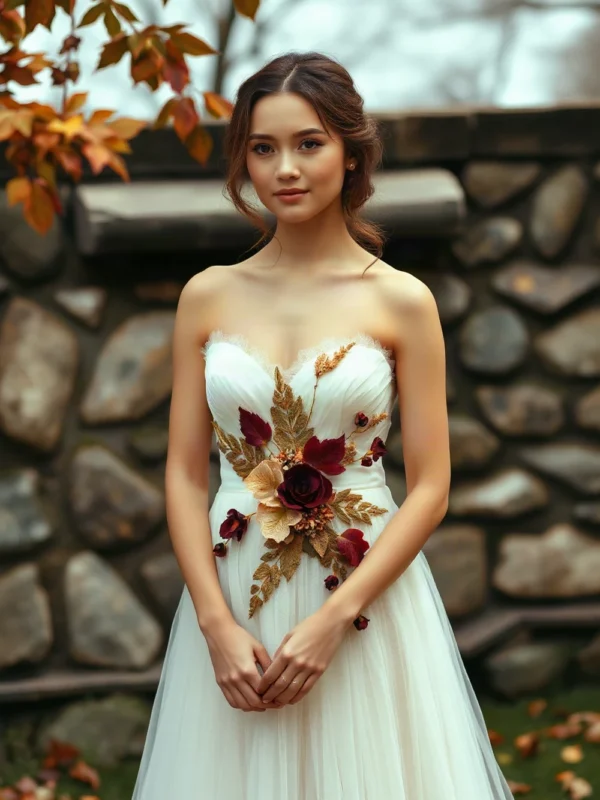
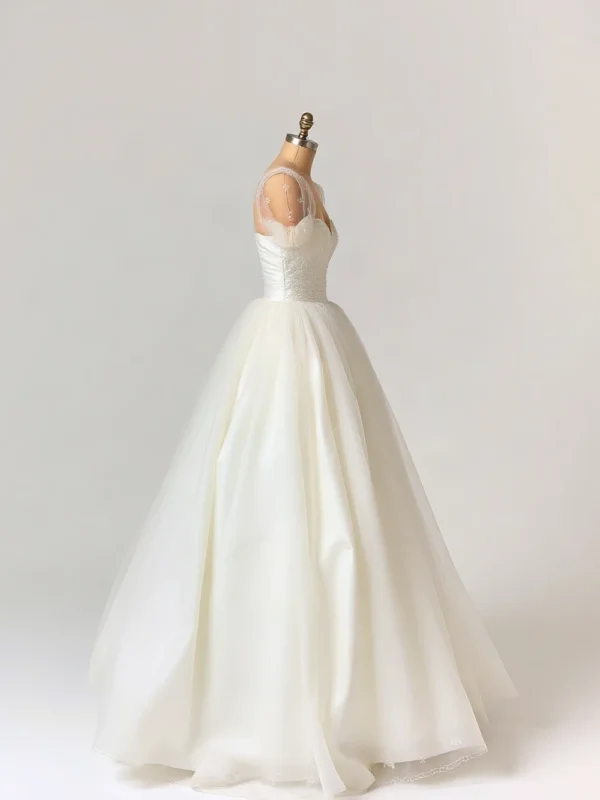
An A-line wedding dress creates a calm foundation for varied necklines and backs because its skirt widens gradually from a defined waist. Yet the shared outline does not make every version feel alike. An off-the-shoulder band forms a broad horizontal frame; a crossover V pulls the eye downward; a sweetheart edge exposes the shoulders around a rounded center. Draping, floral-looking embellishment, an open back, skirt weight and train length can all redirect attention.
These six images present romantic styling as choices rather than a formula: a smooth rear view with a broad train, a breezy coastal dress, a diagonally draped bodice, a strapless sweetheart shape, a detailed plunging V and an open back above an expansive edged train. Rather than copying a complete look, consider how neckline direction, surface detail and skirt movement work together for the intended setting and comfort. Comparing front, profile and back equally produces a more coherent result than selecting the neckline alone.
Balancing an Off-the-Shoulder Neckline with a Clean Back
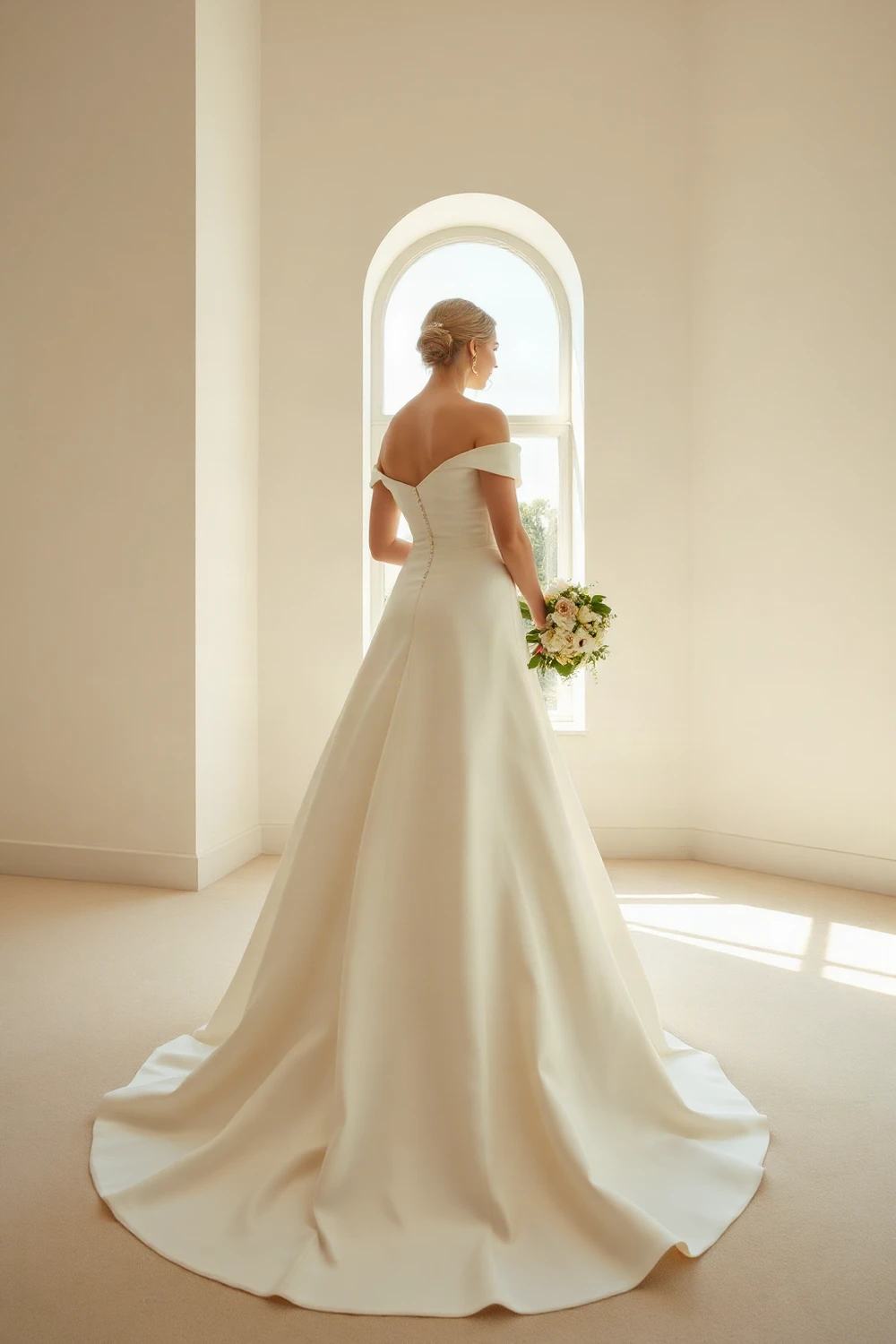
In the first image, the off-the-shoulder neckline makes a wide, gentle curve across an exposed upper back. Only a centered row of small buttons interrupts it, drawing a vertical path to the waist. With little ornament, the seam lines and A-line skirt lead into a broad, rounded train, while the arched window reinforces the symmetry in soft light.
Romance comes from proportion rather than dense embellishment. A low updo preserves the neckline, and a compact bouquet leaves the restrained back visible. At a fitting, test whether the shoulder bands allow sitting, embracing and raised arms. Also practice doorways, turns and the train's later fastening point. For a more decorative rear treatment, compare this controlled design with image six's plunging back and edged train.
Creating Lightness with a V-Neck and Flutter Sleeves
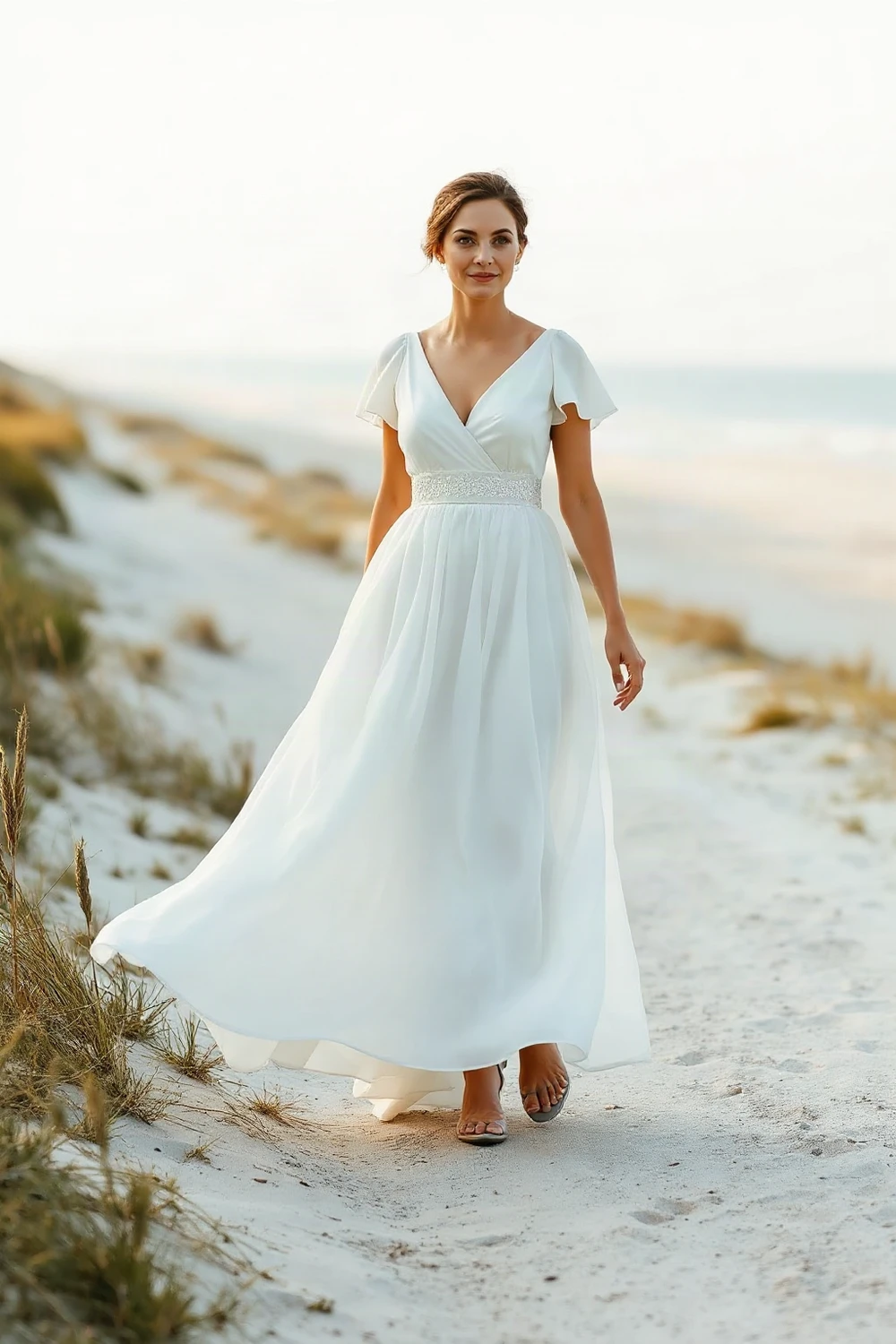
The second image shows the more mobile side of an A-line. A crossover V-neck opens the bodice vertically, while short flutter sleeves provide soft shoulder coverage. A defined waistband meets a full skirt that responds to each stride. The lifted hem and visible shoes stress movement rather than a formal train, reinforced by the sandy coastal path.
That airiness suits an outdoor ceremony but does not guarantee effortless wear. Layers may react to wind, sleeves can shift and the V may change while walking or leaning. Test all three in realistic motion. Compared with a strapless neckline, this offers more shoulder coverage; compared with a long train, it limits contact with uneven ground. Stable footwear, the right hem length and a comfortable way to lift the skirt belong to the same decision.
Giving an Off-the-Shoulder Bodice Shape Through Draping
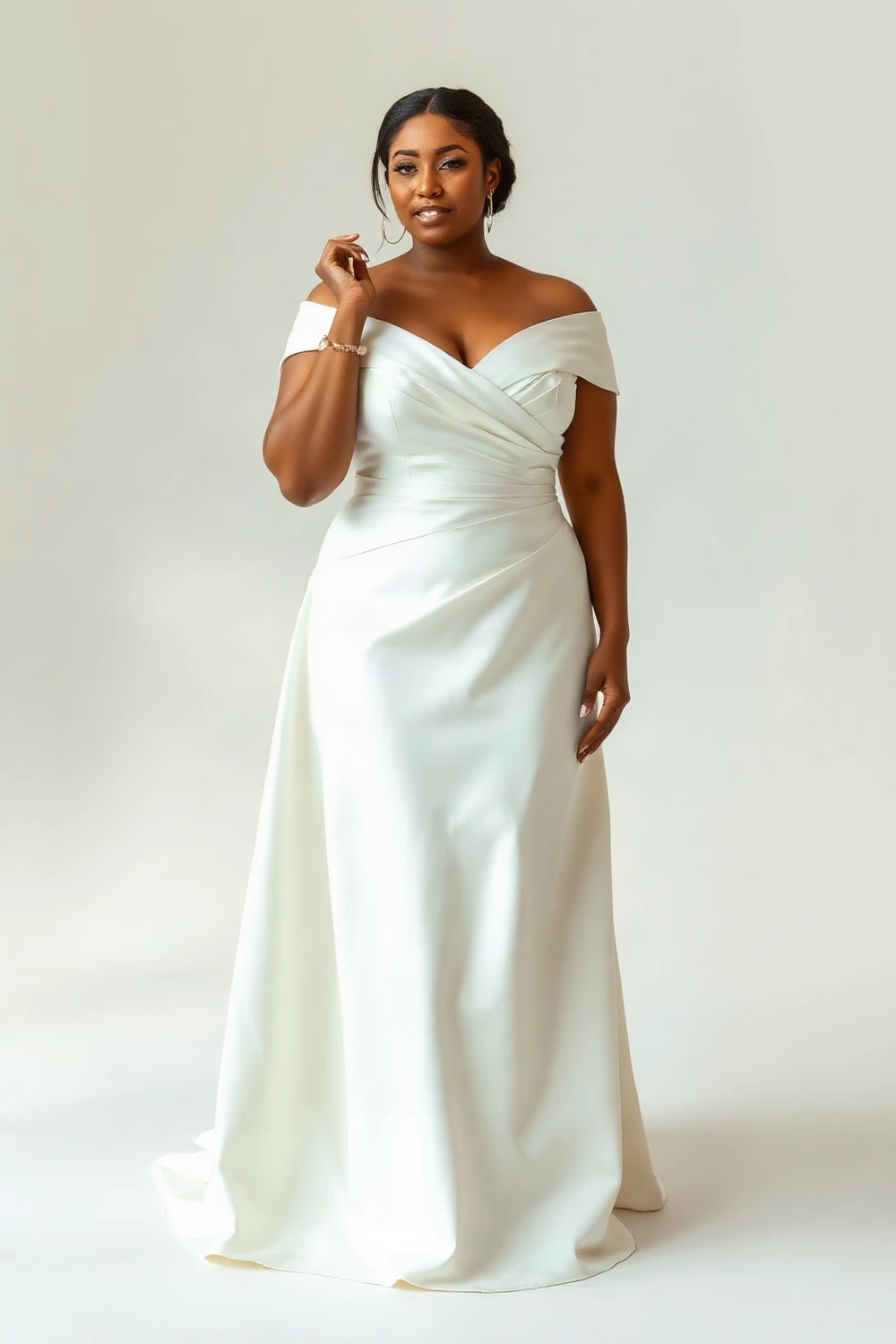
Image three combines an off-the-shoulder neckline with broad diagonal drapes. The folds send light and shadow in opposing directions, narrow at the waist, then release into a smooth A-line skirt. This gives the bodice visual weight without floral ornament, while the uninterrupted skirt balances the crossing lines above instead of creating another focal point.
Judge the draping in motion, not only from the front: sit to see whether folds collect at the waist, raise the arms to test the neckline, and check whether the diagonal lines return after turning. Secure internal support should keep the bands in place without repeated adjustment. Minimal earrings preserve the open neck. Image two offers a lighter, wind-responsive alternative; images four and five provide stronger surface decoration.
Highlighting a Sweetheart Neckline with Centered Detail
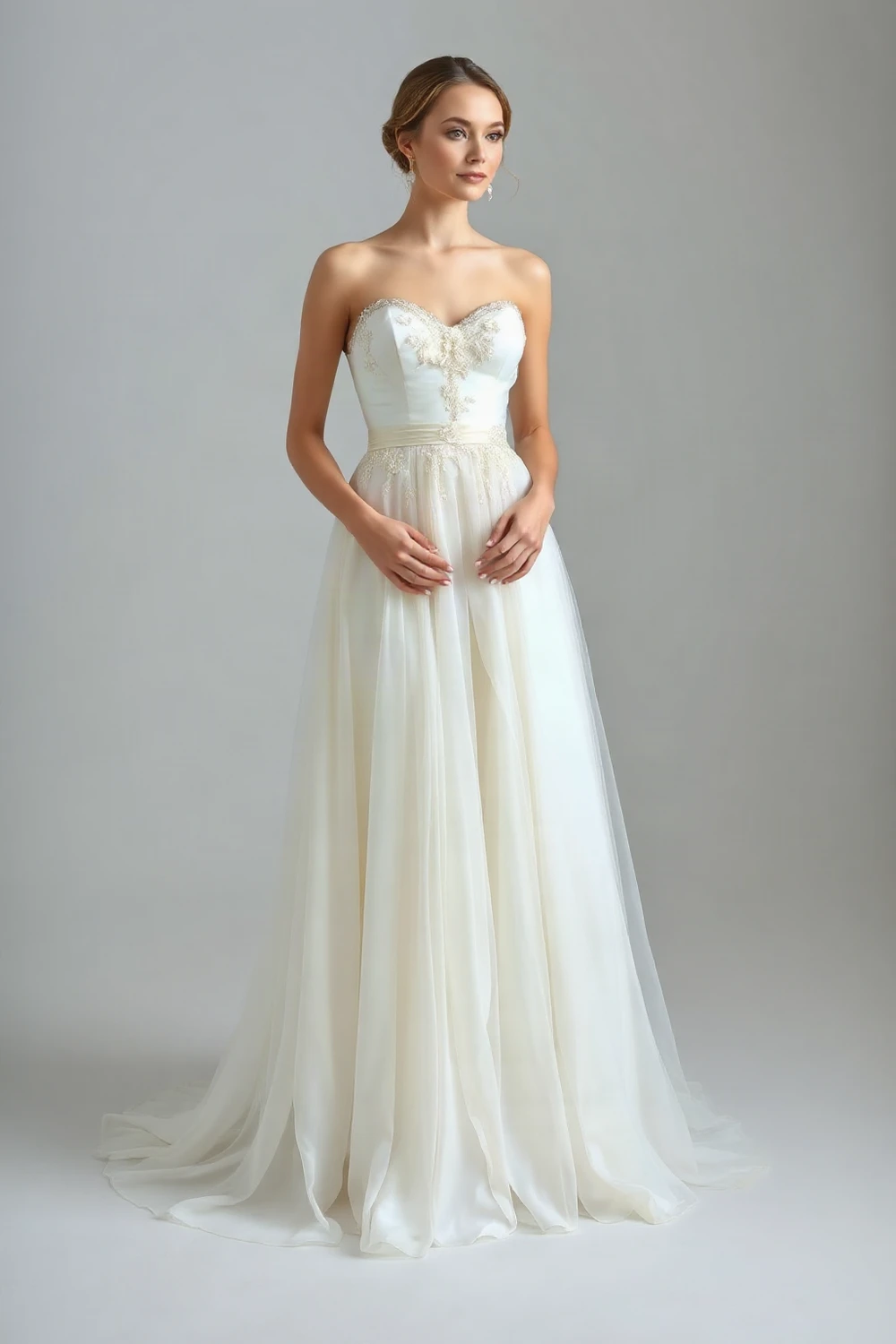
The fourth image uses a strapless sweetheart edge to expose the shoulders and define the bodice center with two rounded curves. Bright, floral-looking embellishment follows the top edge toward the narrow waist. Below, long, soft layers widen gradually, keeping the A-line elongated and calm: concentrated detail above, quieter movement beneath.
The sweetheart is softer at the center than a deep V and more articulated than a straight strapless edge, but it depends on secure fit. Test deep breathing, sitting and dancing rather than relying on a still mirror view. Because the bodice already creates a central focal point, a necklace is optional. Inspect the waist transition from the side as well as the front; where the skirt layers begin affects proportion. Judge the full-length silhouette, not only a neckline close-up.
Quieting a Plunging V-Neck with a Restrained Skirt
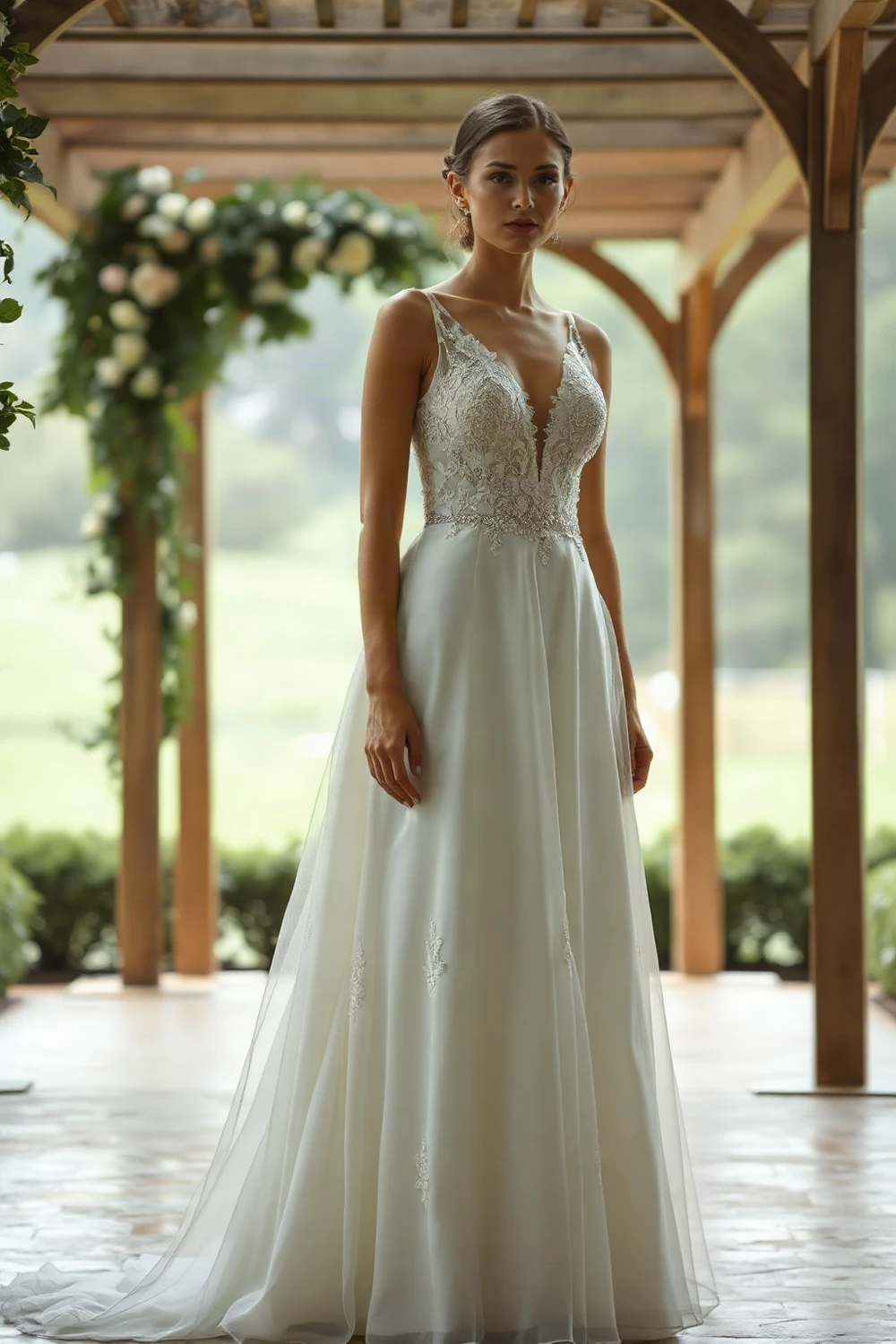
In image five, romantic detail is concentrated on a slender-strapped, plunging V bodice. Floral-looking work runs from shoulders to waist, and a narrow, skin-toned-looking center visually joins the deep opening's sides. Beneath this activity, a largely plain skirt falls in vertical lines. Sparse motifs link it to the bodice without interrupting the A-line's visual pause.
Assess more than the front: check side coverage, bend, sit and raise the arms to confirm that the opening stays positioned. Consider strap pressure, side support and comfort together. Omitting a necklace can keep the long neckline legible, especially in a floral setting. Compared with image four, this has straps but a deeper opening; compared with image two, it is more detailed and ceremonial. The choice balances coverage with texture near the face.
Combining an Open Back with a Broad Framed Train
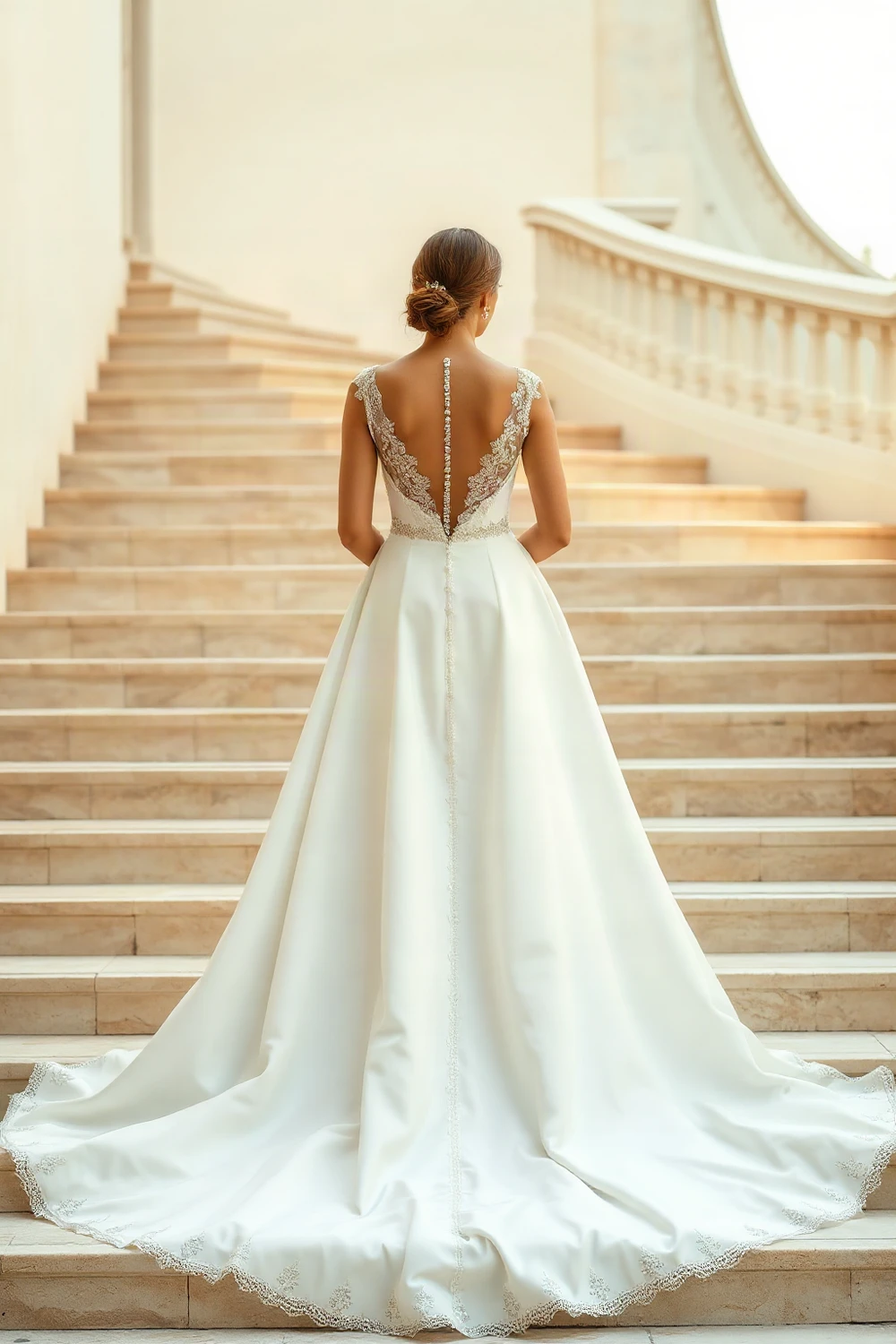
In the sixth image, floral-looking borders frame a plunging V-back from shoulders to waist. A fine decorative row forms a central axis, continued by a related line down the otherwise smooth skirt. The train spreads widely across the steps; ornament along its outer edge emphasizes scale and symmetry. Exposed space, vertical detail and the framed perimeter create the romance.
Plan hairstyle, veil and train as one composition. Hair lifted from the nape preserves the V, while a dense long veil may hide or compete with its borders. Check during fittings that the back edges remain close when walking and that support does not alter the front. Test the train on stairs and level floors, including turns and its later fastening method. Compared with image one, this richer design needs more active management throughout the event.
For an A-line dress, the neckline is only part of the effect. Off-the-shoulder styling changes with a plain buttoned back or diagonal draping; a V-neck shifts from airy with flutter sleeves to ceremonial with slender straps and embellishment. An open back demands more when joined to a broad, edged train. Start with one feature, then test it against movement, support and venue.
At a fitting, take full-length photographs from front, side and back; sit, walk, turn and raise the arms. If the neckline stays stable, the waist remains balanced and the skirt is manageable on the planned surface, the idea is practical. The strongest look is not necessarily the most detailed, but the one whose neckline, bodice, back and skirt create a consistent, comfortable silhouette.
A practical comparison of off-the-shoulder, V and sweetheart necklines, draped or embellished bodices, open backs, fluid skirts and sweeping trains across six A-line bridal concepts.
Frequently asked questions
How can I choose between an off-the-shoulder and sweetheart neckline?
An off-the-shoulder neckline emphasizes a broad horizontal shoulder line and adds a soft band around the upper arms. A strapless sweetheart neckline leaves the shoulders fully open and creates a curved focal point at the center. Compare arm movement, bodice stability, hairstyle and planned jewelry during the fitting.
Which skirt approach is more practical for an outdoor ceremony?
A mobile skirt with little or no trailing length is generally easier to handle on sand or uneven ground. Wind, underlayers and contact with the shoes still need realistic testing. If a broad train is essential, plan how it will be carried or fastened after the formal entrance.
What should be checked when fitting a plunging V-neck?
Check the front and side coverage, lean forward, sit and raise the arms to see whether the opening shifts. Strap pressure and the relationship between internal support and comfort also matter. A skin-toned-looking insert can change the visual continuity, but support requirements remain individual.
Should I choose a draped or embellished bodice?
Draping creates structure through directional folds and changing light, while embellishment produces a more explicit surface focal point. A restrained skirt can balance either option. Check whether folds recover after movement and whether decorative detail competes with jewelry or overwhelms the waist transition.
Which hair and veil choices work with a plunging back?
A low or lifted hairstyle that stays clear of the nape keeps the V-shaped outline visible. View any veil from behind to see whether it conceals the border or competes with the train. A removable veil can preserve different levels of detail for the ceremony and reception.