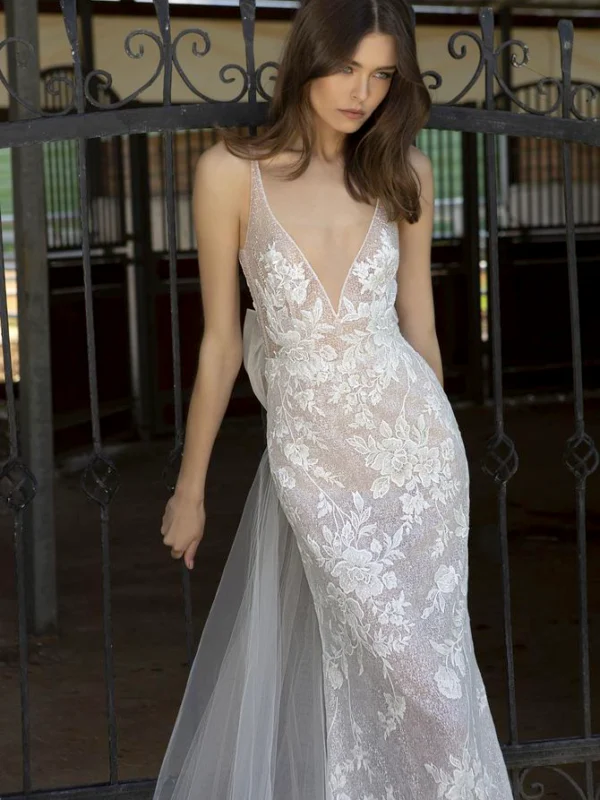
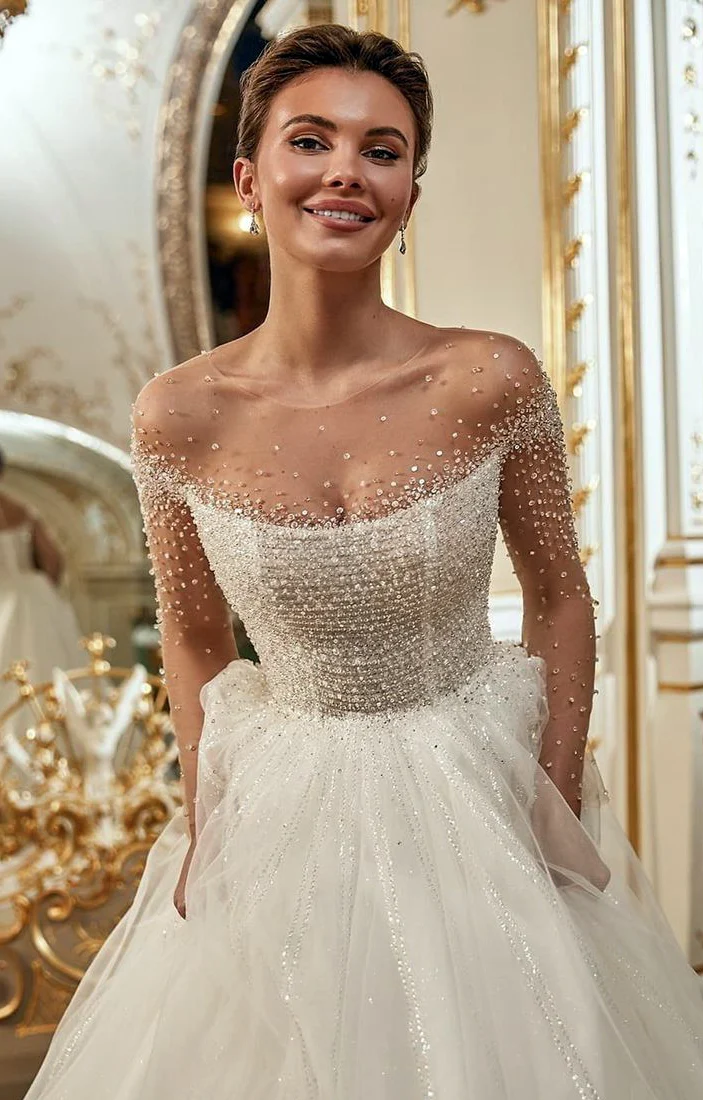
A corset-look wedding dress can create its effect through vertical lines, rounded upper boundaries or a clearly drawn waist. Look closely at the visible bodice before attaching the choice to individual round decorations. These references show a close long form, a densely decorated centre beneath a sheer-looking upper area, diagonal lines in a close view and a softer gathered V bodice as a comparison. The distinctions support a shape decision without confirming a particular internal support structure from the photographs alone.
Choose the leading lines of a corset-look wedding dress
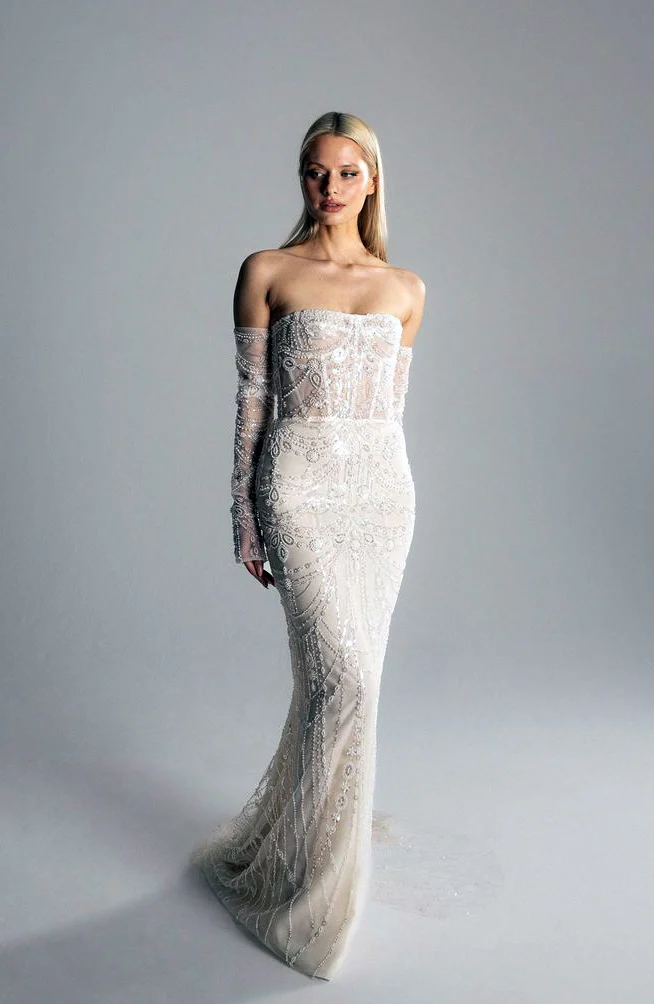
Locate the line you want to retain in the complete garment first. In the long narrow reference, vertical areas travel through the middle while the upper edge runs comparatively straight. The diagonal close view creates another route across the torso. The V bodice gathers finer vertical folds and is bounded by a narrow decorated waist strip. Name these features individually rather than treating every picture as one form. This gives you a clear search question for a fitting, whether the upper roundness, vertical divisions or transition below matters most.
Compare two actual garments with a reasonably similar lower area afterwards. Changing bodice, skirt width and jewellery markedly together makes the source of your preferred effect unclear. Keep additions quiet initially and view the dress from conversational distance. Do you want a strongly divided centre or a softer transition? That answer can concern visible form without presuming technical construction. Record the preferred route before searching for a particular decoration or one unidentified photographed model, leaving room for a real alternative that shares your main preference.
Assess visible form and actual support separately
Corset-look lines provide a design starting point. Establish which inner pieces are intended, how the actual garment closes and what can be adjusted. Ask for an explanation on the worn model with your planned inner layers. Its surface does not show everything beneath it. An upright pose arranged for a photograph also says little about how your own dress sits while seated or after a hug. Those are questions for the actual fitting rather than assumptions from one upper close view.
If you enjoy a line but the real execution does not suit you, describe both points separately. Seek a similarly divided centre with another upper edge or more of your preferred coverage. A corset-look wedding dress does not require abandoning the inner pieces you want because of its photographic effect. Choose the visible form and test the practical solution with the person assessing adjustments on the actual garment. Your request then remains concrete and verifiable instead of becoming a vague search for something simply tighter or more covered everywhere.
Compare open upper edge, V line and sheer-looking area
The long narrow reference leaves neck and shoulders open above a straighter upper boundary. In the denser decorated bodice, a sheer-looking layer extends farther over shoulders and arms. The softer V view instead has broader side areas beside a deep middle. These three options differ through the surface you want visible and covered. Compare them with your own plans for the day, rather than treating substantial decoration as automatically equivalent to your preferred coverage. Surface density and upper-edge height are distinct questions you can explain separately.
View the transition in similar light and with the same hair position. A decorated sheer-looking area may appear different in a photograph from the real garment worn. Check front, sides and a slight forward lean so your coverage choice remains understandable in other positions too. Select the upper solution before adding jewellery. You can like an open neck area and still want more fabric elsewhere. Different regions do not need to form one all-or-nothing decision, and your actual inner layers belong in the same comparison.
Choose waistband and trailing decoration as a separate boundary
The V close view has a narrow strip carrying many small pale round points at the waist. Larger individual points continue across the lighter surface below. The densely decorated bodice divides its centre differently from the wider lower beginning, while the diagonal close view adds a visible narrow horizontal line. Compare a clear waist finish with a less distinctly separated transition. Exact position and width matter more for this decision than a general promise of figure emphasis, and can be pointed out on the actual garment during a fitting.
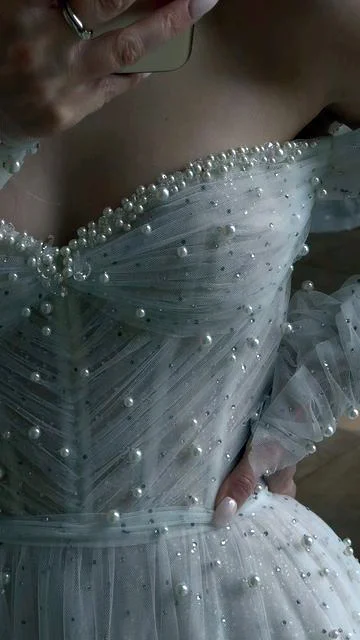
Try the transition without a bouquet or hands held before the body so its real boundary stays visible. Add your intended object afterwards. Sit and stand again, inspecting the position before arranging it for the mirror. If a band or another detail needs changing, ask for the proposal to be explained on the whole dress. A corset-look wedding dress can carry different patterns above and below the waist. Judge the desired transition together with both surfaces rather than selecting a close waistband detail independently of the lower form.
Plan arm surface and upper edge together
Two references show longer patterned or dotted arm areas, while another close view leaves larger regions open. Decide how much surface you want along the arm first. In the long narrow photograph, patterned areas begin beneath the bare shoulder. The picture does not establish every connection between garment and arm section. Ask which actual pieces belong together and what adjustments are possible, rather than assuming removability or a particular glove construction. Information from the person showing the real garment is more useful than relying on its name alone.
Try the chosen solution greeting, reaching forwards and sitting with the complete bodice. Patterned arm areas also remain visible beside jewellery. Begin with earrings and decide on another wrist detail afterwards. The more covered-looking upper zone of the densely decorated example creates a different neck area from an open edge. Compare both with hair moved back, then add your planned hairstyle. Head, shoulder and arm become a connected choice rather than separate attractive additions whose combined effect is discovered only once every piece has been selected.
Add skirt contour and accessories after the bodice decision
For a corset-look wedding dress, the long narrow view follows the hips more closely before widening towards its lower finish. The denser decorated example begins more broadly below the waist. Neither of the other close views shows a complete hem. Use complete views for the lower comparison and crops for their particular upper question. Do not transfer an assumed close-up length into your preferred design. A clear bodice idea can be discussed with another actual skirt form without requiring every feature of the same reference photograph to reappear.
Choose shoes and intended bouquet with that complete combination. Test where the bouquet sits before the middle and how much of your selected line remains visible. Add a veil in your preferred length first, then inspect its edge beside the bodice. Further decoration may introduce another line or repeat the existing one. Decide through the real worn pieces rather than appealing individual pictures. The bodice preference should remain understandable within the complete wedding look too, including any moment when an accessory covers part of it.
Compare two bodice options in the actual sequence
Limit the final selection to two clear descriptions, such as a straighter upper edge with vertical divisions and a softer V line with a defined waist strip. Our boho wedding dress guide shows other silhouettes; the crochet-look bridal selection compares another surface distribution. Take one question from each rather than collecting all the ideas. Try your two real models with the inner layers and accessories you actually intend to use, repeating the same movement and sitting sequence so the difference remains clear.
Record agreed bodice and waist adjustments and clarify care before treatment. The GINETEX guide distinguishes washing, bleaching, drying, ironing and professional textile care; round decorative points or visible bands specify no separate process. Your corset-look wedding dress becomes a concrete choice when you like the drawn middle, actual support and coverage are established, and you have seen bodice and skirt together in normal use. That complete fitting supplies the reliable basis, alongside clear notes explaining which area you retained and which adjustment you expect.
Choose the visible line direction of a corset-look wedding dress first. Establish support and coverage on the actual garment, adding skirt and accessories afterwards.
Frequently asked questions
Do vertical bodice lines establish a particular support?
No. The pictures show visible design. Establish actual inner pieces, fastening and adjustments on the specific worn garment.
Must the upper edge be straight?
No. Compare a straighter boundary with the softer V line and higher-reaching sheer-looking area through your preferred coverage.
Are the long arm sections definitely removable?
The photographs do not establish this. Ask which parts belong together on the actual dress and what changes are possible.
Which pictures need an additional hem view?
The diagonal close view and softer V bodice do not show the complete lower finish. Use them for upper selection and assess length separately.