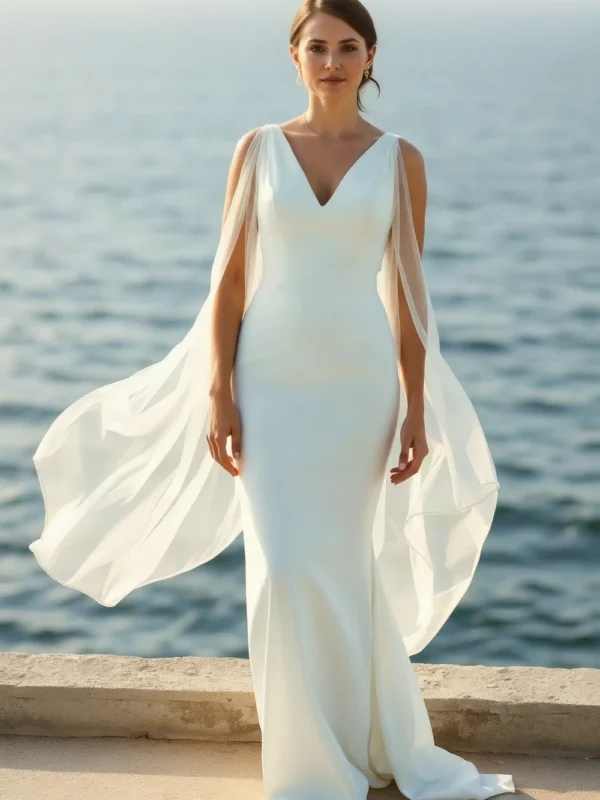
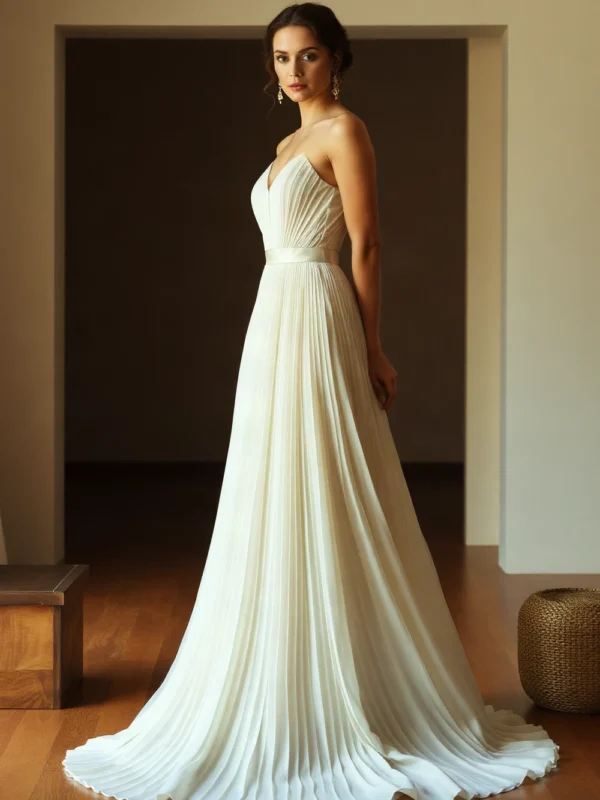
Minimalist open-back wedding dresses rely on proportion rather than heavy ornament. The opening’s depth and shape work with strap direction, the bodice-to-waist transition and the amount of skirt resting on the floor. These six concepts share smooth white surfaces and restrained lines, yet balance upper-body support, hip definition and a softly sweeping train differently.
A deep V creates a strong rear focus but puts more emphasis on strap tension, concealed support and stability in motion. A short sweep can navigate narrow passages more easily, while a wider train has greater presence during an entrance or rear photograph. No approach is universally best; the right balance depends on the wearer and setting. Fittings should assess the front, side and back while standing and moving.
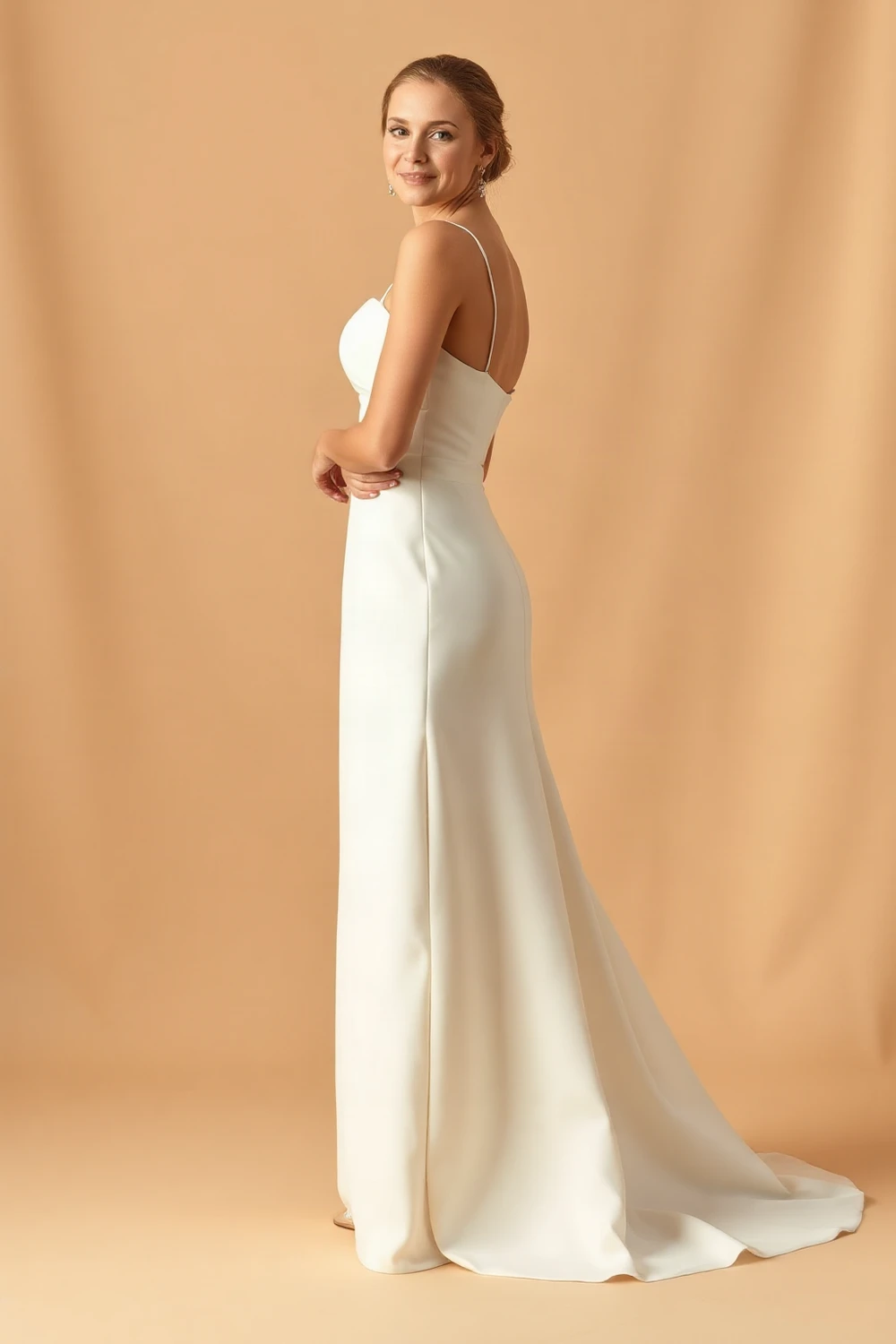
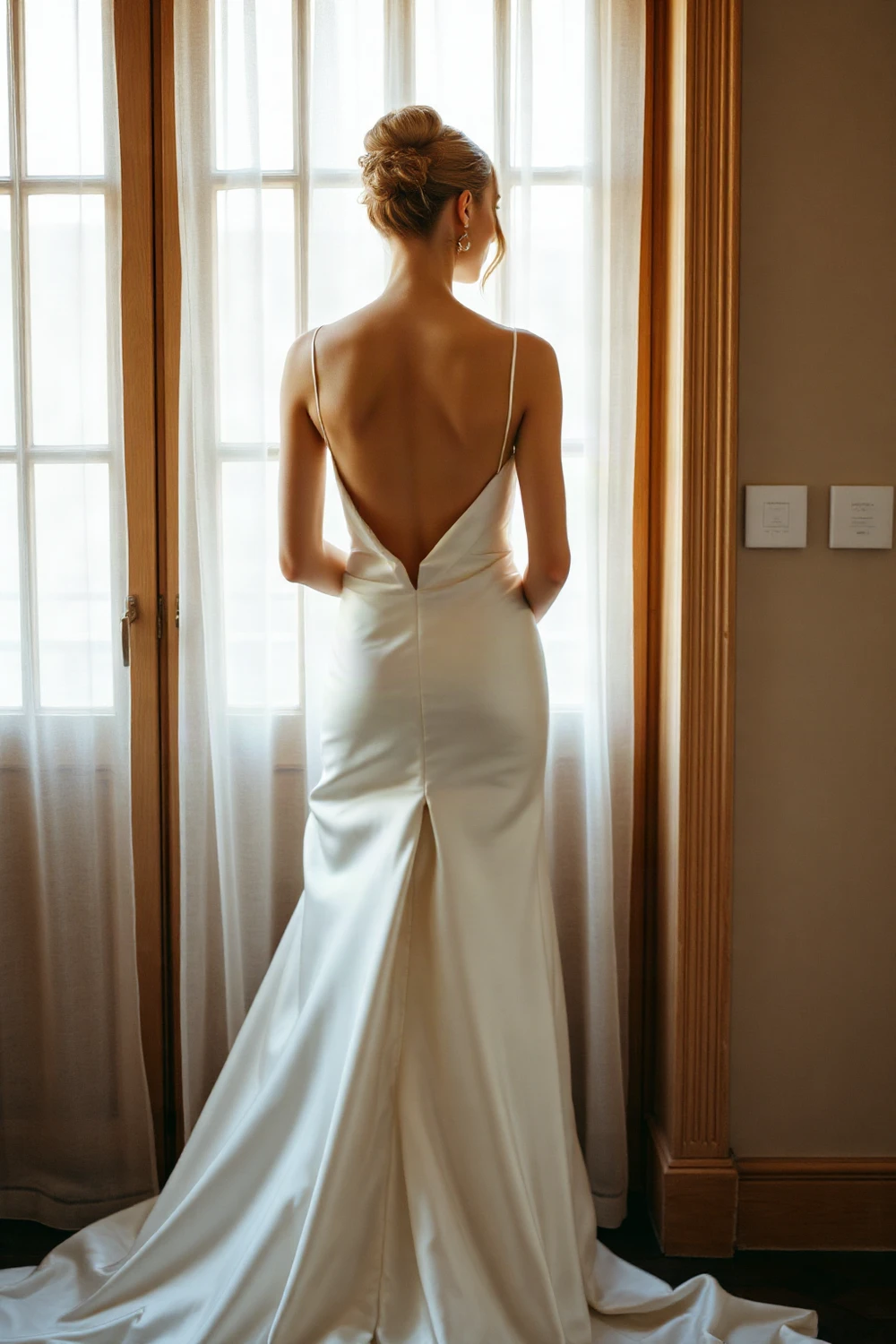
Fine Straps and a Moderately Open Back
The first concept pairs a moderately low back, framed by fine straps, with a controlled, gently A-line skirt. Because the opening ends well above the waist, exposed skin and white bodice remain quietly balanced. The hem extends only slightly behind the feet, leaving the back as the main feature. It suits someone seeking clear openness without an especially deep cut or expansive train.
Fine straps appear weightless, but must stay level as the body turns. At a fitting, raise the arms, sit and look over both shoulders; watch for lifting edges or bodice rotation. Warm studio light makes the central seam readable, so check its alignment. An updo fully exposes the back, while loose hair softens the strap line. Assess either styling choice from straight behind and the same three-quarter angle.
Deep V Back and Pronounced Skirt Flare
In the second look, two fine straps form a V descending close to the waist. The skirt follows the hips before spreading broadly at floor level, balancing narrow, pointed geometry with generous volume. Viewed from behind against a window, the open back provides a vertical focus and the train a horizontal base. It is the group’s most dramatic contrast.
Concealed support must remain outside the opening, strap tension should be equal and the V edges should stay close when leaning or reaching. Test the broad hem while walking, turning, sitting and using steps. An open aisle accommodates its spread more easily than crowded seating or a compact dining space. If the train will be gathered later, test that arrangement because it changes the rear proportions and movement around the hips.
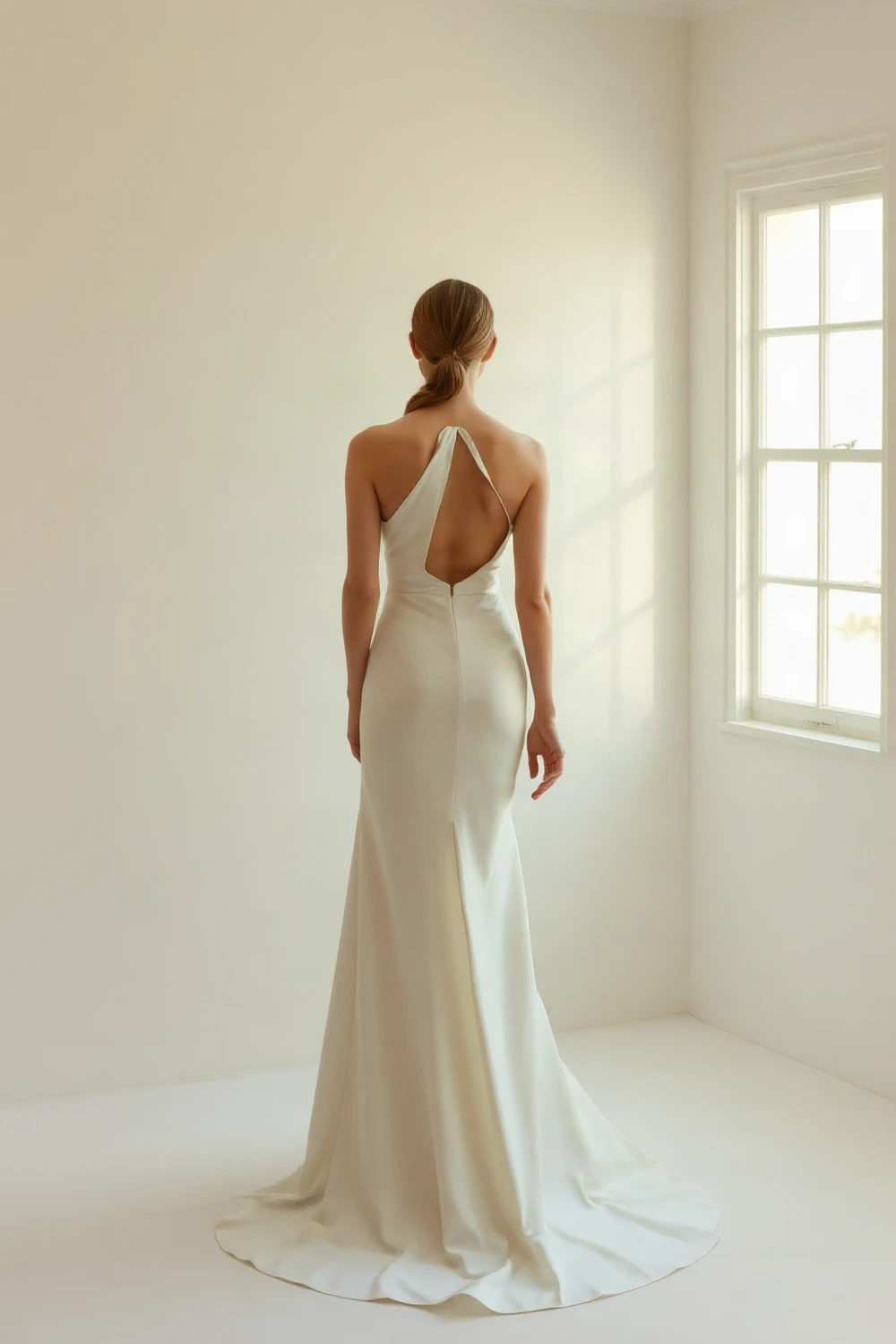
Asymmetric Tie and Curved Opening
The third concept replaces paired straps with a tie-like element rising from one shoulder toward the nape. Its diagonal edge and curved lower boundary create a more organic opening than a sharp V. The silhouette stays close through the hips before widening into a rounded train. That even floor arc provides a calm, symmetrical counterweight to the shoulder’s directional line.
On this minimal surface, the asymmetry becomes the main decoration and distributes tension differently from balanced straps. Check that the tie does not pull against the neck, rotate the bodice or shift the curved edge sideways. Hair gathered from the nape reveals the construction, but a veil comb or loose strands should not interfere with it. The result feels softer than the deep V, yet its cutout boundary is clearer and more deliberate than the fourth look’s draping.
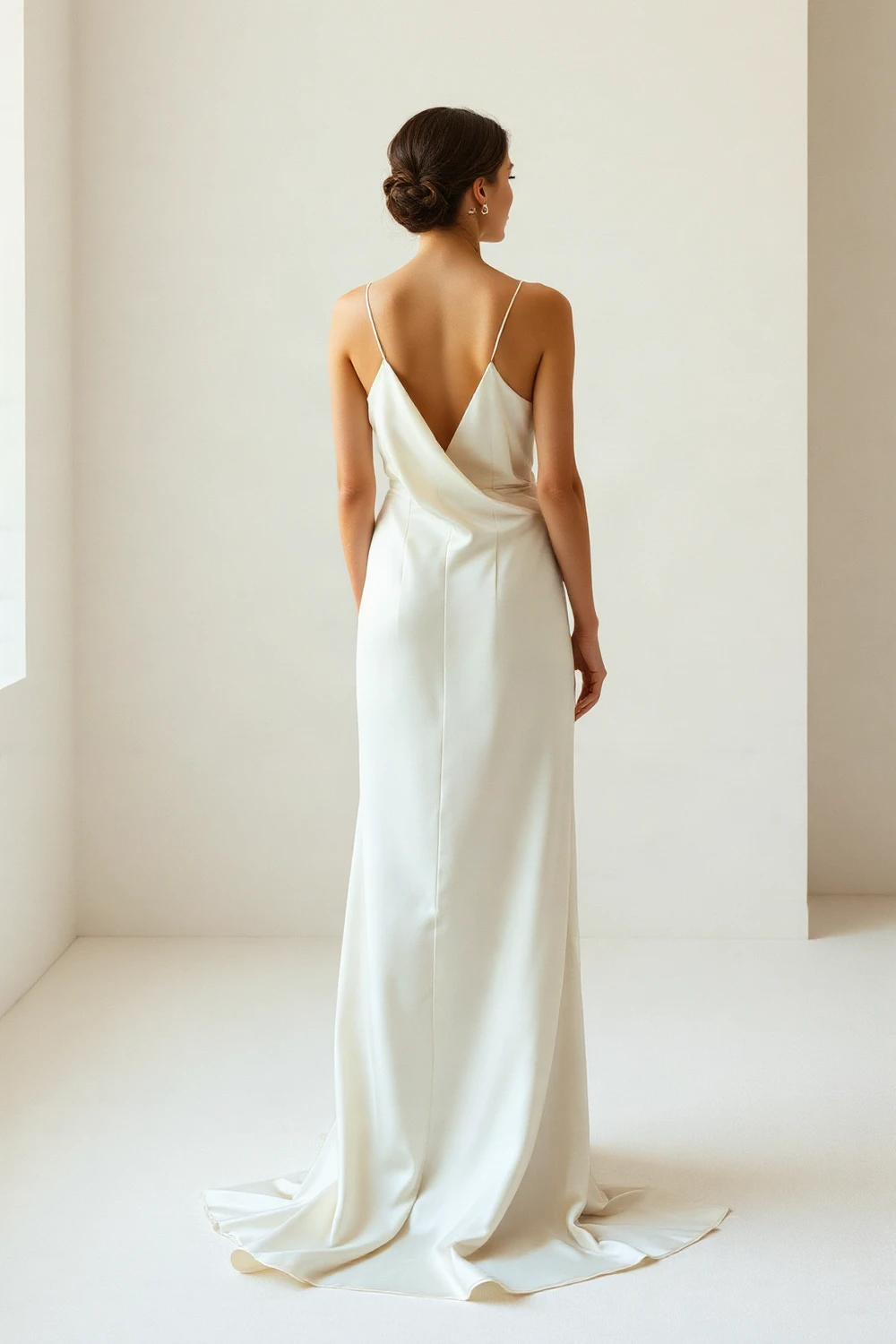
Draped V Back and Straight-Falling Skirt
The fourth look creates its V with overlapping panels rather than taut edges. Fine straps keep the frame light, while the crossover forms a soft central fold and shadow. The skirt falls more directly from the waist and leaves a narrow floor sweep, making fluid draping—not a large train or sculpted lower silhouette—its defining quality.
Softness still needs control in motion. Photograph the back while standing, sitting and turning to see whether folds pull sideways, the upper edge falls away or the waist join twists. Limited floor coverage may suit a busy venue, although the hem should be tested with the intended shoes. A long veil could hide or compress the drape; an updo with no veil, or a shorter veil, keeps it visible. Styling should preserve rather than flatten the crossover.
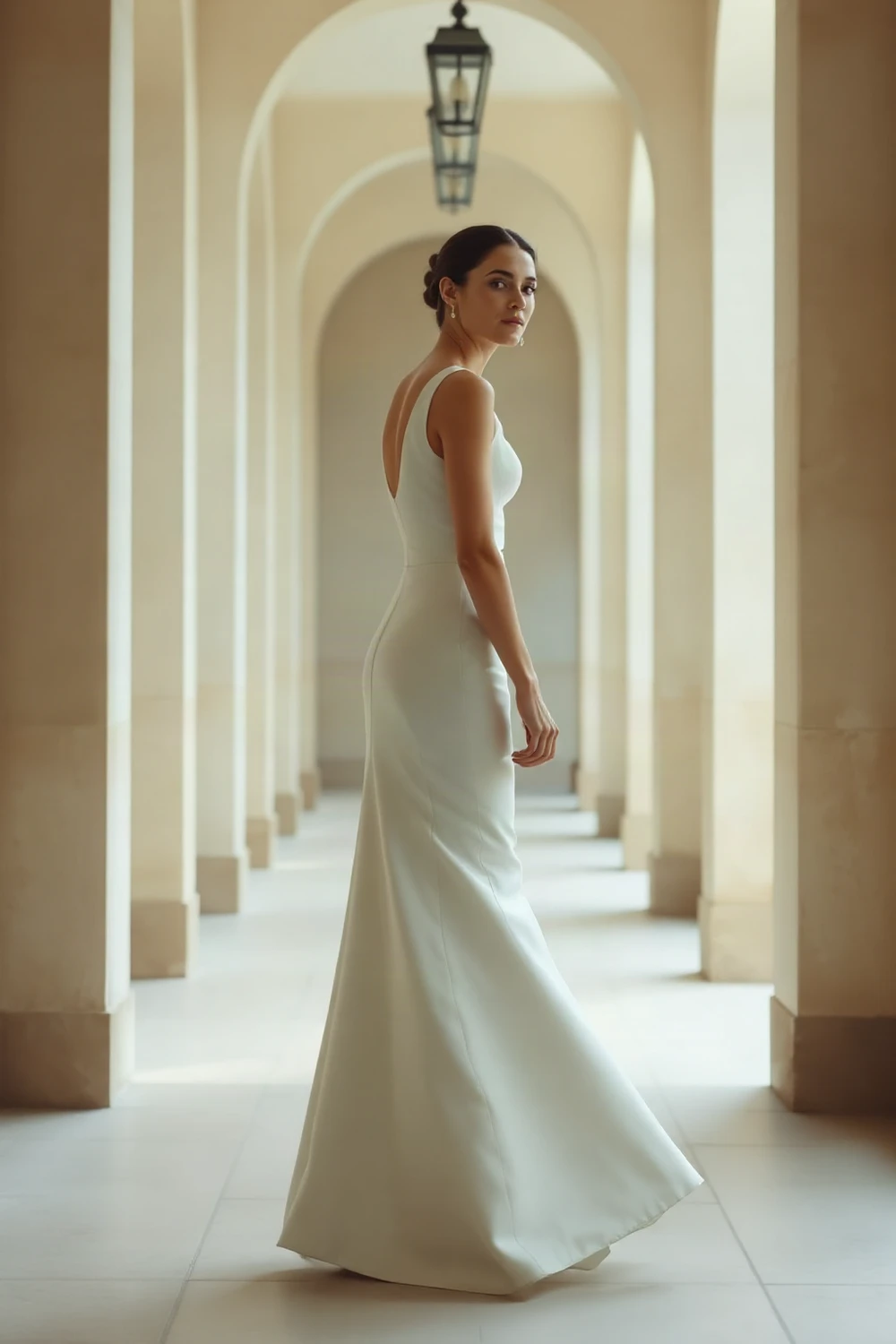
Broad Straps and a Measured U Back
The fifth silhouette uses broader straps and a U-shaped opening ending above the waist. It offers more visual coverage than the deep V while remaining distinctly open. A close upper skirt expands gradually downward, and the corridor’s repeating arches reinforce its controlled vertical proportion. The hem conveys movement and flare rather than a long, stationary train.
Broad straps create a stronger upper frame but do not confirm support by appearance alone. Internal construction, torso fit and armhole shape still need joint assessment. Reach forward and raise the arms to ensure the shoulders do not pull and the U edge stays flat. Turn in the intended shoes to check whether the flare catches underfoot. The clear outline can coexist with prominent architecture without competing with it. A simple low bun and small earrings continue the straps’ clean direction.
Horizontal Support Band and Geometric Back
The final look connects fine straps with a horizontal upper-back band. Below it, the opening tapers to a lower point, combining horizontal and diagonal lines. A close, elongated body line and rounded sweep train give the graphic upper section a quieter foundation. Substantial skin remains visible within a more structured frame.
The band suggests support visually, but its function cannot be determined from appearance. It should feel secure without constricting, sagging or rising when the arms lift. Wrinkles near the lower point may signal that the cut or torso length needs adjustment. This geometry is sharper than the fourth look’s drape and more layered than the uninterrupted deep V. A low bun and restrained earrings keep the complete shape visible. If wearing a veil, test its position over the band and the back’s appearance after removing it later.
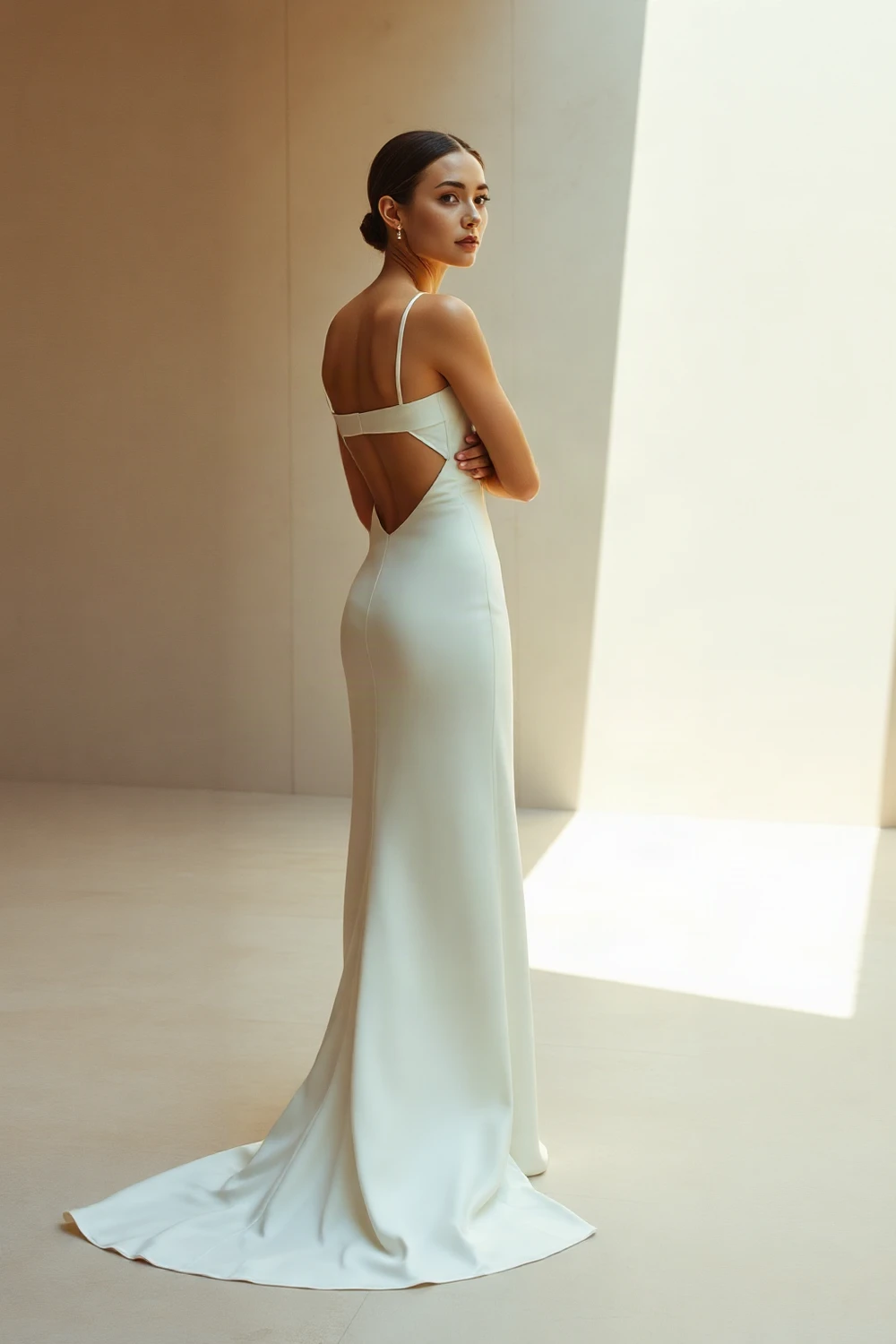
Choosing among minimalist open-back wedding dresses requires considering the whole rear silhouette, not only exposed skin. Fine straps and a moderate opening feel light and balanced; a deep V with a broad train adds drama; an asymmetric tie creates direction; draping brings softness; a broad-strapped U offers more visual coverage; and a horizontal band supplies a graphic frame.
The final choice should also work in motion. Sit, walk, turn, embrace and raise the arms while wearing the intended shoes and, where possible, planned understructure. These tests reveal whether edges lie flat, straps remain stable and the train is manageable. Venue circulation, floor conditions and the day’s pace may affect the suitable sweep. Test hair and veil choices simultaneously because they can reveal, conceal or compress the defining detail. The strongest design remains coherent from every angle and dependable beyond a posed view.
Compare six minimalist open-back wedding dress ideas, from fine straps and deep V shapes to asymmetric ties, draping and support bands, each balanced by a softly sweeping train.
Frequently asked questions
What should be tested when trying a very deep open back?
Lean, sit, reach and raise the arms. Check that the edges remain close to the body, the straps do not shift and the planned support stays completely outside the visible opening.
Which train shape is easier for a compact or busy venue?
A short sweep like those in the first, fourth or fifth image will generally occupy less floor space than the broad second or third train. It should still be tested on the actual type of flooring where possible.
Which back shapes offer more visual coverage?
The moderately open first concept and the broad-strapped U back in the fifth image provide more coverage than the waist-deep V, while still retaining a clearly open-back effect.
How can hair be styled with an open-back dress?
A low bun or other updo exposes the full design. Loose hair softens the frame, but it should be checked to ensure it does not conceal or disturb an asymmetric tie, drape or horizontal band.
Does a horizontal back band guarantee more support?
No. It creates a structured visual line, but actual support depends on fit and internal construction. Test whether the band constricts, sags or rides up and whether any understructure remains hidden.