
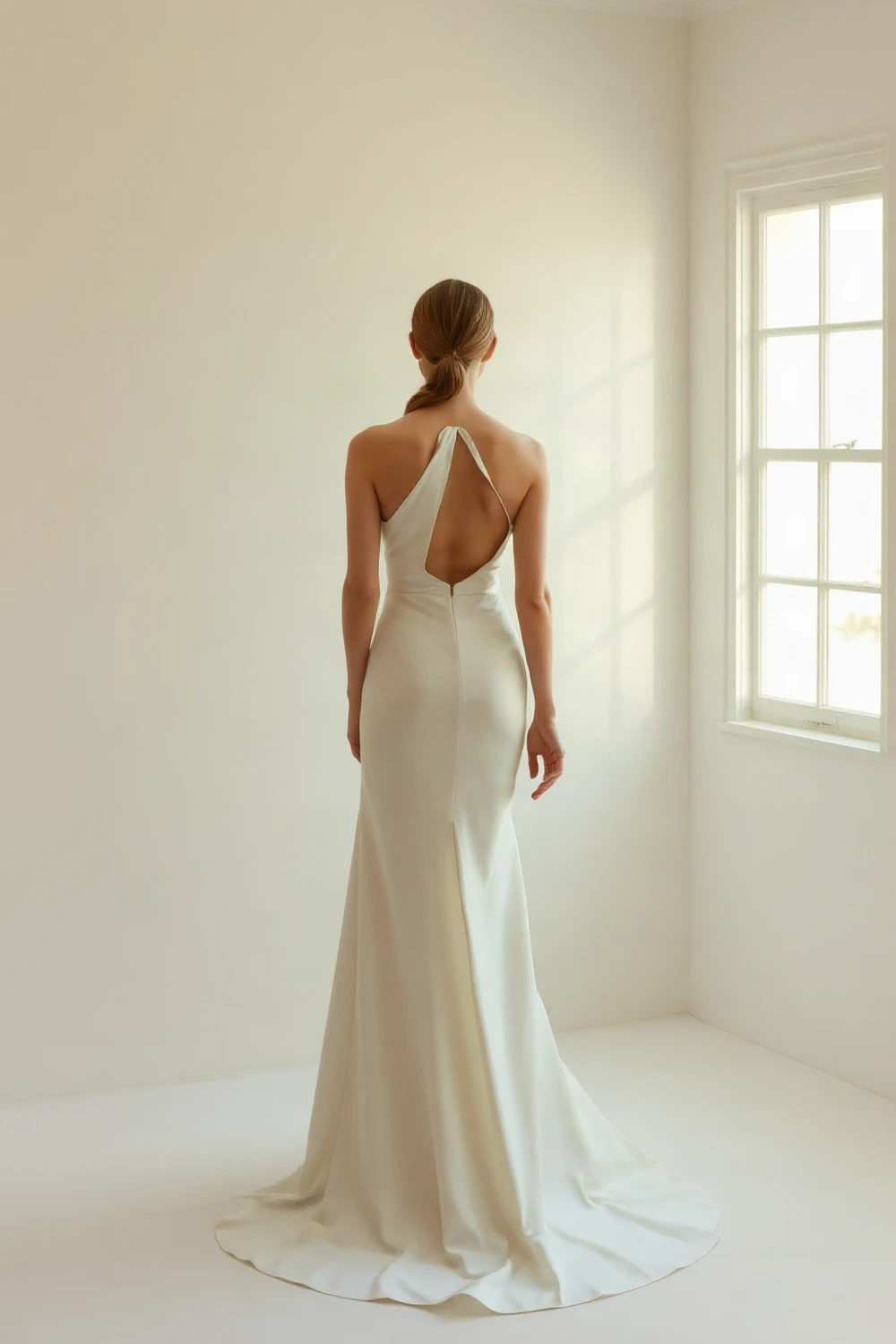
This white look has an asymmetric upper line that distinguishes it from the fine paired straps elsewhere in the gallery. A wider piece rises from one shoulder and forms two tie-like ends near the nape. Its diagonal edge then frames a broad, curved back opening whose lowest point approaches the waist. Below it, the body remains clean and close through the hips. Pale walls, a white floor and limited window shadows keep the composition quiet, allowing the changing direction of the neckline and cutout to remain easy to see.
The skirt opens gently below the knees and settles into a rounded train. That symmetrical floor shape gives a calm foundation to the movement created by the single shoulder. Compared with the sharp V in the second image, this opening has a more organic curve; compared with the draping in the fourth, it is a more clearly cut-out area. When trying an asymmetric design, check that the shoulder element does not pull at the neck, rotate the bodice or make one edge drift. A low ponytail or restrained updo can leave the tie visible, but the hair should also be tested for friction or interference where the ends meet the nape.