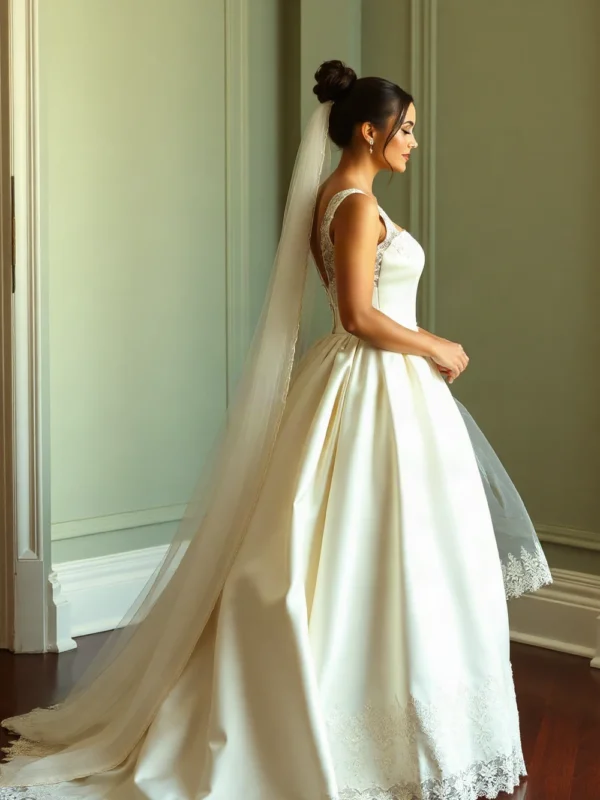
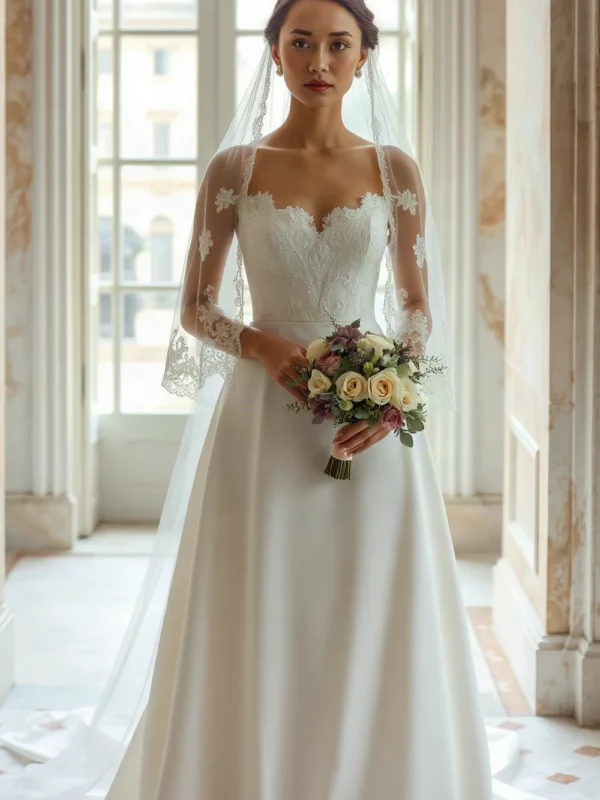
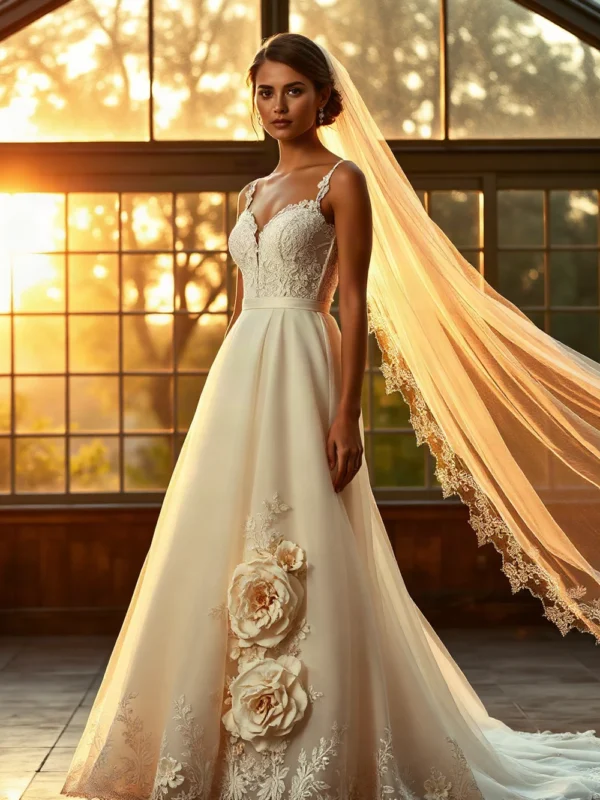
These six visual concepts share a strapless sweetheart neckline, a body-following silhouette that opens below, and some form of lace effect, yet they feel distinct. Small continuous texture and a slim band create restraint; a deep center notch adds drama; broad smooth areas between large botanical motifs produce a bolder graphic effect. Settings from a gray studio and plant-filled room to a warm stone niche, city window, and coastal sunset also alter how ivory tone, relief, and train footprint read. Treat the images as style references for clarifying preferences before a fitting, not proof of purchasable finished products. Look beyond a static front view: assess neckline security, waist emphasis, flare position, pattern scale, and the train’s fit with the venue. These comparisons translate visible differences into practical fitting, movement, and styling questions.
Quiet Texture and a Slim Waist Accent
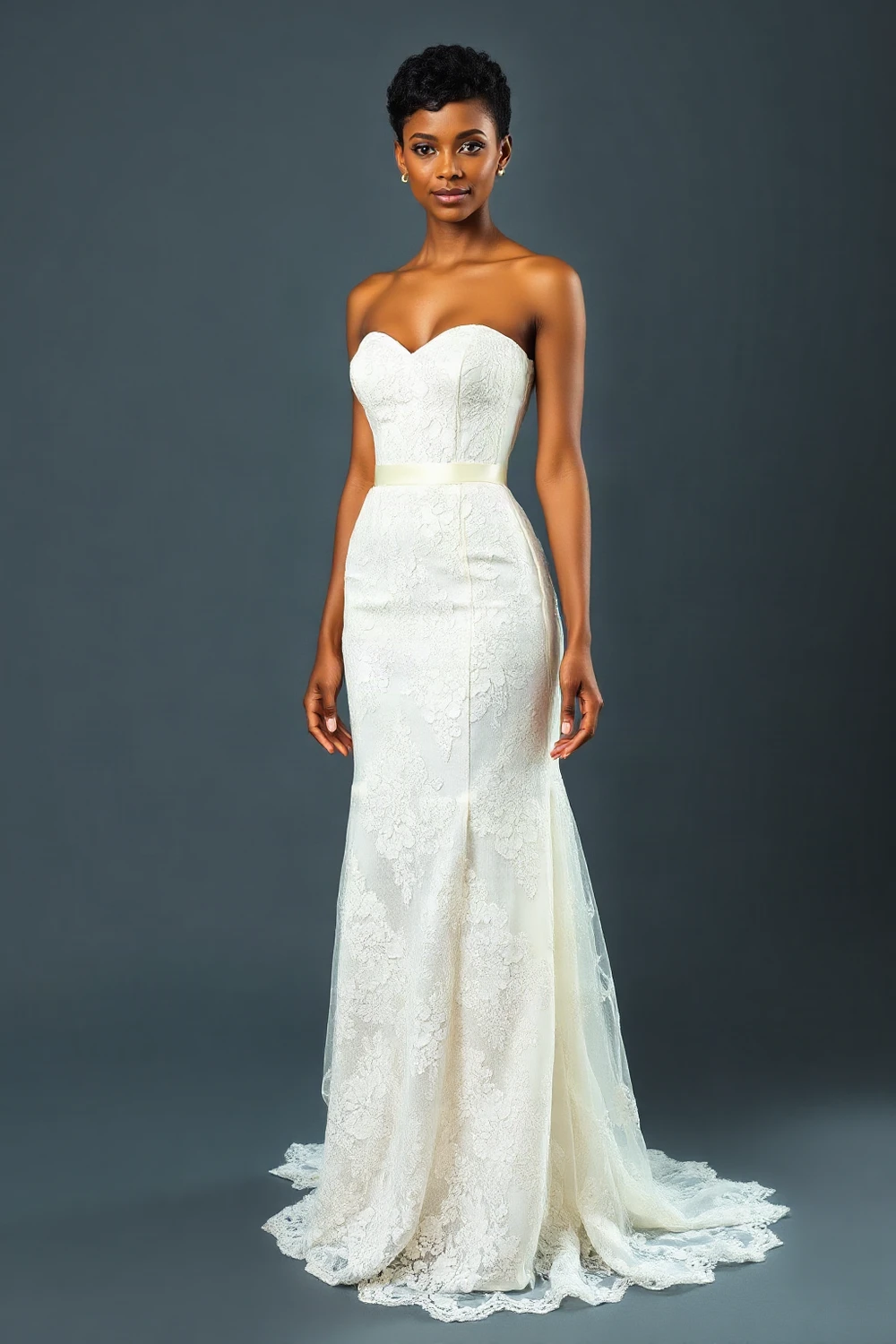
The first direction gains strength from restraint. Small continuous lace against the gray studio is organized by a soft sweetheart neckline and slim pale waistband. The skirt stays close through the hips and upper legs, then opens late, creating a long, column-like outline finished by a short scalloped train without visual weight. Compared with the fourth image’s broad train or the fifth’s oversized motifs, it is quieter and rewards close viewing. In a fitting, check whether the band meets the natural waist rather than dividing the torso awkwardly, and whether the late flare permits a normal step. Sit, turn, and simulate stairs instead of trusting a still mirror view; discomfort may appear only when the narrow section moves.
Deep Neckline, Sparkling Waist and Layers
The second concept defines the sweetheart neckline with a deep, narrow center notch. Dense bust texture is balanced by calmer skirt areas and a thin sparkling waistline, while a plain veil frames the silhouette without fully covering it. Window light makes the relief and widening skirt especially visible. The effect is more dramatic than the first image’s moderate neckline and more layered than the unbelted fourth concept. Look beyond depth: the neckline must stay stable during arm movement, the waist decoration should remain comfortable when seated, and the veil edge should complement rather than compete with the lace. View the combination in daylight, indoor ceremony light, and photographs from several distances to learn whether sparkle, surface pattern, or neckline dominates under actual conditions.
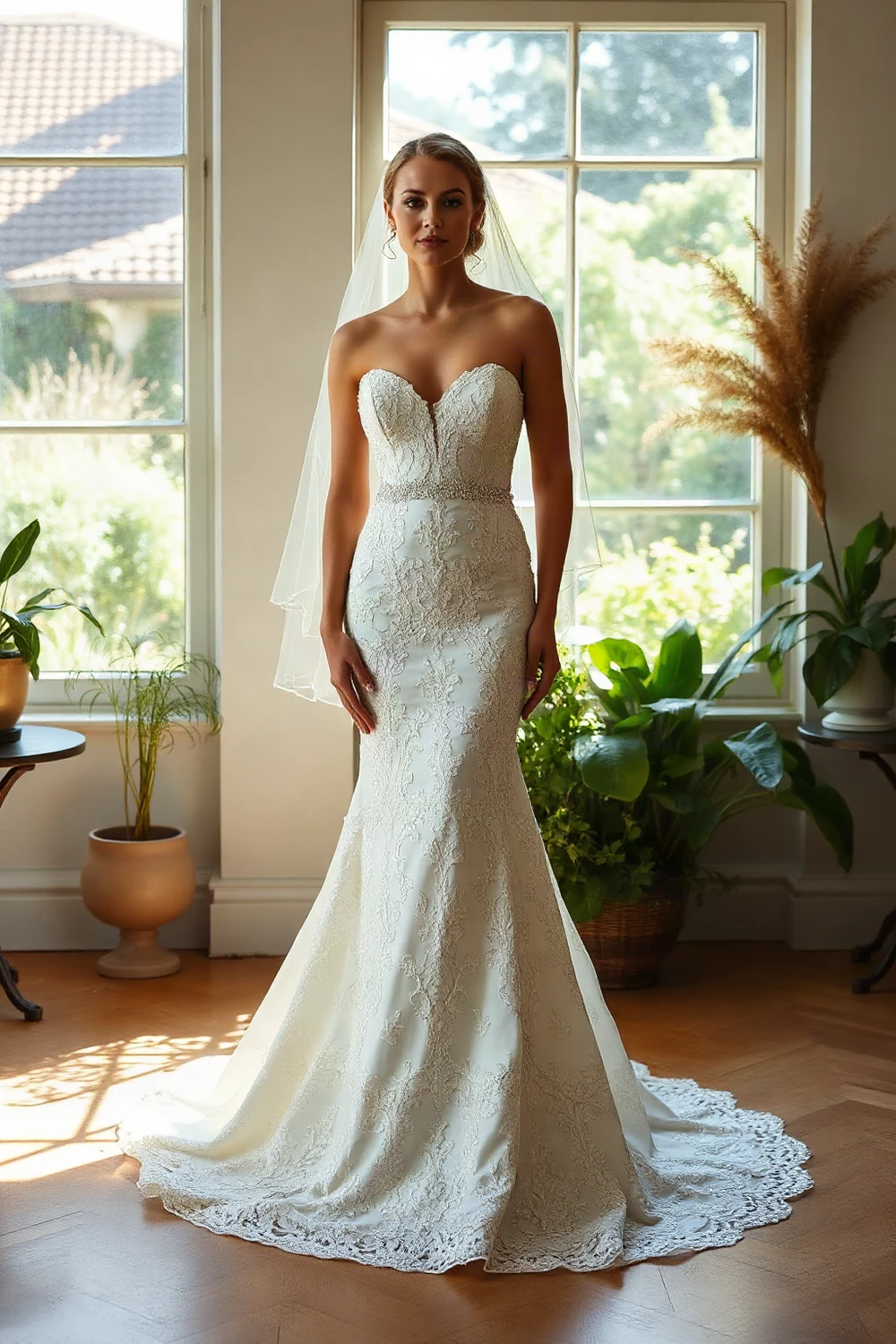
Structural Lace on a Smooth Surface
The third concept treats lace as a structural marker rather than an allover field. Sculpted bust sections, a long central panel, and lace-like pieces descending at the sides create clean vertical flow within the warm stone niche. The skirt opens softly below the knee and ends in a short, smooth train. This is more minimal than the sixth image’s symmetrical motif density or the fourth image’s uninterrupted texture. Yet smooth areas reveal seam tension, underlayers, and minor fit irregularities more readily than pattern. At a fitting, inspect the side profile and seated line as well as the front, then walk and photograph folds that appear in motion. Bust support, the meeting point of side decoration and body, and available stride through the narrow upper skirt determine whether the clean idea succeeds.
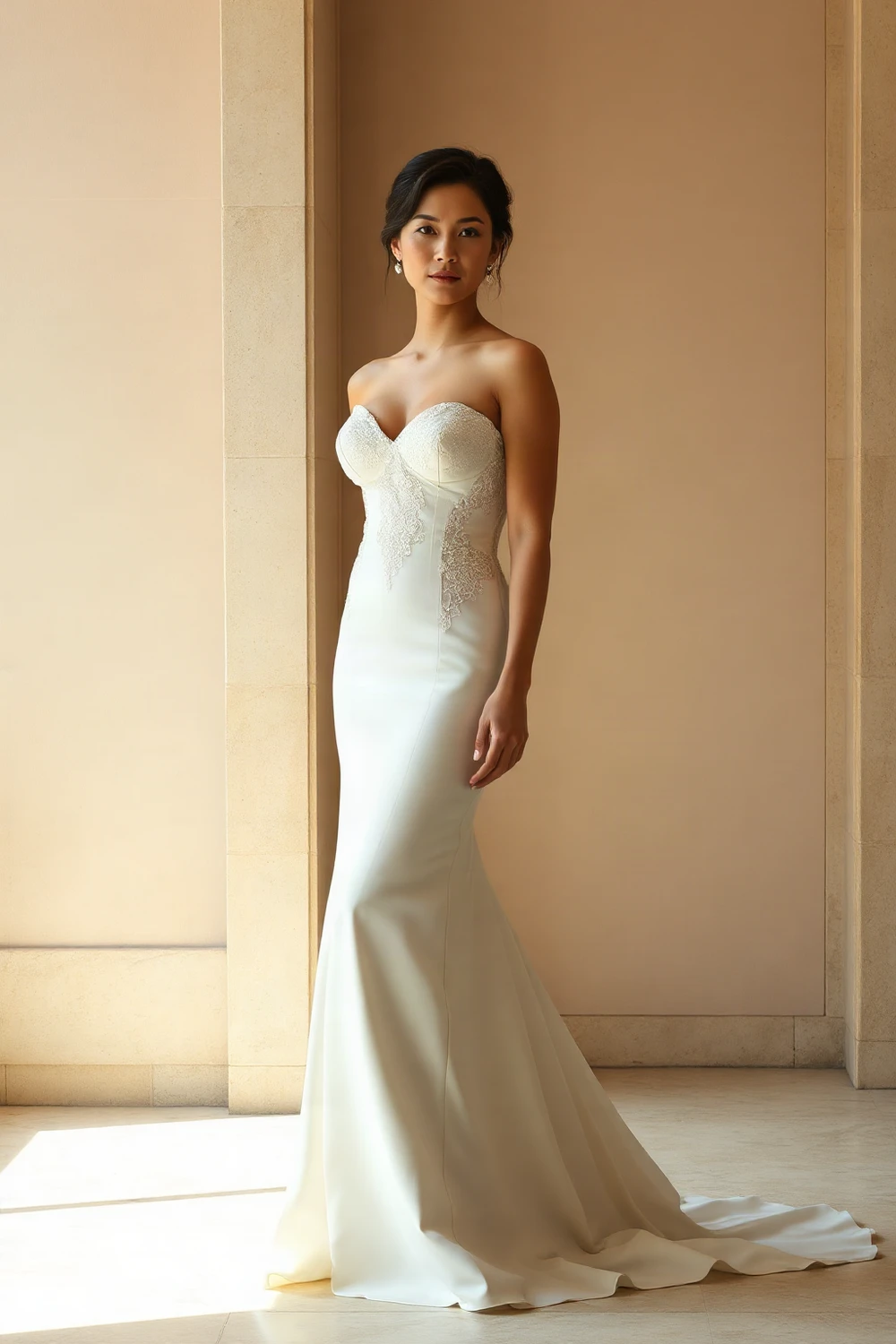
Continuous Lace and a Broad Scalloped Edge
Without a belt interrupting it, the fourth concept carries lace continuously from the sweetheart bodice toward the floor. The fitted upper skirt expands around the lower legs, where a broad, openwork-looking scalloped edge frames the silhouette. A bright room and distant city buildings contrast romantic texture with a contemporary environment. Unlike the second image’s multiple focal points, this idea emphasizes surface continuity and the train perimeter. The wide edge may impress in broad photographs but requires more management in narrow aisles, on stairs, and over rough flooring. Assess it beyond a perfectly arranged pose: gather the train, turn several times, and see how a fastening changes its appearance. Also review a distant full-length photograph to confirm that cut, seams, and pattern direction define the waist without a belt.
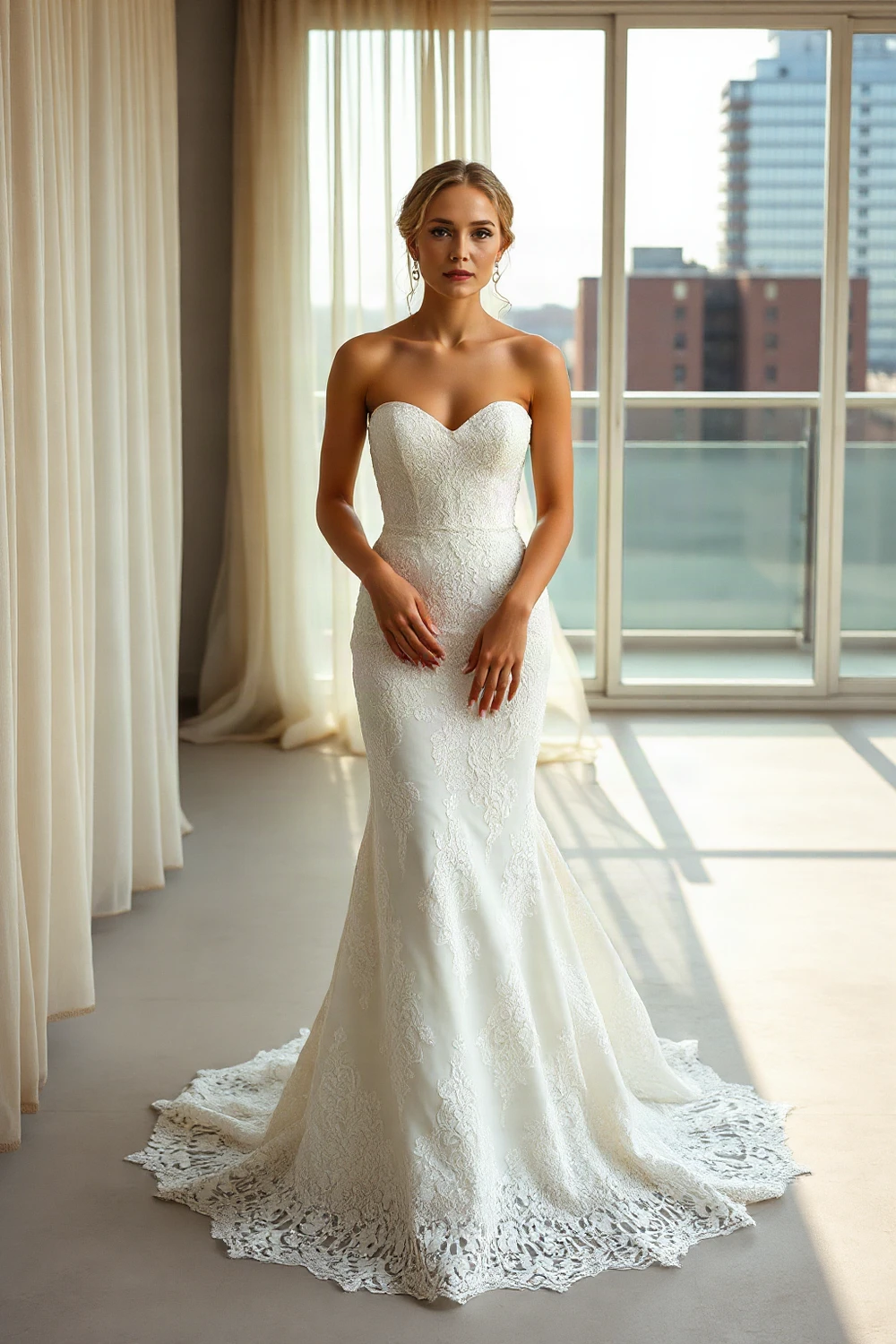
Large Botanicals at an Outdoor Scale
The fifth image sets widely spaced leaf and branch motifs across a smooth ivory ground. A deeply notched strapless bodice, close-fitting torso, and generously opening skirt form a strong outline on the sunset terrace. Compared with the second concept’s smaller, busier motifs, these remain easier to read from a distance. The angled composition also clarifies how the long train relates to the surrounding floor. For an outdoor setting, harmony with the scenery is only one issue. Consider how wind moves the skirt and train, how the lace-like edge meets textured stone, and whether strong backlighting erases subtle white-on-white detail. Photograph a similar surface facing the light and in shade, then test walking and turning. Because the large motifs already provide a focal point, quieter jewelry and a restrained veil often create a clearer composition than several competing decorative layers.
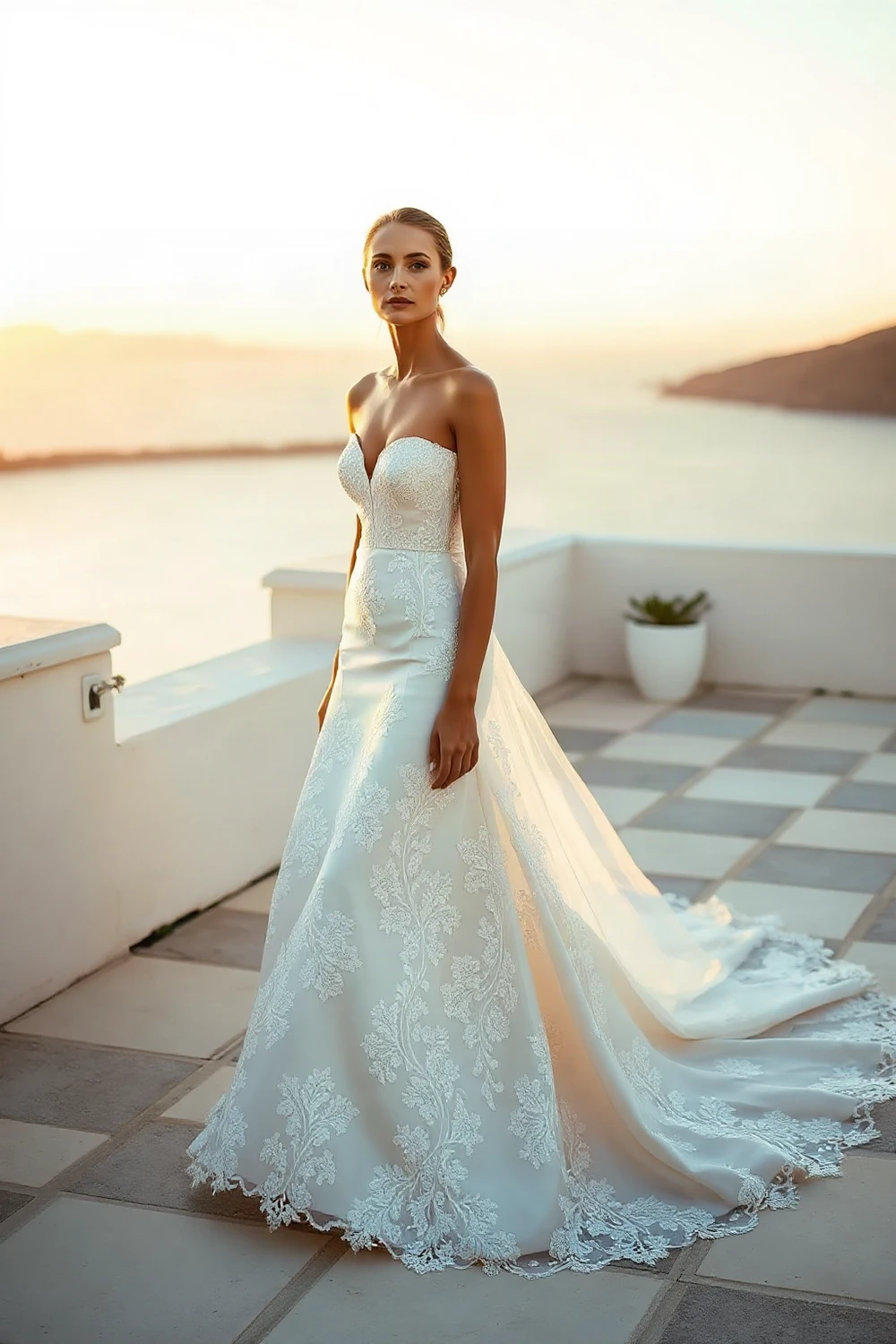
Symmetry, Vertical Rhythm and an Ornate Hem
In the sixth concept, raised lace-like appliqués descend in symmetrical rows over a smooth ground. Their vertical rhythm lengthens the narrow torso, while the expanding skirt and dense border around the floor create a formal base. It is more decorative and ordered than the third image’s sparse side accents. Because it appears on a dress form, however, it provides no dependable evidence about bust support, moving proportions, stride, or train behavior; the separate shoulder motifs should not be assumed to be structural straps. Use it mainly as a pattern-placement reference. With similar decoration, ask whether bodice alterations would displace the central row, side seams would interrupt repeats, or the ornate border would complicate a length adjustment. Exact alignment matters because small shifts can be more noticeable than on an irregular pattern.
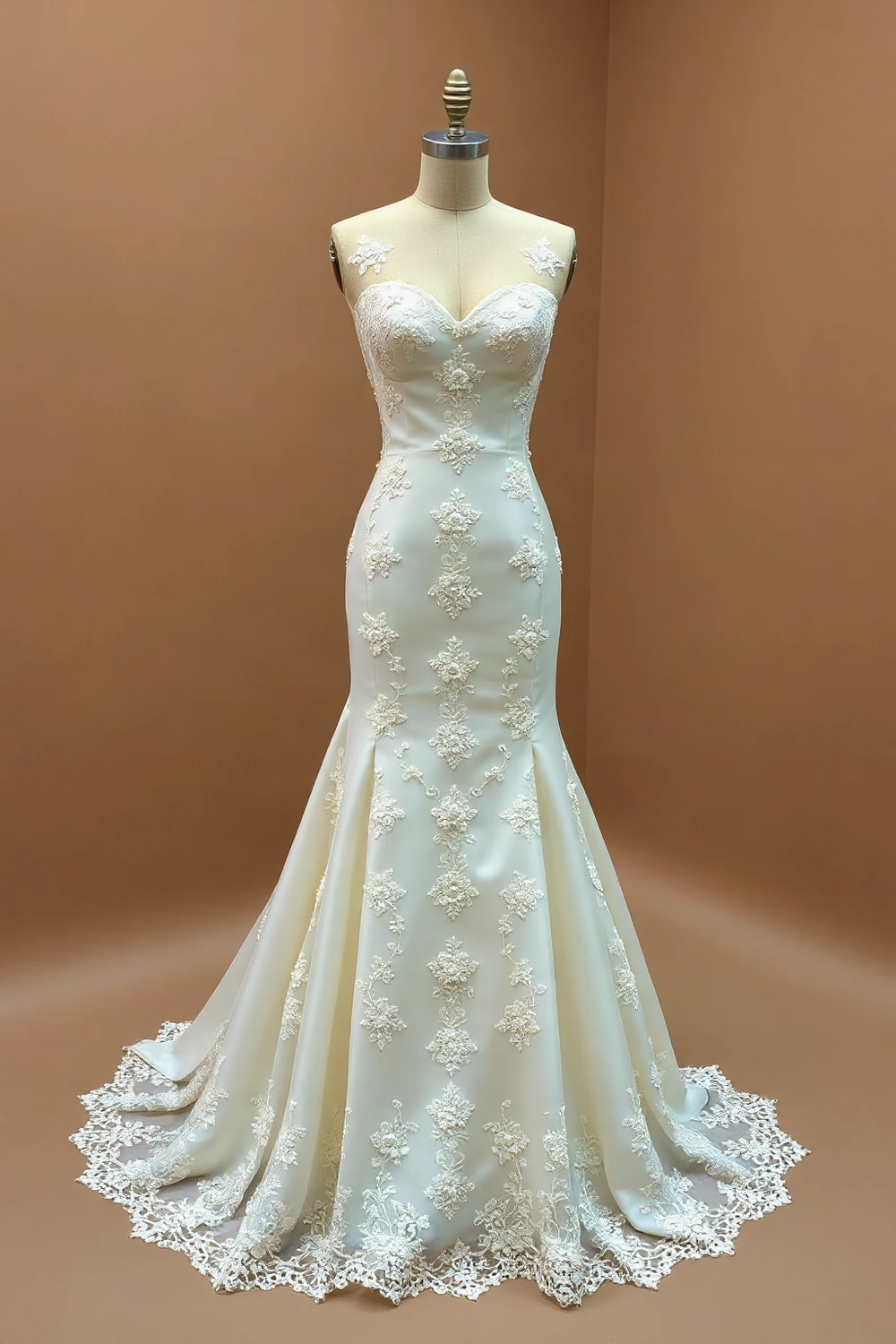
The best direction is not necessarily the most elaborate, but the one suited to the venue, required movement, and intended focal point. Start with priorities for neckline depth, surface density, flare position, and train footprint. At a fitting, take front, side, and back photographs, comparing close views with images from several steps away. Sit, walk, raise your arms, turn, and test the train spread and gathered over a similar floor if possible. Continuous lace offers quiet cohesion, smooth panels modern clarity, and large appliqués a strong distant presence. Add belt, veil, and jewelry only after settling the main surface and neckline. These concepts do not verify finished products, but they can turn aesthetic preferences into precise questions about support, comfort, alterations, and actual use.
Explore sweetheart lace wedding dresses through neckline depth, waist definition, motif placement and skirt shape.
Frequently asked questions
Should I choose a deep center notch or a softer sweetheart neckline?
A deep notch creates a more dramatic central line, while a softer sweetheart reads as calmer and more continuous. Do not decide by appearance alone. In either version, raise your arms, sit and turn to test top-edge stability and the feeling of support.
How do I choose between allover lace and placed appliqués?
Small continuous motifs create a cohesive texture at close range. Larger, widely spaced appliqués preserve more smooth ground and may read more graphically from a distance. Consider the likely photography distance at your venue and compare both close-up and full-length images.
When is a slim waist band useful?
A band can define the transition between bodice and skirt and provide a clear focal point. If it sits away from the natural waist, however, it may interrupt proportion or compete with dense lace. Photograph the look with and without it, and test pressure while seated.
How should the venue influence train choice?
A broad scalloped or long sweeping train can work visually in open, smooth areas, but narrow aisles, stairs, outdoor stone and heavy foot traffic require more management. Learn the floor conditions and practise walking with the train spread, gathered and fastened.
Which movements should I test in a fit-and-flare dress?
Walk at a normal pace, sit, imitate a stair step, turn both ways and raise your arms. Watch whether the flare point restricts stride, the neckline shifts, side seams pull or the train approaches your feet during movement.