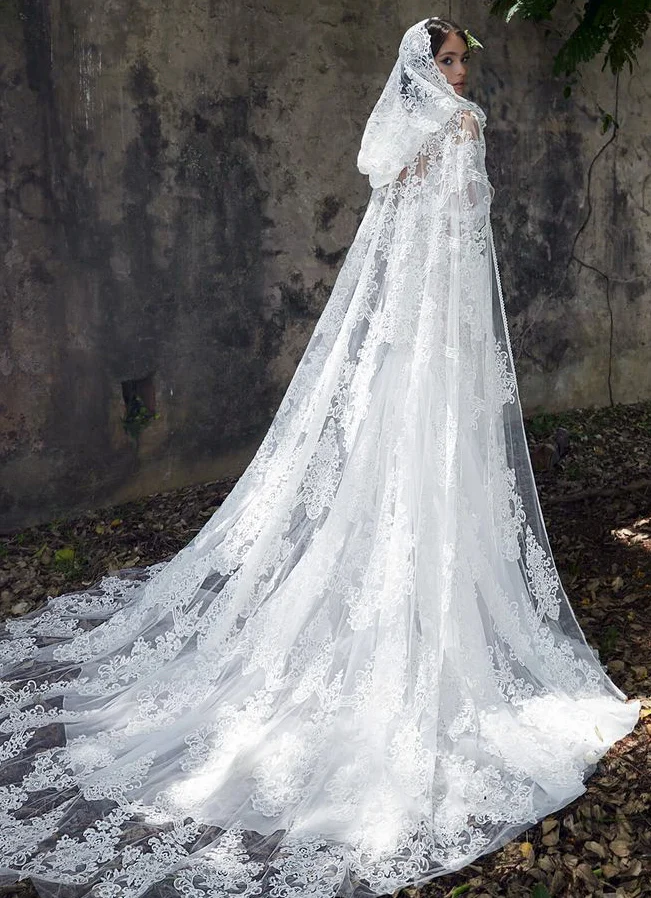
The bridal cape with a floral border shows a broad flower edge running down the sides and across the trailing outer area. Its hood-like upper section sits around the head while the body turns slightly back. A pale dress remains visible through the layer. Larger flower forms and curved ends define the edge more strongly than small evenly scattered points. This is therefore a useful rear comparison for border prominence, but it is not the back of a star model or evidence of a shared product range. Its broad arrangement cannot be added to your candidate as an established feature.
Use it to decide your own cape ending. Compare a distinct border and a quieter edge beside the actual dress hem. Look from a distance to choose between two visible frames or allowing one to recede. On a star model, the last motifs’ distance from the edge may matter too; request its own rear view. Test the real longer piece seated and through a narrower passage afterwards. The broad floor area is one arrangement, not proof of unrestricted alteration to length or fastening. Make the final comparison with the actual dress and cape together.