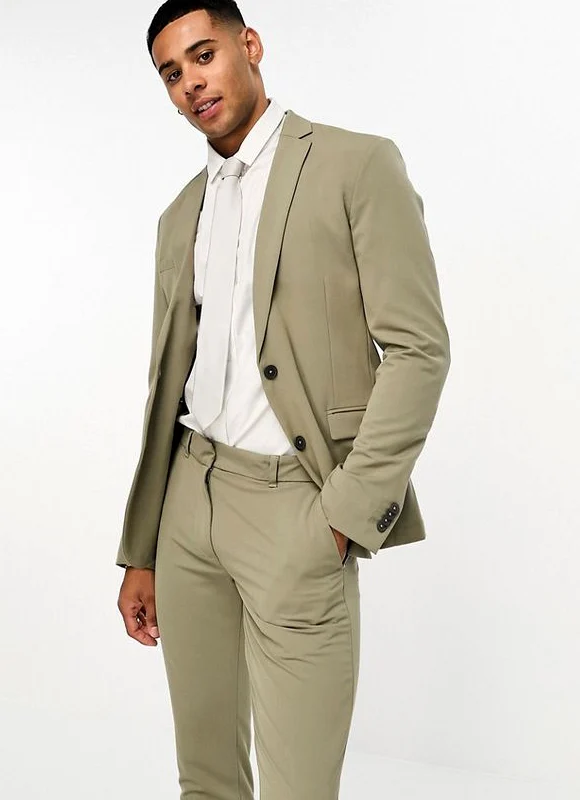
A checked suit repeats a pattern across the jacket and trousers, so compare the scale, contrast and complete silhouette before adding accessories. A fine brown check can read differently from a large pale grid on charcoal grey. Neither automatically tells you the fabric, quality or suitability for a particular event.
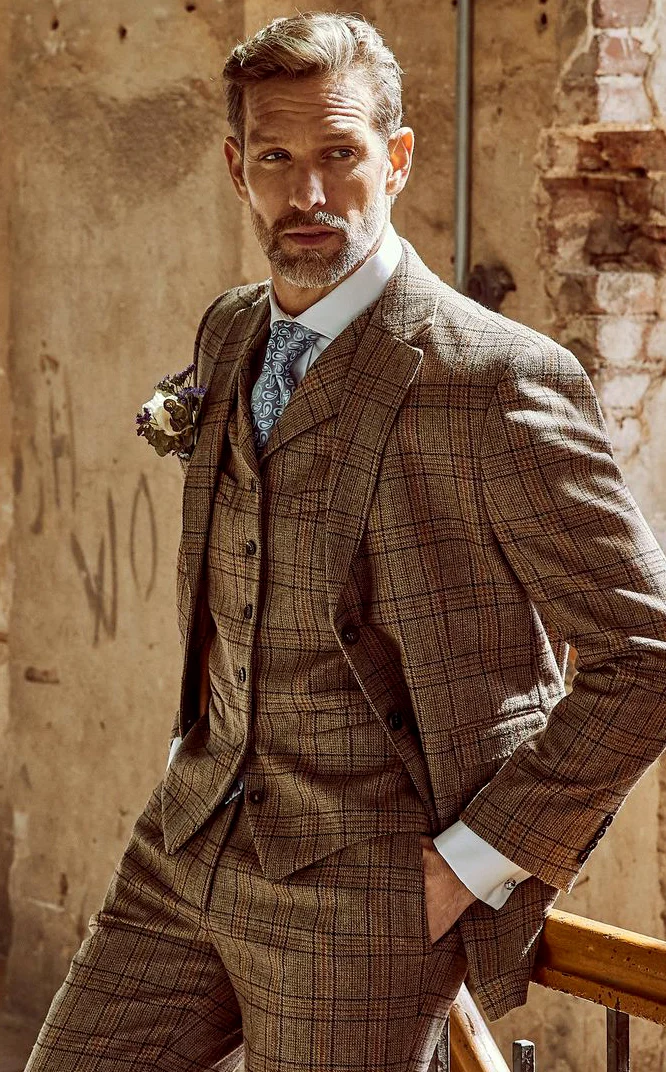
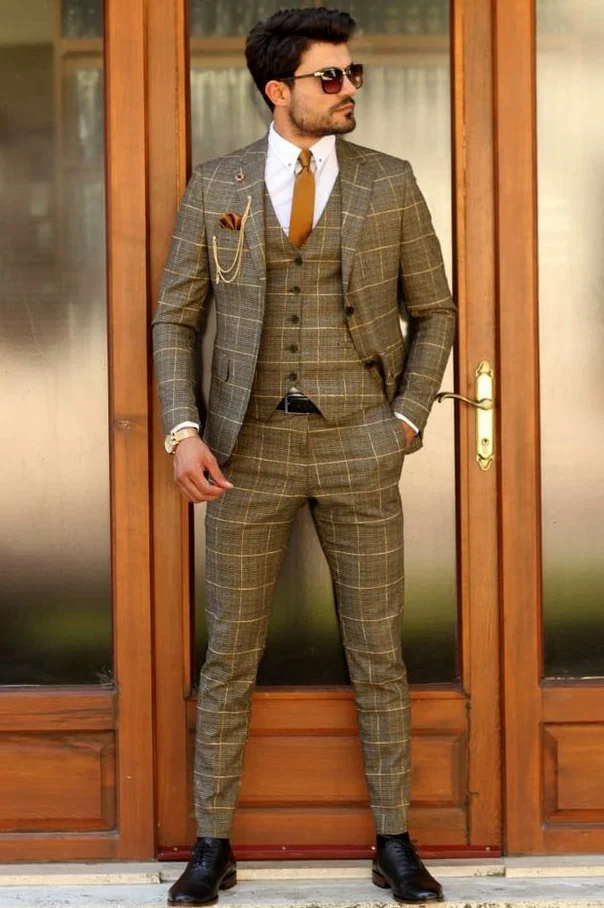
Our references compare a brown checked three-piece, an olive-brown suit with a contrasting warm tie, and a grey three-piece with a clearly visible pale grid. The photographs illustrate styling choices. They do not establish the maker, fibre content, price or whether the items can currently be purchased. Use the gallery to identify details you would like to compare in real garments.
Checked suit: compare the pattern at a normal distance
Start with a full-length view rather than a close crop of the cloth. Notice how strongly the pattern separates from the base colour and whether it remains visible from across a room. A small, low-contrast check can look almost plain at a distance, while a broader grid may remain an obvious part of the outfit.
Try two scales with the same shirt before changing every accessory. This helps you decide whether you prefer the check itself or the overall colour. If photographs are allowed, use similar lighting and distance for both suits. Do not treat a brighter photograph as proof that one fabric has more depth or a different composition.
Compare the three references
The brown reference combines a checked jacket and waistcoat with a patterned tie. Multiple repeated elements sit close together around the chest. If this interests you, first try the suit with a plain shirt and one tie, then compare a second pattern. Keep some elements constant so that you can see which combination you actually prefer.
The olive-brown look presents more of the full silhouette. A warm-coloured tie stands out against a light shirt, while dark shoes ground the outfit. Use the image to compare the relationship between jacket length, trouser line and footwear. The photograph is a visual reference rather than a verified fitting or construction guide.
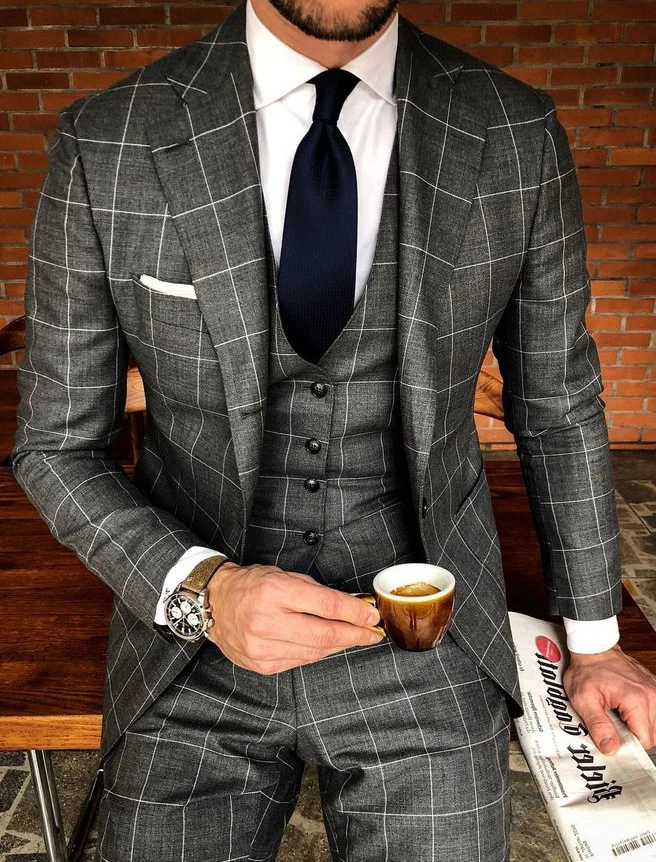
The grey three-piece uses a larger, light-coloured grid and a dark tie. The close view makes the pattern particularly noticeable. Compare a similar grid at a normal viewing distance before deciding how much additional pattern to add. A quieter shirt can give you a clear starting point for that comparison.
Check the jacket in a natural position
Stand with your arms relaxed and look at the shoulder line, collar and front. Then fasten the jacket as intended and move normally. Notice any area that pulls, opens or feels restrictive. A preferred silhouette may be close or relaxed; the useful question is how the real jacket sits and moves on you.
Reach forward, turn and sit. Describe the exact movement when asking for a fitting adjustment. A tailor or alteration specialist can explain which changes are feasible on that garment. Do not assume that every shoulder, collar or front issue can be corrected by simply taking in the waist. Get advice before buying a size that depends on extensive alterations.
Assess the trousers with your shoes
Try the actual shoes or a pair with a similar shape and sole. Look at the front and back of the trouser leg, then walk and sit. Decide how much contact with the shoe you prefer at the hem. A cropped reference photograph is not a universal instruction for the length of every suit trouser.
Check the waist while seated as well as standing. If the suit includes a waistcoat, inspect the relationship between its lower edge, the trouser rise and the shirt. Ask about the proposed changes as a whole. Altering a trouser length does not answer every question about its balance or comfort.
Combine patterns one decision at a time
A plain shirt is a useful starting point because it leaves the check easy to read. Add a tie and assess the whole chest area, then decide whether a pocket square contributes something you want. The aim is a deliberate composition, not a fixed limit on the number of patterns anyone may wear.
If you like mixing patterns, compare their scale and contrast. A fine tie pattern and a broader jacket grid may remain visually separate, but judge the actual combination in the mirror. Small photographs can blur details. Keep your personal preference and the event in view instead of relying on an automatic matching formula.
Match formality to the invitation
A checked suit and a dinner suit are not interchangeable labels. Read the invitation before deciding what to wear. Debrett's describes black tie as a specific formal evening convention; if that wording appears, clarify the expected outfit rather than assuming a dark checked suit fulfils it. Hosts can also give event-specific guidance.
For an office event or a celebration without a stated code, think about setting and the role you will have. Compare your proposed outfit with any direct information from the organiser. There is no need to attach an unsupported claim about professional success or personality to a particular check. The practical decision concerns the occasion and the appearance you want.
Use history as context, not a trend promise
The V&A's Fashioning Masculinities material explores the construction and changing interpretation of menswear and the suit. It offers context for seeing tailoring as something designers continually reconsider. That historical perspective does not prove that any one checked pattern is the dominant trend this year.
For your own wardrobe, decide which pieces you can combine and when you expect to wear them. Try the complete suit before considering the jacket as a separate item. A combination you enjoy repeatedly can be more useful than a look chosen only because an old headline assigns it a future year.
Confirm alterations and care
List any work on jacket, trousers and waistcoat, with cost and timing. Check the final outfit together after alterations. Keep purchase information and care instructions; a checked surface alone does not tell you whether the fibre is wool, cotton or a blend. Ask for the actual composition when it affects your choice.
Read the garment's care label. GINETEX explains textile care symbols, but similar-looking suits do not necessarily share the same treatment. Discuss marks or cleaning questions using information about the complete garment. The gallery's individual detail pages provide visual comparisons and fitting prompts, while the real item supplies the evidence for your final decision.
Compare checks at a normal distance and fit in motion. Add shirt and tie in stages and read the invitation’s dress code separately.
Frequently asked questions
How can I compare the scale and effect of the pattern in a checked suit?
Look at a complete checked suit from a normal viewing distance before studying a close detail. Compare two check sizes with the same shirt and similar lighting. Notice the contrast between lines and base colour and whether the pattern remains visible from a few steps away.
Which movements help me assess the jacket fit in a checked suit?
In a checked suit, start with relaxed arms, fasten the jacket as intended and check the shoulder line, collar and front. Reach forward, turn and sit. Describe which movement causes pulling or restriction, then ask which alterations are possible on that actual jacket.
What should I check together when trying the waistcoat and trousers of a checked three-piece suit?
Look at the waistcoat hem together with the trouser rise and shirt, and check the waistband while seated. Wear your intended shoes to assess the trouser leg and hem. Discuss alterations as connected decisions and try the complete outfit again after the work.