Botanical details do more than decorate bohemian wedding dresses. Their scale and placement can frame a neckline, shift the perceived waist and direct how a skirt seems to move. These six soft-white concepts take different routes: dimensional pastel flowers at the neckline, nearly disappearing tonal branches, a lace-like train border, white sprigs on sheer sleeves, small colored embroidery and large leaves radiating across a circular train. Compare motif density with the fitted, A-line or airy silhouette, desired coverage, and front-versus-back drama. Setting also matters: a trailing gown on a garden path, a transparent layer at a windy coast and a wide skirt in a dry field pose different practical questions. Images help comparison, but only a fitting can assess weight, support, comfort and movement. The approaches below connect those checks with each dress’s visual character.
Dimensional flowers framing the neckline and waist
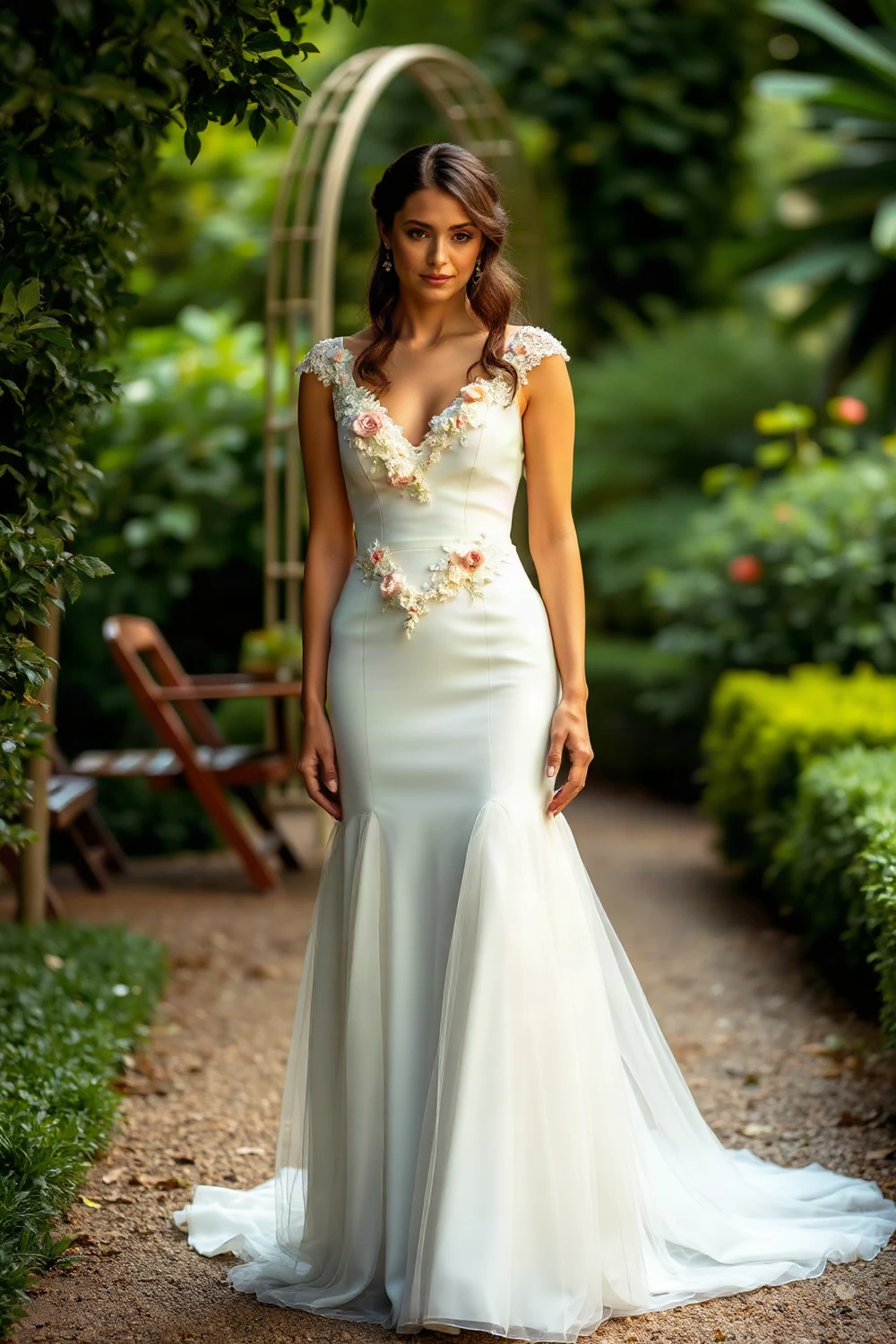
The first concept keeps its close fit and lower flare mostly smooth, concentrating raised pastel flowers around a deep V-neck and front waist. The detail therefore reads clearly in portraits without breaking the skirt’s long line. Short decorated shoulder sections extend the frame upward, while an asymmetric waist cluster creates a second focal point near the body’s center.
It offers a middle ground between a minimalist silhouette and an all-over floral surface. Small earrings may work better than a necklace competing with the neckline, and a restrained bouquet can keep the upper look from feeling crowded because these flowers register more strongly than tonal embroidery. During a fitting, check whether the raised elements touch the inner arms, the V-neck stays secure in motion and the flare allows a natural stride.
Tonal branches balanced by a full skirt
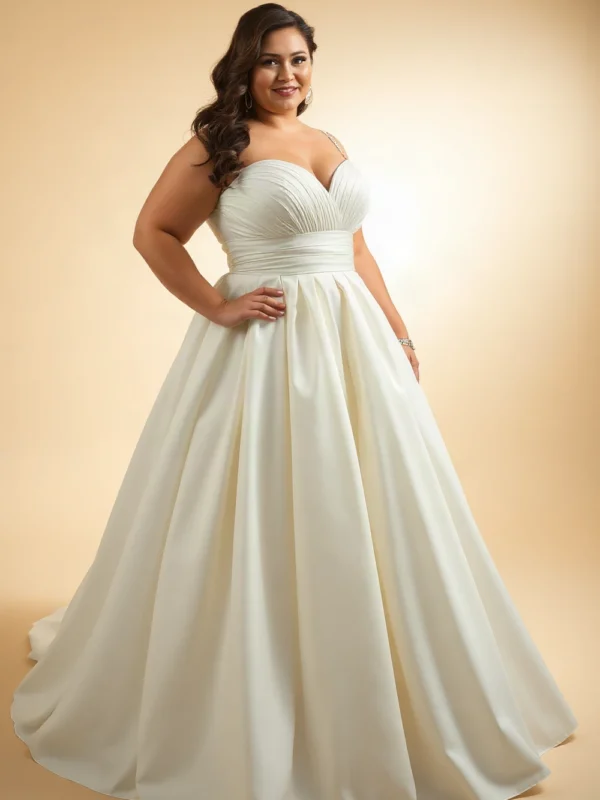
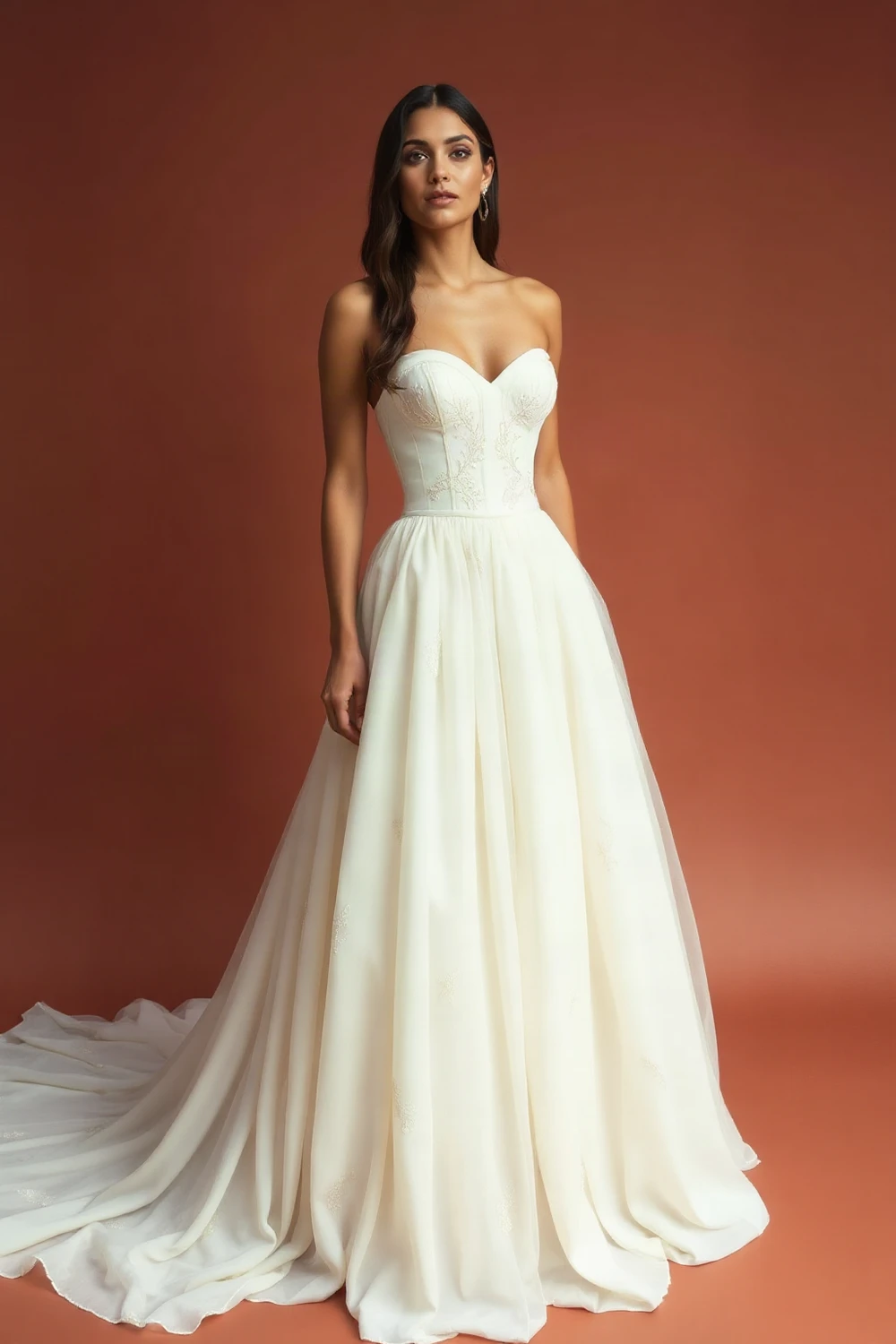
The second design pairs a sweetheart strapless neckline and fitted bodice with a full skirt, establishing classic proportions. Its bohemian character comes from low-contrast branches rather than the cut alone. Most visible across the bodice, the markings become sparse on the skirt so long folds and volume dominate; the warm background shows how subtly the pale embroidery merges with the base.
Tonal detail suits someone who finds colored or dimensional ornament too assertive. Support and stability at the strapless edge matter as much as appearance, so sit, raise both arms and turn during the fitting. Although the skirt offers leg room, it may take substantial space around chairs or in a narrow aisle. One textured earring or a fine botanical hair detail can echo the surface without disturbing its quiet character.
A lace-edged train on a fitted silhouette
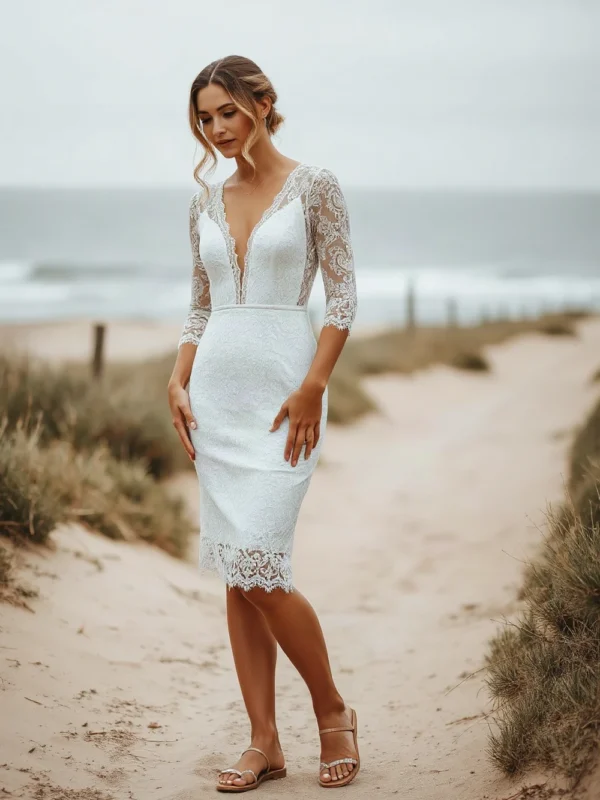
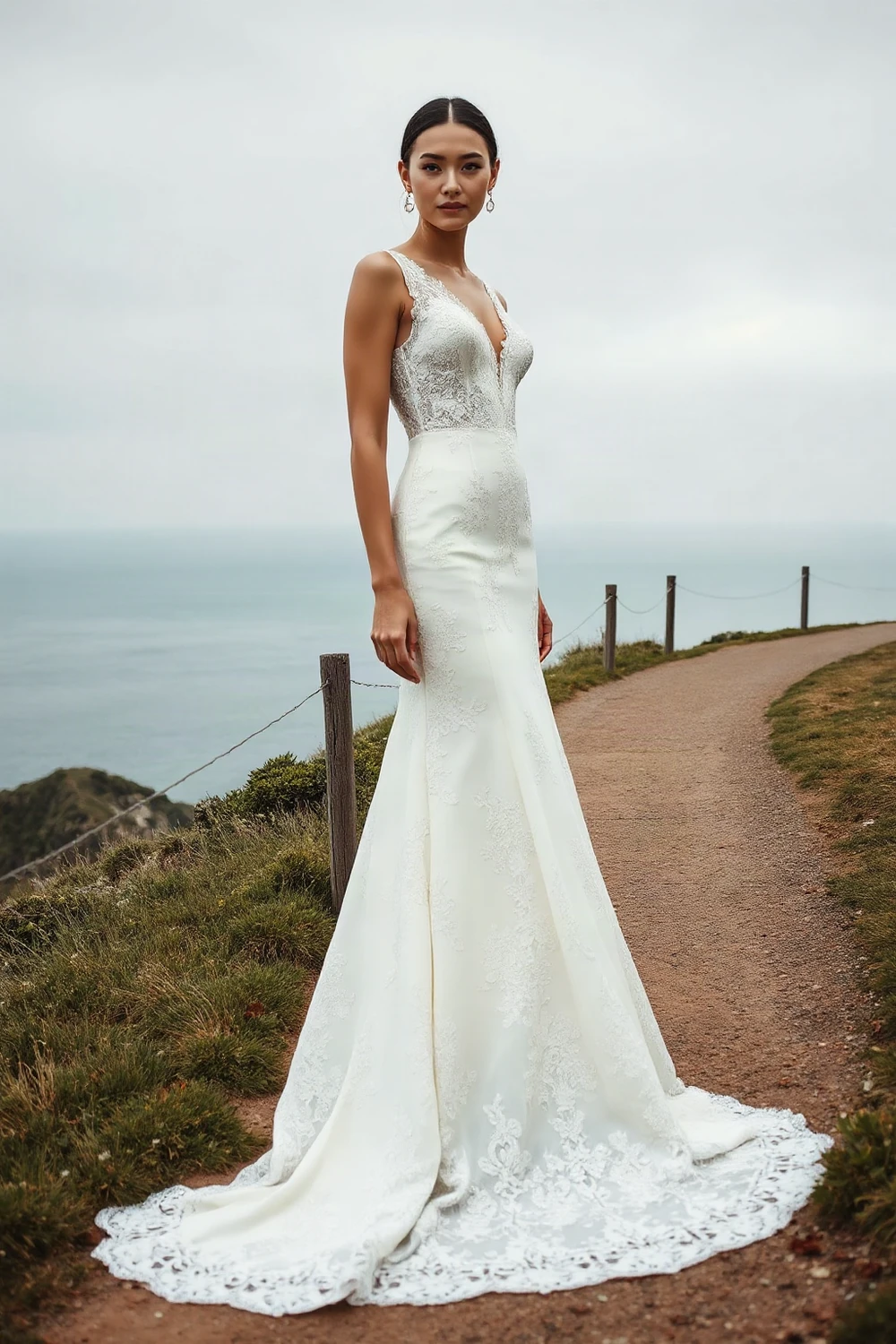
The third gown runs close from broad straps and a deep V-neck through the hips, then opens into a train with an ornate lace-like edge. Tonal motifs strengthen near the floor, leaving the front restrained but making side and back views more decorative. The long coastal path reinforces the vertical line before the hem spreads over the ground.
This distribution suits someone seeking a controlled entrance and memorable train in full-length photographs, but the surface matters. Gravel, dry grass or damp ground can catch or mark the open-looking border. At the fitting, see the train spread, carried and gathered as intended, and test stairs, sitting and long steps because the narrow hip line affects movement differently from an A-line skirt. Managing the hem while preserving its defined border is the practical priority.
Sparse botanical sprigs on sheer long sleeves
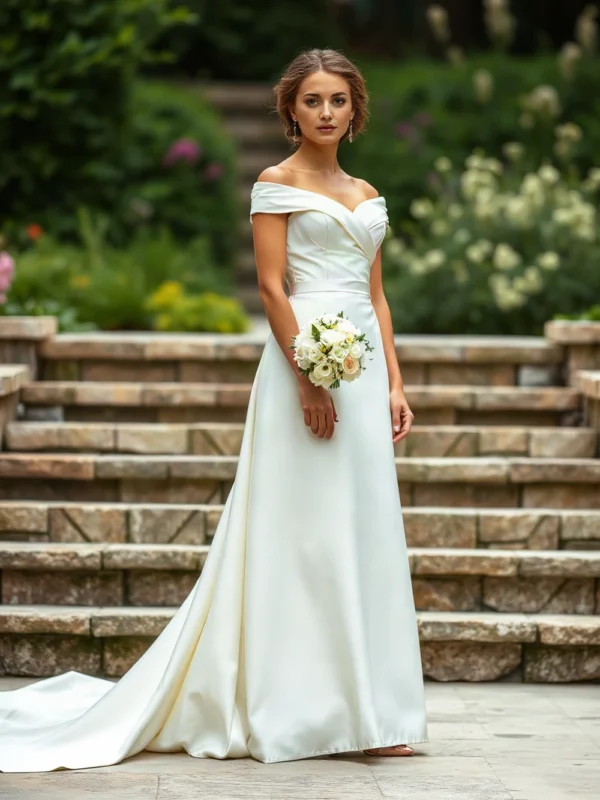
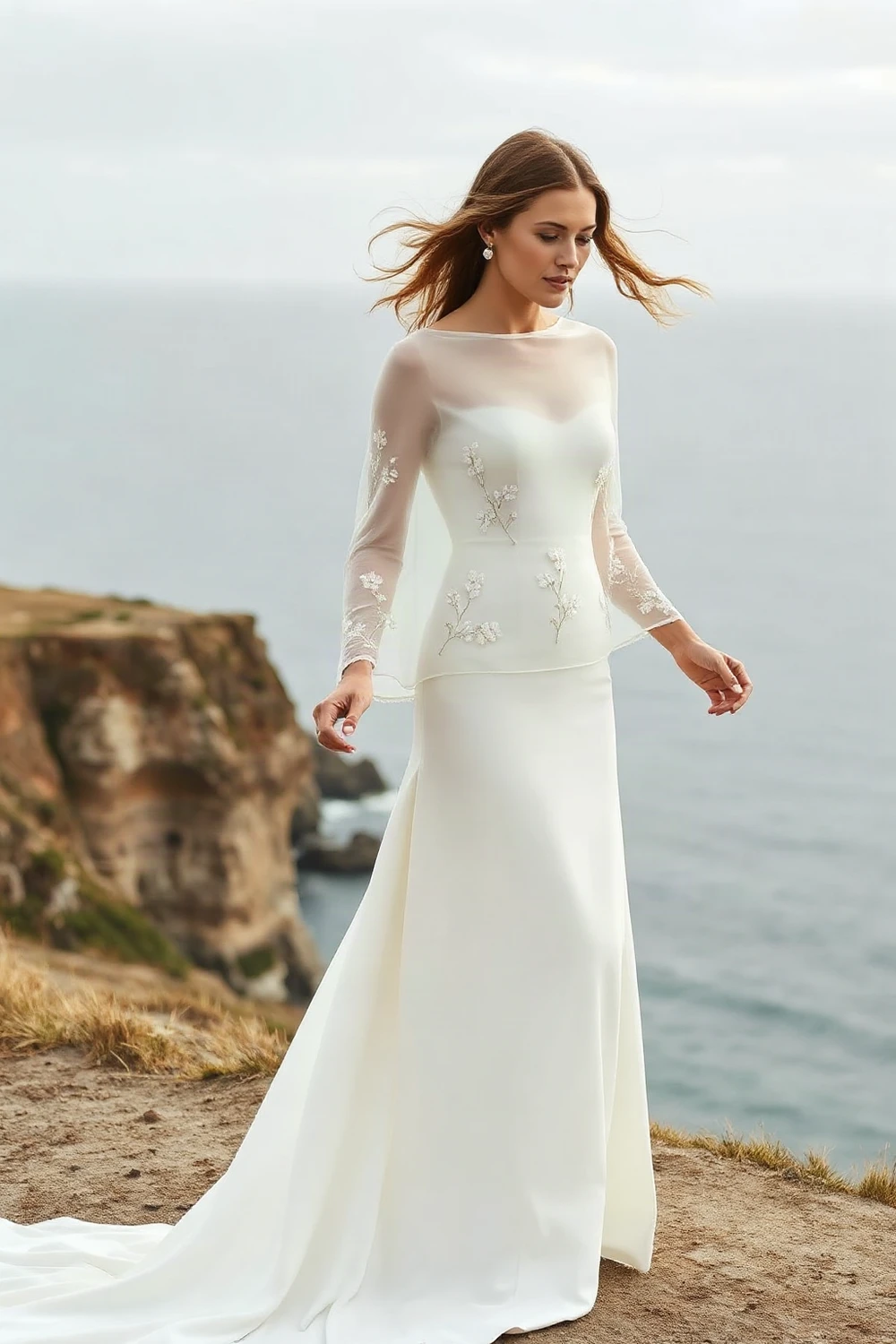
The fourth concept layers a sheer bateau-neck top and long sleeves over a smooth bodice and gently widening skirt. Small white branches are widely spaced from shoulders to wrists and across the torso. With a plain lower section, the coverage remains visually light, while the curved opaque bodice edge is softly visible beneath the transparent layer.
This provides arm coverage without all-over lace. A small earring or simple updo supports the quiet front; a necklace may be unnecessary beside the higher neckline. Because sheerness does not guarantee flexibility, bend the elbows, reach forward and lift the arms during a fitting, checking shoulders and cuffs for tension. At a windy location, observe the fine upper layer around the face and jewelry. Minimal floor-level decoration keeps attention on the sleeves and upper body.
Colored embroidery with airy natural contrast
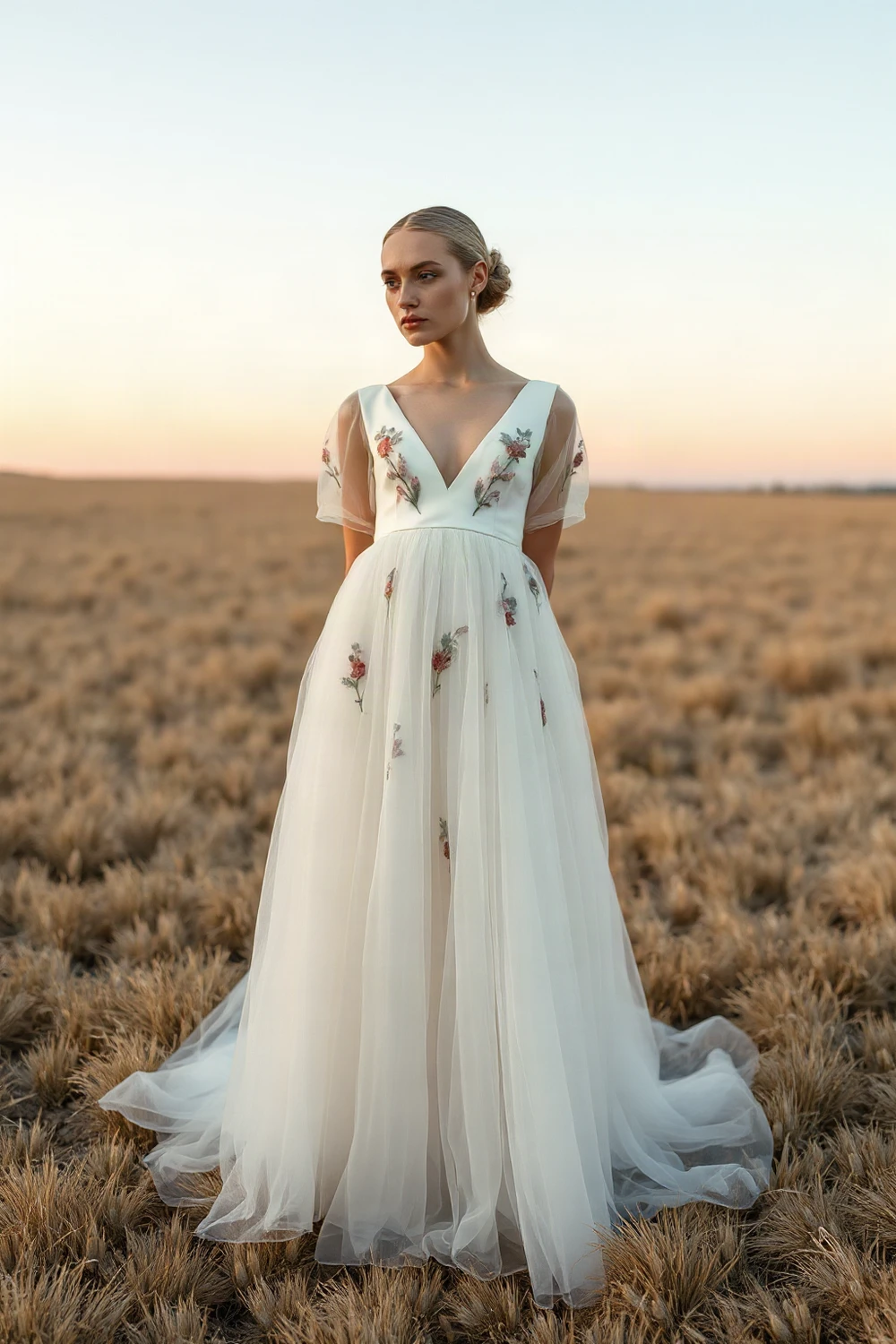
The fifth design scatters small pink, muted red and green botanical motifs across a deep V-neck bodice and flowing skirt. Short transparent sleeves soften the shoulders, and a slightly elevated waist lengthens the loose lower section. Warm sunset light and dry field tones echo the embroidery without eliminating the open spaces between sprigs.
This is the clearest choice for controlled color rather than an entirely white botanical scheme. Bouquet and hair flowers need not repeat every shade; one muted tone used sparingly makes a calmer connection. Because waist placement and V-neck depth vary by body, assess front and side views. Check that the skirt layers clear the shoes and stay separate while walking. The shape may offer more step room than a fitted gown, but loose layers still need attention in wind and turns.
Botanical motifs radiating across the train
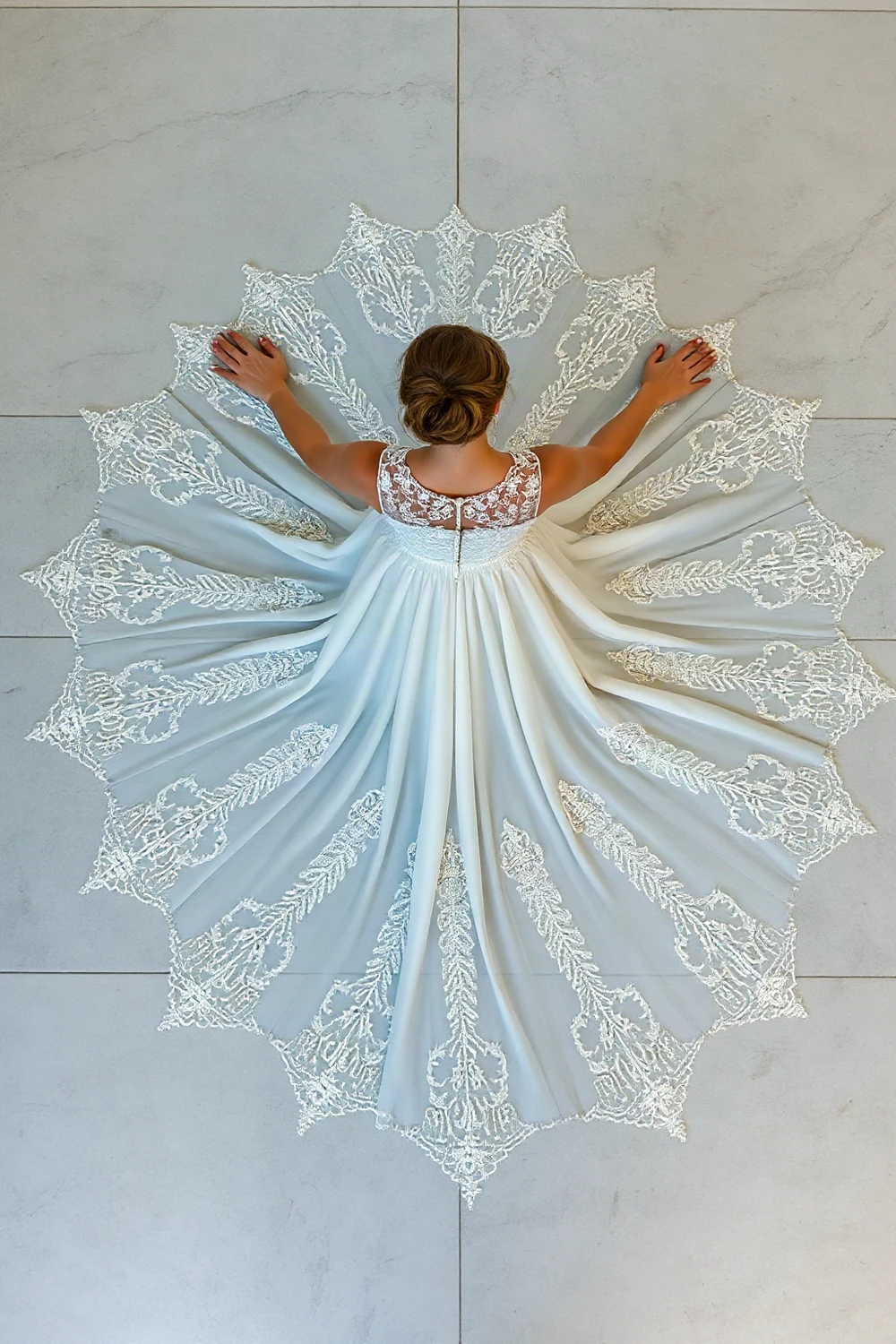
In the sixth concept, botanical detail structures the composition. Broad train panels spread from the waist, with large leaf and bud forms following that direction toward pointed, scalloped edges. A dense lace-like back anchors the center, and plain white spaces divide the repeating motifs. From above, the result is symmetrical and strongly flower-like.
Such scale requires planning beyond photographs. Confirm the ceremony space can hold the train’s full width, choose who will arrange it and determine how it will be gathered afterward. At a fitting, practice turning, passing through a narrow doorway and starting a dance instead of judging only a still pose. Compared with the third image’s narrower train, this layout occupies much more space at the sides. A smooth floor and generous aisle therefore matter as much as the motif when deciding whether it suits the venue.
Choose among botanical bohemian wedding dresses by settling on the silhouette before the flower treatment. A fitted line makes raised blooms clear focal points, while a full A-line softens tonal branches. Sheer sleeves offer visually light coverage, and colored embroidery adds contrast without dense decoration. As a train widens, photographic presence grows, but floor conditions, turning space and gathering become more important. View each option from front, side and back, then reassess while walking, sitting and raising the arms. Testing neckline security, sleeve flexibility, stride length and train handling together matches the visual concept to real movement. For accessories, repeating one color, texture or botanical cue is usually more balanced than copying every gown detail.
Compare dimensional flowers, tonal embroidery, sheer sleeves, colored motifs and radiating trains across bohemian wedding dresses, with practical guidance on silhouette, movement and venue.
Frequently asked questions
Should I choose dimensional flowers or tonal botanical embroidery?
Choose dimensional flowers if you want a focal point that remains visible in portraits and from a distance. Tonal branches create a quieter surface and leave more visual space for accessories.
Can a long train work for an outdoor wedding?
It can work on a dry, even surface, but it should be tested while walking, turning and gathered. Gravel, vegetation and damp ground require extra care with ornate or open-looking edges.
What should I test when considering sheer long sleeves?
Raise the arms, reach forward and bend the elbows. Check for tension at the shoulders, restriction near the cuffs and whether raised motifs or seams cause discomfort during movement.
How should colored floral embroidery relate to the bouquet?
Rather than matching every embroidered color, repeat one muted shade in a limited way. This connects the bouquet and dress without making the entire look feel overly themed.
How do I choose between a circular train and a narrower train?
A circular train creates a strong overhead and rear view but needs more room for display and turning. A narrower train may handle transitions more easily, although both should be tested in their gathered positions.