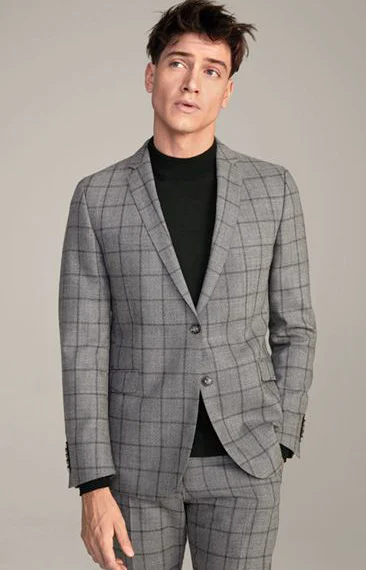
A grey grid defines the jacket and visible upper trousers in this closer front view. Its lines remain darker than the larger grey ground. A plain black top sits beneath without an additional visible tie. One hand rests in a pocket and the other beside the body. The crop finishes before the complete trouser hem. This outfit has a quieter middle than the three references with further neck patterns or larger colour accents, supplying a specific comparison before more drawing is introduced.
Use the arrangement as a deliberate starting point. Inspect only the grid beside the black area on the actual jacket initially. Decide whether that distribution already suffices. If another drawing is wanted, introduce a real shirt-and-tie version as a separate second trial rather than treating the plain top as incomplete. The changed area and its contribution remain identifiable.
Keep important companions reasonably consistent when switching. Look from an ordinary distance and record which pattern appears first. Add a complete stance with your shoes for the whole suit choice. The quiet black middle provides a comparison area without explaining fibre, warmth or universal event suitability. Those questions belong to the real product and your intended setting.