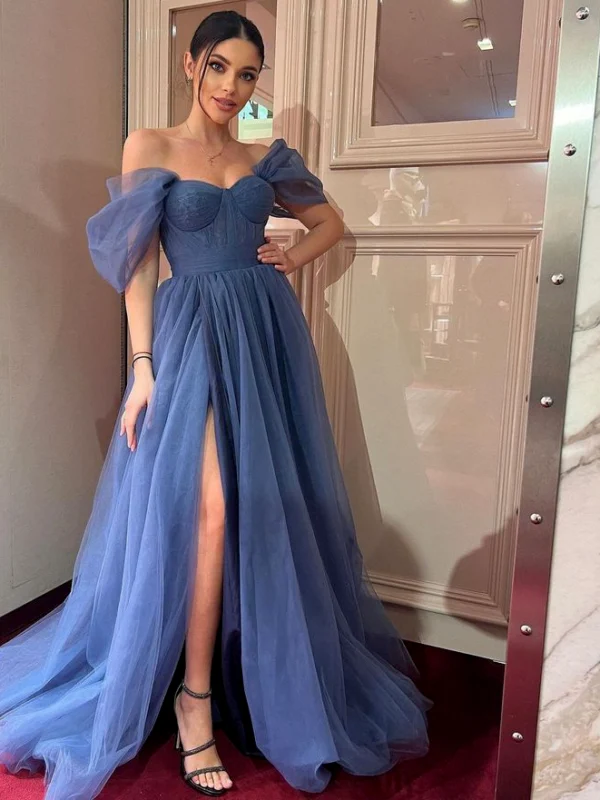
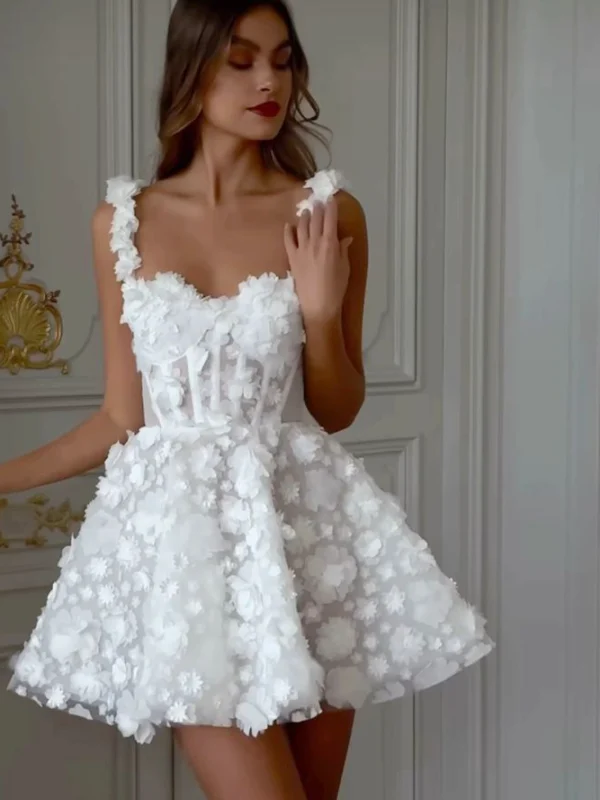
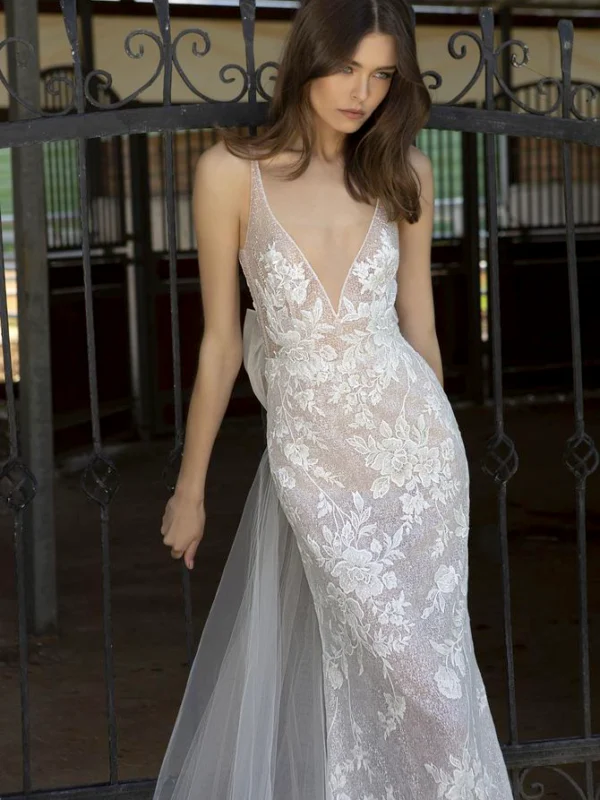
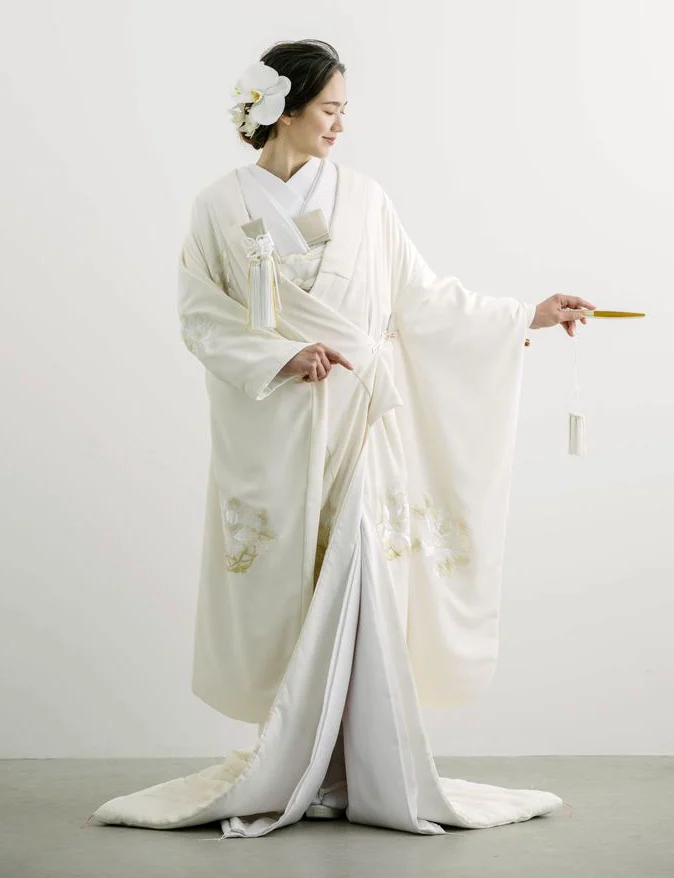
When planning a bridal kimono, a clear picture of the complete arrangement helps more than searching for any white dress with wide sleeves. The references show crossed collars, overlapping areas, long broad sleeves and different rear views. Another picture deliberately adds a white scalloped patterned overlay above a bridal dress. Use these differences to discuss the silhouette you want and the actual pieces within an offer. The comparison concerns visible forms; origin, material and exact ceremonial classification of the photographed garments remain unconfirmed.
Discuss the bridal kimono as an actual ensemble
The V&A kimono explanation describes straight-seamed wrapped garments secured with an obi. The Met describes an uchikake as an outer robe over a wedding kimono in the traditional marriage context. This limited terminology helps discuss separate layers. It does not automatically identify the photographed pieces or make a white patterned overlay a kimono. Ask the actual provider which garments and additions belong to the proposed ensemble, so the conversation concerns the arrangement genuinely offered rather than similar-looking surfaces alone.
Look at the individual pieces first, then ask to see them explained together when worn. Record what you select, what is added during dressing and which adjustments the provider handles. If you want a particular ceremonial form, discuss its name and use with someone experienced in that field. If you mainly enjoy the visible broad sleeve line, describe that preference separately. A general image attraction then becomes a clear choice between a particular ensemble and another bridal silhouette with a related area of fabric.
Choose collar colours and visible layers alongside one another
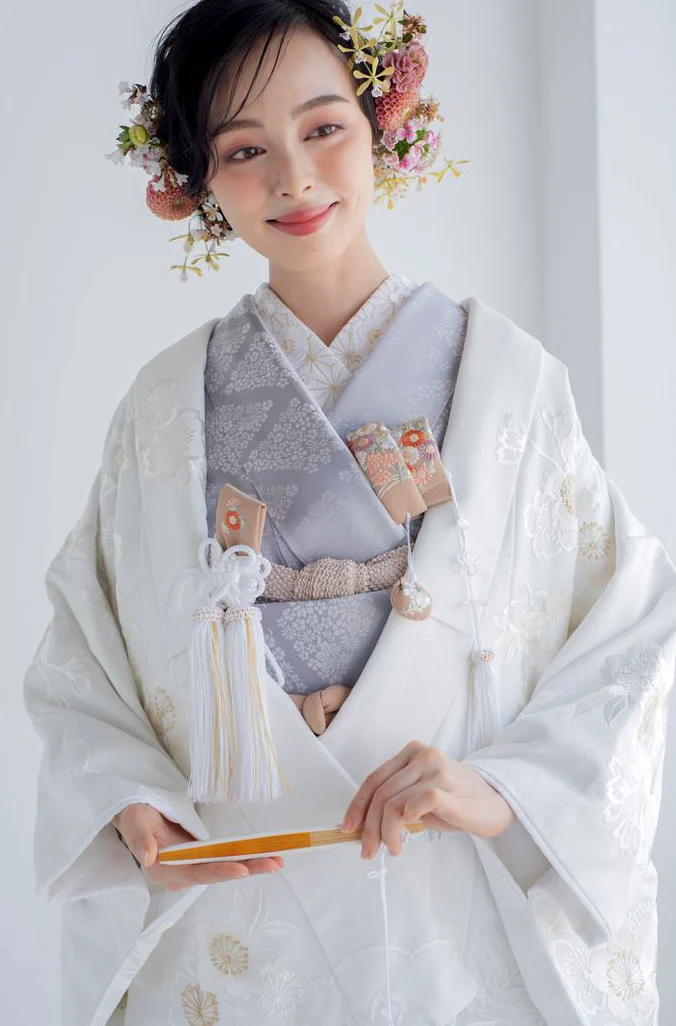
The closer view places a grey patterned area inside a white outer layer. Several collar edges create a visibly stepped transition around the neck. The complete white view stays closer to one colour family there, making the difference more through overlapping edges. Compare those two relationships without additional jewellery first. Would you like a clearly distinct inner field or a quieter sequence of lightness? This is a more specific question than simply asking for as much white as possible throughout the whole outfit.
Assess the actual arrangement from the front, side and with your planned hairstyle. Hair may cover part of the collar line, so a photograph using another head position does not show the same distribution. Ask for an explanation on the real ensemble rather than reconstructing it yourself from a single picture. Decide which edge should remain the leading visible line afterwards. A bridal kimono with several pale layers needs a different comparison from a dress with one smooth neckline edge, even when their overall lightness initially seems related.
Compare long rectangular sleeves with a softer overlay
The white robe references show long broad sleeve areas, especially clearly in the rear view with bird-shaped motifs. The large-bouquet photograph instead has a scalloped patterned edge and a softly finishing overlay. This second form is a deliberate comparison, not evidence of kimono construction. Decide whether you want the clearer long side area or a softly curved boundary. Both can create substantial room around the arm while producing quite different upper silhouettes, so the broad description wide sleeves does not settle the choice alone.
Try the actual chosen form during tasks that belong to your day. Let your arms rest naturally first, pick up an intended object and sit. Notice where the lower sleeve or overlay edge falls. If the sequence needs a particular arrangement, ask the person dressing you to demonstrate it. A quiet broadly spread photographic pose does not explain every hand movement. Connect your preference for a large area with understandable handling of that specific outfit rather than assuming all wide shapes behave alike.
Plan front and rear motifs as separate views
The grey close view places smaller forms and several hanging details towards the front. The full white view distributes subtler-looking motifs over larger areas. In the rear photograph, clearly visible bird-shaped figures occupy the long surface, with a red lower edge adding another boundary. Compare which view should carry your main priority. A quiet front can accompany a more noticeable back. You need not seek identical scale or density across every area simply because the whole arrangement belongs to one outfit.
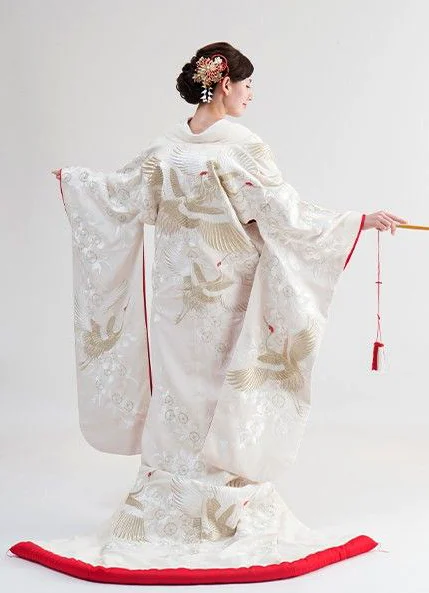
If a particular motif matters to you, ask for its actual name and, where relevant, its meaning on that specific piece. The pictures alone establish neither a precise bird species nor a personal or ceremonial message. You can still be visually specific: larger figures at the back, smaller forms in front or a strong coloured lower edge. Request complete views before deciding. An attractive close photograph does not replace the long pattern sequence on the worn ensemble, and liking its placement is a separate question from choosing a documented meaning.
Choose fan, flowers and hand use individually
Several references show a closed fan-like object, while the soft white overlay is paired with a large colourful bouquet. These create different fields before the body and occupy hands differently. Decide first which object actually belongs to your chosen arrangement and plans. Hold it in the intended place at the fitting and inspect which collar, waist or sleeve areas remain visible. An object should have an explained role rather than being adopted solely because it appears in a reference photograph or seems to coordinate from a distance.
Plan the moment when you need both hands for something else as well. Where will the object be placed or passed, and which surface remains prominent afterwards? Test that second state with the real pieces. A bridal kimono need not be mentally loaded with every flower and jewellery detail from all the pictures. If choosing a specific traditional ensemble, clarify its intended additions with the experienced person assisting you. An alternative soft overlay can require another accessory decision without blending both concepts into one unexplained arrangement.
Assess hair and small accents beside the collar
The closer robe view has colourful flowers beside the head; the full white view has a large white flower shape. Smaller decoration sits in pinned-up hair in the rear image. Consider these first through area and position, rather than deriving a requirement for your selected dressing arrangement from the picture. A side accent can frame the collar differently from a rear detail. Try the planned hairstyle with the actual upper arrangement instead of leaving it as a separate final decision after the garment choice.
Compare earrings or neck pieces only if you want them within your particular ensemble. Record a quiet initial view, then add one change at a time. Beside closely arranged collar edges, another small pale point can work differently from one next to an open V area. Choose through the complete head-and-shoulder region. Two clearly described options are more useful than numerous attractive accessories when you know which line should stay visible and which addition supports that decision. The relationship remains clear when the pieces are finally brought together.
Clarify dressing, route and care with the complete ensemble
Make the final trial a real sequence: have the complete arrangement put on, stand, take a few appropriate steps and try the intended tasks. Discuss long lower edges, transport and eventual removal with the provider. Other bridal silhouettes can be compared through our boho wedding dress guide or crochet-look bridal selection. These support a deliberate shape decision; related patterns or broad surfaces do not make them an identical ensemble. Keep each reference within its own visible context when choosing the actual direction you want.
Base treatment on the real information for each piece. The GINETEX explanation distinguishes washing, bleaching, drying, ironing and professional textile care. Clarify suitable handling of special or unfamiliar pieces with the responsible provider or care service. Finally record the layers, collar line, sleeve effect and additions you actually tested. Your bridal kimono is then planned as a concrete ensemble whose visible design and practical sequence work together, rather than simply following a broad style label with the individual garments still undefined.
Plan the bridal kimono through its actual separate pieces. Compare collar layers, long sleeves and front and rear views, then additions and dressing.
Frequently asked questions
Is every broad white overlay a kimono?
No. The scalloped overlay is explicitly another bridal form here. V&A and Met terminology helps discuss the actual pieces.
Do the bird motifs establish a precise meaning?
The pictures identify neither an exact bird species nor a personal or ceremonial message. Ask for the name and any relevant meaning on the actual piece.
Should I copy the fan and large bouquet together?
Not automatically. Clarify which object belongs to the chosen ensemble and plans, testing its actual handling and the state without it.
Which view should accompany the grey collar close-up?
A complete worn view supplies the missing lower length. Inspect the collar with the planned hairstyle and without the object before the middle too.