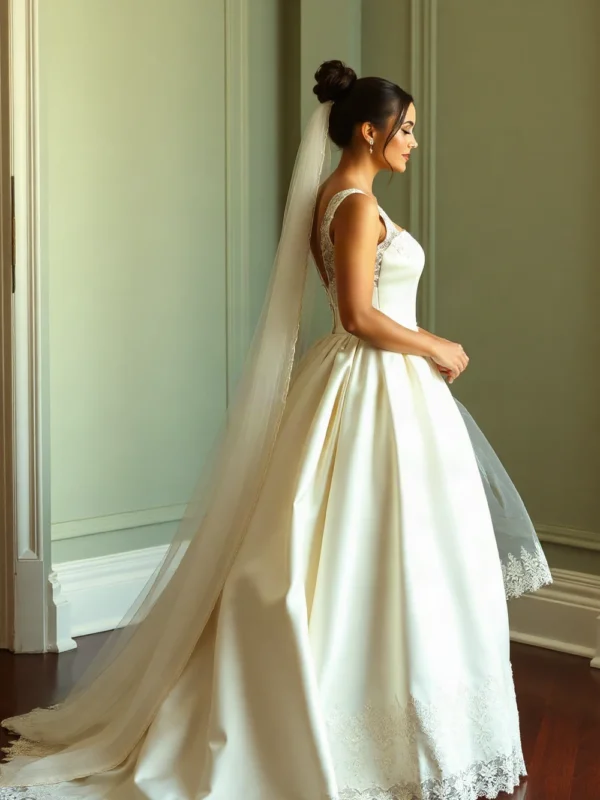
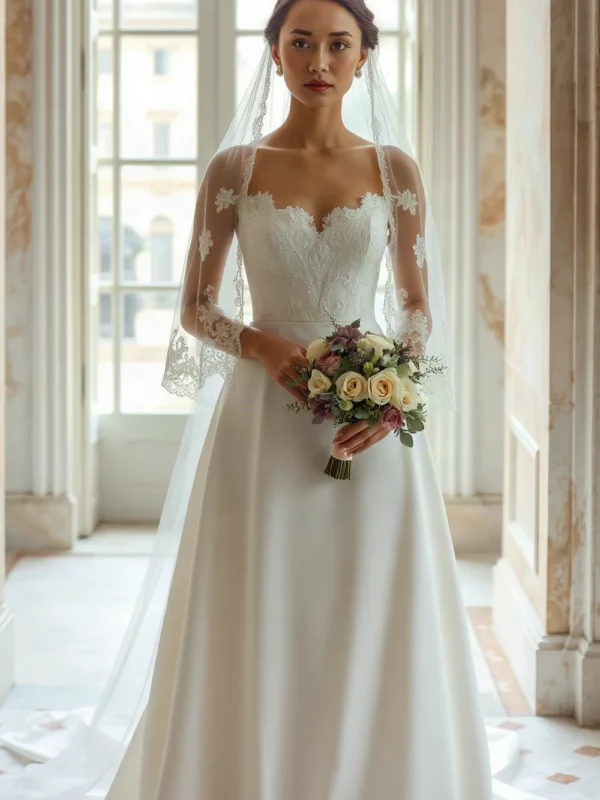
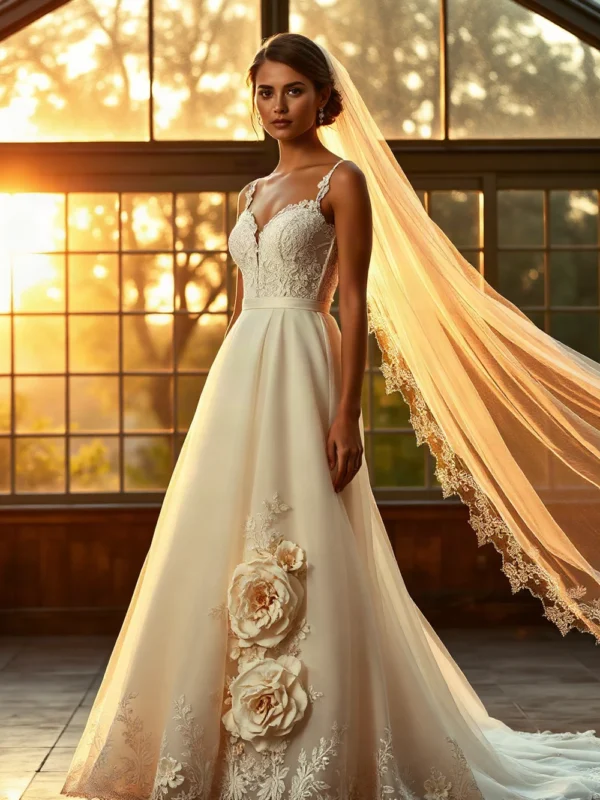
A romantic floral lace ball gown is more than the sum of a voluminous skirt and an ornate bodice. The neckline, back construction, distribution of appliqué, response of the surface to light, and amount of floor space occupied by the hem all work together. These six visual concepts explore a related pale palette across a paneled salon, glazed room, arched corridor, conservatory, library, and grand staircase.
They are most useful as style and composition references rather than as a catalogue of purchasable dresses. Instead of copying one look, examine the design problem each scene resolves: a clean shoulder line or soft off-the-shoulder frame; a dramatic open back or floral straps that read clearly in portraits; an expansive train or a more manageable spread. The comparisons below connect appearance with movement, architectural scale, and photography, helping you identify which elements support the atmosphere and practical experience you want.
Strapless Simplicity and a Broad Bell Shape
The first image sets a straight strapless bodice against a skirt that opens powerfully from the waist. Sparse floral branches travel across a gently lustrous surface and become denser at the lace-like border. Detail therefore remains visible at a distance without covering the large, quiet areas that make the skirt look expansive. The turned pose shows both the central back line and rounded bell shape.
This approach works when silhouette should remain as important as ornament. The second concept’s lowered shoulder bands frame the upper body more romantically, whereas this uninterrupted neckline feels cleaner. Its circumference is impressive in a photograph but requires forethought around chairs, narrow doors, and dancing. The paneled room’s vertical lines balance the horizontal spread; in a smaller interior, the same volume could dominate rather than harmonize with the setting.
A Soft Transition with Off-the-Shoulder Bands
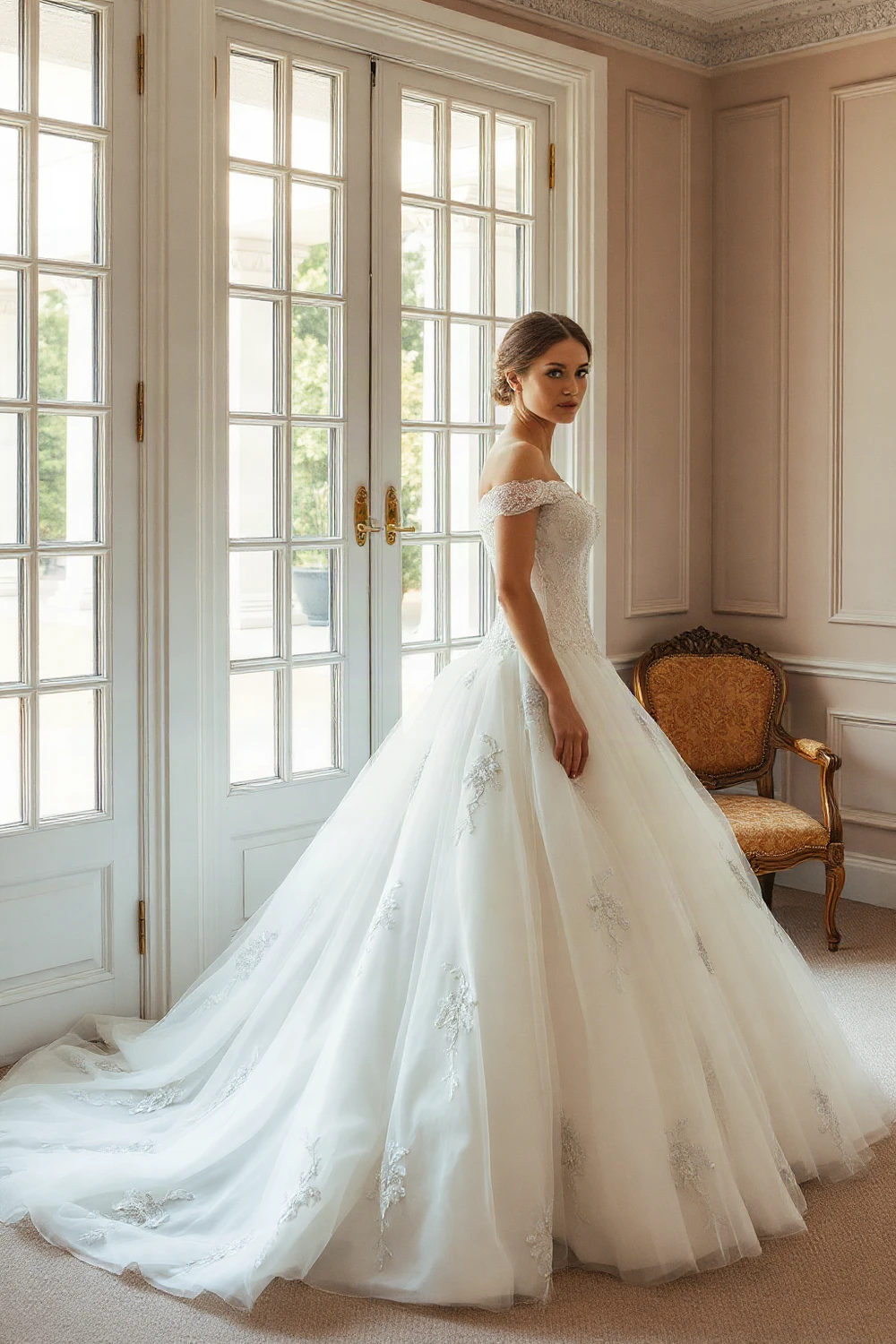
The second image creates a gradual transition from a densely floral bodice to a lighter, layered-looking skirt. Short bands below the shoulders gently frame the face and collarbones, while scattered appliqués balance the visual weight of the upper section. The long skirt drifts sideways over the floor, introducing fluid asymmetry instead of a rigid central axis.
This neckline is more decorative than a strapless edge and more horizontal than the narrow straps in the fifth image. Test how it behaves while lifting the arms, embracing someone, and sitting; a graceful standing position is not the only movement that matters. Diffuse light through the glazed doors reveals the fine layers, while the gold-toned chair supplies warmth. A similar setting benefits from soft window light, which can preserve both bodice texture and the airy distinction between skirt layers.
A V Back with a Ceremonial Train
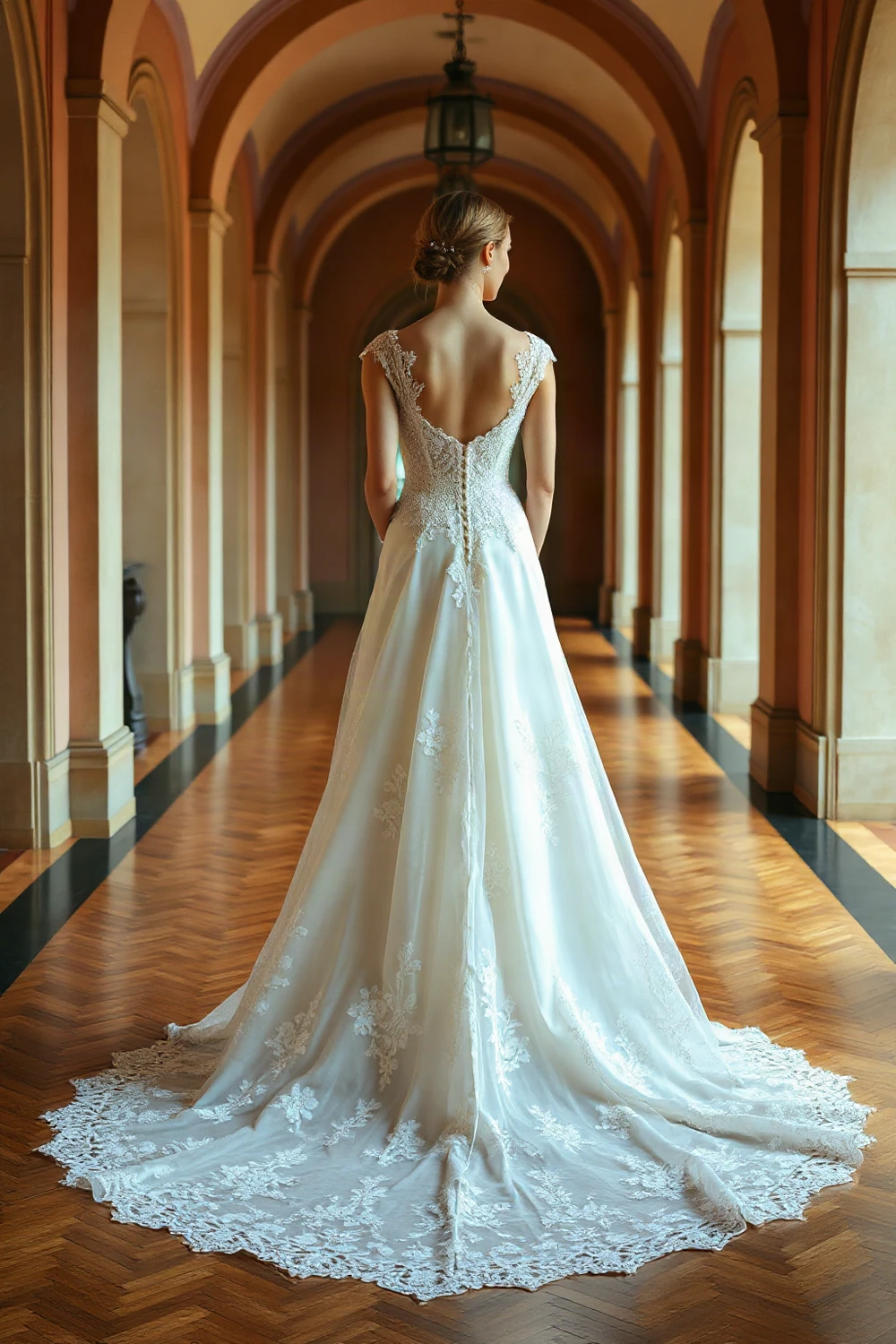
The third concept focuses on a deep V back, a central button line, and a broad train arranged in a circle over the floor. Lace-like shoulder pieces outline the opening. Beneath the richly detailed bodice, a quieter skirt gains floral motifs toward its edge, concentrating ornament where it will remain legible in a distant rear view.
The long arched corridor reinforces the design’s vertical, symmetrical character. The fourth image offers a more segmented open back and a more controlled train; this result is comparatively formal and dramatic. Before choosing such a spread, consider walking distance, turning space, floor texture, and the time needed to arrange it for photographs. A low updo keeps the back visible. If freedom is needed after the ceremony, a practical way to gather the train should be addressed from the beginning rather than treated as an afterthought.
A Lighter Open Back for a Conservatory
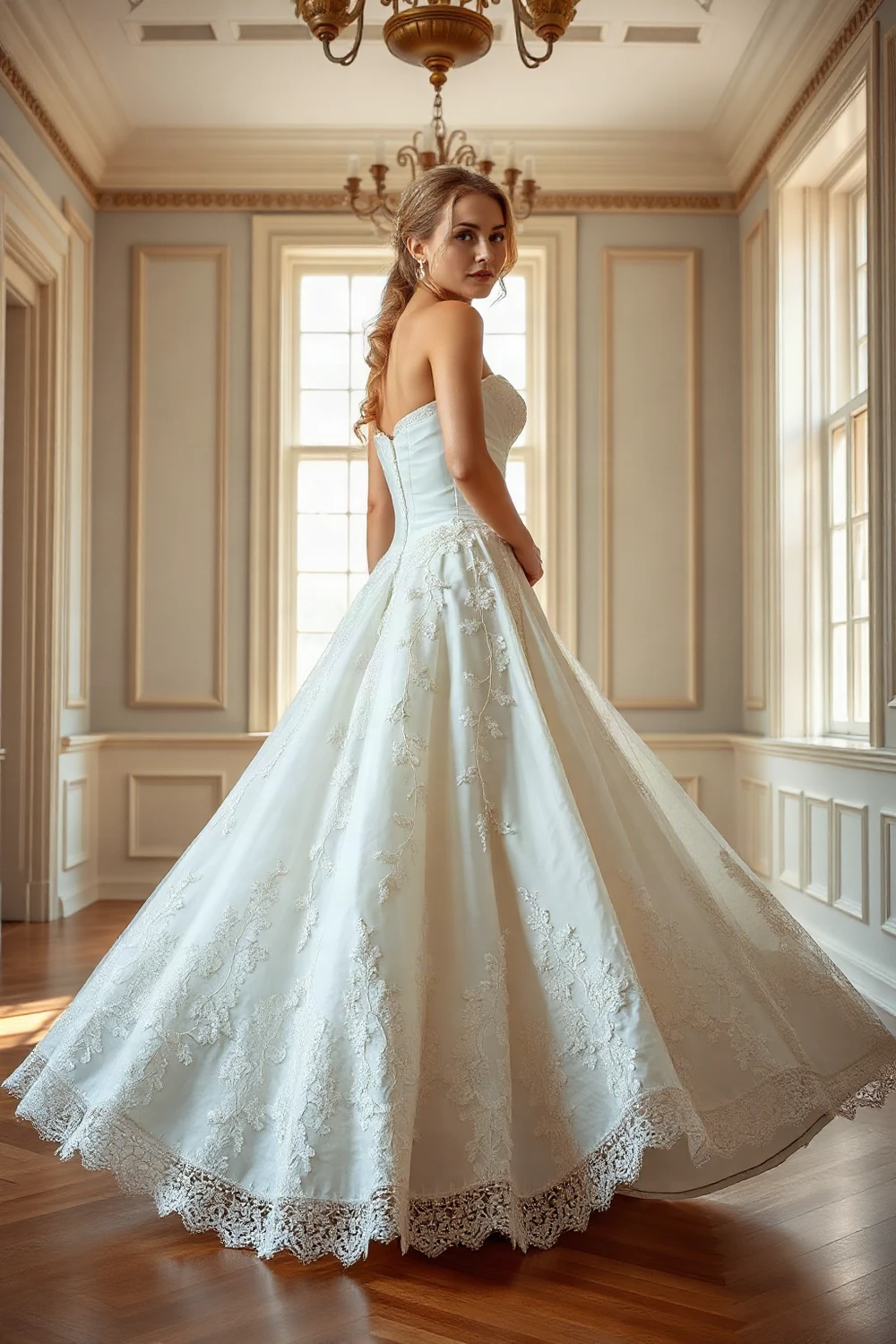
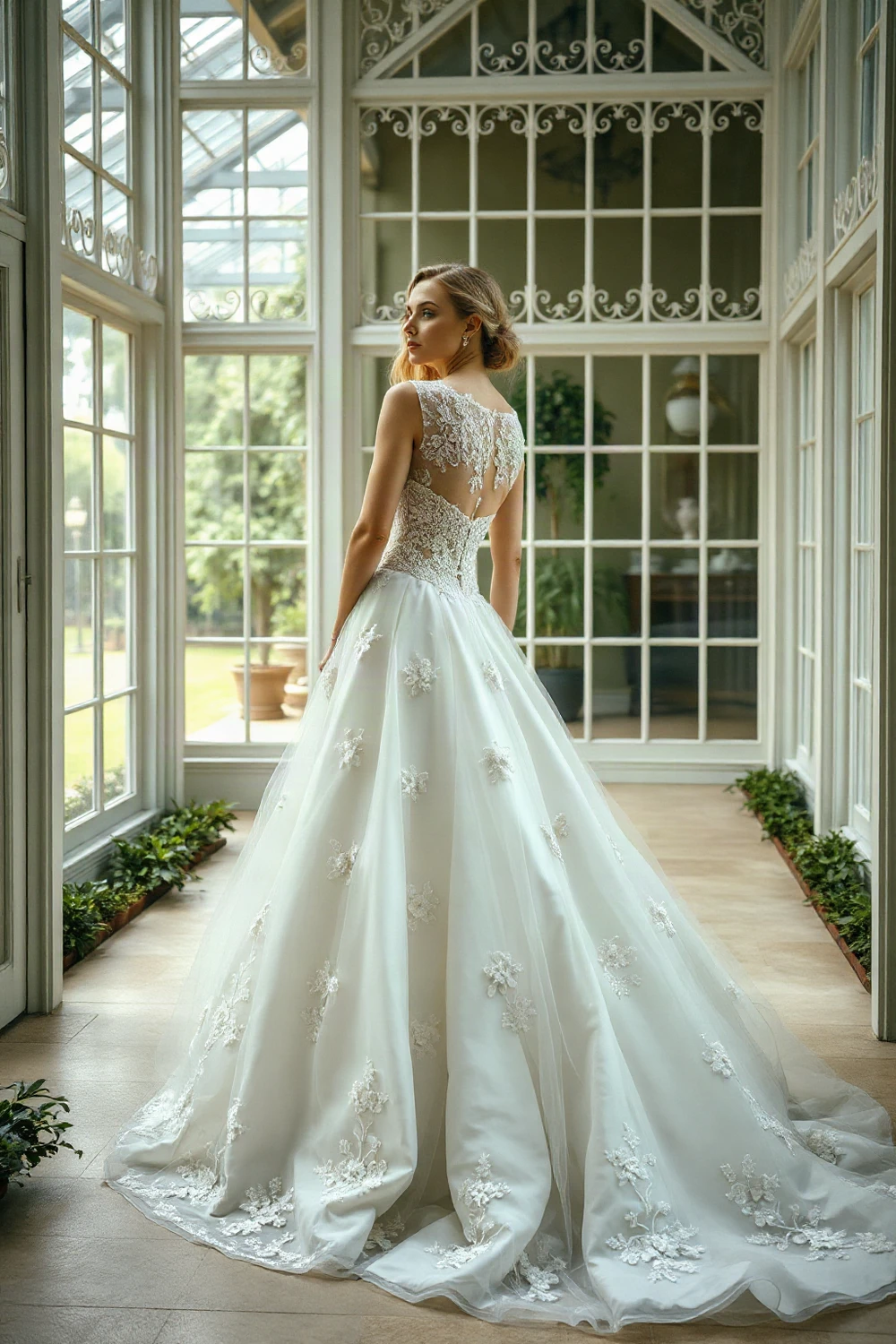
The fourth concept combines a floral panel over the shoulders with a broad shaped opening above the waist. A densely detailed bodice releases into large, calm skirt areas, punctuated by raised appliqués that grow more numerous near the edge. The effect is softer and more layered than the third image’s continuous V, yet more textural than the smooth expanses of the first.
A glazed roof, pale frames, and surrounding greenery create an airy environment for the light silhouette. Because the back supplies the principal detail, hair, veil, and jewelry can be restrained to keep it visible. An illusion-like panel should be evaluated from every side, with attention to arm movement and support rather than front appearance alone. The controlled rear spread may navigate passages more easily than the third concept’s train, although the full skirt still requires clearance from planting borders and door frames.
Floral Straps That Read in Portraits
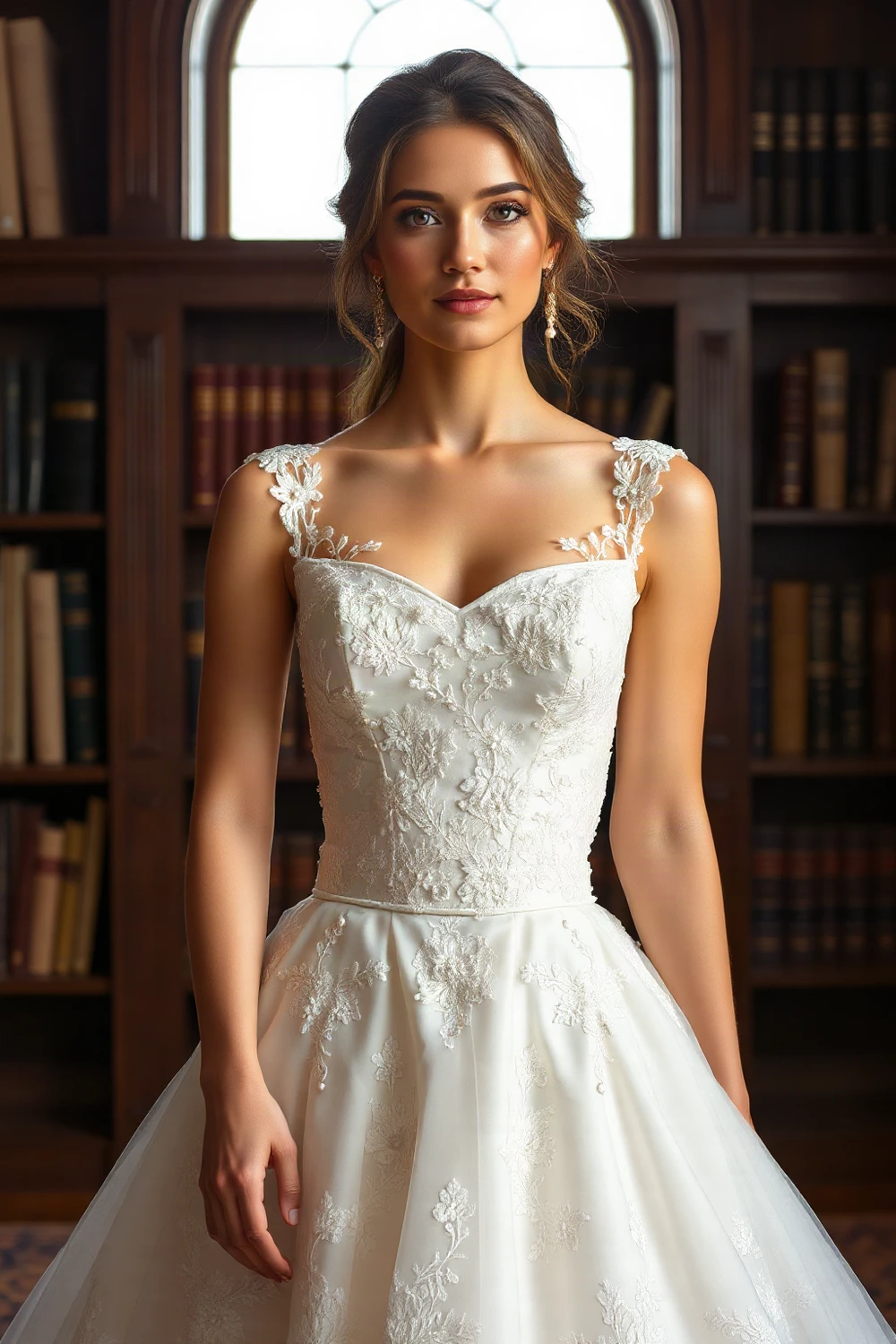
The fifth image’s close crop brings narrow floral appliqué straps, a softened sweetheart neckline, and dense bodice texture to the foreground. Motifs flow from the shoulders toward the neckline, then become more widely spaced below the waist. This rhythm creates a decorative connection between face and gown, while the dark bookcases make the pale raised details easy to distinguish.
It is a useful direction for someone who wants a visual link over the shoulders without the horizontal effect of off-the-shoulder bands. The sixth concept leaves the neck and shoulders completely open; here, delicate flowers frame the same area. During a fitting, inspect strap width, edges against the skin, bodice support, and motif symmetry at close range. Small earrings or restrained hair details can let the floral neckline remain prominent in portraits. Wider photographs should still be made to confirm how the upper detail relates to the full skirt.
Sweetheart Symmetry at a Grand Staircase
The sixth image presents a strapless sweetheart neckline, defined bodice, and broad skirt from the front. Vertical floral sections interrupt the large smooth surfaces and guide the eye from waist to hem, where lace-like motifs gather more densely. A fine veil and centered stance establish a calm ceremonial presence within the strong curve of the staircase.
Although it shares the first image’s open shoulder line, the sweetheart shape and frontal view are more assertive here. Floral straps add framing in the fifth concept; this version lets the bodice structure carry the focus. A staircase can display volume beautifully, but moving on the steps introduces risk. Build the pose on a level landing where possible and place the hem deliberately. Strong side light helps define folds, provided exposure retains detail in the palest areas of both bodice and skirt.
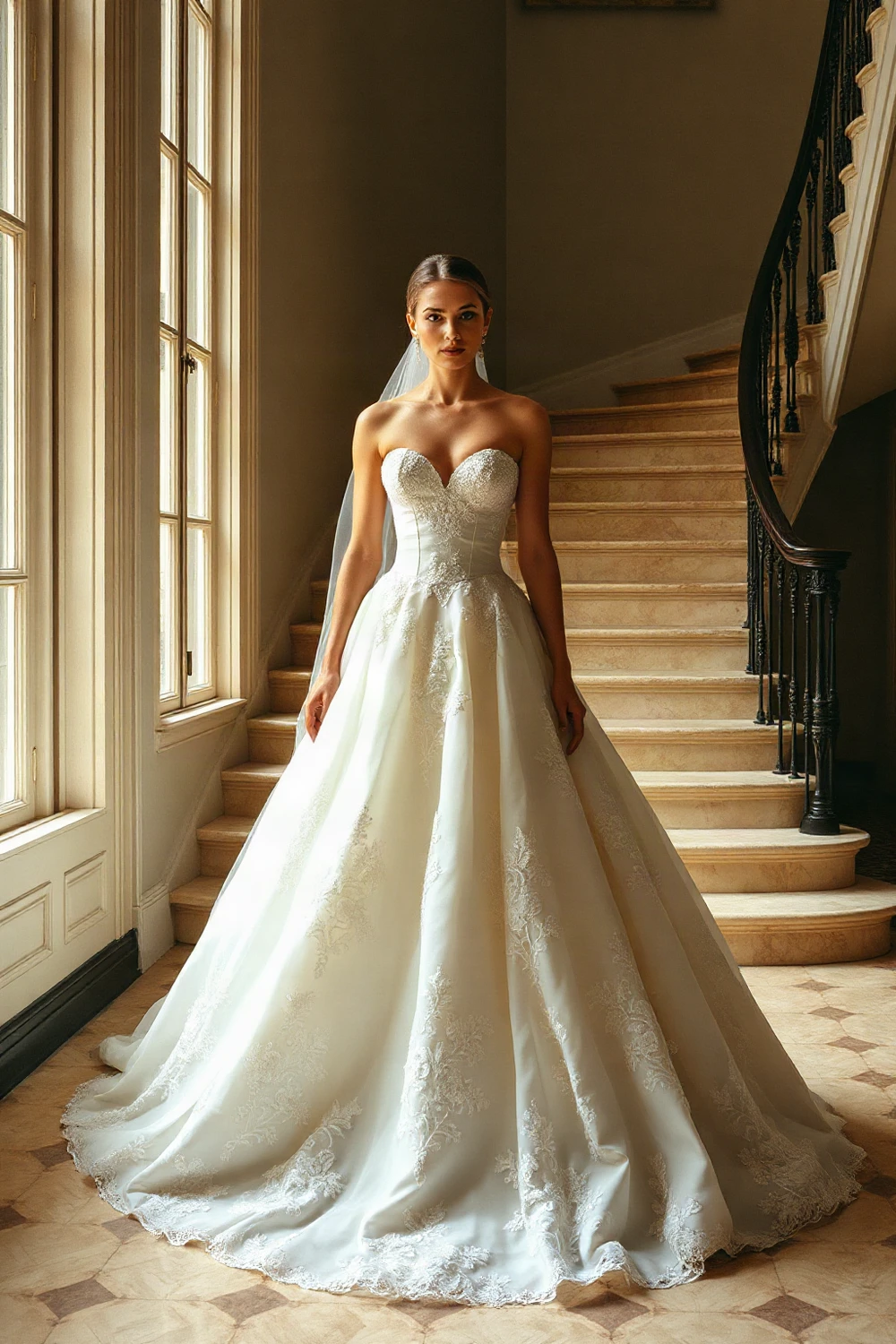
The best choice among these six ideas is not necessarily the most ornate one, but the one whose priorities agree. For an uninterrupted shoulder line, begin with the first or sixth image; for a softer shoulder frame, study the second. The third and fourth make the back a central event, while the fifth gives floral detail particular strength in close portraits. Next, test that preference against room size, walking route, sitting time, and the direction from which most photographs will be made.
Do more than stand before a fitting-room mirror. Walk, turn, sit, raise your arms, and view the concept from the front, side, and back. Check whether the appliqué density competes with the face, whether the skirt disappears against the architecture, and whether the train can actually be managed along the intended route. Lasting romance comes not from accumulating decorative devices, but from letting neckline, back, texture, volume, and setting tell the same composed story.
Compare floral lace ball gown wedding dresses through necklines, back details, bodices and full skirts.
Frequently asked questions
Should I choose a strapless neckline or floral appliqué straps?
Choose the strapless direction in the first or sixth image for a clean, open shoulder line. Use the fifth as a reference if you want a floral frame and a visible connection over the shoulders. In either case, test bodice support while walking, sitting, and raising your arms.
Is a long train practical inside a narrow mansion?
The third image’s broad train works visually in a long, empty corridor but needs space, arrangement time, and help at tight turns. For frequently used passages, compare the fourth image’s more controlled spread or consider a train that can be secured after the principal photographs.
How dense should the floral appliqués be?
A richly detailed bodice with a quieter skirt, as seen in the second and fifth concepts, frames the upper body without making the whole silhouette busy. Motifs can gather again near the hem for definition. In compact rooms, broad calm areas often read more clearly than an uninterrupted dense pattern.
How can hair and a veil complement an open back?
A low updo and a narrow, restrained veil can preserve the back detail in the third or fourth concept. If the veil completely covers the opening, much of its visual purpose is lost. Review the combination with fitting photographs taken directly from behind, not only in a front mirror.
What is the safer way to photograph a full skirt near stairs?
Use a level landing whenever possible, keep the hem clear of step edges, and lift it while moving. Arrange the skirt only after the wearer is stable, with assistance nearby. The sixth image offers compositional inspiration, but safe footing matters more than perfect symmetry.