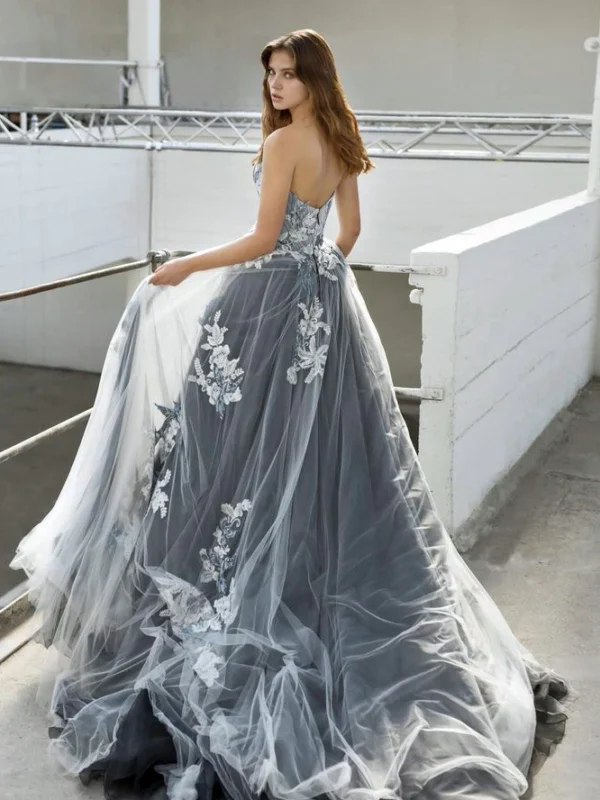
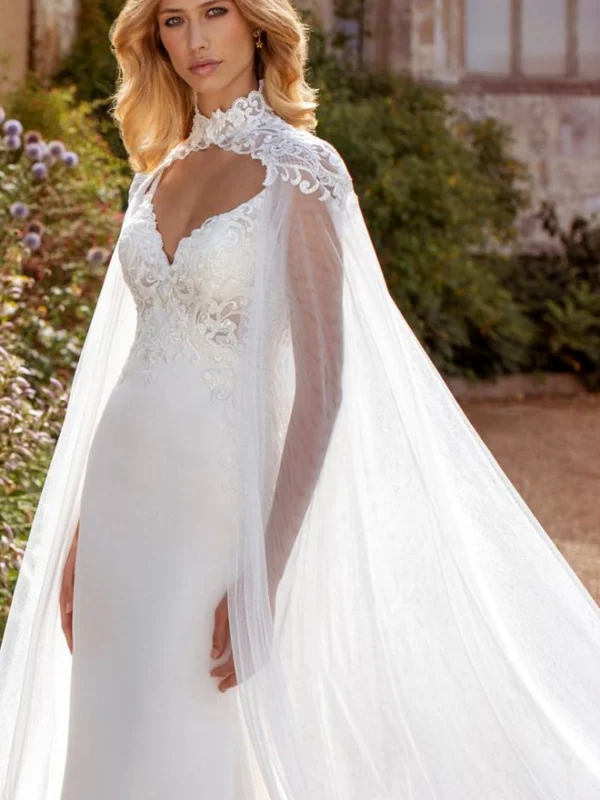
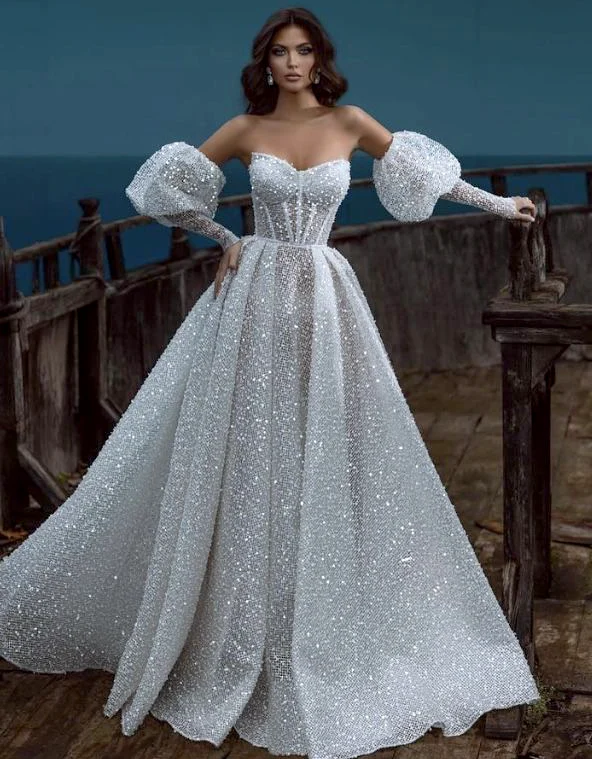
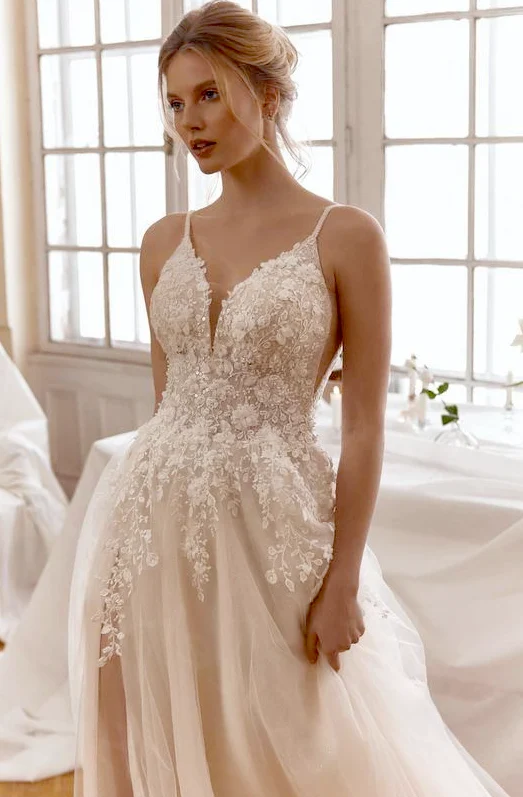
A wedding dress with vertical lines is easier to discuss when you name the line you actually see. It might be a descending floral route, a quiet skirt fold or a seam that the supplier can explain. Our main pale reference pairs narrower vertical bodice paths with a wider quieter skirt and scattered floral details. Four separate fronts add other ways of drawing the upper body and lower surface. None proves a guaranteed height effect, fibre or common maker. Start with the visible region, then establish the real construction of the dress being offered.
1. Trace one line before naming a cut
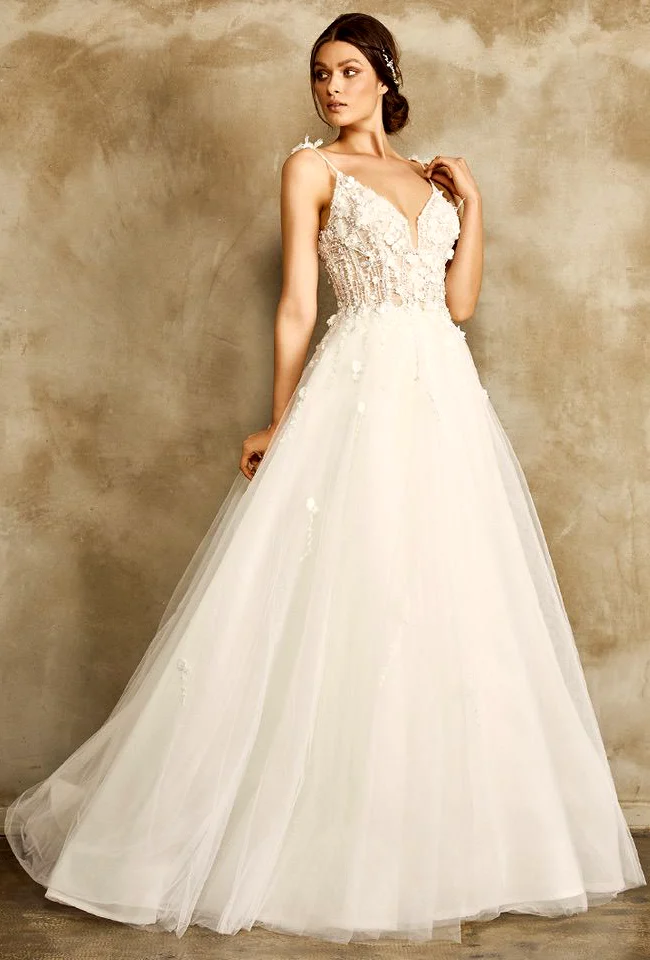
In the main view, finer upright paths run between denser floral-looking upper forms. Some little motifs continue onto the broader skirt below. The window-side floral front instead extends more obvious flower routes beyond the waist, while the V front with short shoulder finishes joins a patterned upper area to quieter long folds. These are particular visual arrangements. Calling them all vertical does not identify the same sewing method or make their skirts interchangeable. Point to the exact route that matters to you before discussing a general silhouette.
Ask for a suitable close view of that region on the actual candidate. Follow where it begins, whether another detail crosses it and where it ends. Record a preferred drawing separately from a confirmed seam. A front-facing photograph can show a border clearly while leaving its attachment unseen. The wedding dress buying guide helps turn that preference into questions about the actual model, supplied version and fitting rather than a promise assembled from unrelated pictures.
2. Separate a manufacturer’s construction wording from the archive
A named example shows why a precise description matters. Sincerity Bridal calls model 4011 a fit-and-flare gown with vertical illusion seams. Its own description identifies illusion netting running from under the arm towards the hem. Those are details of that different named model. They identify none of our five references and cannot supply their textile, lining, stretch or fastening. The useful distinction is between a visible direction and construction that has been explicitly described for a particular garment.
For your own offer, ask which lines are sewn joins, which are decorative and which arise from the fabric’s current position. Have the corresponding side and rear shown on that same piece. If you want a line moved, continue the discussion at the actual garment rather than assuming the work is a simple change to one mark. Ask which neighbouring edges or motifs would be affected. Keep the offered construction and a proposed alteration as separate information until the work is agreed and the complete result can be tried again.
3. Compare the waist with both adjacent surfaces
A horizontal division does not automatically cancel a preference for longer lines. The main reference has a change between its denser upper region and broader quieter skirt. The rounded-front comparison marks the waist with a narrow pale band; the V view with short shoulder finishes also has a distinct horizontal boundary. You can compare those arrangements without treating one as universally better for a particular body. Examine where the upper drawing ends and the lower folds begin rather than choosing through the single word vertical.
Try the actual garment in a normal front and side stance with planned underwear. Locate its waist on your own body, then move and inspect it again. The photographs do not supply your bodice length or a guaranteed fit. Where finer areas appear beside denser drawing, ask about the real inner arrangement. The sheer wedding dress comparison helps name visible outer and inner boundaries without assuming every pictured intermediate space has identical coverage or a confirmed open construction.
4. Keep the shoulder frame independent of the skirt
The main view has narrow floral straps beside a lower V middle. Other references use short patterned shoulder ends, broader projecting fine shoulder pieces or fuller fine arm areas. Those differences remain choices even when several skirts share longer folds. Compare the top edge before deciding whether a particular arm outline belongs in your own combination. A photograph cannot establish that sleeves detach or that one shoulder arrangement can replace another on the same dress.
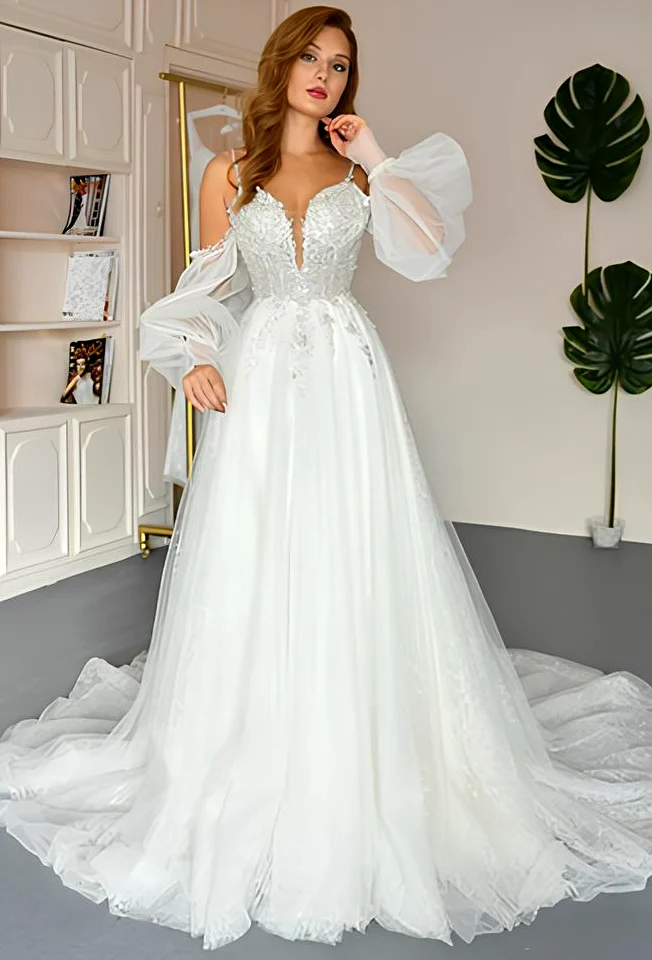
The off-shoulder wedding dress guide adds questions about where upper borders and arm areas begin. Request your candidate with both arms down, then bend the elbows and bring one hand forwards. Observe its actual upper edge and sleeve finish yourself. The fuller-arm reference raises one hand near the face, while other pictures keep hands before the body or near a skirt side. Different poses cannot establish unchanged coverage, movement room or inner support for your own fitting.
5. Complete the lower line with your own footwear
The window-side floral reference ends before the whole skirt hem and shoes. Other views include fabric reaching the floor but still conceal footwear. Those images cannot give you a hem measurement by comparing the pictured people’s apparent heights. Request the actual candidate’s complete front, sides and rear with the shoes you intend to wear. See the skirt with the fabric released rather than continually pulled at a side. Its real fall belongs to that garment and stance.
Walk, turn and sit before inspecting the existing edge again. Where fabric extends on the floor, discuss that area separately from the front length. If a change is planned, identify the motifs or border near the proposed new finish. Ask how their relation to the whole skirt would be shown afterwards. Another reference’s floor spread cannot supply the missing rear of your own dress or predict the result of shortening. Arrange a complete further fitting after agreed work instead of judging only a small changed section.
6. Add accessories and confirm care
Try planned hair beside the actual shoulder frame before adding jewellery or a veil. The main image’s small side hair accent and the other references’ loose waves are styling observations, not required supplied items. Add one real accessory at a time and check its contact with the garment during ordinary movement. For treatment, GINETEX explains textile care information; use the finished piece’s own directions, including its components. A wedding dress with vertical lines becomes a specific choice through a named visual preference, an explained construction and your complete fitting, rather than a photographic promise.
Five pale fronts compare descending decoration, quieter skirt folds and different shoulder frames. Visible lines need a separate explanation of the actual seams and inner construction.
Frequently asked questions
Does a wedding dress with vertical lines prove a particular seam construction?
A wedding dress with vertical lines may show decoration, folds or an actual seam. Ask which line is which on the offered model; a photograph alone does not identify its construction.
Does a wedding dress with vertical lines guarantee a taller appearance?
A wedding dress with vertical lines supplies no guaranteed change to your appearance or measured height. Compare the actual lines and proportions on your own garment rather than following a universal body rule.
Can the five wedding dress fronts be combined into one available model?
The five wedding dress fronts are independent references. A shoulder, skirt or rear from one cannot complete another as an already available product; ask about the actual offered version.
What care applies to a wedding dress with vertical lines?
A wedding dress with vertical lines needs its own finished garment’s care information. A fine drawing or pale surface supplies no general washing or ironing method.