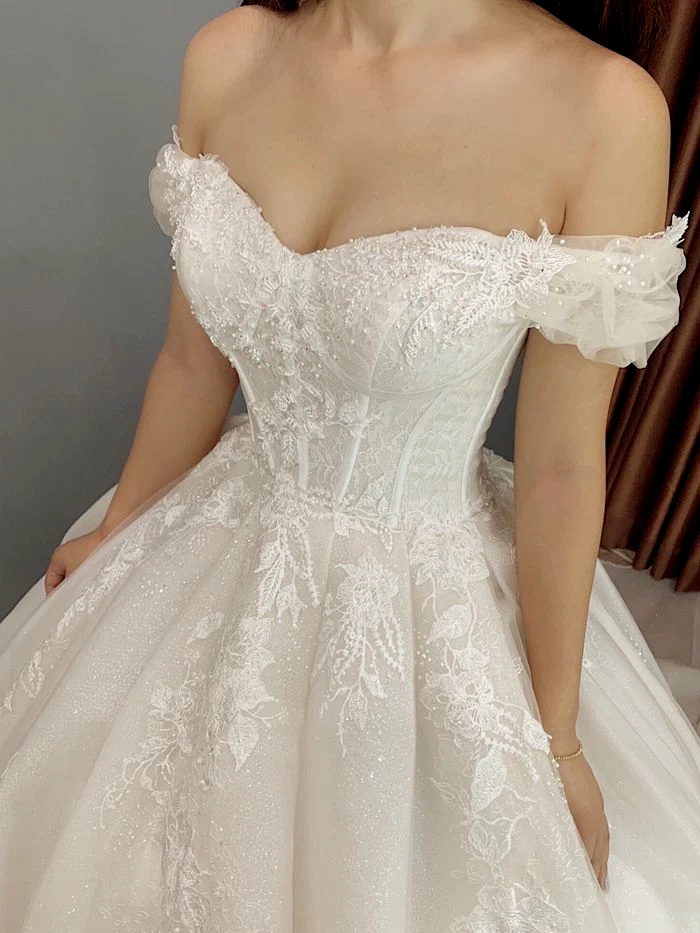
A clear central bodice point directs attention downwards in this closer front. Vertical and gently curved lines organise the upper area. Side bands sit below the shoulder tops. The lower boundary reaches farther down at the middle into the beginning of a wider skirt carrying larger floral forms. That lower direction supplies the relevant comparison. The two rounded upper areas and central upper dip describe a different boundary, rather than confirming the shape below them.
If the clear point appeals to you, name it without adding an assumed internal construction. Would you retain that clarity with smaller motifs or a different upper edge? Compare it with a softer middle connection. This helps establish whether the lower geometry is your main preference or whether you mainly like the entire decorated front as a complete arrangement.
For an offer, request an unobstructed full front and side view. Examine the course on the real garment before specifying its position on your body. Visible vertical lines cannot establish support. If alterations are needed, explicitly include the preferred point and its side connections in the discussion rather than assuming they remain unaffected by every change.