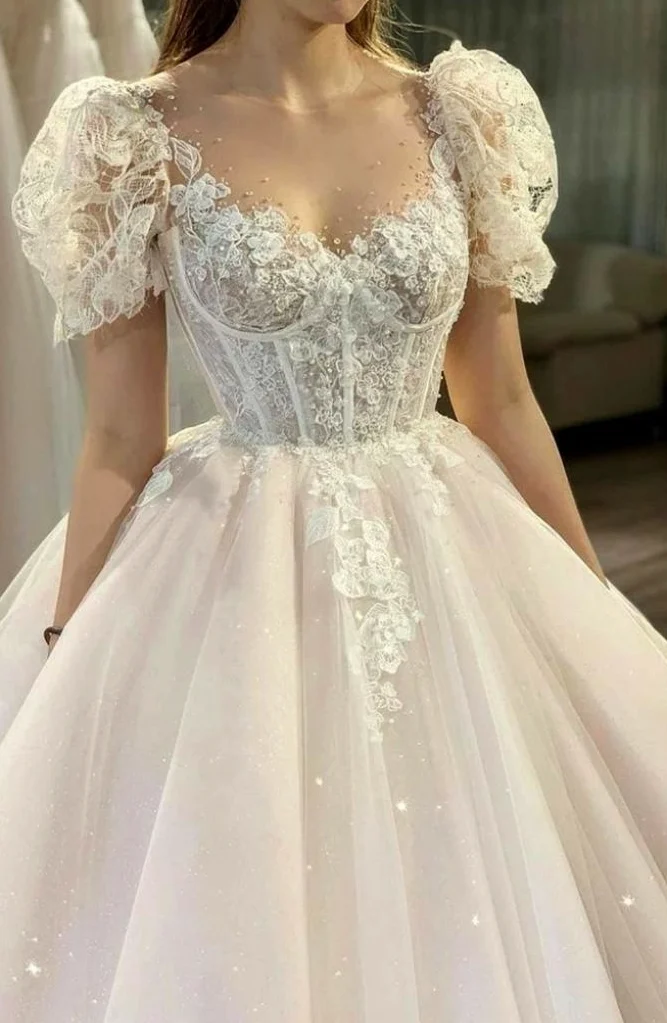
A shallower boundary beneath floral motifs provides a comparison with the more clearly downward middle points. Vertical lines and larger flowers organise the closer bodice. Short voluminous sleeves sit at the sides, with a sheer-looking upper area above. The skirt starts widening under the decorated section. Individual floral forms enter that transition without independently explaining its entire underlying course. Compare the broad boundary rather than following each flower as if it were the edge.
Look at the lower middle first. Do you like its less pronounced point, or miss the clearer extension shown elsewhere? That answer is more useful than treating all the pictures as one shape because they carry patterns. Keep preferred upper coverage similar during a fitting, then compare the lower form deliberately rather than changing the whole arrangement at once.
Request a front unobstructed by hands on the actual offered dress. Add a side view and ask where the real connection lies if flowers conceal it. Visible vertical lines do not confirm internal construction. Your initial preference may simply be a shallower connection under a more strongly divided bodice, regardless of a label applied to the complete dress.