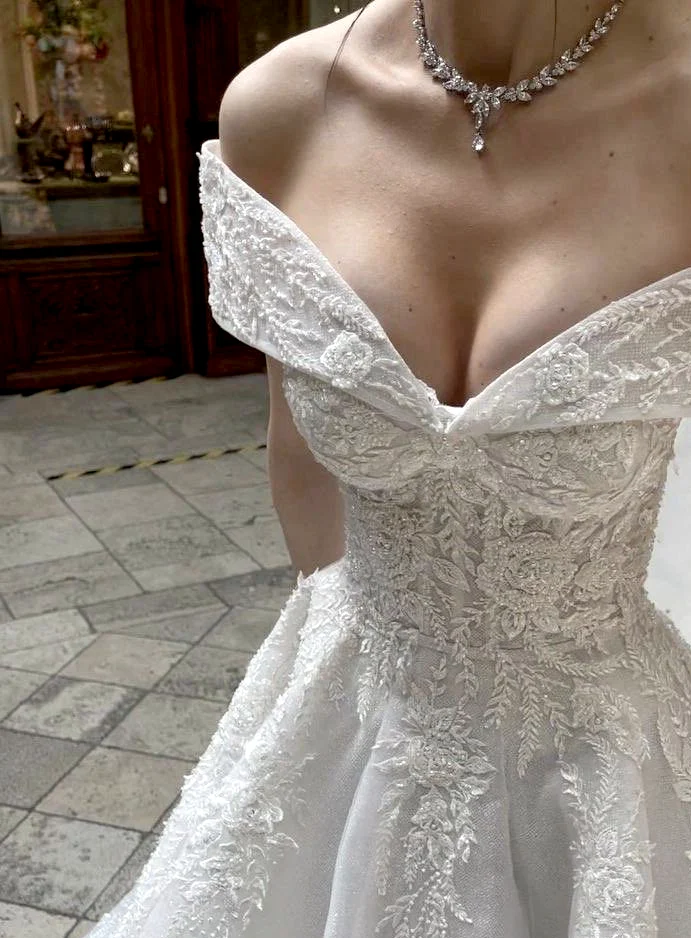
A basque waist wedding dress draws attention to the lower bodice edge. Its boundary with the skirt extends into a lower middle instead of finishing at one level throughout. The decision here concerns that lower course rather than the upper neckline. These photographs offer clearer central extensions alongside softer, shallower and partly obscured comparisons. Use them to develop a precise shape preference. Choose the visible line first, then establish how the actual offered candidate is constructed and which additional properties you want beside it. A name can guide your enquiry without supplying every answer.
Follow the lower boundary of a basque waist wedding dress
Trace the bodice from one side towards the middle and back up the other side. Where does its visible area end, and where does the wider skirt begin? In the closer front with vertical bodice lines, the boundary extends more clearly downwards at the centre. The reference with the broad folded shoulder area also carries a central extension into the skirt. Describe that direction before choosing the entire decoration or the neckline above it. A striking upper edge remains a different line, even when both occupy the same photograph.
Maggie Sottero’s waistline overview describes the Basque waist through a V- or U-shaped course; its separate explanation refers to a soft V or central point. That definition helps name the shape. It cannot identify the maker or model in these pictures and does not explain the internal construction of a photographed garment. Initially, establish which visible lower boundary appeals to you and which one you want to find on a real candidate, without adding an unverified construction claim.
Compare a clear point with a softer middle
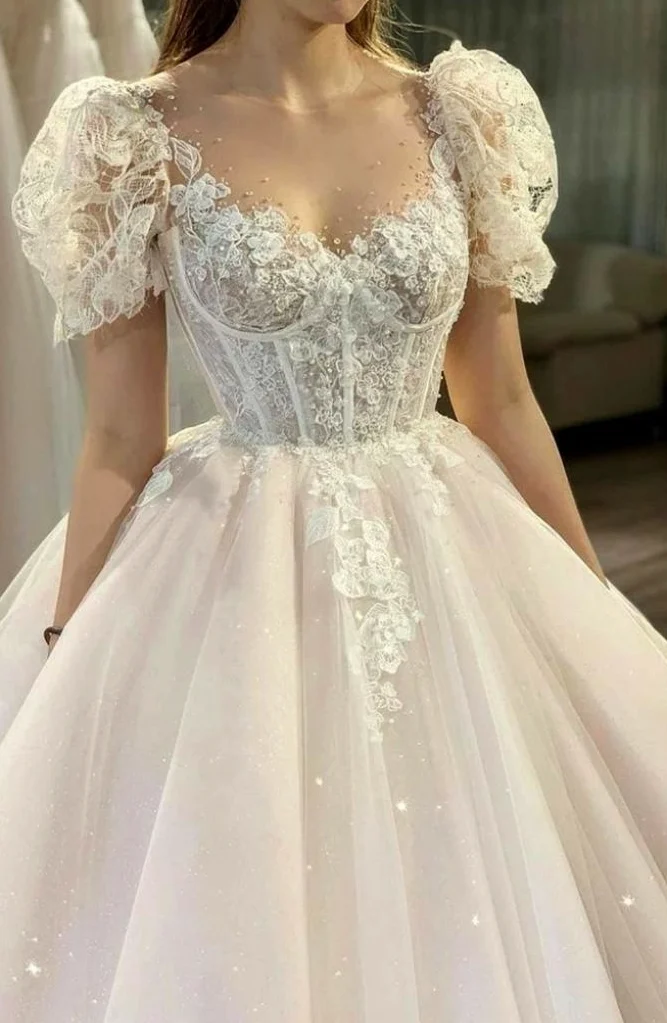
The closer front with more distinct vertical areas carries its lower transition into a clearer middle point. The view with smaller side shoulder sections and a held-out skirt presents a softer transition. Compare those effects without adopting every other detail. Do you want to read the lower middle immediately, or would you prefer a less sharply marked course? A softer finish is not an incomplete design. It may create exactly the connection between bodice and skirt that you want, particularly when you prefer the line to remain secondary to the whole dress.
Request similarly unobstructed front views of two actual candidates. Keep hands and bouquet away from the middle initially. Look from a little distance and then closer. Note whether you like the direction itself or mainly its clarity. A pale motif can reinforce a point, while denser pattern may make it busier. The question remains geometric: how should the lower edge run? Avoid specifying a fixed drop in centimetres from a photographed proportion that you have not yet assessed on your own complete garment.
Use shallower and obscured boundaries as real comparisons
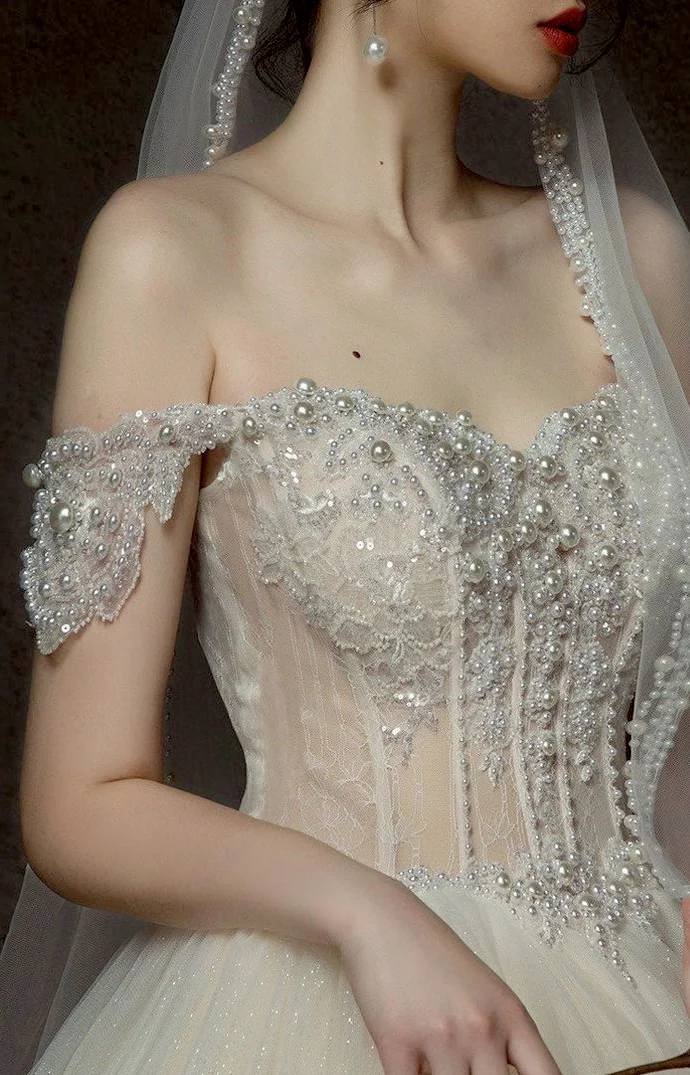
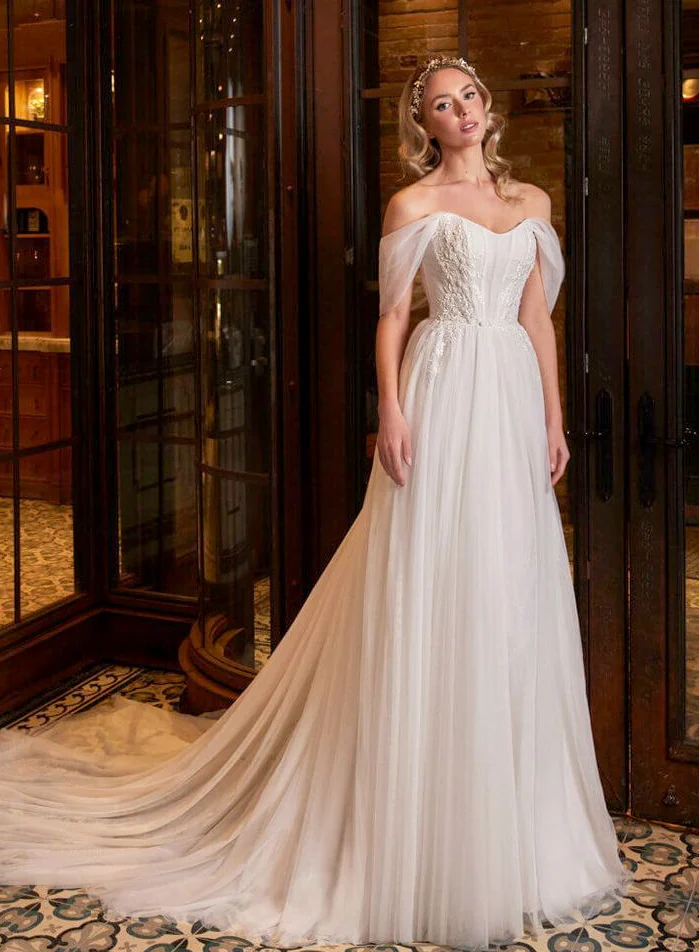
The fuller front with the quieter skirt shows a shallower middle finish than the clearer close view. In the more heavily ornamented close photograph, arm position, decoration and crop reveal only part of the lower boundary. These differences are useful. An appealing bodice does not have to carry the same pronounced point. Include a shallower alternative in a fitting if you remain unsure. That tests the actual lower form rather than moving only between different amounts of decoration while leaving the important line outside the comparison.
For an obscured boundary, another view supplies the missing information. Request a photograph without an arm or bouquet over it and add a side view. Do not complete hidden sections from apparently symmetrical motifs. Vertical lines in the bodice cannot automatically establish its lower course either. The corset-look wedding dress guide explores that upper line effect. Here it is simply a neighbouring property; it confirms neither the lower shape nor a particular support arrangement inside the garment. Ask those questions about the real item separately.
Distinguish the shape boundary from the pattern ending
Individual floral extensions may continue beneath an identifiable bodice boundary. Conversely, a densely patterned area may finish without fully explaining the garment’s actual transition. Look at the underlying shape before its decoration. You might want a definite lower point with softer trailing motifs, or a more restrained curve made clearer by a patterned border. Name these properties separately. A later comparison can then retain a similar bodice shape even when motif scale changes, instead of beginning again with an entirely different upper arrangement each time.
Ask where the actual connections lie on the offered dress. Visible decoration alone cannot identify a seam or method of making. These images show decorated surfaces, without establishing fibre or handwork. Direction and distribution provide enough information for your initial preference. If a motif fully hides the course you are seeking, request an explanation on the real garment. Keep the lower geometry as the principal preference while the amount and ending of decoration remain another decision. This prevents a floral extension from standing in for a confirmed structural boundary.
Look at where the skirt starts beside the lower point
The references join their bodices to widening skirts. The fuller front reveals a large quieter lower area, while other views place numerous floral forms immediately beneath the transition. Now assess how the skirt surface should begin beside your preferred middle shape. Would you like greater fullness immediately at the sides, or a quieter initial section? Compare two real dresses with similar lower bodice boundaries for that purpose. Otherwise a change in overall skirt quantity can overwhelm the smaller central course that you originally meant to assess.
View the skirt without holding it out first. The held photograph supplies another look at its surface, rather than replacing ordinary fall. The full-skirt wedding dress guide develops the volume decision further. That choice need not be settled by the Basque shape. Record the lower bodice point and desired side fullness separately. A noticeable middle does not require the largest available skirt, the same lower edge or the same photographic pose. Those properties can remain open while you confirm the line itself.
The buying a wedding dress guide adds ways to organise this selection. Bring your two preferred lower lines as a specific question and request actually available candidates before choosing extra sleeves or jewellery. Keep that note beside you when comparing similar shapes with different decoration.
Confirm the selected transition on the actual garment
Finally examine front and sides in ordinary posture. Move your hands away from the middle, turn and sit as appropriate for the actual dress. Look at where the chosen line sits and whether it remains as visible as you want. This is a fitting question, not a promise about every dress carrying the label. Add bouquet or other accompanying pieces afterwards. Their usual position may cover precisely the point you selected as your most important feature. You can then decide consciously how much of it you want to show.
If alterations are needed, indicate the desired lower contour and ask how the proposed work would affect it on that garment. A change in one area may require a fresh assessment of the complete transition. Do not infer feasibility or outcome from the reference images. Record three points for the next fitting: clearer or softer centre, side transition and preferred skirt start. This gives you a precise shape description to test on an actual offered dress, independently of assumed maker, internal support or the name of its upper neckline.
Choose the downward bodice boundary deliberately: a clearer point, softer curve or shallower alternative. Confirm skirt start, unobstructed views and the actual garment.
Frequently asked questions
Does Basque refer to the upper neckline here?
No. It concerns the lower bodice boundary with the skirt, which takes a V- or U-like middle course. The upper edge is a separate decision.
Does every decorated waist need a clear point?
No. Pattern distribution and lower underlying shape are different properties. Compare shallower and softer transitions as well.
Do vertical lines establish a particular internal construction?
No. They first describe visible design. Ask about the actual construction of the offered garment.
Which view helps when an arm hides the boundary?
Request an unobstructed straight front and side view of the same dress. Do not complete its hidden course from individual motifs.



Thoughts on this article