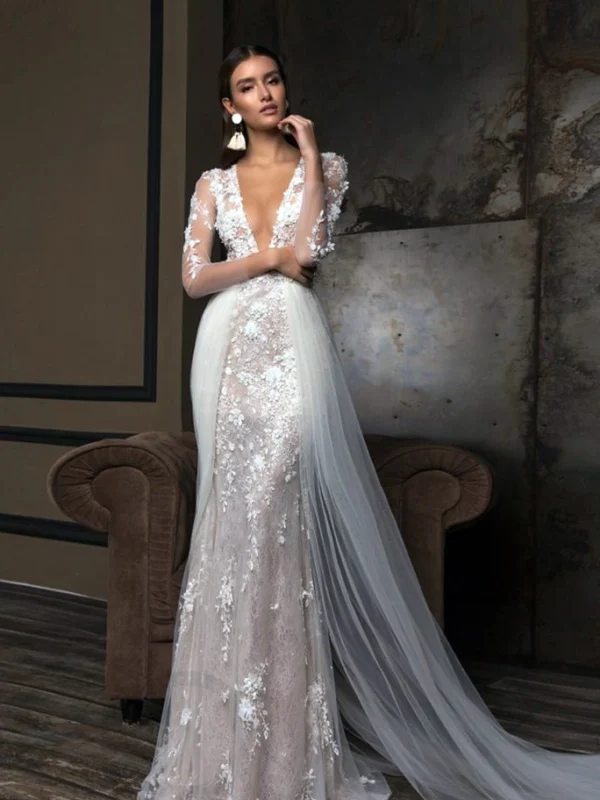
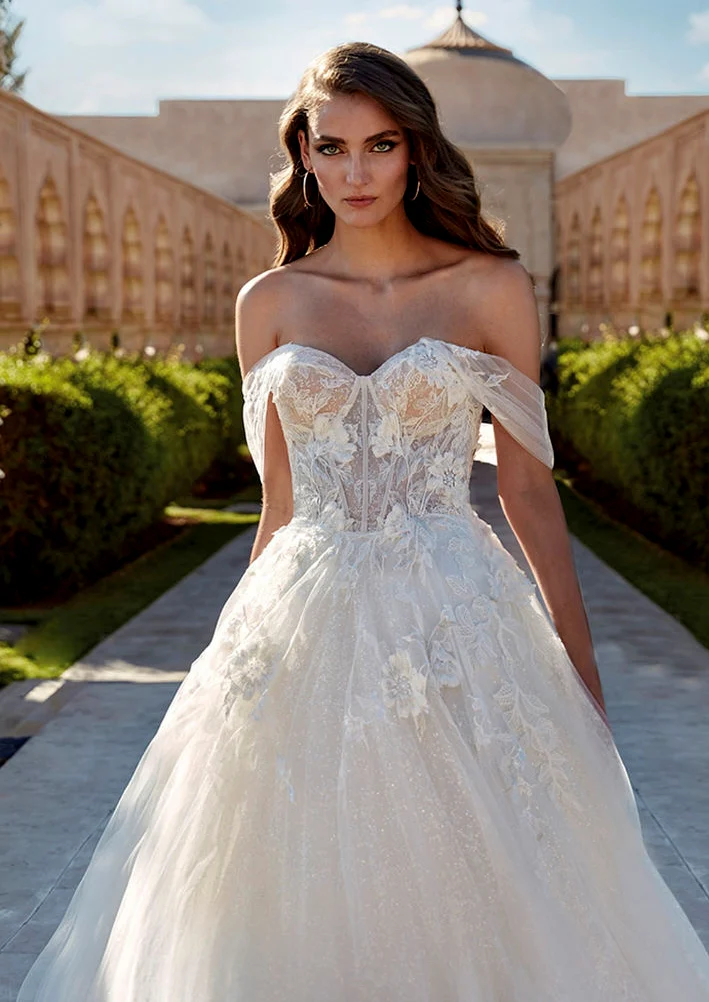
A princess wedding dress is often chosen through its full skirt first. For a more personal look, examine the upper area too: how does the bodice end at the shoulders, where does the waist appear, and do motifs continue towards the skirt? The two pictures connect large lower areas with different answers. One combines a sweetheart boundary, narrow off-shoulder bands and a visibly divided bodice. The other shows long patterned sleeves, a shallower V opening and a broad plain waist band. Compare these features before deciding only between more and less skirt volume.
Choose a princess wedding dress with one upper priority
Decide which feature you want noticed first. In the sweetheart example, pale motifs follow the divided front areas while narrow side bands sit below the shoulders. The neck space remains broadly open. In the long-sleeved example, pattern continues across the arms, while the broad band interrupts the design in the middle. Both approaches connect a defined upper contour with a large skirt. They create different looks and need not use the same accessories.
Choose one main point for the first fitting: the sweetheart shape, patterned arms or clear waist boundary. Treat other features as possible additions. This is more specific than a general request for a fairy-tale dress. A similar full skirt can accompany many upper designs. If one shoulder arrangement is unsuitable, you do not automatically need to abandon the entire skirt idea. Ask which actual alternatives are available rather than assuming every princess-labelled garment has the same construction.
Frame the sweetheart neckline and open shoulders of a princess wedding dress
The first image has an upper boundary with two rounded areas meeting towards the middle. Narrow side bands leave the neck and much of the shoulders uncovered. This open space, together with the front motifs, may already be the focus you want. Begin without a necklace. Then try small earrings or one other addition, checking whether the contour remains as clear as when you first chose it. An open neck area can be an intentional complete choice.
Assess the bands with relaxed arms and again while reaching forward. Ask how they attach on the actual model and what movement its specific design allows. Visible bodice divisions alone do not confirm a particular supportive inner construction. If you want more upper coverage, compare a real alternative rather than forcing yourself to reproduce the photograph. The bridal accessories guide helps examine a necklace, earrings and headpiece individually. Adding one at a time makes its effect on the neckline easier to see.
Choose long patterned wedding dress sleeves as a separate design area
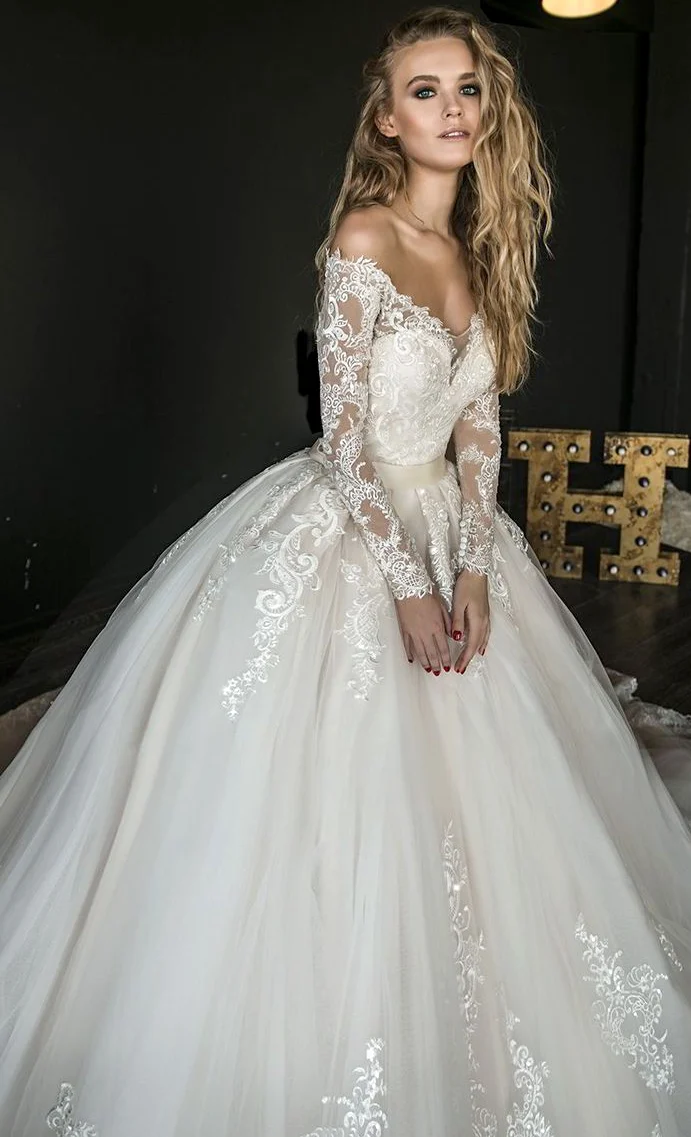
The second dress distributes pale branching motifs across translucent-looking arm areas. Its upper boundary is less heart-shaped and closer to a shallow V. Together with the longer sleeves, this creates another frame for the face and neck. Decide whether you like that connection between bodice and arms before selecting jewellery. The visible spaces are a design observation rather than a precise description of lining, net construction or fibre composition.
On an actual long-sleeved candidate, move both hands forward and bend the arms. Inspect the neckline and sleeve ends afterwards. Begin the styling comparison with quieter wrists so that the arm pattern remains visible. If you want a bracelet, introduce it separately. The lace wedding dress guide helps separate motif, background and verified material description. Do not automatically treat a visible design as proof of a particular textile manufacturing method; use the real garment information to complete that question.
Princess wedding dress: compare continuing motifs with a waist band
In the sweetheart bodice image, pale shapes appear to continue over the transition into the full skirt. In the second picture, a broad plain band makes a clearer horizontal boundary. This offers a particularly useful choice: would you like a connected flow of motifs or a visible separation between upper and lower areas? Neither method is compulsory for a particular body shape. It describes how you would like to organise your own silhouette.
Compare the two approaches from the same distance and with similar hand positions. Hands placed before the middle can hide part of the boundary, as in the long-sleeved photograph. Look again with your arms relaxed at the sides. An extra band or belt should appeal beyond a close-up alone. Assess its relationship with the neckline and skirt through a complete view. If you want another position, discuss it on the actual garment and within its specific alteration possibilities.
Let the skirt frame the upper design
Both references show large lower areas, but their poses differ. The person in the long-sleeved dress leans forward, with the skirt spread widely around her. In the sweetheart image, the person stands on a path. These differences affect how wide a skirt appears in a photograph. Do not choose only through the outermost width of the image. Request an ordinary standing view and examine where the fullness actually begins beneath the bodice.
Try the intended skirt shape with your shoes and any underlayers actually offered with it. Walk a few steps and sit. Then decide which upper line you want to remain visible during movement, and whether you would hold the skirt differently for particular actions. A cropped image edge does not establish the full train or hem. If fullness itself is your main concern, the separate full-skirt wedding dress guide complements this narrower comparison of upper designs without making their details interchangeable.
Finish accessories and the actual version together
Choose a hairstyle and possible outer layer after narrowing the shoulder and sleeve question. A veil may accompany the upper pattern or temporarily cover it, so look at both states. For an order, record which bands, sleeves and underlayers are actually included. A complete-look photograph is not a detailed delivery list. Ask any proposed alteration to be described through its affected area and expected new line. This gives the final fitting a concrete set of decisions to check.
The GINETEX explanation distinguishes care symbols for washing, bleaching, drying, ironing and professional treatment. Read the label on the selected dress and clarify outstanding questions with its provider. Your result should connect three deliberate choices: an upper frame, a waist transition and a skirt you have actually tried. That relationship makes the full silhouette your own bridal look rather than describing it only through a general style name.
A full skirt can connect with very different upper lines. Compare continuing motifs with a visible waist band, then choose accessories around that decision.
Frequently asked questions
Does every full skirt mean the same princess cut?
No. Labels are not used uniformly. Compare the actual starting point of the fullness, upper design and included underlayers.
Can the motif on a princess wedding dress prove its fabric composition?
No. The photograph shows pale motif placement, but not verified fibres or the whole construction.
Must I wear a necklace with a sweetheart princess wedding dress?
No. Assess the upper line alone first. Add a necklace only if you like its relationship with earrings and your hairstyle.