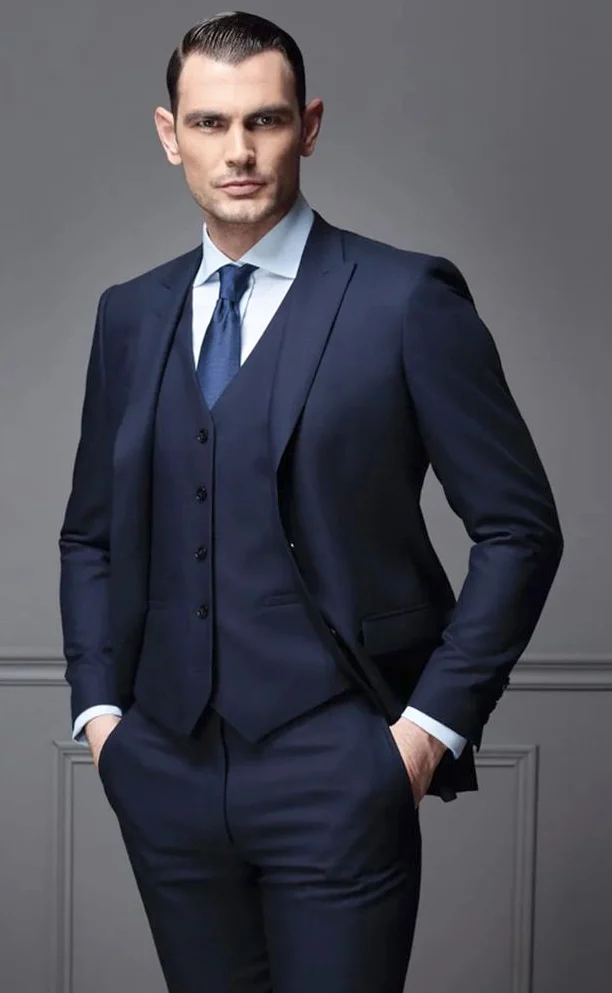
A navy three-piece suit appears against a plain grey background, with a pale shirt and dark tie. The jacket, waistcoat and visible trousers create a closely related colour arrangement. That visual continuity makes a useful documentation question: do the statements supplied by a seller apply to every piece, or only to one cloth? The picture cannot answer it, and the cropped lower framing also limits a full-length fit comparison.
Map composition and each precise claim to jacket, waistcoat and trousers. Ask about lining separately where information is available. If a waistcoat has a different back section, request its actual specification rather than assuming it matches the visible front. Keep model references together so that a certificate for one piece is not accidentally presented as covering all three.
For practical use, try the outfit seated and with the jacket removed if you plan to do that later. Check the waistcoat-to-waistband relationship on the real garment. You can prefer this coordinated appearance while asking for bounded evidence component by component; a three-piece look need not become a three-piece environmental claim without relevant documentation.