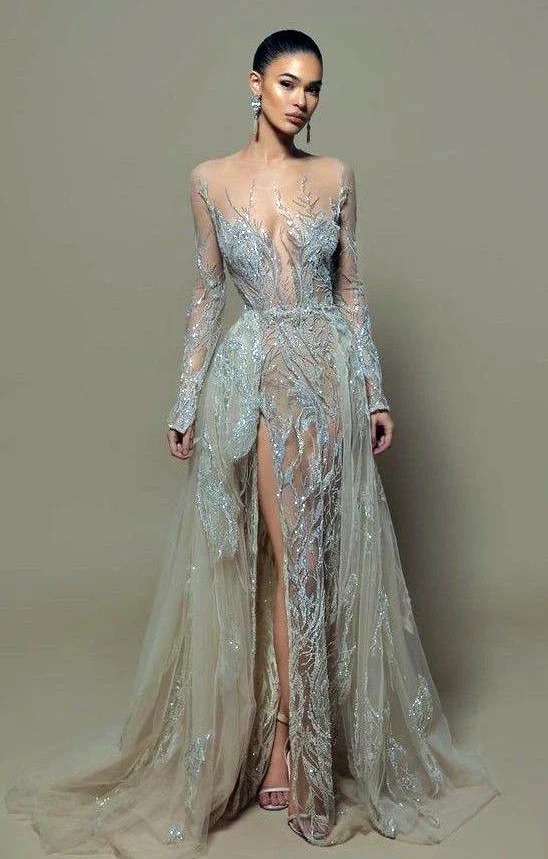
The drawn fine long-sleeved front leads a higher rounded outside neck area above a denser shaped inner front edge. Larger pale leaf- or flame-like forms cross bodice and long sleeves. Finer intervening areas remain visible. A clearer waist joins the closer inner lower form to longer drawn paths. A broader finer outside surface falls to the ground beside a higher front leg opening. Arms hang lower beside the body. Head and face appear completely with closely pulled-back hair and longer pale earrings. Pale shoes have narrow ankle straps.
Read the broader outside lower surface beside the closer middle as a visible arrangement. Two outside boundaries confirm neither a detachable connection nor a separate material type. The longer floor area shows neither complete movement nor a measured shared length. Larger motifs explain no particular hand technique. Visible width cannot establish an offered additional piece.
Request the actual favourite’s matching sides and rear with your preferred inner layer and shoes. See the lower area again after ordinary steps. Have every existing surface explained individually before turning its width into an offered change or removable component.