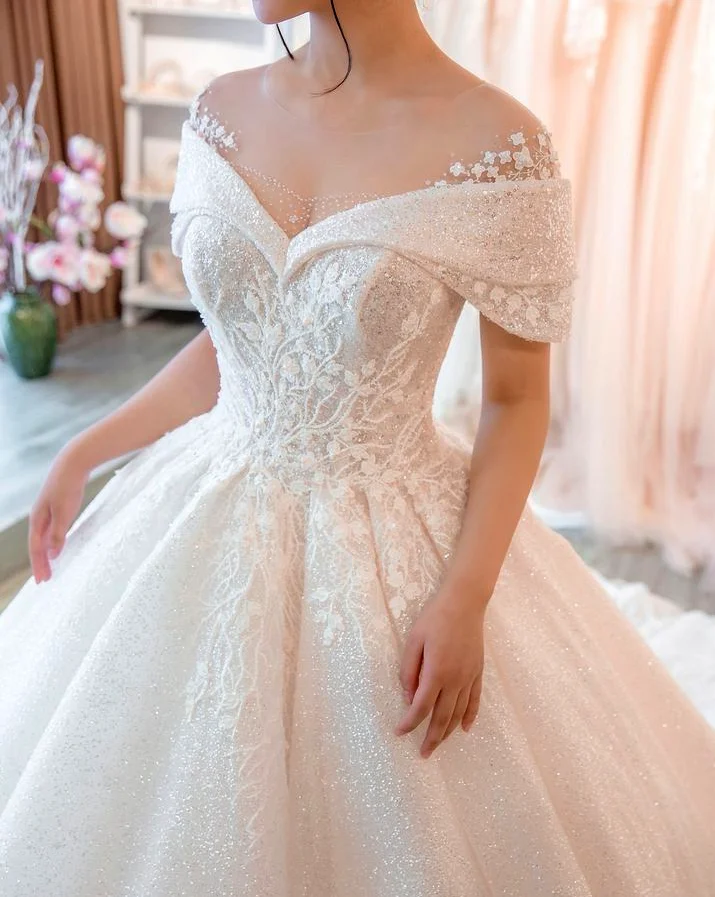
A folded shoulder edge creates a broad pale area around the upper front in this close view. A higher sheer-looking section with small pale shapes remains visible beside it. Beneath the folded line, trailing motifs travel over the narrower middle and into the beginning of the full skirt. The arms stay bare below the upper sections. Hands and the lowest hem are included only partly, concentrating the comparison on upper direction and finer middle drawing.
Compare this approach if you want a clear upper boundary beside a finer pattern. Explain whether width, angle or the quieter folded surface matters most. You need not choose the identical motif density beneath it automatically. Request a presentation in which edge and middle can be discussed separately rather than treating the entire photograph as one fixed specification.
Move your arms forwards and sideways at the real fitting stage. Look at the upper line before rearranging it. Try small neck decoration afterwards or deliberately keep the area open. Clarify which elements are connected and which alternatives are actually offered. A visible fold does not establish removability. The view helps explain a shape preference rather than proving a manufacturing route or guaranteed function.