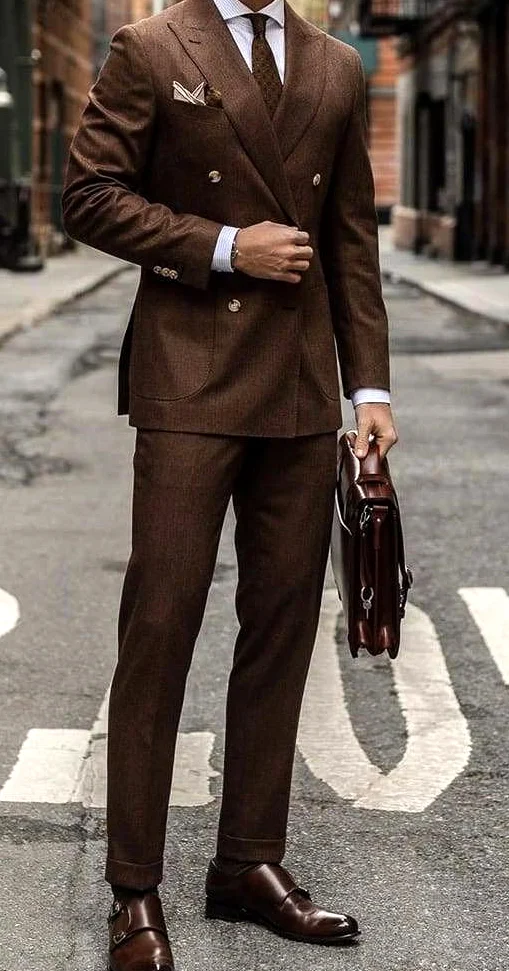
A brown double-breasted suit makes the largest continuous colour area in this full-length view. The pale shirt and darker tie create a narrower centre. A folded pale pocket-square edge remains visible. Darker-looking closed brown shoes sit below, beside a brown bag. These areas are related in colour rather than identical. Their appearance cannot establish the suit fibre or the material of the bag and shoes.
For your own version, compare suit and shoes first. Should the lower finish stay darker, or would you like more separation? Include the bag afterwards and inspect all three areas from some distance. A brown object does not need exactly the same shade for you to choose the connection deliberately. Decide whether you prefer the shared colour family or stronger differences.
The overlapping jacket front is a separate shape decision. One hand sits near the centre while the other carries the bag. Assess your candidate without that pose too. This separates your response to brown from fastening tension and the photographed posture, giving you a clearer basis for comparing another real jacket shape.