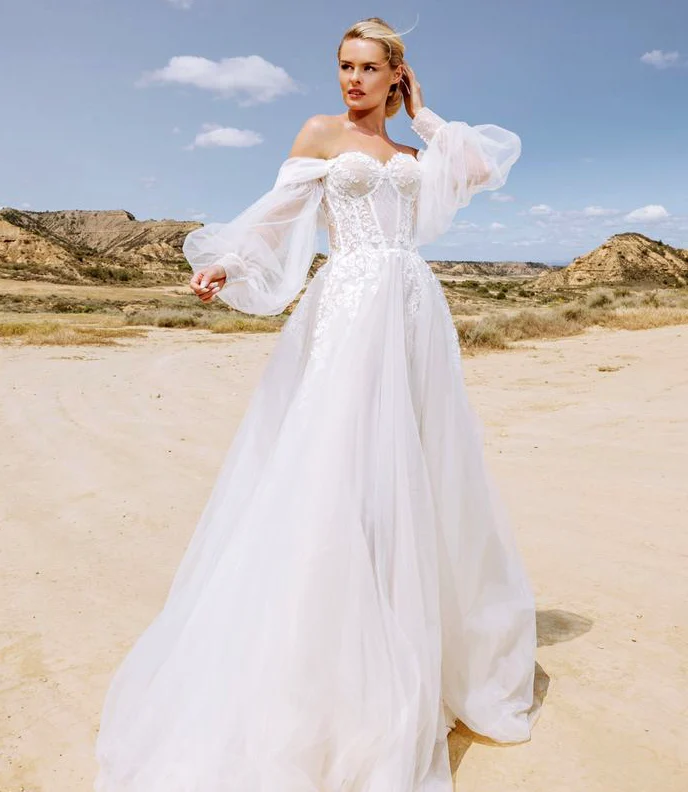
The pale outdoor view joins low folded shoulder bands to a shaped upper middle. Floral drawing and upright lines become denser across the closer bodice. Long fine-looking sleeves widen at the sides before narrowing towards wrist finishes. The fuller long skirt shows larger quieter areas and reaches the ground. One hand sits beside the head while the other arm extends diagonally down and out. Fingers lie near the lower sleeve area. Face and drawn-back hair are included. Footwear is not fully visible. Sand and dunes belong to the surroundings without establishing a season or actual wedding.
Compare the denser middle with larger quieter neighbouring surfaces. Their different appearance establishes no separate fibres. The farther-out arm position is not a fixed measurement of sleeve fullness either. This front photograph explains neither the rear nor every connection, and another similar sleeve picture cannot supply those missing angles.
Request both arms in the same relaxed posture on the actual model, plus its own sides and rear. Add underwear, planned shoes and an object you intend to carry. Reassess the real finish after ordinary movement before agreeing an alteration.