In floral wedding dress styles, the flower itself attracts attention first, but placement and density determine the real balance of the look. The same botanical idea feels graphic as a black hem border, romantic when it frames a deep V-neck and airy when pastel blooms scatter below a high waist. Silhouette changes the result as well: a close mermaid shape carries motifs along its curves, whereas a broad A-line skirt supplies calm space beneath a decorated bodice.
The images in this guide are visual styling concepts rather than records of purchasable gowns. They offer a basis for comparing contrast, necklines, backs, waist positions, movement and accessory choices. The practical goal is not simply to find an appealing floral detail. It is to understand whether that detail works with the complete dress from the front, side and back, both at rest and in motion.
Strong Contrast at a Botanical Hem
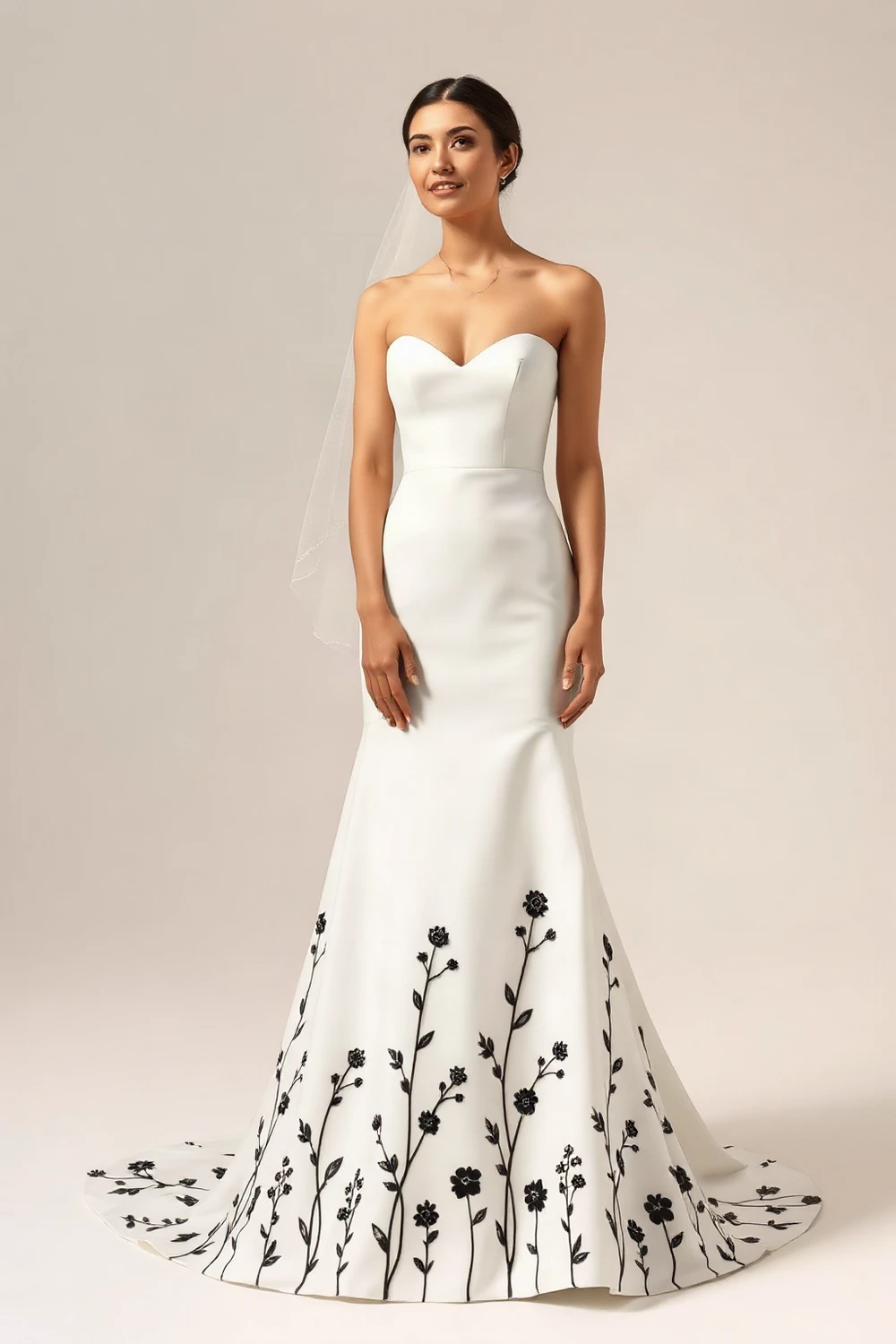
The first look keeps its sweetheart strapless bodice and long fitted torso almost entirely plain. Black flower stems appear only as the skirt begins to flare, rising to different heights across the white ground and continuing onto the train. This placement moves attention downward without completely cutting off the sense of length because the stems remain vertical. Far more legible at a distance than tonal embroidery, the border can give even a restrained setting a pronounced graphic character. The trade-off is that a bouquet, shoes or jewelry need not compete at equal strength. During a fitting, check whether the motif breaks at side seams, whether hemming would preserve its proportions and how the black pattern looks when the train is bustled. Rear and walking views are as important as the centered front view.
A Tonal Frame Around a Deep V-Neck
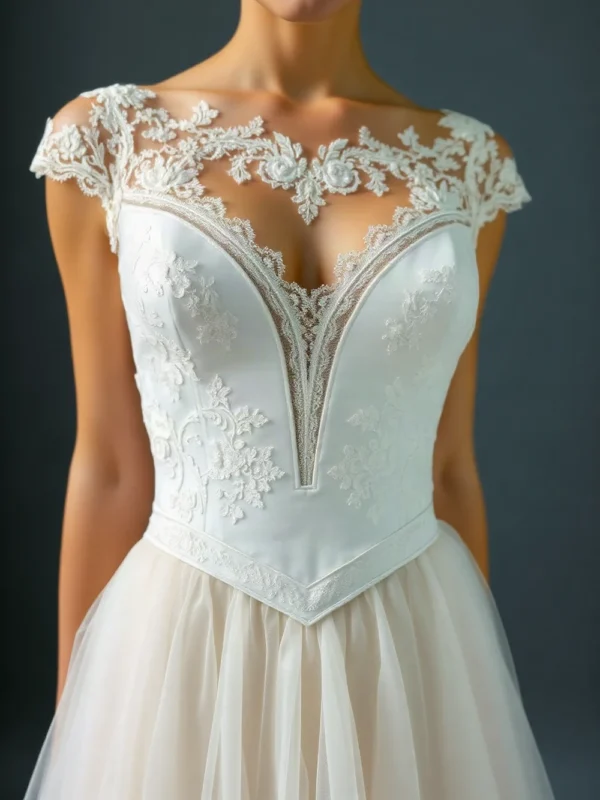
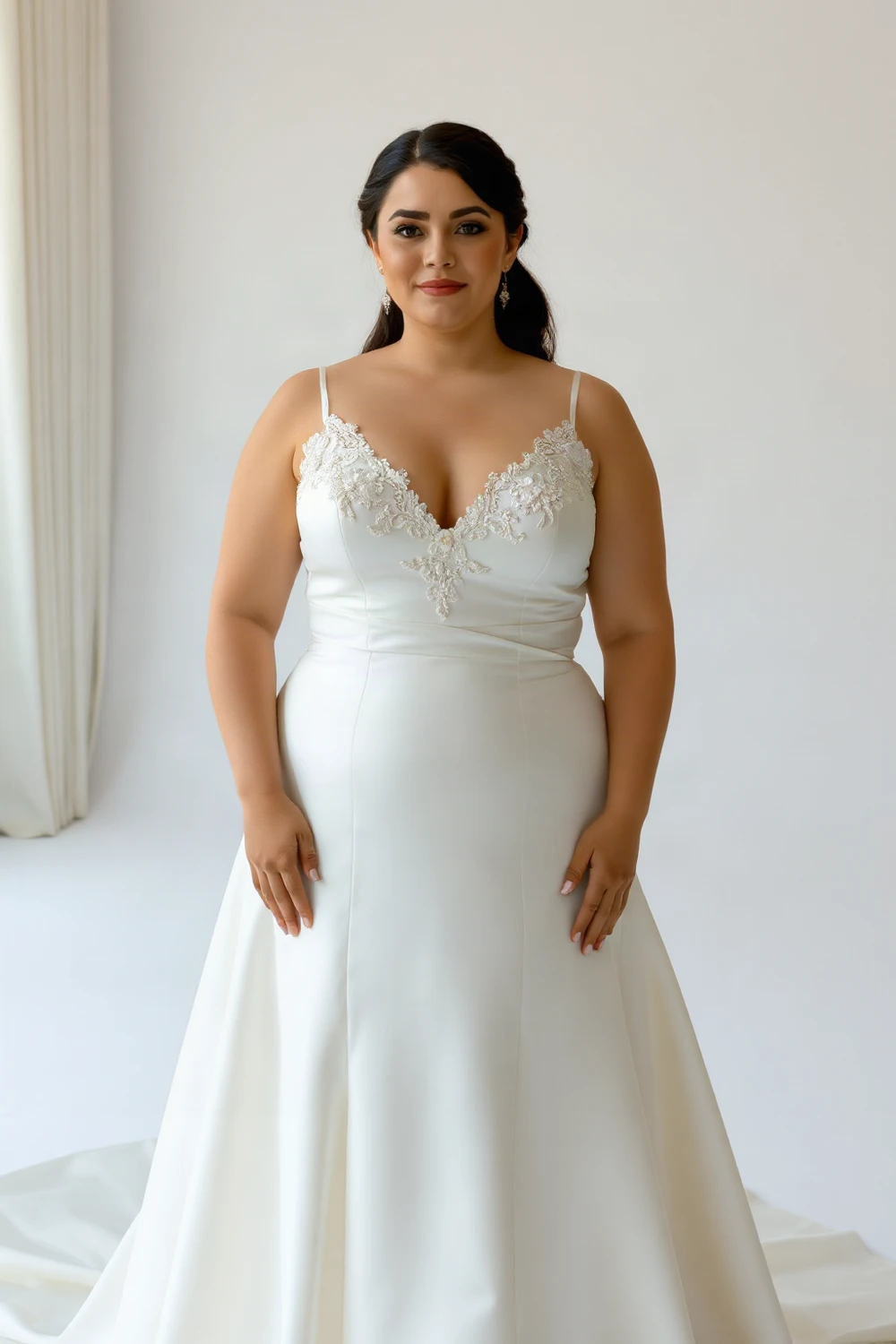
In the second design, a deep V-neck connected to slim straps is framed on both sides by raised white floral forms. The decoration narrows toward the center of the bust, drawing attention to the face and upper body, while the clean A-line area below the waist restores visual calm. Instead of the sharp opposition of a black border, shadows reveal the texture. The detail may therefore read strongly in close photographs and more softly from across a room. When choosing a deep neckline, consider the support and coverage offered by the actual construction during movement, not only its outline in a still image. Since the florals already complete the neckline, small earrings may be more coherent than a large necklace. Any likely bust or strap adjustments should also be reviewed in relation to the placement of the embellishment.
A Trail of Motifs on a Mermaid Shape
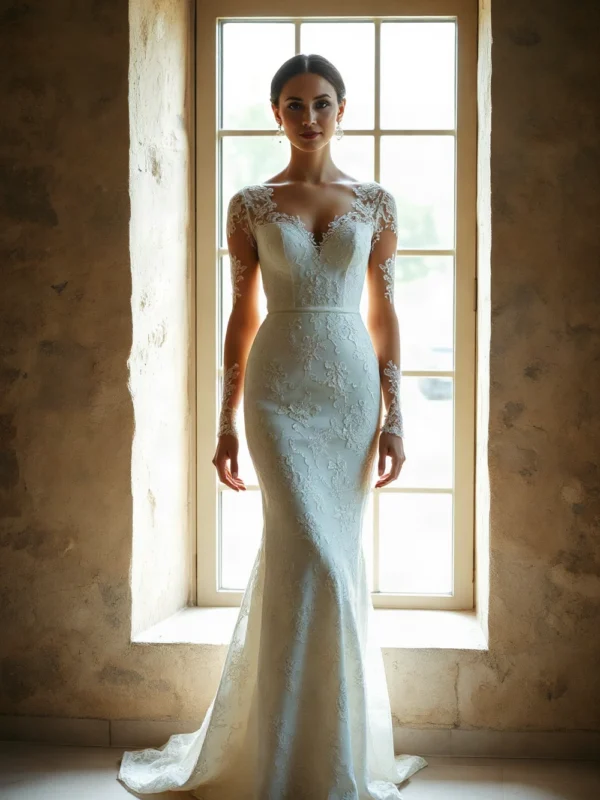
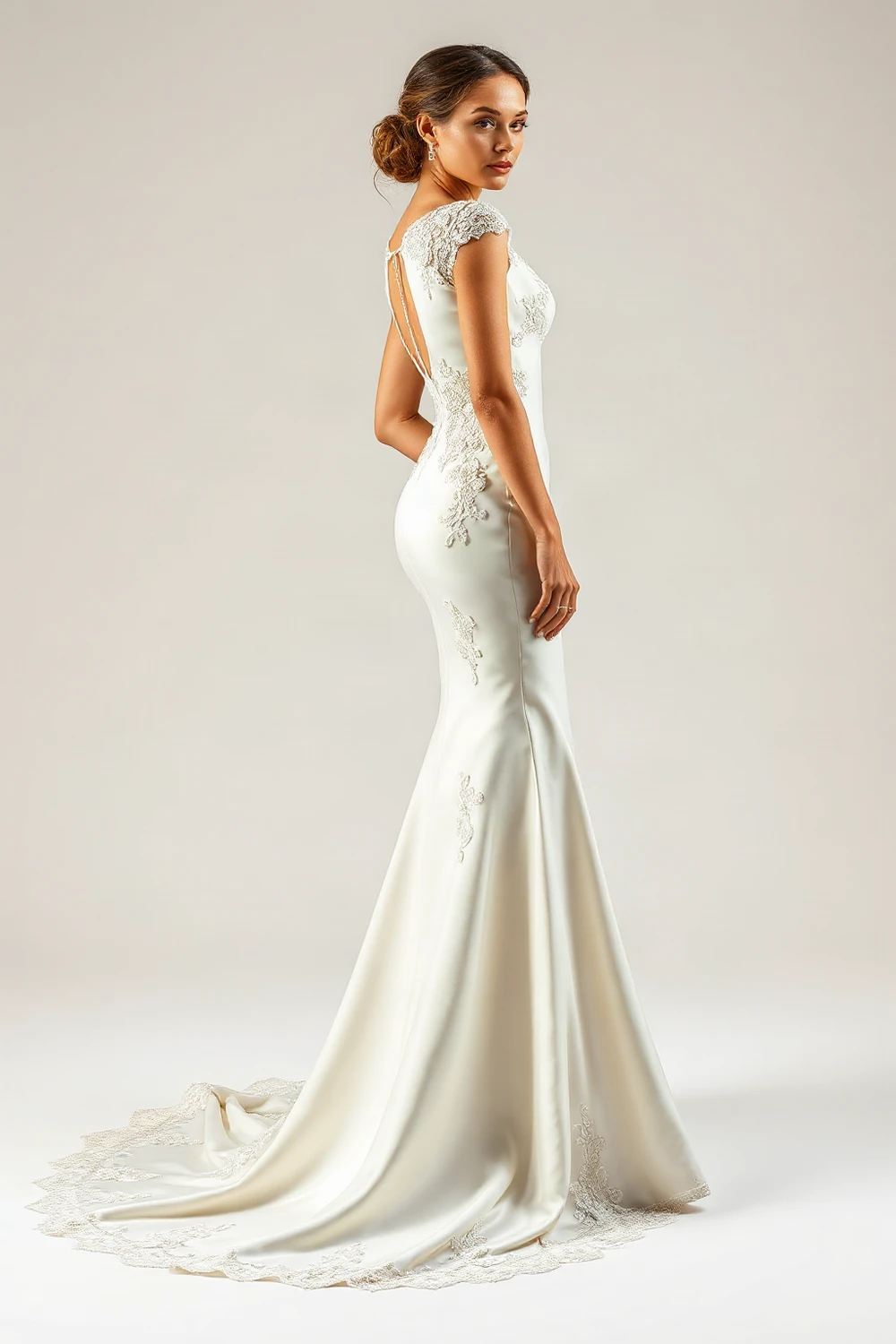
The third look combines decorated cap sleeves and an open back with a close mermaid silhouette. White motifs form intermittent stops at the shoulder, side waist, hip and lower skirt rather than filling one continuous panel. This route follows the body’s curve and brings movement to the smooth surface, while a fine border around the train resolves the composition near the floor. The apparently irregular spacing feels more organic than a formal repeat. If hip or waist alterations are expected, however, nearby motifs may be difficult to preserve in their original positions. A fitting should include sitting, long steps and turns; a static outline does not reveal the whole experience of a close cut. To keep the open back visible, an updo, compact earrings and an uncomplicated veil can prevent the shoulder and back details from being covered.
Balancing a Floral Back and Long Sleeves
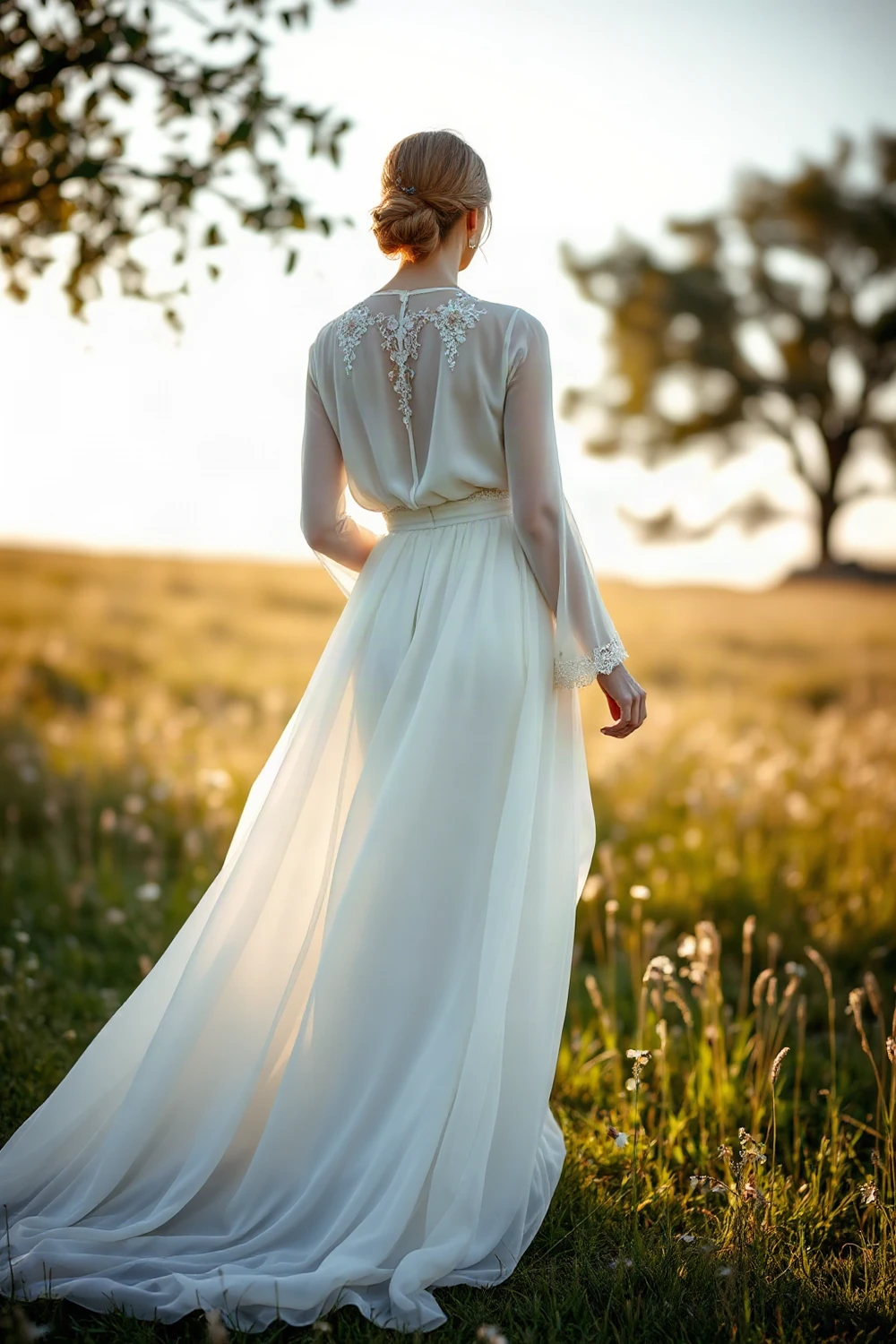
The fourth concept shifts the floral emphasis toward the rear. Pale motifs descend in a V around the translucent-looking upper-back area, with related decoration repeated at the cuffs of the long sleeves. A softly draped bodice is gathered by a narrow waist band, and the broad skirt falls in undecorated layers. The result balances greater arm coverage with a light back opening. Although this fluid outline suits the visual atmosphere of an outdoor setting, practical questions include how the length moves over the ground, how it reacts to wind and whether fine sleeve surfaces might catch on nearby objects. A long veil could obscure the upper-back arrangement; a more transparent option or one beginning beneath the hairstyle may retain its visibility. Rear fitting photographs are especially helpful for checking the level of the waist band and the relationship between the floral composition and the chosen hairstyle.
Sparse Pastels Below an Empire Waist
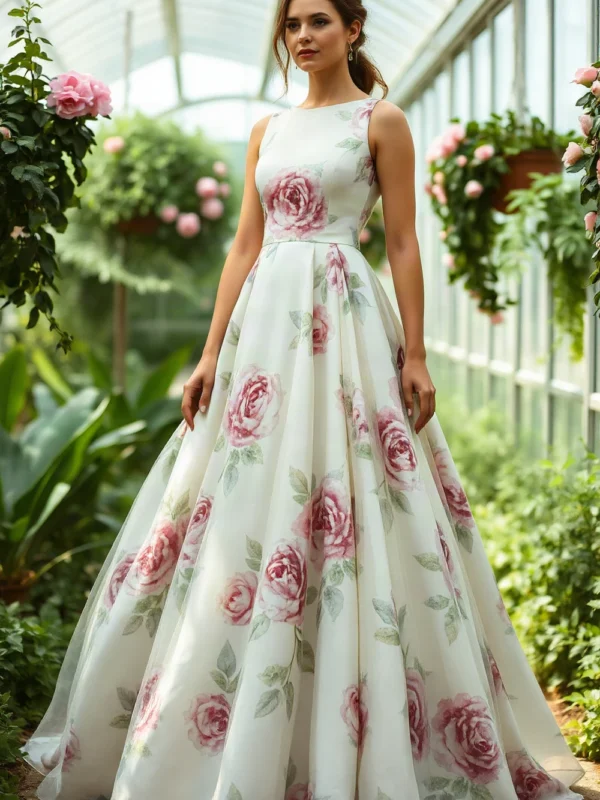
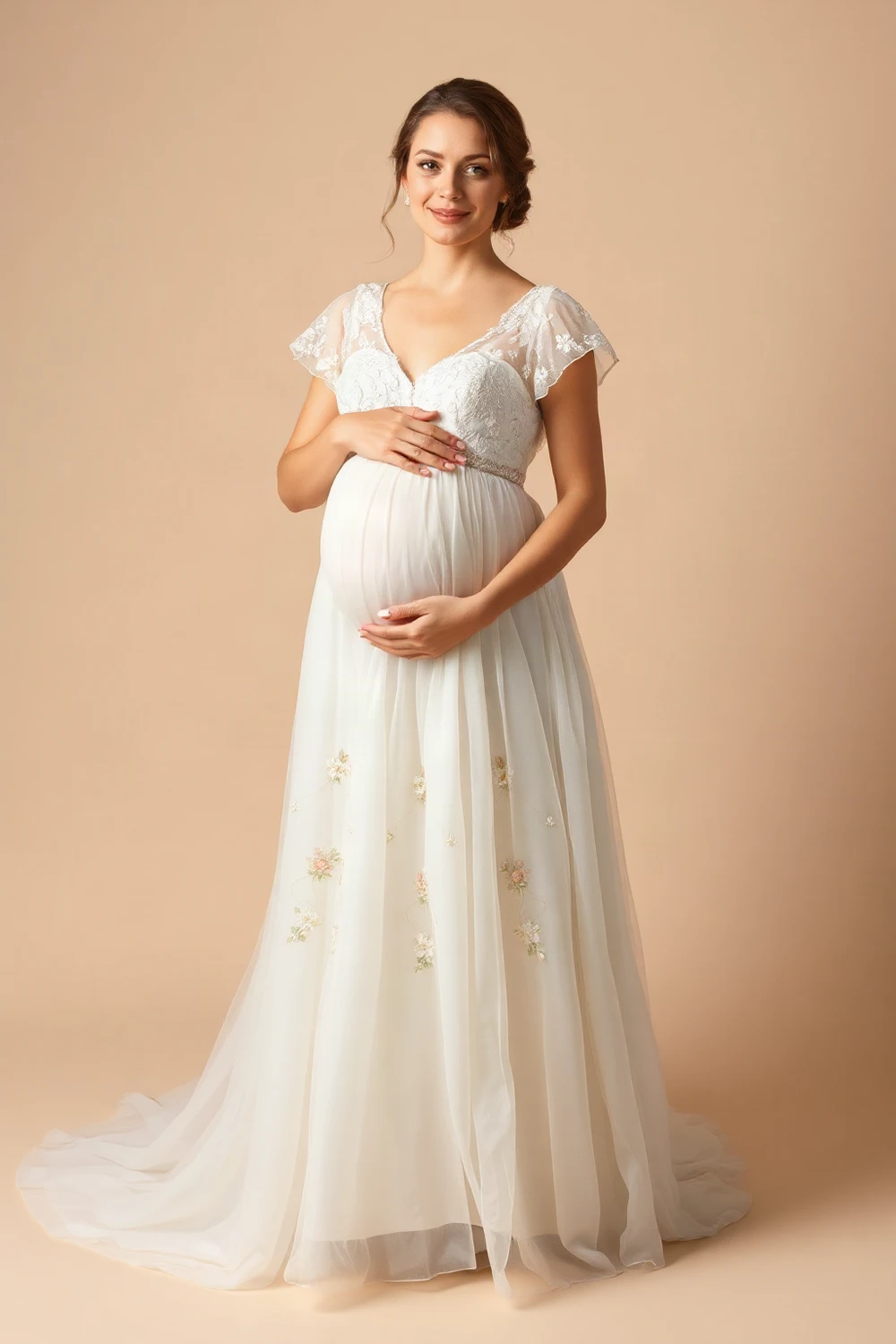
In the fifth look, a high line beneath the bust allows the skirt to fall freely. Translucent-looking short sleeves and a floral-textured bodice establish detail above, while small pastel blooms are spaced widely across the lower half. The restrained distribution leaves the vertical layers uninterrupted and keeps the colors as gentle accents. This silhouette can be a useful starting point for maternity bridal styling, but comfort cannot be inferred from the cut name alone. Professional fittings should consider possible size changes before the event, pressure at the under-bust band, room within the lining, sitting comfort and the finished length with shoes. A bouquet does not need to reproduce every shade in the floral details. Selecting one of the motif colors, or pairing neutral flowers with greenery, maintains a quiet connection without turning the whole arrangement into a dense collection of competing pastels.
Concentrating Color at the Bodice and Waist
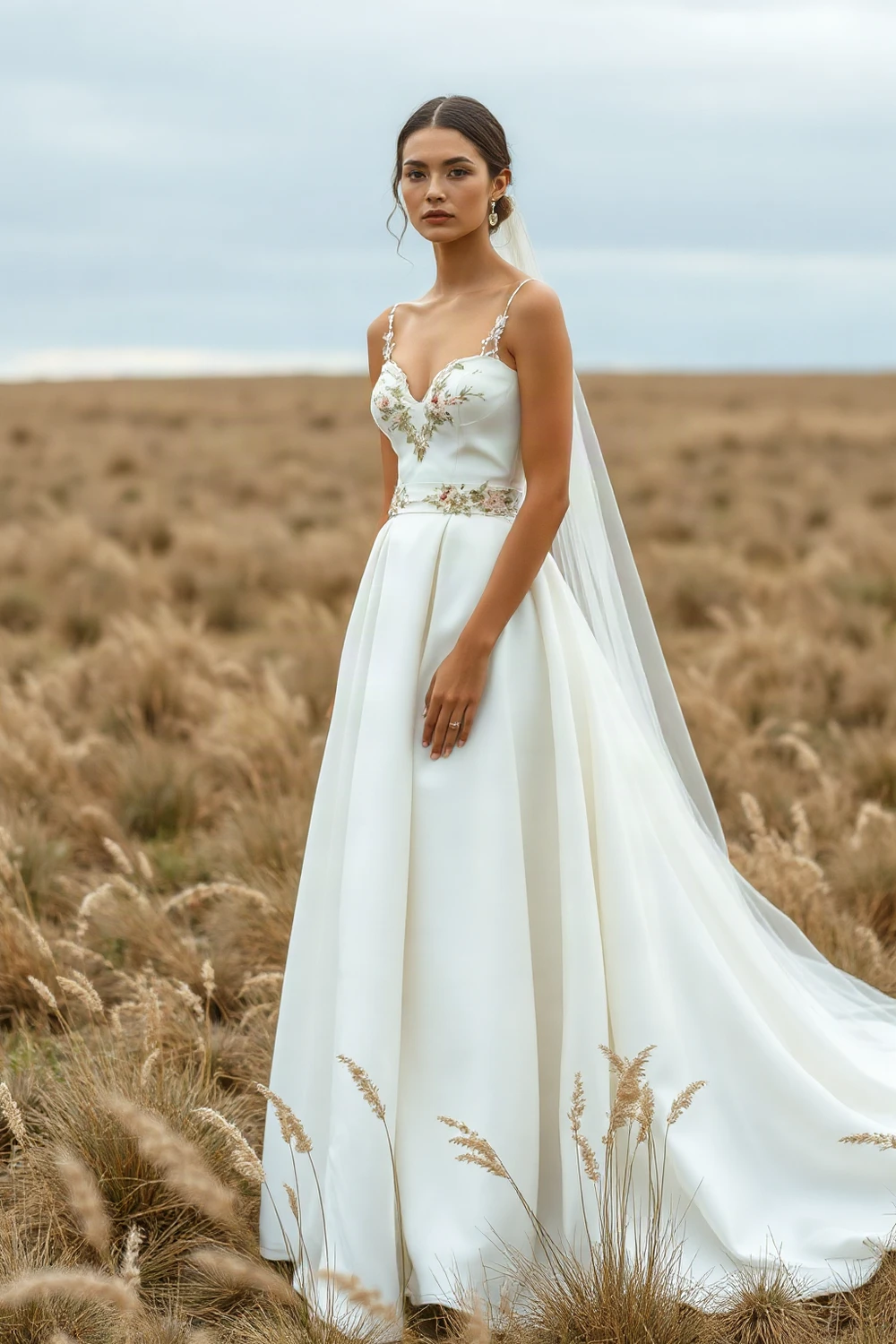
The sixth design carries small colored motifs from the slim straps along the neckline, through the center bodice and across the waist. Because the broad, pleated A-line skirt remains mostly plain, the flowers form a clear focal point around the face and upper body. This distribution reverses the weight of the black-bordered first look: attention stays high while volume expands below as a calm white field. A horizontal floral line at the waist joins the two parts, and the vertical folds maintain a sense of length. A bouquet can repeat one main bodice color rather than multiplying the complete palette. The veil should be tested for enough transparency and an appropriate starting point so it does not hide the decorated straps. Since the small motifs may recede in distant outdoor photographs, close images of the neckline and waist can also be planned.
When comparing floral wedding dress styles, begin by deciding where the motif should create focus. A black hem border establishes a strong base, a floral V-neck frames the face, an open back creates a rear focal point, and an empire waist allows a looser vertical flow. Then judge contrast and silhouette together. Dark or dense decoration benefits from quiet accessories, while small pastel flowers are often most legible in closer views.
Do not make the final decision from a catalog pose alone. Examine the dress from the front, side and back while walking, sitting and turning, and try the veil, hairstyle and bouquet together whenever possible. The construction, motif technique and alteration options of any actual gown must be confirmed separately. With those checks, a floral detail can become more than an attractive isolated feature: it can support the waist position, skirt volume, movement and atmosphere of the complete bridal look.
Compare a black botanical border, tonal embellishment, an empire waist and colored wildflowers to see how floral placement works with different wedding dress silhouettes.
Frequently asked questions
How can a black floral hem be balanced with accessories?
The graphic border already provides a strong focal point. Small earrings, a simple veil and a bouquet with one color or a limited palette can complete the look without competing with the lower skirt.
Does a floral deep V-neck need a necklace?
Dense decoration around the neckline often creates its own frame. Small or medium earrings may be enough, although the real neckline depth, support and personal comfort should always be assessed during a fitting.
Can floral placement affect wedding dress alterations?
Yes. Motifs close to side seams, the waist, hips or hem may shift during taking-in or shortening. Discuss the alteration plan early with a professional who can evaluate pattern continuity.
What matters when choosing an empire-waist maternity wedding dress?
Check pressure beneath the bust, room in the lining, sitting comfort and possible body changes before the wedding. A professional fitting close enough to the event is important for the final adjustment.
How should a bouquet be chosen for a dress with colored flowers?
It does not have to repeat every color. Selecting one main shade from the motifs and supporting it with neutral flowers or greenery can create a calmer, more connected result.