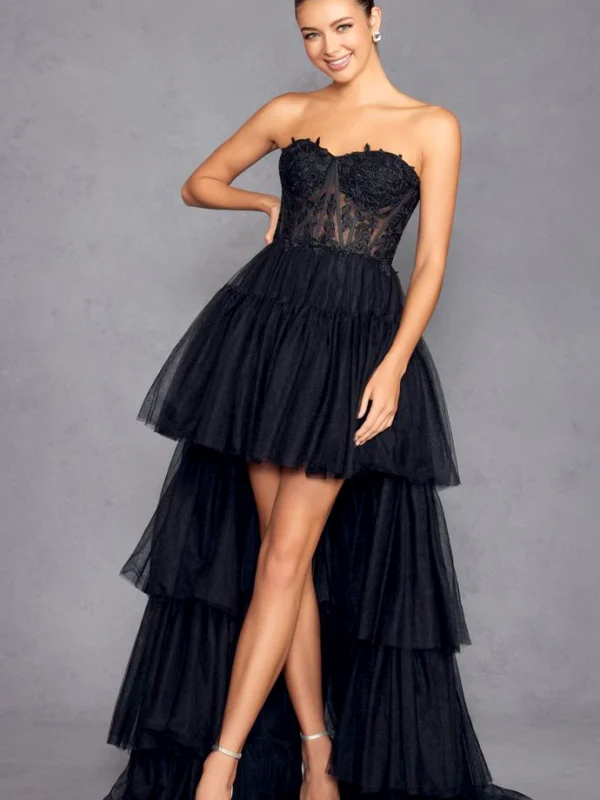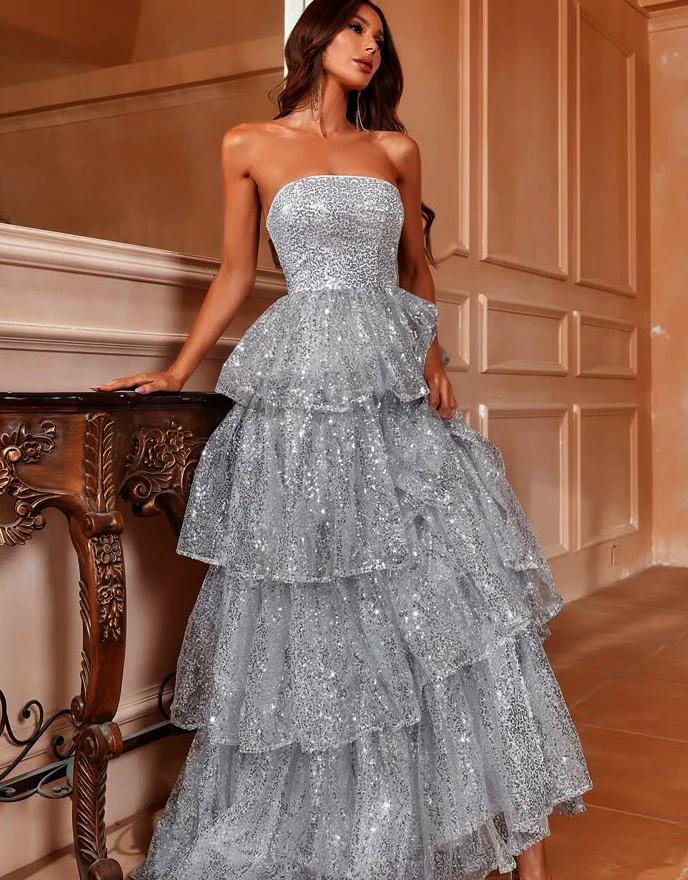
A tiered party dress creates depth through visible horizontal breaks and overlapping fabric in the skirt. You do not have to combine several separate pieces to create depth. The two references here use visible horizontal breaks and overlapping fabric to organise the skirt. One concentrates on repeated tiers and a bright surface; the other combines a printed surface, fuller sleeves and a lower tier. Start by deciding which part of that organisation you enjoy. Then use a fitting to check how the layers behave while you move, sit and add the outerwear you actually need.
Tiered party dress: identify what the pictures show
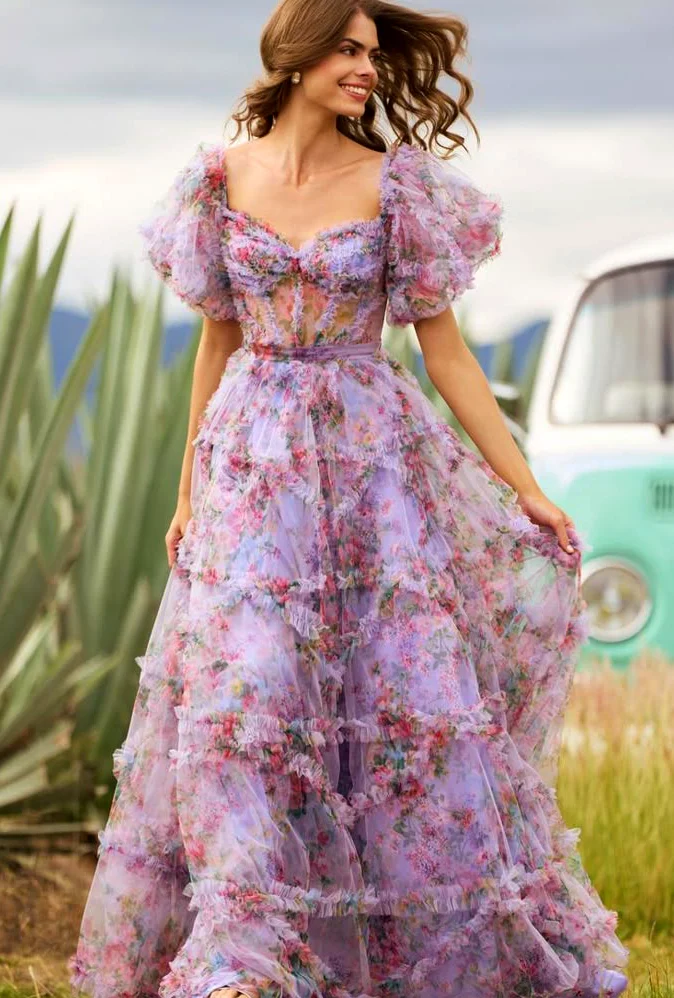
The silver-coloured dress has a straight strapless neckline, a fitted upper body and several progressively spreading skirt tiers. Its visible surface catches the light throughout the dress. The printed dress uses pink and lilac tones, short full sleeves, a shaped bodice and a long skirt with a distinct lower section. The photographs do not show a detachable skirt, separate sheer overlay or interchangeable outfit system. Treat them as references for construction visible from the outside. Questions about removable parts belong to the seller of the actual garment you are considering.
Compare repeated tiers with one main break
The silver reference divides the skirt several times, so the horizontal edges are central to the image. The printed reference combines a busy surface with fewer obvious divisions through the main skirt. Neither approach needs to be described as universally flattering. Try looking at each from the same distance and ask where your attention lands first. If you are searching for a similar dress, explain whether you want multiple clear steps or one lower change in volume. That specific request is easier to compare with available options than a broad request for a layered look.
Keep colour and structure as separate decisions
A photograph can make it hard to tell whether you prefer a shape or its colour treatment. Imagine the silver silhouette without its bright surface, then imagine the printed silhouette in a single colour. You do not need to know how either garment would actually be manufactured to use this as a preference exercise. Make two notes for your appointment: preferred skirt structure and preferred surface. You may discover that you want the repeated tiers of one reference with a quieter finish, or the fuller sleeves of the other with a different pattern.
Try the bodice as carefully as the skirt
For a strapless dress, sit and stand, raise your arms into an ordinary greeting and notice whether the upper edge stays where you want it. Ask how the real bodice provides support. For a sleeved dress, reach forward and bring your hands together in front of you. Look at the neckline after the sleeves have moved. A skirt with attractive layers can distract from a bodice that does not feel right. Give both parts equal time during the fitting, including a check with the underwear you plan to use at the event.
Watch the tiers return to place
Walk across the fitting area at your usual pace, turn and stop. Look at how the visible edges settle, then repeat after sitting in a chair. Ask yourself whether you like the dress in these ordinary positions, rather than only when you hold the skirt out. In the printed reference the wearer lifts part of the skirt, which changes the displayed outline. That is useful for seeing the pattern, but it does not establish the unposed fall of a dress you might buy. Make the standing, walking and seated views part of your own comparison.
Set the length with your event in mind
Bring the intended shoes and discuss the route you expect to take: stairs, a short outdoor walk or a seated journey can each prompt a different practical question. Check the hem during a normal step, not just with your feet together. If a tiered skirt needs shortening, ask where the adjustment would be made and what the bottom section would look like afterwards. Request an explanation on the real item. There is no reliable way to promise an alteration method or price simply from the number of visible layers in a reference photograph.
Plan a top layer without hiding your favourite feature
Try any jacket, wrap or coat during the fitting. Decide whether you want to show the waist, the full sleeves or the first skirt tier when the outer layer is on. Look at the outfit open and closed, and sit with it as you expect to during the evening. This turns layering into a practical styling choice instead of an assumption that another garment must be added. If the dress is already the main visual focus, a simple outer shape is one option to compare; it is not a requirement you have to follow.
Check bags and jewellery against the actual surface
Put a bag in the hand you usually use and see where its hardware meets the dress. Move it as you would while greeting someone or taking a seat. Add jewellery one piece at a time. On a bright or printed surface, the question is whether you can still see the detail you most wanted to highlight. Compare a short necklace with no necklace, or earrings with the sleeves fully in place. The images cannot tell you whether a surface will catch on a particular accessory, so check contact on the actual garment carefully with permission.
Leave the fitting with a short decision record
Write down the skirt arrangement, neckline, sleeve movement and hem length you approved. Ask for the garment's documented composition and the details of any agreed alterations. Brand, price and availability are not established by these pictures. Care follows the garment label; GINETEX explains the symbols. Ask the supplier how they recommend transporting and storing the layers of the actual dress. Your record should make it easy to repeat the successful combination of shoes, underwear and outer layer when you collect the garment, rather than relying on how a single posed image looked.
Compare several clear skirt tiers with one lower division first. Decide on pattern and colour separately. Then test the bodice, sleeves, the skirt after movement and the hem with your shoes.
Frequently asked questions
Do photographs of a tiered party dress establish that its layers are removable?
Photographs of a tiered party dress do not establish removable parts. The references show skirt divisions and overlapping areas within the garments. Ask about detachable features on the actual product being offered instead of assuming that a layered appearance means separate removable pieces.
How can I tell whether I like a tiered party dress in motion?
Try a tiered party dress by walking, turning and stopping. Sit down, then check the skirt again as you stand. Compare the ordinary fall of the layers before arranging them with your hands, so you assess movement beyond a carefully posed view.
How do I separate a pattern preference from a shape preference?
Record your preferred skirt structure and surface separately. Ask whether you would enjoy the same silhouette in one colour, or whether the photographed colour treatment is the main attraction.
When should I try a jacket over a tiered dress?
Try it during the fitting with your intended shoes. Look at the jacket open and closed and sit in the combination. Check how it lies over full sleeves and which part of the skirt remains visible.