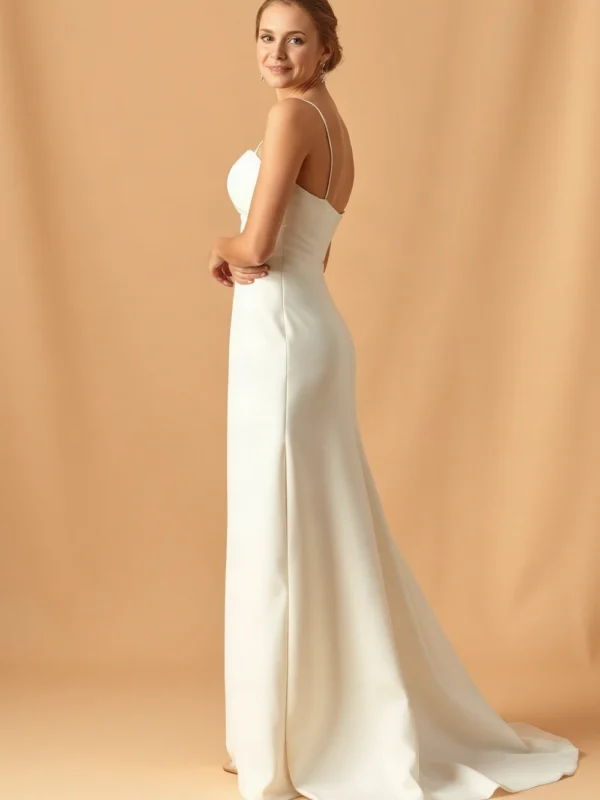
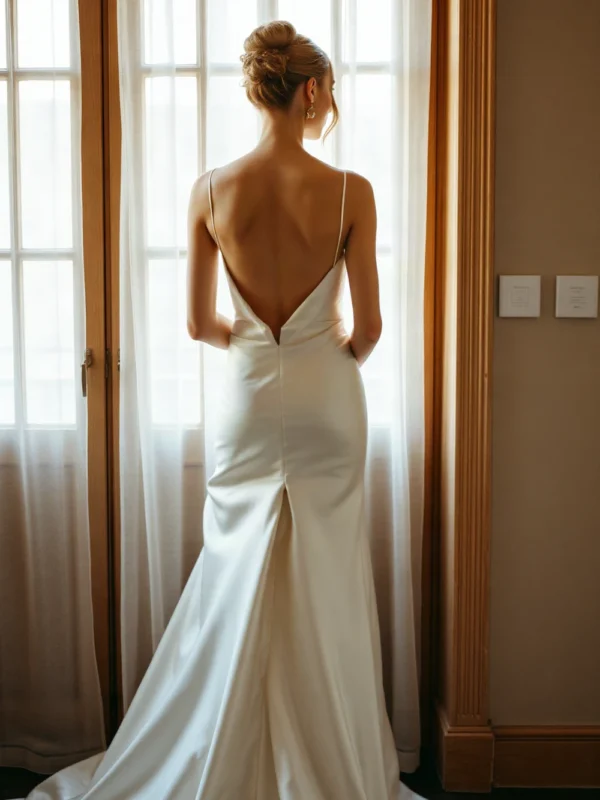
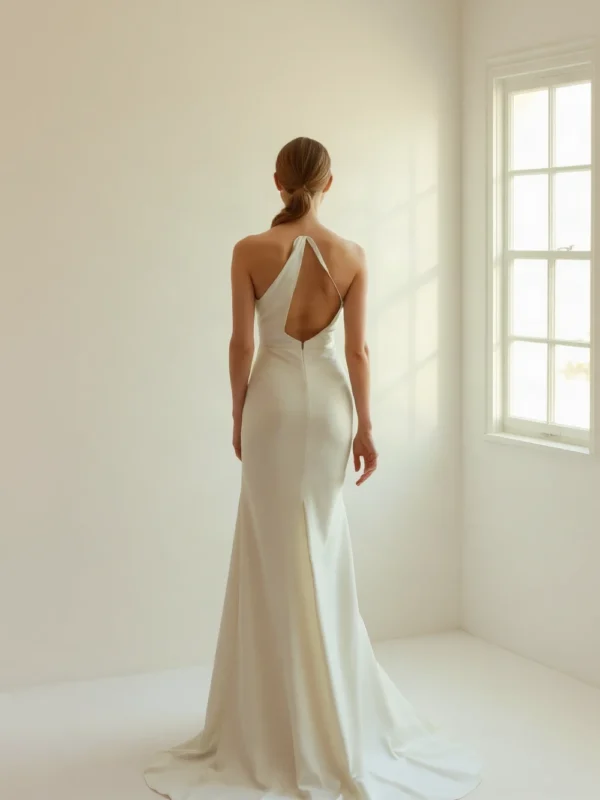
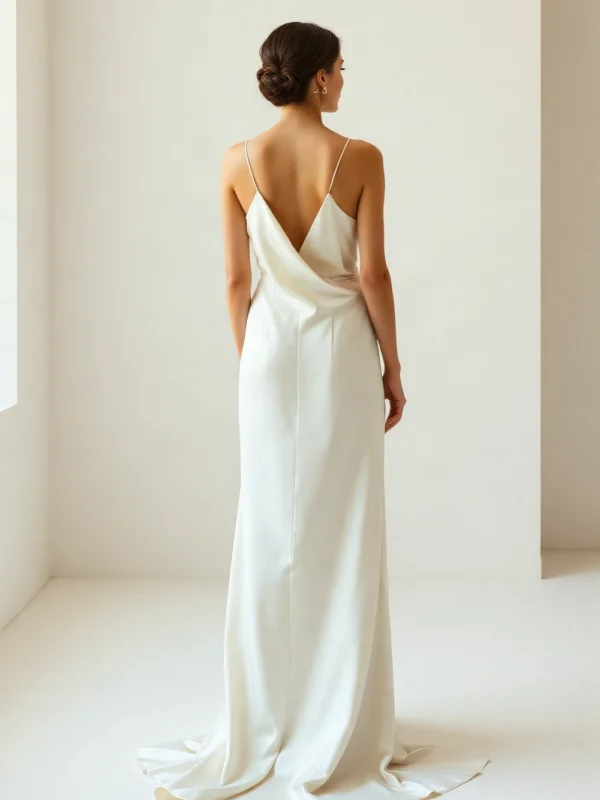
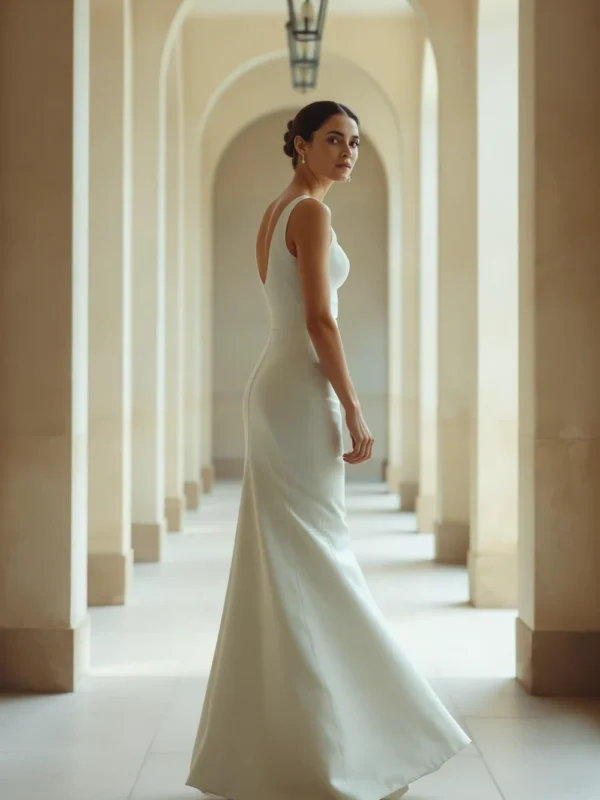
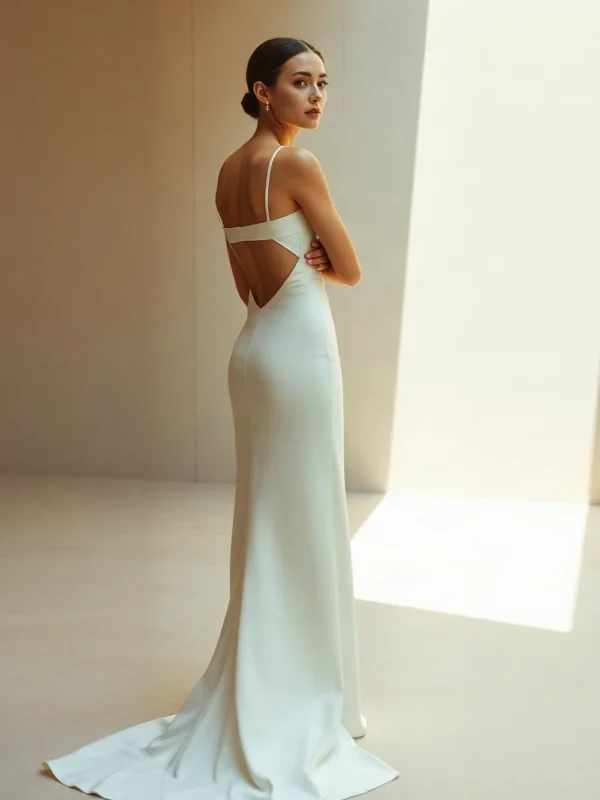
All six looks share smooth white surfaces, minimal embellishment and silhouettes designed to be read clearly from the back. Their differences are not limited to how much skin is visible. The direction of the straps, the point where an opening meets the waist and the amount of fabric resting on the floor all change the balance of the figure.
The first look pairs fine straps and a moderately open back with a gentle A-line and a short extension. The second takes the V much lower. Its skirt stays close around the hips before opening into a broad train that pools in front of the window, producing the strongest contrast between a narrow upper line and an expansive hem.
The third idea is asymmetric, with a tie-like element rising from one shoulder and a curved cutout crossing the back. A rounded train steadies that directional detail. In the fourth look, two fine straps frame a softly draped crossover V. The straighter skirt and limited floor coverage make it feel less ceremonial than the wider trains.
The fifth silhouette offers broader shoulder straps and a controlled U-shaped back. Its measured flare echoes the vertical rhythm of the arched corridor. The sixth combines fine straps with a horizontal band and a pointed geometric opening below it. A close, elongated body line ends in a rounded sweep train, balancing structure with softness.
When choosing among these approaches, test the back rather than judging it only from a still pose. Check whether its edges lift when the arms move, whether the planned understructure remains hidden and whether the straps stay level. A short sweep may be easier in a compact or busy venue, while the second or third concept gives more floor presence for a formal entrance. An updo keeps the back design visible; any veil should be tried with the dress so that it does not flatten draping, obscure a tie or compete with a support band.