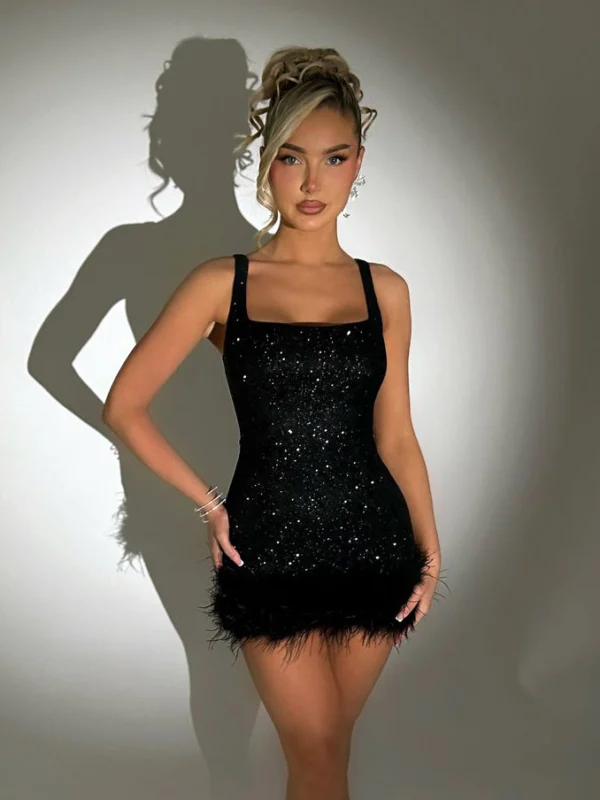
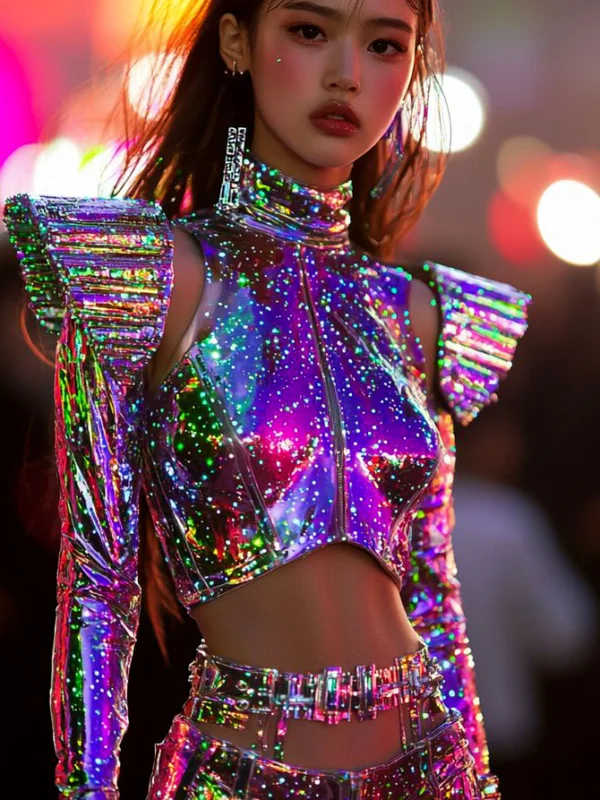
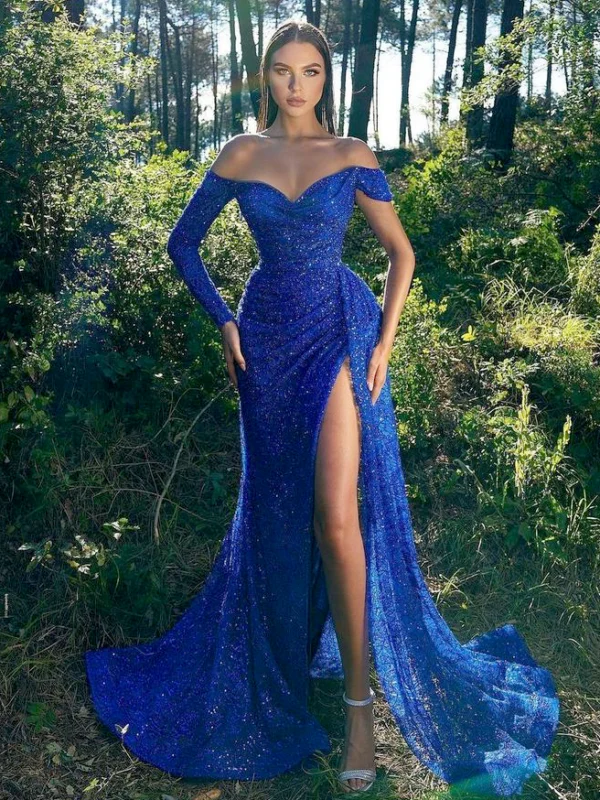
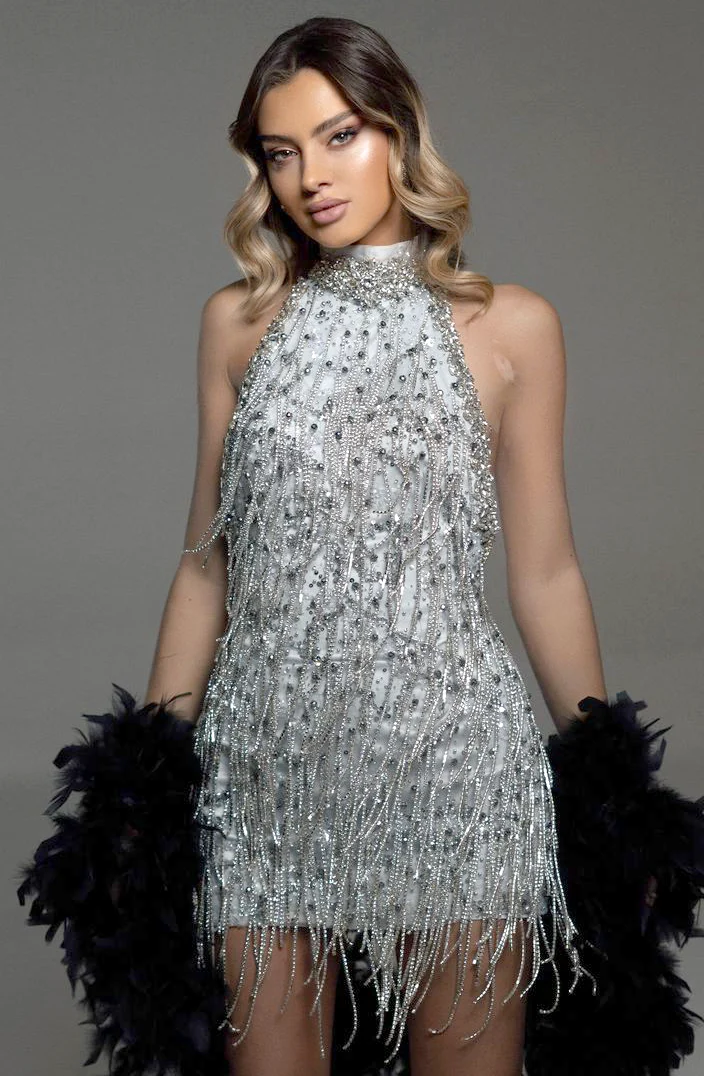
Choose a fringe party dress through its visible hanging elements: where do they start, which direction do they follow and how far do their free ends reach? The short pale main reference shows those strands particularly clearly. Three further images deliberately add different surfaces: small round details on a broad fabric area, dense reflection and feather-like projections. They are comparison images rather than four examples of the same fringe arrangement. Identify the effect you actually want before choosing length, neckline or additional pieces.
1. Separate free ends from reflection alone
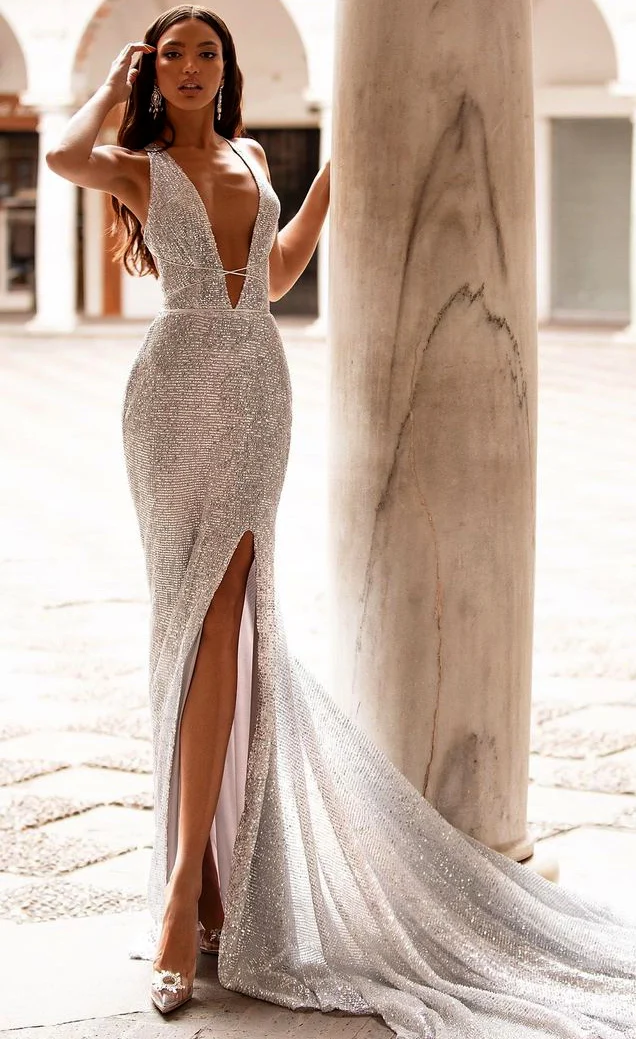
The short reference has many pale reflective-looking strands across the surface, hanging different distances below a shorter fabric finish. Some form curves at their ends. This is a different visible arrangement from the dense small points on the long silver-looking dress. Light can stand out strongly there without long, freely ending rows being evident. Do not call every shining surface fringe. Look for the start, course and free end of the trim that interests you.
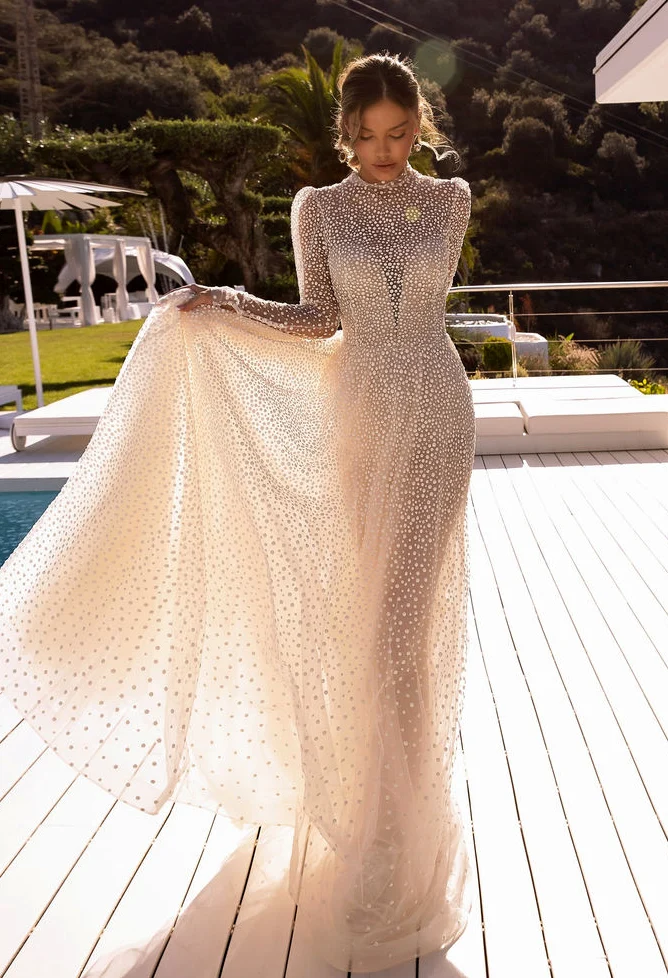
Feather-like projections introduce a separate comparison. The long white rear view has many fine projecting elements, without the same clearly separated hanging rows as the short main image. Appearance does not confirm real feathers. A specific product illustrates why different descriptions may be needed together: Mango describes model 27081186 with feather embellishment and a fringed hem as separate details. That information belongs to that product and identifies none of the archive dresses.
2. Decide on placement and distribution
Choose whether you want hanging lines across the visible dress or only at a particular edge. In the main reference, dense decoration sits near the high front neckline, with further strands distributed over the torso and skirt. Their ends reach different levels. The visible fabric length and the longest hanging elements are therefore two separate lower boundaries. Mark both when recording an image idea for your search, rather than assuming the fabric edge describes the complete finish.
The fringe evening dress guide develops row spacing and direction. For an actual fitting, three questions help: where is the highest starting point, where are the lines most concentrated and which area remains quieter? Then consider a less decorated arrangement as a comparison. You need not adopt every detail in the main reference to choose hanging strands as a deliberate accent. A quieter upper surface and an emphasised lower edge are separate preferences to search for, not a confirmed alternative version of the dress shown here.
3. Test fabric length and hanging length separately
The short main image shows a lower fabric edge above several strand ends, with feet and shoes outside the frame. The three long references establish other lengths and surfaces, rather than a long version of this short dress. Specify whether you want a short fabric base with a longer finish or an entirely long garment. The short or long party dress comparison helps separate that length decision from reflection and neckline.
Try the actual candidate first while standing, then walking, turning and sitting. Observe how the free ends lie and how close they come to your hands or the seat. A photograph proves neither freedom of movement nor a particular movement of the decoration. Ask if elements overlap in an unexpected way. Have their intended arrangement demonstrated instead of undoing unfamiliar connections yourself or assuming extra components from another product’s description. Record what you see in stillness and movement separately.
4. Weigh neckline, sleeves and jewellery together
The main reference combines a high front neckline with uncovered shoulders and dark feather-like areas at the wrists. The wide pale fabric held out in the long reference creates a different side outline. Neither the dark wrist detail nor the held area automatically explains the garment’s construction or identifies separate components. If fringe alone appeals to you, name that preference independently of the other conspicuous details. Their appearance together does not require you to choose them together.
Compare planned earrings first without an extra necklace, then with a necklace you are actually considering. This is a comparison sequence rather than a fixed jewellery rule. Where many lines meet near the neck, the difference between a clear edge and a partially covered one may already matter to your choice. The shimmering party dress guide also helps separate an entirely reflective surface from individual accents. Decide whether your priority is brightness, free ends or both.
5. Bring the bag and shoes into the comparison
Take your planned bag to the fitting and hold it as you would normally carry it: low at the side, in front of the body or by its intended strap. Observe which strands it covers and where the bag or hand comes near the decoration. This does not mean that a particular rubbing problem or damage is established in the photograph. It creates a concrete question about the real combination that a standing image without a bag leaves unanswered.
The guide to shoes for an evening dress compares open and closed shapes. Wear your actual footwear before assessing the longest hanging ends or a possible long skirt finish. The silver-looking V reference includes a pale closed pointed shoe with a flower-like detail; it belongs to that different look. Its appearance establishes neither a compulsory shoe shape nor a heel height for the short fringe dress. You still need your own complete view with both shoes.
6. Match the visual choice to actual model information
Record the placement you want and both lower boundaries: the fabric finish and the longest free ends. Add your chosen neckline, the bag you actually tried and the shoe shape. If information is missing, ask about the offered dress’s real trim composition and attachment. The archive photographs establish neither metal, beads, real feathers nor a special method of hand production. An ordinary standing pose is also insufficient evidence of suitability for dancing. Use the real garment and its actual description to resolve those questions.
For cleaning and storage, follow the finished garment’s own instructions. The GINETEX explanation of care symbols helps interpret the label without prescribing a treatment inferred from shine. A fringe party dress becomes a concrete choice when you can describe the free lines you want and have checked how the actual candidate combines with your other pieces. Keep unanswered material and construction questions open until they are resolved rather than filling them in from appearance.
Compare the start, direction and free ends of the fringe. Test fabric length, hanging length, bag and shoes on the real dress instead of equating reflection with fringe.
Frequently asked questions
How do I identify the fringe I want on a party dress?
For a fringe party dress, compare the start, course and free end of the hanging elements. A surface that is merely reflective or covered in small points does not confirm those strands.
Are fabric length and fringe length the same decision?
Free ends on a fringe party dress can extend below the fabric finish. Choose the fabric length and longest hanging finish separately, checking both with your shoes.
Does a fringe photograph prove suitability for dancing?
A photograph of a fringe party dress proves neither particular freedom of movement nor suitability for dancing. Walk, turn and sit in the actual candidate and resolve questions at the fitting.
How should I test a bag with a fringe party dress?
Hold the planned bag in your usual position with the fringe party dress. Compare which strands it covers and where your hand, strap or bag comes near the decoration.