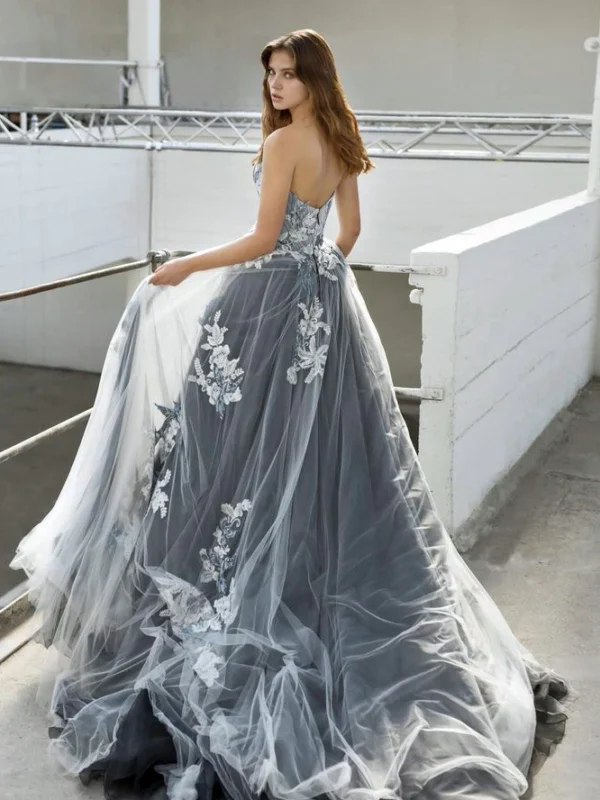
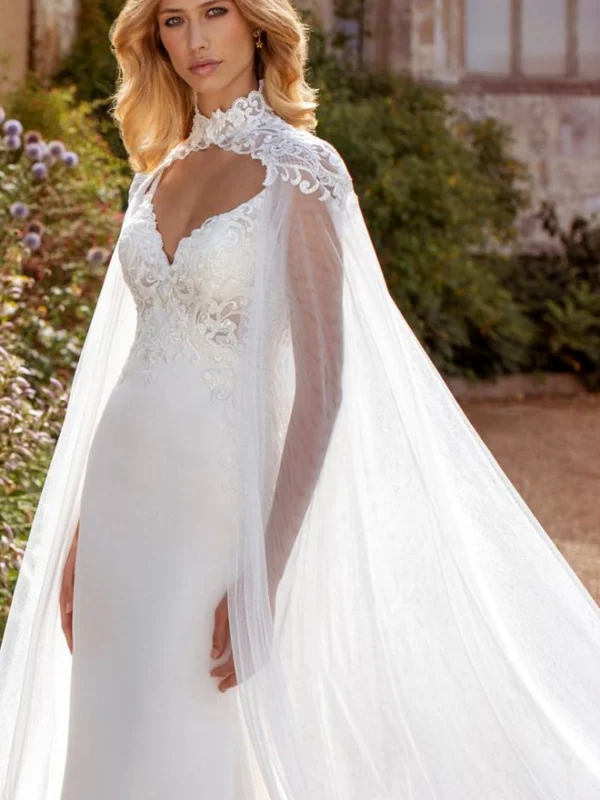
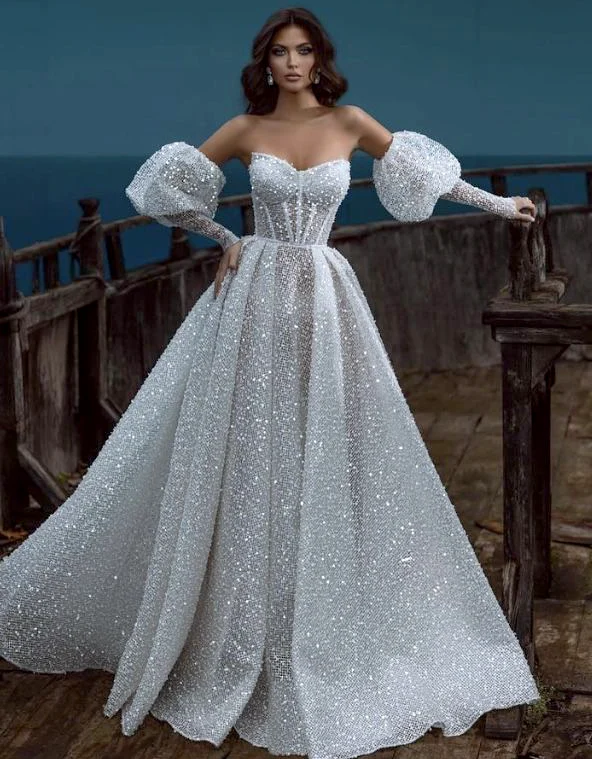
A 3D floral wedding dress is interesting for more than its flower motif. Visibly projecting leaf- or petal-like forms also change the neckline edge, shoulder outline and pattern in front of the waist. The four close views show different distributions: larger upper forms, smaller grouped edges or more pronounced details below the waist. Choose where you want that projection visible first. The photographs can support this comparison without being assigned a particular attachment method, fibre or handwork that they do not establish.
Separate surface and outline on a 3D floral wedding dress
A flatter-looking motif can be compared mainly through colour, scale and distribution. Clearly projecting forms add the side outline as another question. A flower may sit among other motifs in the front view but extend beyond the edge from the side. Look first at the outer boundary around shoulder and neckline. Which points do you want visible there, and where would you prefer a quieter edge? That is a different decision from the total amount of floral pattern across the garment.
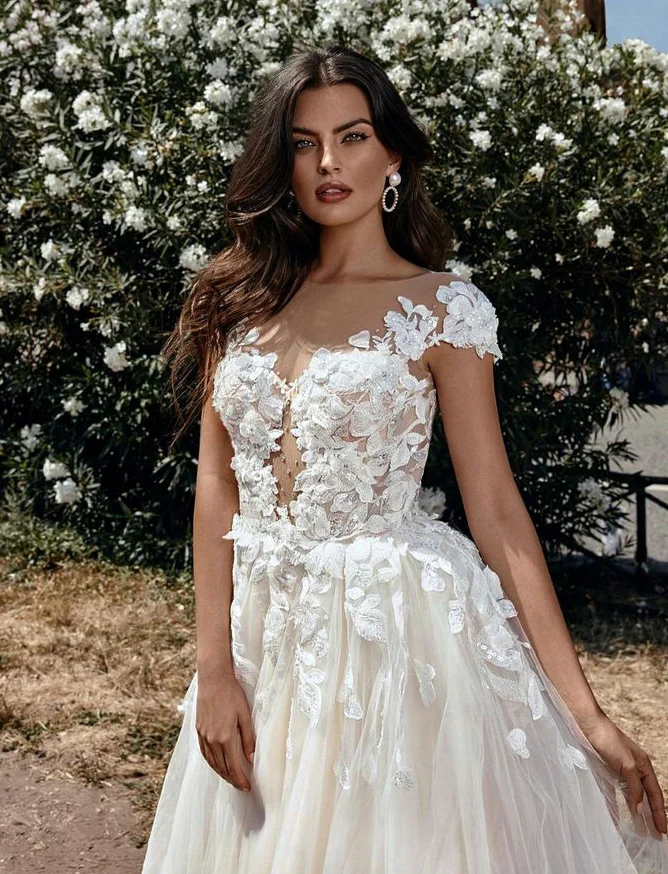
Request an unchanged front view and the same close side view for two candidates. Add a view from normal conversational distance. You can see whether a small raised area remains important in the whole arrangement or appeals mainly in detail. The pictures do not need identical flower shapes. The useful contrast is between a clearly projecting edge and an area whose floral pattern stays closer to the visible basic outline. Name that effect before requesting a particular method of making it.
Choose the emphasis at shoulder and upper edge
In the off-shoulder example, clearly projecting flower forms sit along the upper chest edge and short upper-arm sections. The boundary itself becomes decorated. Another view places larger leaf-like shapes around shoulder and waist, with less dense pattern across the soft-looking skirt section between them. Ask whether you prefer projection as a frame around the neckline or as distributed individual points. Both solutions can be floral while producing very different upper outlines, which is why the actual location matters as much as the motif.
Compare the upper edge with the hairstyle you truly plan to wear. Hair falling to one side can cover some of the forms, while an updo leaves another shoulder area visible. Decide whether large earrings should remain noticeable beside them as well. Our bridal accessories guide helps make that joint choice. Avoid trying to make every detail equally prominent in isolation. A plain area beside a raised flower can make the emphasis you want just as clear in the full view.
Compare small edge forms with large individual flowers
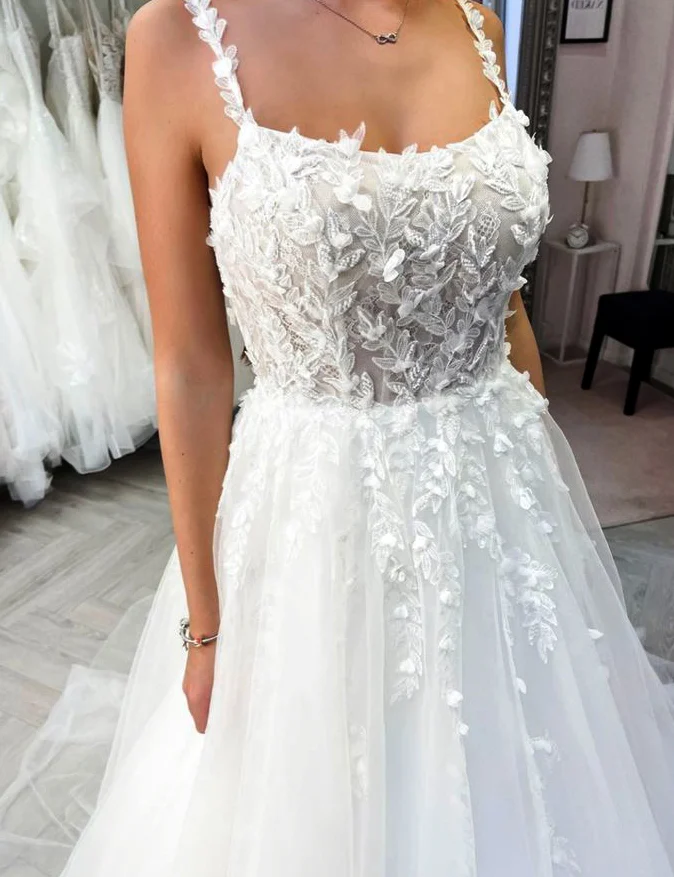
The close view with leaf-chain-like straps shows many smaller shapes near the upper edge and dense pattern across the chest. It establishes a different scale from the large flowers at the off-shoulder neckline. Decide whether you want individual forms recognisable from farther away or prefer a finer continuous edge structure. Compare at the same image size. A small motif photographed very closely should not accidentally be assessed as a large flower simply because that crop has been enlarged more strongly.
Also observe the spaces between forms. Visible intervals leave individual edges distinguishable, while a tighter group may read more as a continuous pattern. Both can be compared in the mirror and photographs without becoming a rule for every dress. Choose the distribution you like and describe it through location and spacing. Wanting more separately visible forms is more precise than requesting a stronger 3D result everywhere. The real garment can then establish whether any specific change is possible at the place you have identified.
Assess the waist and hip area separately
One view with broader V straps has a more densely patterned bodice and more projecting forms below the horizontal decorated waistband. The sculptural emphasis moves downwards. Other pictures carry leaf lines from the waist into a quieter skirt. These choices concern the connection between upper and lower sections. Decide whether the waist should form a quieter interruption or allow the floral movement to continue across it. You can discuss that transition usefully without mistaking the close waist view for evidence of the entire lower shape.
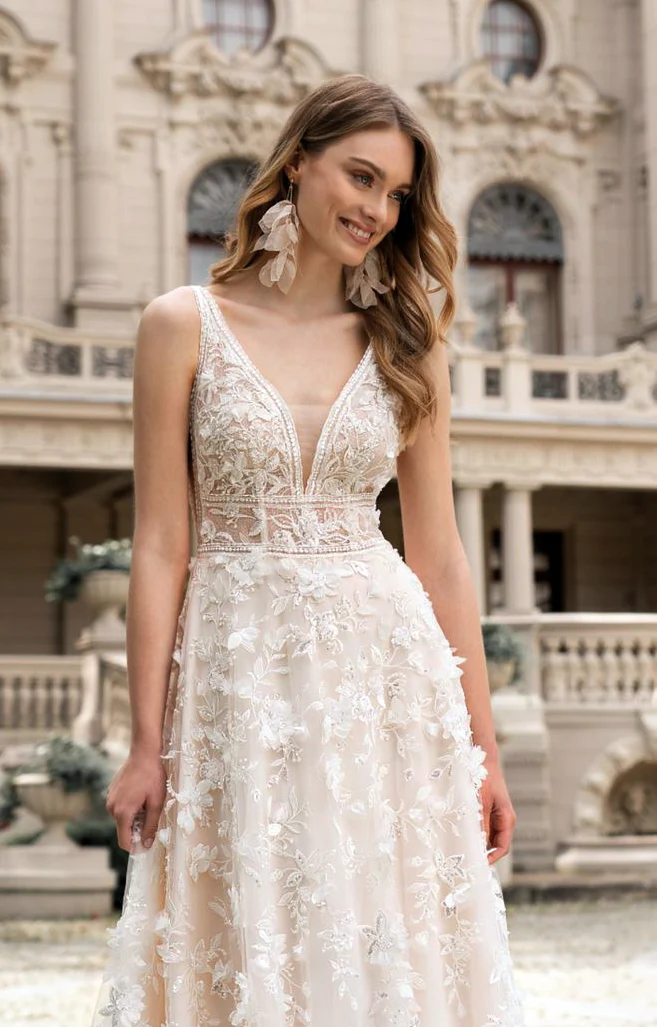
A complete dress decision does require more pictures, however. None of these close views shows the full lower finish. Ask for a full-length view before settling skirt width and length. Our floral wedding dress guide adds distribution across larger areas. For a 3D floral wedding dress, the extra question is which projecting forms actually stand out in the side view and how you want them to relate to the lower volume. Keep both scales visible in the final comparison.
Try the dress with your veil and bag
Raised forms near the upper arms occupy a different location from details on a plain front skirt section. Test the movements and object-holding you plan directly with the dress. Bring a small bag or an object of similar size and hold it in the way you expect to use it. Start with the visible relationship: does it sit beside the forms, hide them or move the emphasis you wanted? Assess that specific arrangement before adding more jewellery or further layers to the comparison.
An intended veil belongs in the same fitting. Have its route across shoulder and back demonstrated, and compare the view before and after a small turn. Whether anything catches or needs particular handling can only be tested in the real combination; it should not be predicted as a certainty from the photographed effect. Discuss another position or accessory route with the shop if needed. The purpose is an understandable shared arrangement rather than a general list of prohibitions for every dress with raised decoration.
Compare two complete placements in the last round
Choose two clearly different areas of emphasis for the final round, such as flowers at the upper edge versus stronger projecting decoration below the waist. Keep hairstyle, accessories and viewing distance constant. Add the same side crop and a short movement for both. This compares a 3D floral wedding dress through a wearable arrangement rather than its most impressive close-up alone. Also record which plainer area you want retained beside the decoration. It forms part of the same placement decision rather than an unimportant leftover space.
Write one specific advantage for each candidate afterwards. Perhaps one frames the neckline as you want, while the other keeps the upper area quieter and becomes more sculptural around the hips. Add one unresolved question for the real fitting or an alteration. The final choice can then rest on visible differences. You do not need the option with the greatest number of raised forms if another distribution better suits the complete picture you want to build with hair, veil and bodice together.
Clarify technique and care without photographic assumptions
When ordering a particular flower shape, ask for its actual attachment to be explained. Is it part of the base fabric or added separately, and what can be moved during an alteration? Ask about the offered dress rather than a method guessed from the picture. A three-dimensional-looking flower does not reveal its internal construction. Record confirmed information separately from your visual request, including whether special guidance for transport or folding particular areas is supplied. This makes the garment conversation specific without turning an appearance into an invented technical claim.
Treatment follows the labels on the real dress. GINETEX explains the five care-symbol groups: washing, bleaching, drying, ironing and professional textile care. This does not supply a general method for a photographed flower. Have information for decorated areas and any separate components explained. The selection is complete when the desired projection and placement are as understandable as the confirmed construction and handling. The raised effect then remains a deliberate design choice supported by actual garment information, rather than a collection of uncertain material assumptions.
A 3D floral wedding dress can be selected through visibly projecting shapes and their placement. The photographs do not establish a particular attachment method.
Frequently asked questions
How can I clarify flower attachment and possible alterations?
Ask to see the actual connections on the available dress. Find out which forms can be moved, replaced or repaired before commissioning an alteration.
Should I compare only a front photograph?
No. Add a close side view and a view from normal distance. These show which forms actually project beyond the outline as well as their distribution.
How should I choose a veil with raised flowers?
Try the intended veil with the dress and have the shoulder and back contact areas shown. Choose its position from the real combination rather than the photograph alone.
Which extra views should I request for skirt shape and length?
Add full-length front, side and rear views with the intended shoes. Use them to assess skirt width, the lower hem and any train together.