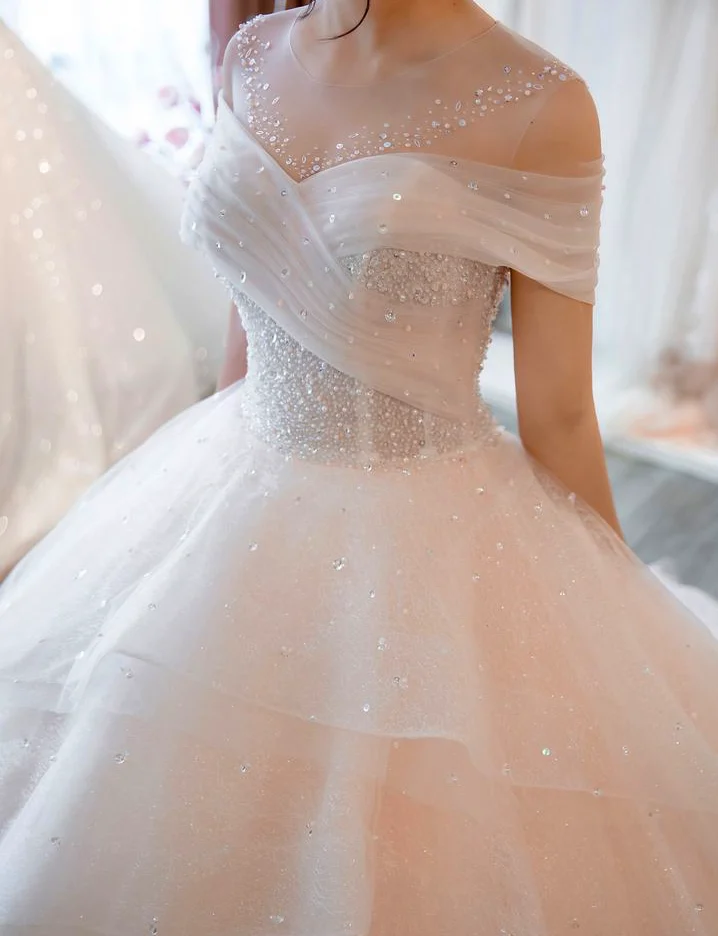
Diagonal upper bands travel across the chest and continue at the side below the shoulder here. A higher sheer-looking area carries small pale points. More densely reflective middle surfaces sit beneath, while the beginning of the skirt shows several outer layers. One shoulder remains more clearly exposed. The crop is restricted to bodice and upper skirt, explaining neither the head nor complete lower length. It supports a particular direction question rather than the whole finished outfit.
Compare this line with a broader straight folded upper edge. Do you want diagonal movement or a quieter continuous boundary? Mark direction before deciding how many small reflection points to include. Similar pale colour does not make the solutions identical. Ask for an understandable presentation of the overlapping parts in the actual design.
Look at the shoulder edge with your intended arm movements afterwards. Add a planned veil only after checking the upper shape. Clarify the agreed fitting stage and remaining details. Visible layers establish neither a particular fabric nor a construction that can later be removed. They help describe the desired direction concretely and connect it to a complete silhouette once the missing lower view is supplied.