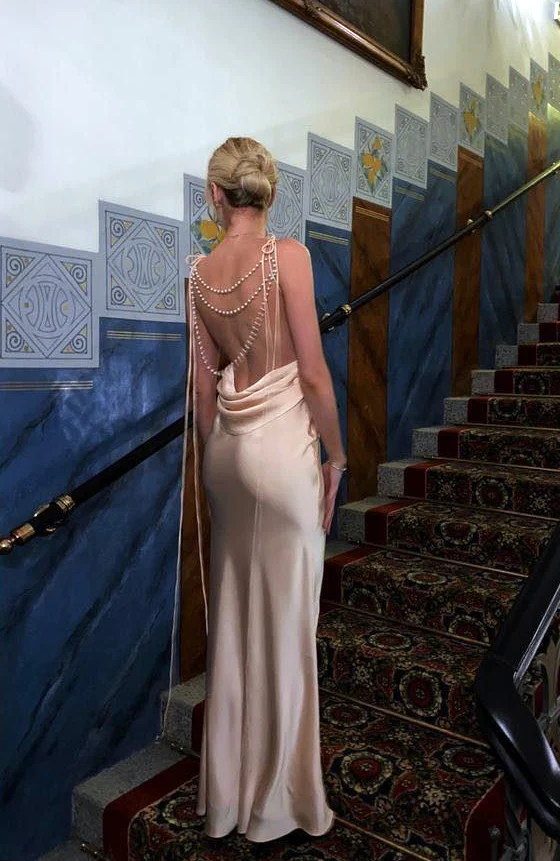
Broad back folds sit beneath an open upper field here. Several bead-like arcs connect the shoulder areas, with additional fine strands descending below. The pale rosy fabric follows the hips and continues to the floor. Long pale strips fall at the sides. Hair is arranged in a bun and leaves most upper graphics visible. Unlike the narrow grey curve, several visible folds spread the lower edge across a broader field. The picture establishes neither jewellery material nor the function of each individual connection; it supplies a visible comparison of fabric volume and lines.
Choose the fold volume without counting the extra arcs initially. Do you want this broader finish specifically, or would a quieter deeper curve appeal more? Compare the upper graphics with your own hair on the real garment next. Include outerwear in that trial: inspect it closed, remove it and check the back again. Establish how the long side strips should actually be handled too. The photograph becomes a comparison between fabric area and lines above it rather than a package whose every element must be adopted simply because the colours work together.