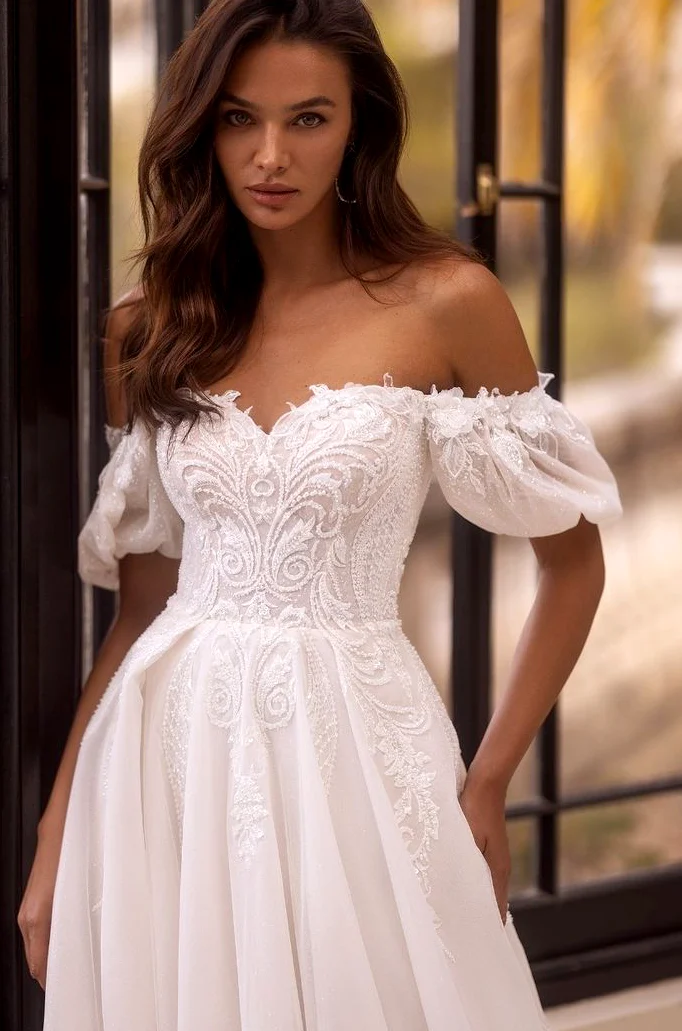
The pale curling floral front leaves the shoulder tops bare above a shaped heart-like upper edge. Repeated curling pale routes and a round central motif cover the closer upper middle. Vertical lines lead towards the narrower waist. Short broader fine puffed arm areas sit at the sides beneath floral edges. A wider fine skirt begins below with longer individual floral routes. Both arms are lowered, with one hand near the hip and the other partly cropped at the lower picture border. The face is visible beside longer loose wavy brown hair and pale loop-like ear accents, with the uppermost hair cropped. Full lower hem and shoes are absent.
Compare hair position with the visible upper border without turning it into a fixed accessory rule. Curling drawing identifies neither textile fibre nor inner support. The short puffed outline does not demonstrate a removal function.
Request that same actual model’s own matching sides, rear and complete length. Try planned hair first and add one accessory afterwards. Have the real arm connection explained before treating the separate-looking fine areas as detachable pieces.