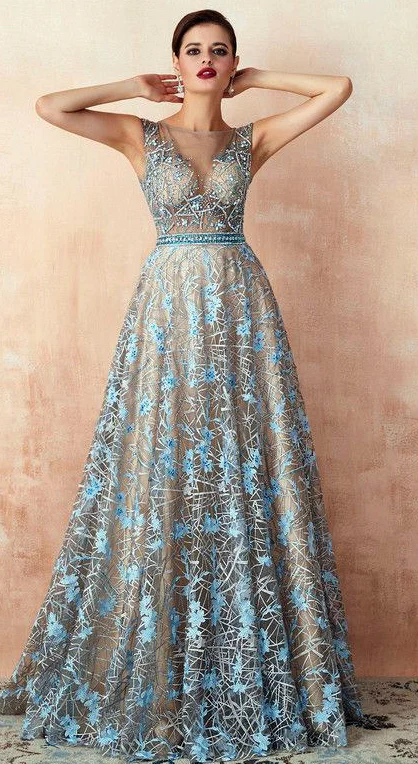
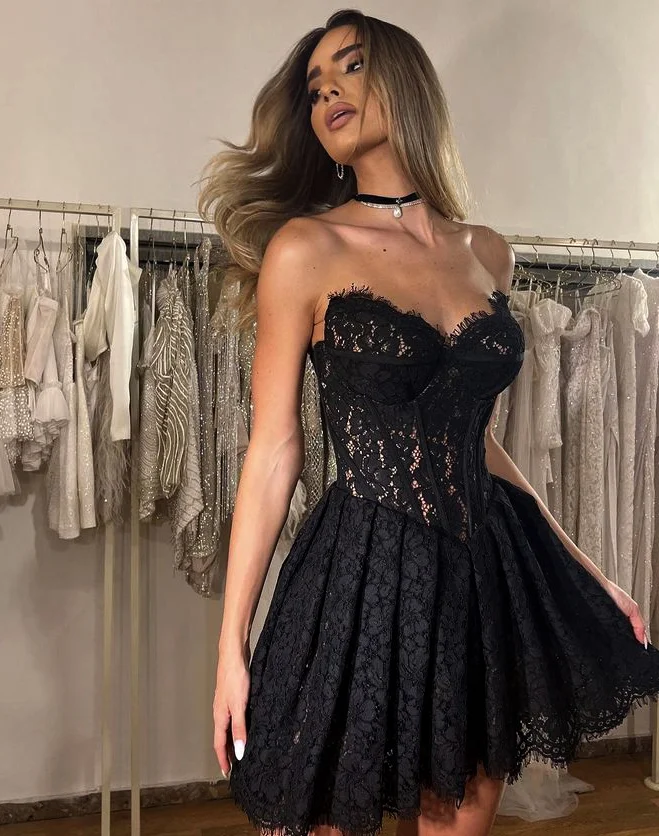
A lace-look evening dress first presents a visible pattern rather than a confirmed manufacturing technique. Our long main reference combines blue floral drawing and pale angular lines over a lighter ground. A separate black mini shows floral openwork-like areas beneath an exposed shoulder line. Neither photograph identifies needle lace, bobbin lace, fibre or handwork. Use these two different references to decide which visible arrangement matters, then ask about the actual textile and execution of the model you are considering. The photographs do not establish a shared brand or collection.
1. Describe the drawing before naming its technique
The blue long view combines curling floral forms with pale angular routes across the upper body and broad skirt. A narrow blue waist band interrupts that larger drawing. The black mini instead concentrates more clearly outlined spaces between floral forms around a closer upper body and a shorter flared skirt. These observations help explain your preference without inventing a textile name. Write down the region and shape you want compared: a broad all-over drawing, a floral upper border or a pattern continuing into the skirt.
The Metropolitan Museum separates handmade needle and bobbin lace as different technical categories. Its distinction concerns construction, not simply a flower motif. It classifies neither pictured dress. Ask the seller for the actual textile information and suitable detail views before adopting a precise technique name. A dark gap in a small photograph can be difficult to distinguish from a contrasting ground or the layer beneath it. Keep that uncertainty in your notes instead of choosing a confident label from appearance alone.
2. Compare the upper frames separately
Broader straps lead towards a deeper V-shaped drawn edge on the blue gown. Finer ground remains visible higher before the chest. The black mini leaves the shoulders bare above a curved heart-like upper edge and a fine irregular border. Those are different upper frames, irrespective of skirt length. The statement party dress guide helps choose a leading focal area before adding other pieces. Decide whether your interest lies in the upper contour or the more extensive pattern below it.
The blue model’s arms are raised with hands near the head. That pose does not show the same upper arrangement with relaxed arms. Request the real favourite’s own normal front, sides and rear, starting with arms lowered. Move in the actual dress afterwards. Neither a strap nor a bare shoulder line proves particular inner support, reliable fit or freedom from adjustment. Record what the real fitting shows, keeping outer drawing separate from information about the garment’s existing internal layers and connections.
3. Establish coverage on the actual piece
A fine-looking area before skin need not be an uncovered hole. On the blue reference a higher fine surface remains visible above the deeper drawn line. On the black reference, floral drawing and darker areas follow vertical upper-body routes. Neither view reveals every inner layer or its full connection. Ask where ground, decoration and any existing underlayer begin and end. A close detail from one region cannot establish the same coverage throughout the whole dress, particularly where a darker background changes the apparent contrast.
Request the exact version on offer in suitable ordinary lighting. Try your planned underwear and inspect the front, sides and rear yourself. If you want more coverage, explain its precise location and have the real garment assessed before discussing work. Do not assume a new lining can be added everywhere or that another colourway has identical construction. Keep the existing version and any proposed modification separate in the written description, and arrange another complete fitting if work is actually agreed.
4. Choose length without borrowing a missing hem
The blue skirt is broad and reaches the floor, hiding footwear. The black reference has a short flared lower outline, but its lower legs and shoes are outside the frame. These pictures do not provide interchangeable length information. The short or long party dress comparison supports treating length as its own decision. You can prefer either proportion while still asking separately about the upper edge, actual textile, complete rear and the version available to try.
One hand holds the black skirt to the side. Have the same actual dress shown without that pull before assessing its normal lower width. Wear your intended shoes to establish your own hem position. Walk, turn and sit, then inspect the existing edge again. Someone else’s floor contact cannot determine your measurements. Discuss any desired shortening or other work on the real garment, including the pattern near the proposed new edge, rather than assuming the visible drawing will remain unchanged after an alteration.
5. Add hair, jewellery and bag gradually
The black mini appears beside loose highlighted hair, pale earrings and a black neck band with a round pale hanging detail. The blue reference instead includes hair taken up above the patterned upper frame. These are different ways of leaving an edge visible, not compulsory jewellery combinations. The jewellery with a statement dress guide supports comparing one addition at a time. Start with planned hair, then inspect a jewellery piece beside the same actual neckline before adding your own bag.
Check for yourself whether accessories touch one another or the garment during ordinary movement. Keep the upper frame visible while comparing a longer earring or a neck piece. Photograph the unchanged outfit before introducing another addition so you can identify what changed. The pictured neck detail is not confirmed as supplied with the black dress. Ask about included components separately instead of treating a styled reference as a complete package or assuming that every visible accessory belongs to its maker.
6. Finish with actual care and invitation information
The finished garment’s own label governs treatment; GINETEX explains care information for textiles and their components. A lace-like pattern does not establish hand washing, ironing or professional cleaning. Clarify unclear instructions before intervening. Check the clothing requirement of your actual invitation as a separate decision. A lace-look evening dress becomes a more precise choice through visible drawing, confirmed textile information and your own complete fitting. Neither an archival year nor another person’s photographed setting can supply those missing facts.
Compare a blue patterned long gown with a black lace-look mini. Separate visible drawing from technique, and complete the same real dress with its own missing views.
Frequently asked questions
Does a lace-look evening dress photograph identify a particular lace technique?
A lace-look evening dress photograph does not establish a particular lace technique. Ask for the actual textile description and a suitable close view of the offered model.
Does the blue long dress establish a particular collection year?
The blue long dress establishes no collection year through its visible pattern. An archival year in a page address is not a maker’s dated identification of that garment.
Can a lace-look evening dress be made opaque in every area?
A lace-look evening dress has no universally confirmed lining option. Discuss the actual existing layers and a specific requested change on the real piece before planning work.
Can both lace-look evening dress references receive the same cleaning?
The two lace-look evening dress references have no established shared cleaning treatment. Follow information for each actual finished garment, including its trims and other components.