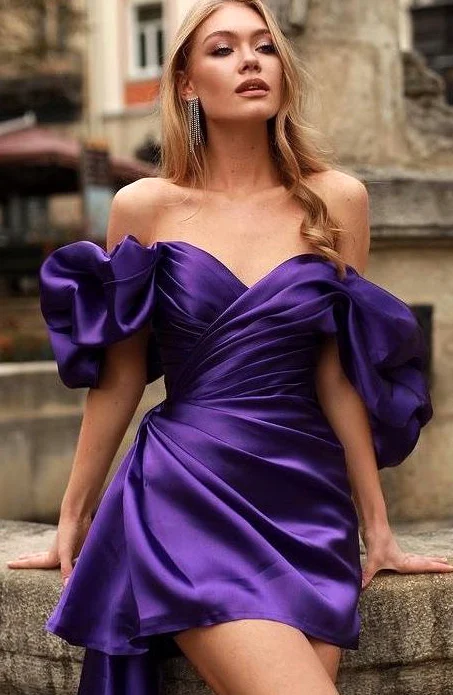
The violet dress places larger puffed shapes beside the exposed shoulders. Diagonally crossed and draped-looking surfaces lead across the centre to a closer-looking waist. The short lower edge appears uneven. Long hanging earrings sit beside the neck, while the hands rest on a stone surface. The pose does not provide a complete freely standing view. Use the picture first for the relationship between side volume and diagonal front lines, requesting other views of an actual favourite for the questions this frame leaves open.
Consider one side beside the face and hair. How much of the larger upper-arm shape would you want to leave visible there? Try the hair arrangement first and then the earrings on a real dress. Change one element so its contribution is clear. Longer earrings beside a larger side form need no universal prohibition; you decide on their actual position in your own combination. Return to the complete upper view after that comparison.
Turn your head and bring your arms forward at the fitting. Observe where hair, earrings and outer dress surfaces sit. Add a complete view of the same actual model with your shoes to assess length. The draped design can remain a clear preference without requiring one still pose to answer every question about the worn outline.