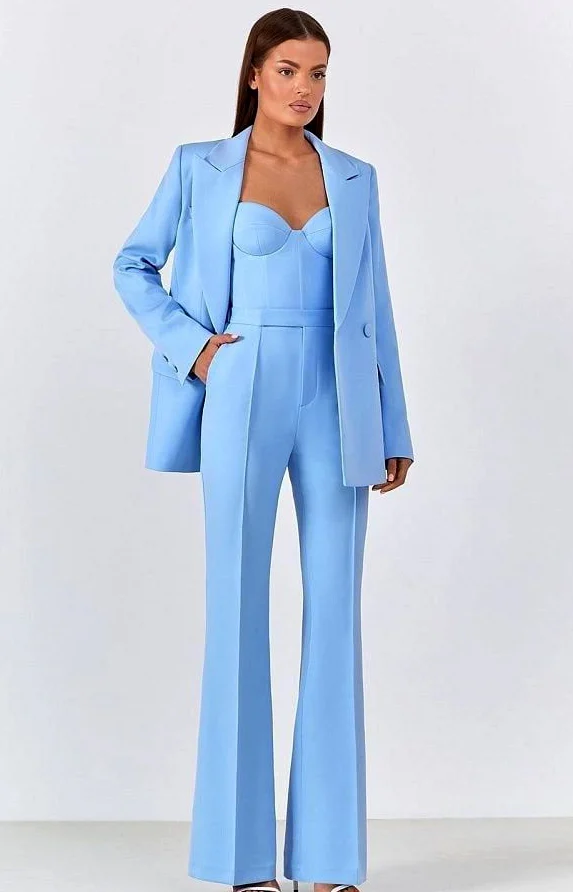
A party outfit with a blazer starts with a practical choice: will the jacket be an extra layer, or will it determine the whole silhouette? That decision affects the lower garment, the visible upper edge and how you use the outfit during the evening. Two photographs offer different approaches. The black look emphasises a deep front opening and a chain belt above a short lower area. The blue ensemble combines an open blazer with a shaped top and long trousers. Neither photograph replaces checking the construction and included pieces of the actual garments you are considering.
Plan a party outfit with a blazer through coverage first
Look at the black reference without immediately calling the short arrangement a blazer dress. The photograph does not establish exactly which separate garment is underneath or how the jacket closes inside. For your own outfit, decide what should remain covered while standing, sitting and leaning forward. A similarly long jacket can look different over shorts, a skirt, a dress or trousers. A visual reference therefore does not automatically become a shopping list containing just one garment.
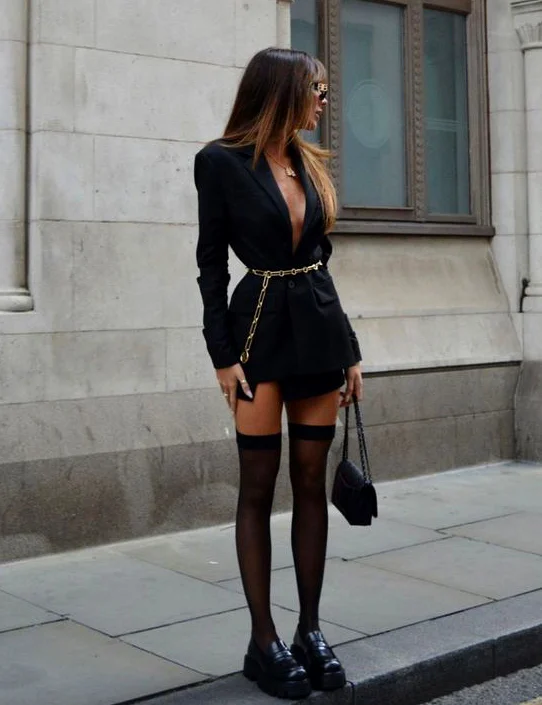
Put on the intended lower layer before assessing the jacket hem. Sit on an ordinary chair and stand again without immediately rearranging the bottom edge. Then observe the front opening and the length at the sides. If you want more coverage, compare an actual design suited to that purpose or a separate layer. Do not assume a belt will solve every movement question. The real fastening and the relationship between the pieces belong to the fitting decision.
Choose the top for a party outfit with a blazer
The blue example makes its underlying top clearly visible. Its rounded upper boundary and vertical lines differ from the longer blazer lapels. The open jacket therefore has another defined line beneath it rather than carrying the entire design alone. Consider which upper edge you want to show: a straight finish, a quieter curve or another neckline. Use the image to compare choices, rather than treating it as a requirement for a particular underwear or top construction.
Try the outfit in front of the mirror without the blazer as well. Would you wear that version if you became warm at the venue? If not, plan the jacket as a continuing part of the outfit and assess its movement accordingly. If you want a removable outer layer, the combination underneath should feel complete on its own. The guide to combining party separates helps assign a role to each piece before you add a bag and jewellery. This makes an open or closed jacket a deliberate choice.
Wear a party outfit with a blazer open or belted
In the black look, the gold-coloured chain draws a horizontal line across the middle and continues down one side. It changes both the waist emphasis and the direction of attention across the front. The blue blazer stays open, with a similarly coloured top visible between its edges. Compare these approaches from the same mirror distance. Decide whether the defined middle or the longer open line is more important to the outfit you want to create.
Place a proposed belt over the actual jacket you have selected. Sit again and check where its fastening and loose end rest. A long chain section can be visually appealing, but decide whether you want to keep arranging it during your evening. Preferring a quieter unbelted front is a complete choice too. A shorter or less noticeable accent is another possibility. You do not need to adopt every accessory in a photograph together simply because the combination makes an effective still image.
Treat the lower garment as a separate decision
The long blue trousers carry the colour below the jacket and create a very different lower line from the short black look. Choose your preferred length before deciding how closely the colours should connect. Do you want a continuous area, or should the jacket remain visibly separate? A shared colour name on two shopping pages does not guarantee that both surfaces will look identical under the actual light at your venue.
Compare the top and trousers together, including the appearance of their surfaces. Check the trouser waist while seated and the jacket edges while walking. If you want a clearer difference between the garments, the blazer and trousers guide offers further questions about connecting separate pieces. Use its comparison method rather than automatically adopting one proportion. Your particular party, the real garments and your own preferences determine the result. Keeping one top while changing two possible lower layers makes their effect easier to understand.
Match shoes and a bag to a party outfit with a blazer
The black reference combines the short lower area with dark high hosiery sections and substantial dark shoes. Darkness repeats towards the ground, while visible breaks remain between the areas. In the blue image, the long trouser line dominates. Neither arrangement establishes a general rule requiring high or flat shoes. Wear the shoes you actually intend to use and observe the hem while standing and taking several ordinary steps. A posed photograph does not show the whole walking sequence.
Add your planned bag and carry out familiar actions: open it, take out your phone and remove or replace the jacket. Then look at the sleeves, belt and front edges. This sequence gives more useful information than a single pose with one hand in a pocket. It can also help you decide between jewellery at the wrist and a quieter cuff. When something feels unclear, change only one piece at a time so its effect on the whole outfit remains visible.
Finish with the actual product information
Before buying, confirm which pieces are included and which are sold separately. A coordinated ensemble in a photograph may contain several independent items. Record the model, size and coverage that matter to you. If an alteration appears necessary, ask what can be changed on that specific garment rather than assuming any longer blazer can produce the same arrangement. Checking these details early avoids discovering an essential missing layer only when everything is worn together.
The GINETEX explanation distinguishes symbols for washing, bleaching, drying, ironing and professional care. Read the label on each actual piece; blue or black colour does not determine its treatment. Finally record the complete combination: lower coverage, the version without the jacket, the chosen middle line and the shoes you tested. You then have a party outfit selected for how you will use it, as well as for how it looks in a still photograph.
Decide whether the blazer is an extra layer or the main part of the silhouette. Check what remains visible without it, then test the complete outfit in movement.
Frequently asked questions
Can every long blazer be worn as a dress?
No. Visible length does not establish the fastening, coverage or intended use. Check the actual garment and choose a separate lower layer where needed.
Do the trousers need to match the blazer?
Matching colour is one option. Decide whether you want a continuous colour area or a clear distinction between the jacket and the lower garment.
Is a chain belt necessary?
No. Start without a belt and add one only if you like the changed waist line. Check its position and fastening while seated too.